
Monthly Archives: March 2013

If You’ve Ever Wondered Who It Is Government Works For….

Brucoe, a real man's stuffed animal who takes no crap from anyone, especially cell phone companies
Brucoe, a real man’s stuffed animal who takes no crap from anyone, especially cell phone companies

There’s an interesting situation going on right now in the US Government, and it involves cell phones. From the Wall Street Journal comes a story about how the president is trying to convince Congress that we should allow unlocked phones to be allowed so that people can switch phone providers after their contracts have expired. The interesting part of the story, and the part that most people won’t get, is that this isn’t the first time the president and Congress have dealt with this issue. As a matter of fact, Congress originally made this ruling with a previous law, but made it one of those cumbersome laws that expires, which they often do when they don’t really want to do something. After it expired, these “penalties” were enacted for unauthorized unblocked phones:

The Library of Congress’s rules establish federal copyright penalties for unlocking a cellphone. Wireless carriers can collect statutory civil damages of between $200 and $2,500 per violation and criminal penalties can rise to $500,000, five years in prison or both for the first offense. (from the previously linked article)

Only after a digital write in campaign did the president actually chime in with his own thoughts, backing the people rather than the rich bigwigs in Congress.

So, the question going through your mind should be: For whom does the government work? Because the last time around, Congress did nothing, which managed to benefit the phone monopolies instead of the people, because they realized they wouldn’t be held accountable for doing nothing (a common misconception by Congress). In my opinion, if there wasn’t a write in campaign to the president, I doubt he would have addressed the issue either.

I suspect nothing is going to be done about this, unless people rally and hold their representatives accountable. The telecoms love the way things are right now, even though they claim that they allow phones to be unblocked (so people can switch companies without having to buy a brand new phone), but they don’t make it easy. As a matter of fact, from AT&T’s response to the issue, they have to give permission, even though they claim they probably would. That’s not a right. That’s being locked into a post-contract situation over a phone that your contract actually paid for.

So, if you ever want to know for whom government works, watch how this plays out. People can say and claim all sorts of things, but until you see it play out in front of you, you don’t know how things really happen. Words are great, but actions trump works each and every time.
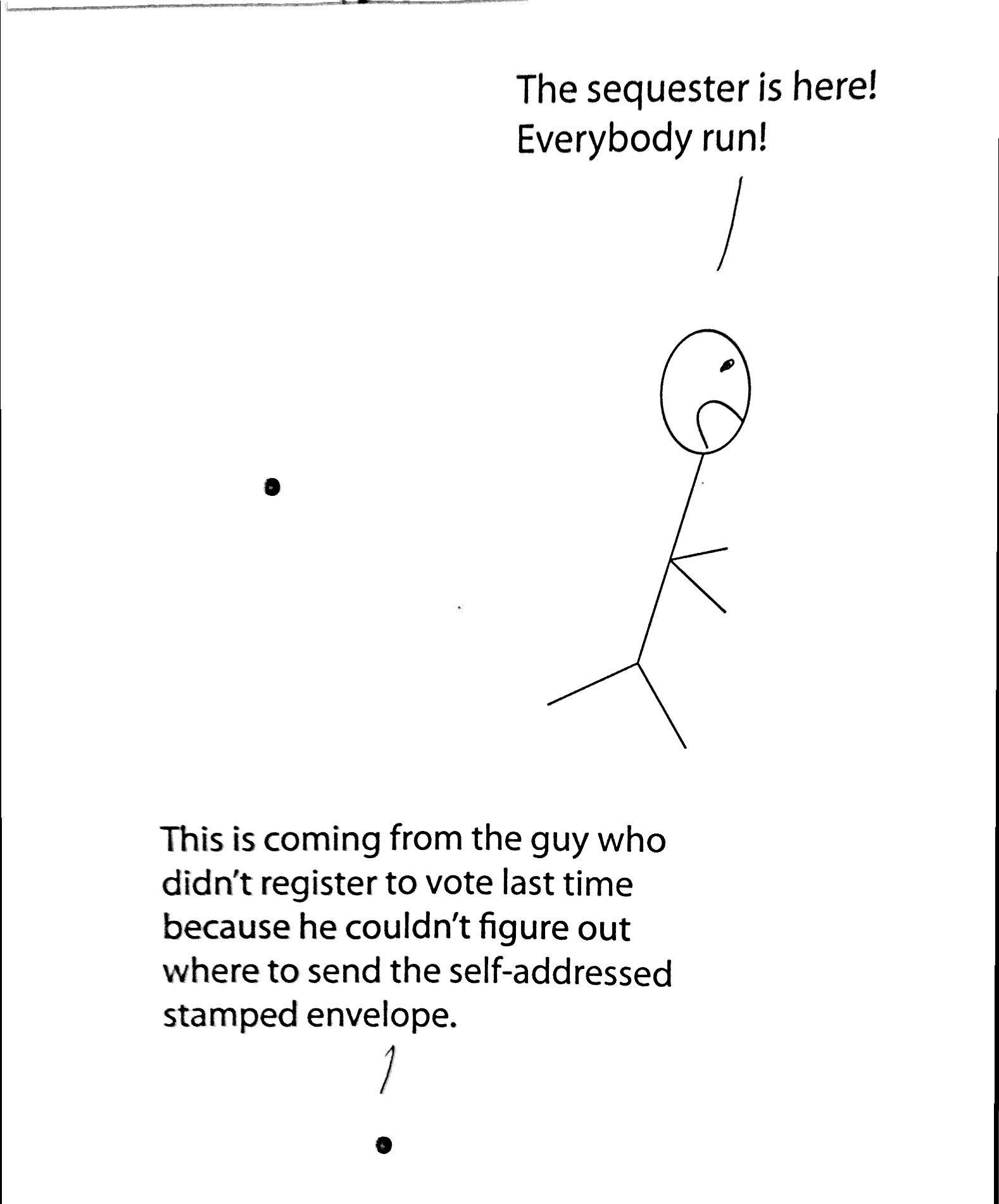

So what does the sequester mean for the rest of us?

Sometiimes you have to back up your words

I keep reading, hearing and watching doom and gloom stories about how the apocalypse is now upon us because of the sequester. A few weeks out, it was warnings of all government services suddenly stopping on Saturday morning. When that didn’t make much of a dent in everyone’s day, we started hearing about how the Defense Department would have to stop giving out guns and issue recycled plastic sporks to soldiers instead, the homeless would be fed turf grass, and our income tax returns wouldn’t be returned to us until the Year 2375.

Then Friday happened, the two parties couldn’t come to an agreement, and then the apocalypse came upon us. The news stories around then seemed to all have the same point: “The other guys are being really mean to the good guys, and now the world is at an end.”

Now, I understand the whole desire to blame the other guys; we’ve been doing that sort of thing as long as we were old enough to point fingers at other people. One thing we never really learned was how to stop pointing fingers and just get things done. This would be easy if we didn’t have a government that’s so two-sided that they are completely incapable of coming up with compromise. The funny thing is: In Morris Fiorina’s must read book (if you were doing a Ph.d in political science it was, in fact, a must read book), Divided Government, having a government where one side wasn’t in charge (which is what we have now) is the greatest thing ever because that means both sides compromise and work out solutions that benefit the most people. Unfortunately, it hasn’t looked that way for about a decade now, and I don’t perceive it going back to the way things were before. Hell, even Fiorina turned around last election and heralded Ron Paul as a solution to our problems, basically throwing his lot in with someone who had zero chance of winning whatsoever. If our main political scientists have given up on both sides, it can’t mean good things for the Republic.

But right now, we’re in sequester land, which means Monday morning a lot of sober people are going to have to look at the government they’re leading and realize it is going nowhere very fast. Does that mean we’ll start to see compromise, or will it be more of this zero sum crap we keep seeing all of the time where one side has to lose so the other side can win? Instead of governance, we get kids in the playground laughing at the handicapped kids because they haven’t been taught that’s inappropriate.

There are some real issues that need to be worked out, but probably never will because the people who have to work them out are rich, out of touch with the population and more interested in being reelected than they are in making things better. What they don’t realize is that there aren’t two sides to this problem; there are three: The Republicans, the Democrats and then everyone else who has to actually fund these two sides in their esteemed places in government. That third party (the people themselves) often is seen as only signficant when it comes to elections. Otherwise, they’re mostly ignored and spit on the rest of the time.

It should be interesting to see where things go from here.

One of my problems when it comes to teaching

The other day, I was teaching a class on Public Speaking. My goal for the evening was to teach the nuances of persuasive speaking topics, so I started in on techniques that decent speakers use in order to engage an audience…you know, the whole ethos, logos and pathos spread. At one point, I was explaining how I was once intrigued by a speech given by Helen Caldicott that she gave to UC Berkeley one night, involving cost overruns on defense programs. I was just going to touch on it and move on, but a couple of the students kept asking me follow-up questions on the concept of cost overruns, and next thing I knew I was teaching them all about how the defense industry has practically bankrupted our country by low bidding for projects and then pushing those same projects way over budget. It didn’t take much for me to realize my audience was more fascinated with the cost overrun topic than they were in learning how to make a point about persuasive speeches. Finally, after I explained far more than I ever should have about a political economic issue, I backtracked and explained that we needed to get back on topic about persuasive speeches.

The problem is: I do this a lot. When I teach political science courses, it’s not so bad, but there are times when I’m introducing Socrates and his theory of justice, and next thing I know I’ve gone onto a tangent involving Socrates, Aristotle, Locke, Hume and numerous contemporary philosophers. Almost always, I hit a point where some young girl says: “Do we need to know this?” or my other favorite: “Is this going to be on the test?”

I remember when lecturing on interpersonal communication a semester or so ago where I ended up explaining numerous stories from Plutarch that helped me explain why people socialize. It may sound kind of strange how that happens, but it almost always makes sense at the time, even if it might take some explanation to say exactly how it might happen.

I sometimes feel like I’m one of those philosopher-scientists of olden days whenever I teach a class like that. I love stories, whether they come from history, biology or strange politics. I remember going through school when a professor would read from the book, and people would fall asleep in the class. I don’t think I’ve had a student fall asleep in one of my classes in ages.

Every semester I receive reviews from students who say they really enjoy my classes, and enough of them stay after class to ask about all sorts of topics that sometimes have little to do with the subject matter itself. Almost always, I try to present material for them to research on their own (to learn it rather than just have me talk about it), and quite often one of those students will come back another day of class and present me with questions based on that suggested reading. There’s no better feeling when some young person comes armed with knowledge, wanting to know more.

The thing I struggle with is that I don’t see a lot of my colleagues doing the same thing. Instead, it’s almost like they’re competing with students to see who can do the bare minimum to get through class (teachers competing against students). I listen to the conversations in the teachers’ office and think I must be doing something wrong, because the conversations often hit me with statements like: “You’re wasting your time. Just teach the material and go home.”

What’s one to really think?