Category Archives: Memoirs

When the Smile Disguises the Truth

One morning, two and a half years ago, I woke up to a sight I had never seen before. It was one of those sights that people don’t tell you about. It never gets mentioned in movies or even on popular television shows. I’m not sure if it doesn’t get mentioned because it’s such an isolated situation, or becauses it has little possibility of gaining anyone’s attention. But I discovered it happens, so it must be important to some people.

Anyway, one morning, my feet were ridiculously bloated, kind of like something you see in a comedy about some crazy scientist who has enlarged his limbs at comedic proportions.

Rushing to the ER, I soon discovered that what I was experiencing was complete kidney failure. Considering the fact that humans have two kidneys, this meant that both of my kidneys had failed.

In the hospital for a week, I discovered the treatment was something called dialysis, where you spend a large time in a hospital bed as a huge machine sucks your blood through it and then filters it back into your body. This procedure can take quite a while.

During this first time with dialysis, I sat in this bed, not being told how long I was going to be here, staring at a young Asian nurse who made every effort to not make eye contact with me while she read her book. Keep in mind that I had nothing to read myself, my iPhone was in my hospital room four flights away, and I couldn’t even find someone to communicate with me. It’s hard to describe how horrible this situation was as I wasn’t being told what was happening (no one communicated with me to tell me I was even going to be undergoing dialysis, what it was, or how long it was going to last). I kept begging the nurse for some type of reading material, including a phone book if they still manufactured those, or anything, but she just shrugged her shoulders and didn’t even respond with words. It was such an awful experience. I probably would have handled it a lot better if she would have just said, “Don’t worry, this is only going to last four hours.” But not even knowing how long it would last made it that much worse, and no matter how many people I have shared this story with, they seem to not think it’s that horrible, mainly because they never had to undergo it themselves. Not knowing is probably one of the worse feelings one can experience. I can’t emphasize this enough.

After I left the hospital, I ended up having to visit a dialysis center three times a week where I would have to undergo treatment for four or so hours a day. I have to admit that I was lucky that I was working in a job that understood what I was going through and tried to support me during this period of massive transformation in my life. Other jobs would have probably gone through the paces and then worked to get rid of me as soon as possible. So, I was one of the few lucky ones.

But I did want to say one thing about these dialysis centers, or at least the one where I was required to go in the beginning. The people there are quite often very miserable. After all, they ended up in an establishment that is going to require them to go back to it every other day and leave them in a such a crappy state. Sitting in those machines sucks. You have no one around you to communicate; because of the immense size of these machines, you’re rarely close enough to any other person to communicate. Unlike hospitals, there are no visitors, and every other week or so, an emergency crew is rushed to the complex to take someone to the hospital because of some other organ failing or just some unfortunate circumstance happening. Keep in mind, most patients, once in this state, tend to give up on life and are just waiting for the inevitable, giving up but too scared to pull their own plug. I know this because in the very beginning, that was the state that I was in.

But I had to go three times a week for sessions that seriously weakened me for hours, and sometimes days afterwards.

But interestingly enough, in the first days of this ordeal, while in the hospital, one of the young nurses who was doing her rounds and was in my room, suddenly stopped and said: “Don’t I know you from somewhere?” I had interacted with so many people that I wasn’t sure if I knew her or not, and then she added: “Don’t you teach?” I said I did, that I taught both political science and public speaking. Then her face lit up: “You were my public speaking teacher.” I asked: “Are you sure?”

She nodded, “You made me laugh.” And then I knew it was true. So we spoke for a few minutes and then she went back to taking care of her rounds.

Right then and there, as I was thinking about how crappy my life was about to be going forward, I decided that if I had any control over anything, I was going to spend the rest of my time making people smile, and if possible, laugh.

So I decided then and there that any time I came in contact with someone, I was going to make them laugh. It was something I used to do in all of my classes. Teaching students and making them laugh while passing on knowledge always brightened my day. If I was going to be in a miserable situation, I could at least try to transform the experience into positive humor.

If you’re ever in a similar situation, one thing to keep in mind is that the only solution to kidney failure is a transplant. Someone has to give you their extra kidney, and to be honest, most people have no interest in donating a kidney to you or to a kidney foundation. For selfless reasons, people either don’t think about it, or they perceive that they’re going to always need both kidneys, even though most people never have a need for the second kidney. Honestly, they just don’t ever think about how their kidney could save someone else from years of having to live a horrible existence.

Because I’ve done everything the nurses tell me to do, including eating only specific foods and drinking miniscule amounts of fluid every day, I’ve become one of those “at home” dialysis people where I sacrifice having to go to a dialysis center every other day so that I can do it at home, EVERY day at night while I’m sleeping. Every other night, I’ll wake up in the middle of the night with an alarm going off for any number of reaons, which include cords crinkling, my body not receiving the appropriate mixture for REASONS, power fluctuations, or just random loud alarms that don’t actually tell you why, which requires you to call an “on call” nursing service that serves most of the country, so you wait in a que until someone can speak to you.

And I can’t really go on vacation because to do so requires dragging a very large machine with me, including large bags of sugar solutions that are extremely heavy, and each night requires using at least four of them. And besides those, there is a lot of other equipment required each night so if trying to travel (which I’ve tried), it’s very uncomfortable to do so. Right before I lost the use of my kidneys, I was planning to travel to Warsaw, Poland. I will probably never be able to in my lifetime because do so, I would need a transplant, and I’ve been told that getting one might take ten years, if lucky. By that time, I will probably be taken off the last for any number of reasons, the least of which will be age.

But I really didn’t intend for this article to be about complaints. What I wanted to talk about was smiling and laughter. One thing I devoted myself to was making people laugh.

And that was something I did, and often. Every doctor’s visit I made was devoted to making everyone in my presence laugh. When I was sitting in a chair for four plus hours, everyone who came near me was subjected to my unique brand of humor. Over time, more and more dialysis staff would come over to my chair to communicate. And I would make them laugh. And sometimes, they would make me laugh because humor is contagious, and it can brighten so many people’s days.

One of my favorite subjects was a Vietnamese nurse who was always so gruff and angry-acting. I devoted my every session with her to making her laugh. And she would just growl at me most of the times.

But I kept up for the entire four hours I was there some days. She would stop by, do her required nursing duty, hear me making joke after joke, every one of those jokes being spontaneous and brand new from the previous ones. But I would continue, stretching my humor to lengths even I didn’t know was possible.

I kept this on for YEARS.

One late afternoon when she was there doing her duty, I was about to start a new routine with her, and then out of nowhere she made a joke to me. It was raw and very new-like, but it was funny, mainly because it came from her and was humor that only she could have come up with. I laughed.

From that point forward, she was constantly trying humor out on me. And then I also noticed that she was humorous with the other patients, something I’d never seen before. Somehow, she had transformed from a mean, gruff nurse to one who shared humor with her patients.

If anything in my life is seen as an accomplishment, I can relish in this. I had transformed someone into someone with a dispensation towards humor. Her future patients would benefit from this, even if they never, ever, came in contact with me.

When you hit this stage, you take the victories where you can, or give up and wait for the inevitable.


Bill

licensed from Adobe Stok

I’m starting to get old. Don’t get me wrong; I don’t mind getting old. What I do mind is the inevitable. And, honestly, I never thought I’d be ready for it.

Recently, I wrote an article about my roommate in college who passed away. Tom was a good friend of mine, and he was always my greatest advocate.

Bill was also a great friend of mine. But he and I had kind of simmered on our friendship for the only reason that I now lived in Texas, and he lived in California. However, whenever I got the opportunity to travel back to California, he and I returned to our friendship almost as if we had never parted. A short while ago, I received a message that he had passed away, too.

One of my recent plans had been to make it back to California so he and I could hang out again. Now, I don’t have a single reason why I would make the trip. Bill’s no longer there.

So, let me tell you about Bill. He used to work for a bunch of computer gaming companies. When I was working for Maxis (and then EA), he would be working for companies like LucasArts and Microprose. He was an actual pilot, so when those companies were designing flight sims (like Xwing, Tie Fighter and F-15 Eagle) he was always there testing out those types of games.

One of my favorite stories was when he was testing X-Wing, and the producer had told him that it was impossible to destroy the Imperial Star Destroyer that was producing all the enemies in the game, he spent days flying missions against it until he turned off the damage on his own vessel and finally destroyed the Imperial Star Destroyer. After a couple of days, the developers indicated that it was impossible to destroy the Imperial Star Destroyer.

Having felt like he had laid down the law, the developer thought nothing of it as Bill spent days flying endless sorties against the Star Destroyer, and then he destroyed it again. But this time on the hardest level.

The developers, after discussing it amongst themselves, decided to add a readme file on the main disk indicating that “if you destroy the Star Destroyer, you might not be able to finish the game.”

One of my other favorite stories of his exploits was the origin of his ecology degree from UC Berkeley where he had gone to college after his time in the Army as an Army pilot. He was on the original GI Bill, and the way it used to be structured was you could continue your education until you graduated, and then it was over. So, Bill being like Bill was, continued until he was about finished with one degree and then he would change his degree to something else. He did this for a very long time until the Department of the Army sat down with Berkeley, and an offer was made that he could choose several degrees (of his choosing), and they would confer it upon him. So, the ecology degree ended up being one of the ones he chose, just cause it sounded kind of cool.

My other favorite story was one that everyone wished they had done themselves, and it involved the pettiness of a ticket he received from the city that was for several hundred dollars. And add to it that they had sent him a threatening letter if he didn’t pay it immediately.

So Bill took the train to downtown and walked in to pay his bill. And he brought a handful of dollar bills to pay it.

So, the clerk took the money, counted it and determined there were several dollars missing. Bill swore there was an exact amount, so the clerk spent quite a while counting it again. This time, she came up with a different amount, but not the amount that was supposed to be there.

So, this went on for several more rounds until a supervisor came over, grabbed the money and counted it himself. He came up with a number far below the amount required. So he told Bill he’d have to get the proper amount and return.

Bill swore the amount was correct. He’d counted it a bunch of times before coming in.

The boss started counting again, got about a third of the way through and then just shoved the money into a drawer, saying: “Fine. He paid the right amount. Give him a receipt.”

So Bill walked out of their with a happy grin.

Now, these are all stories told to me by Bill over the years, and the one reason I believe him on each story is because he told me these stories over and over, thinking he was telling me them for the first time. So, if they didn’t really happen, at least he believed in them. And that was all I needed.

Bill was one of those people who had brilliant ideas that were completely out of left field. I remember when I had a theory about how gravity was a physical property, not just an action on something else. I thought it was completely original, but the second I told it to Bill, he started analyzing how my theory might actually exist and exactly how we could test it. Unfortunately, neither of us had an actual spacecraft needed to test it, but we discussed it late into the night, throwing theories back and forth.

The point being: A guy with his degree from Berkeley in various disciplines was capable of going toe to toe with a guy with a physics degree from West Point. And his analysis was good.

We’re a couple of months away from the actual release of Starfield, and as much as I long to play it, I really wish it would have come out earlier, because this is the type of game Bill would have loved. And he would have found a way to break it, too, cause that’s what he did.

And no one did it better.

What Exactly is a Nice Guy?

In my many space travels as a legospaceman, I never ran into a civilization that didn’t speak lego

One of the more common tropes of banter on social media is the concept of nice guys and how someone feels she was treated badly by one, and thus, they’re all just really bad guys. It’s almost its own demographic within the confines of writing that whenever I see a story that mentions “nice guys”, I suspect it’s going to turn negative and start talking about how nice guys are anything but that.

Well, I’m going to let you in on a little secret. Most nice guys aren’t nice guys. They’re opportunists that hide behind the designation and then will eventually pounce when the time finally comes around. But that doesn’t mean there aren’t guys out there who aren’t nice guys; it just means that there are very few, and most women will come across one or two in her lifetime, and probably never even realize he was standing in front of her at the time because she’s focused more on the guy pretending to be one and making lots of noise to convince her of that possibility.

I remember a story of a friend of mine who stopped by our usual coffee joint one day and started out the conversation with “I don’t understand women. I’m a nice guy, and I get treated like crap.”

Now, you’re probably thinking all sorts of things about my “friend”, who let’s just call Bob for the sake of names, and let’s just get the baggage out of the way with what we suspect about Bob. If Bob called himself a nice guy, your impression of him probably has a lot to do with how you’ve been treated by the guys in your past, so that if you’ve been treated badly, you’re probably going to think Bob is just pretending to be a nice guy, and if you’ve had a decent relationship with guys in your past, you might suspect that he could be a nice guy, but he probably has a flaw or two that might need to be fixed.

But Bob was really none of those. You see, Bob was full of crap.

When Bob told me this nice guy stuff, I remembered that he had been in a dicey relationship with Shirley because she had found out about Becky, and he was trying to make time with Veronica (yeah, all made up names cause this isn’t a gossip column). But seriously, he wasn’t loyal, cared only about the woman he was with at the very moment he happened to be standing in front of her, and he either dumped or got dumped by them on almost a whim.

He was most definitely not a nice guy.

But here’s the catch. He THOUGHT he was a nice guy.

Why? Because he was who he was, and in most people’s stories they are never the villain; they are always the hero. Our psyche is designed to make us feel that way. Our inner voice rarely says, “hey, dufus, you’re a bad guy.” But there are many occasions where it probably should.

As a guy who tends to be that person that people confide in, let me just tell you that practically every guy sees himself as a nice guy. Because he’s who he is, and I would argue that even a guy sitting on death row for murdering half the population of Arkansas with a chainsaw is probably looking into the mirror and saying: “Nails, you’re really a nice guy.” That’s just the natural state of people. We’re stupid when we need to be stupid just so we can get through the day into the next one.

So, what is a nice guy? Or more importantly, do any actually exist?

I’d like to think they do, and I’d like to say that I’m probably one of them, but I may suffer from disillusion just like Bob did. I’m bred like every other male on the planet in that I’m always going to believe my inner voice is helping me to do the best job I can, so therefore, I must be a nice guy. Wouldn’t surprise me, however, if there’s some woman out there thinking to herself, “sorry, kiddo, but you couldn’t even put the toilet seat down no matter how many times I told you,” so even that’s probably just in perspective. Some people are going to like you, and others, no matter what you do or say, aren’t going to like you.

That’s just life.

So, let’s take it a step further. If you desired to be a nice guy, what would differentiate you from those who aren’t, because in the end, just gaining the designation of “nice” indicates that there must be those who aren’t nice, or are at least not as nice. So, how do we achieve just that?

I’d argue that to begin with, your goals need to be further than a cost-benefit analysis of outcomes. If you do everything in the guise of transactional behavior (if I do this, I get that), you’re never going to achieve a sense of niceness. Instead, you’re going to gain whatever item or items you were striving for that you hoped your good nature would yield for you. There’s no niceness in that whatsoever.

When I think about feeling “nice,” I often find myself having to think outside of myself. And it’s a two-step process. First, you have to want to do something for others to benefit them. And then, which is the hardest part, you have to do it in a way that doesn’t actually work to benefit you.

Years back, I used to mentor young people in writing. People used to ask me what I got out of it. My response was that one day I would get to see really good writing out there in the world that I wouldn’t have seen if I hadn’t offered my assistance back then. I saw that as “nice” behavior, even though in the end, I was still probably getting something out of the mix. But then I ran across predatory writing mentors that were interested in achieving a piece of someone’s future success, or some that actually used it as a vehicle to further their dating prospects, neither of which seemed very “nice” to me. But then, I suspect “nice” wasn’t exactly a part of their process.

So, after years of interacting with people on various levels, I’ve come to the conclusion that being a nice guy means going out of your way to help others without any desire for compensation or benefit in return. Having said that, there’s an element that sometimes goes over the top with this definition, where people think to be “nice” you have to actually sacrifice and lose something to achieve such a status. Again, that’s back to the transactional approach to giving and receiving.

For me, I’m satisfied just going out of my way to see someone else benefit from something I’ve done or said. And sometimes, just a smile of acknowledgement is enough to make me feel that I’ve done something that is perceived as being “nice”. Those who seek awards or accolades aren’t necessarily nice people, but people seeking some type of validation as payment.

Back when I was in grad school, I remember the grad lounge had a printer that always broke down. Before going back to grad school, I was a computer repair technician, and I specialized in harder to maintain aspects of that field like monitors, hard drives and, yes, printers. So, often, when I heard another grad student complaining about how he or she couldn’t get his or her papers completed in time because of the printer, I would sneak into the lab at night and actually fix the printer so it would be working the next morning. No one ever figured out who was constantly fixing the printer (it was old and it happened a lot due to the amount of usage), but eventually people started giving credit to one of the “smarter” grad students who was always bragging about his accomplishments; he even took credit for it. I could have jumped in and revealed his lack of accomplishments, but honestly, I didn’t care, and I found it kind of funny while a bit interesting as it told me more and more about this individual than I would have ever discovered any other way. For the longest time, he was perceived as “nice” for going out of his way to fix the computer constantly, and he did nothing to challenge that assumption.

That sort of showed me that this is how so many people can constantly perceive the wrong people as “nice guys”, and then feel so angry when they discover they’re not, in fact, really nice guys.

The reality of the situation is that most nice guys will go under the radar because that’s part of the process of actually being a nice guy. When you seek validation for it, you’re not really nice any longer.

It’s kind of like the old Socratic argument that plagued the philosopher in his final days. People claimed he was the smartest man alive, yet he suspected that once he acknowledged himself as the smartest man, he would no longer be worthy of that title.

Nice guys are somewhat the same way, which is why the noisiest “nice guy” who wants everyone to know how nice he is, is often not actually a nice guy. If you want to find the “nice guy” look in the shadows near the guy taking the most credit, and chances are you may actually find him. Just don’t let him know you found him, because most often he remains the nice guy as long as he never has to claim the title.

The Rise and Fall of Mega Music Bands

Years back, I was the security investigator for a major hotel chain, and I had been assigned to one of their large properties in San Francisco. As a somewhat superfluous member of that institution’s security department, it was never really understood where I stood in the chain of command, but it was always assumed that I was probably somewhere near the top, but never high enough to be one to make actual decisions. For a young man fresh out of the military, it was kind of comfortable because being in such a position meant access to whatever was going on without much of the responsibility for what was happening. If I had to sum it up, I was an executive at just looking good and being present for anything important happening.

Well, one of those things that happened was a major convention for a national music organization that sponsored a major headliner show featuring Huey Lewis & the News with an opening act by a young group Wilson Philips.

Now, at this time, Huey Lewis & the News was probably one of the biggest bands in America. And Wilson Philips, which acted as their starter band, was gaining a lot of traction with three hit songs that had been released earlier that year. So, it was expected that a lot of people were going to show up for this shindig to see the hottest show in town.

As this “important” security person, I was literally right there in the wings of the stage as the bands went on to perform. Around me were all sorts of music insiders who had serious clout with various record companies. And as I was dressed in a suit rather than casual wear, it actually appeared I was more connected to this industry than I was. In reality, I was the glorified security, but because my position was mostly a specialty of remaining undercover, people just assumed I was part of their crowd.

So, why am I sharing this? Well, one of the perks of this kind of position and such placement is that you begin to discover that musicians quite often are quite bored backstage and are constantly inundated with attempts by industry people to get their attention. My focus is always on just watching the crowd, so I kind of stood out because I was one of the few people there who didn’t appear all that interested in trying to gain the attention of the people who perform on stage. As a result, these stars had a tendency to sidle up next to me and start conversations.

And there were many of them, but one of them struck me as more interesting than the others. Chynna Philips, the lead singer for Wilson Philips, was wandering around backstage after their set, while Huey Lewis & the News were performing. She stood next to me and said: “Aren’t they great?”

I nodded and said, bluntly: “They used to be my favorite group.”

She seemed kind of surprised by my statement. I assumed most people probably spoke in awe of that band to her as she was basically delegated to being the starter band for a rock band that was extremely popular at the time. “Used to?” she said.

I nodded. “They’re kind of on their way out. Bands like yours are going to quickly replace them.”

She seemed actually pretty interested and then continued talking to me about Huey Lewis & the News, music in general and how interesting the industry was. Then she mentioned she needed to use the restroom, and did I know where one might be. I think she had realized I was some kind of higher up with the hotel because a couple of the security officers had walked over to me to pass on information to me while Chynna and I were talking. So, I walked her through the bowels of the infrastructure of the hotel to take her to the women’s restroom, choosing that path because I knew it would keep onlookers from intercepting her during the journey (something I’m sure happened quite often to a musician who was dressed in a very Hollywood-ish type ensemble for her performance.

During out trip, she shared a lot of interesting information about herself and the industry, and to be honest, I think she was just happy she was able to talk freely without having to answer questions as a “star”, which probably was the only kind of conversation she had been entertaining since gaining mass celebrity as a musician in a very popular band.

Anyway, this story isn’t really about that encounter, but to point out that she introduced a really interesting subject to me, something I hadn’t given much thought to before, and that’s that bands have an interesting life cycle that almost always seem to lead to inevitable conclusions. Even the band Wilson Philips made that journey, gaining mega fame almost overnight and then disappearing in a wisp of smoke so soon after appearing on the horizon.

What I hadn’t mentioned is that right before my conversation with Chynna Philips, one of the band members of Huey Lewis & the News was fuming backstage before they went on. This was while Wilson Philips was playing their set. But as I watched him, I had no idea what was bothering him, although he wasn’t focused on the music playing; something else seemed to have triggered him. And then they went on and did their full set, putting on what I honestly thought was one of their best performances to date. However, when they left the stage and walked by those of us on stage, I remember one of the stagehands saying “Good show!” to them as they passed him, and that musician gave him the dirtiest look I’ve ever seen from one man to another. I doubted the two of them even knew each other (that look he gave was more a “how dare you!” than a “Not this again!”). It was right about that time that I determined this band was about to end, and I didn’t know anything personal about any of their dynamics.

However, a short time later, the band fizzled and died.

This got me to thinking that most bands tend to go through this cycle of discovery, mega stardom and then collapse soon after. It’s almost as if they are only designed to last a certain amount of time before they implode and dissolve.

So, I thought I would focus on the different reasons why bands collapse after they reach their apex of success. So, generally, what are these reasons?

  1. Break-up: The quintessential example of this is probably the Beatles, a band that broke into the stratosphere and then imploded one day after recording “Let It Be”. It’s that one band that so many wished would have gotten back together again, but which turned out to be sustainable with each member alone until, unfortunately, several of their members lost their lives. As of now, two members are still active in their own careers, but the two we lost were definitely legends all on their own. Other groups that have gone this direction (with pushes and shoves to regroup and try again), include: the Eagles, the Everly Brothers, and Fleetwood Mac (although many others probably fit this category).
  2. Departure of a Main Influencer: This happens when one or a few members of a band decide to go their own way, and generally don’t come back. Examples of this include Van Halen when they lost David Lee Roth and Journey when they lost Steve Perry. The bands continue to try to recapture their momentum going forward, but in many cases they are never perceived to be the same powerhouse band they were back when they were previously together. This was somewhat the storyline of “This is Spinal Tap,” even though the band was mostly fictitious (but possibly better than some bands that actually took themselves seriously).
  3. Bands That Take a Bad Turn: This is really the story I probably started telling when I first started this article, as this was, in my opinion, the direction that Huey Lewis & the News took. Back in their prime, HL & the News probably could do no wrong, and it was a band that was at the forefront of setting trends during this period. And then, out of nowhere, they sort of died off. Strangely enough, I kind of predicted this was going to happen the first time I heard their last big hit, Hip to Be Square, in which it really felt like the band was trying to carry-over its coolness factor by purporting to be so cool that it could do so while being a total square. It sort of set them off on a trajectory of obsolescence.
  4. The Trend is Over: As much as I liked Wilson Philips, this was the direction they took when they released their second and third album. People were thrilled with their first album, but the follow-up albums felt a lot like they weren’t breaking any new ground. And they had received so much play time with the first album that people generally didn’t perceive any reason to want to continue buying much of the same. This is why a lot of groups really need to go big with their second and third albums, because the public is extremely fickle when it comes to music. If the audience doesn’t feel like the band is growing, quite often they will turn off the band going forward. A good example of bands and entertainers that have defeated this problem are Taylor Swift, Kiss, Madonna and AC/DC. While I definitely wouldn’t lump their music in the same category, their sustainability is about as legendary as the Rolling Stones.
  5. A Primary Member Dies: This is quite similar to one of the main influencers leaving, except that there’s not going to ever be a reunited tour somewhere off in the future. Lynyrd Skynyrd, besides being one of the hardest bands to spell correctly, was already established as a powerhouse in the music scene when its lead Ronnie Van Zant, Steve Gaines and back-up singer Cassie Gaines died in a plane crash in South Carolina; while the band has tried to recover with new players over the years, it has never reached the apex it achieved during those earlier years. Other bands that lose one influential member to death quite often lead to their demise as well.
  6. Unpopular Music Direction: From time to time, a band will have had a career of solid music and then take a completely different turn in its music, which immediately causes its audience to seek other entertainers instead. While this is a more subjective category, such bands can be included with this designation as Jefferson Airplane, Chromatics, Neil Young and Bob Dylan. What makes this category controversial and debatable is that quite often musicians that go this direction can make massive strides moving forward, but just in a completely different venue.

If anything can be said about the whole phenomenon of music sustainability, it’s that the artists rarely know what’s about to happen to their longevity before it happens. But that one evening that Huey Lewis & the News performed, it was obvious that that musician started to realize things were starting to unravel for his group. Either that, or he was just generally a sour person.

But one thing that was for sure was that Huey Lewis & the News stopped being the powerhouse it once was and no attempts to recover that lost popularity was ever going to succeed. So they may have been hip to be square, but unpopular was never going to be cool.

The Depressing Part of Being a Writer

Joshua had a few things he needed to say

There are a lot of writers out there who haven’t been that successful. Yet, they keep on plugging away, convinced that one day it’s all going to work out for them. I’m kind of in that same boat, but unlike the others who never had their chance, my chance came several times…and sort of fizzled away. Let me explain:

Years back, I was shopping my first book. I was in my early twenties, and I had written it while in the Army. It was a really good book called INNOCENT UNTIL PROVEN GUILTY. And it was published. Not to great fanfare, but it was published.

So, I started shopping my second novel, LOSER (which would eventually become LEADER OF THE LOSERS). Nothing. Not even a whimper from anyone wanting to sell it. One editor pointed out that perhaps it was the depressing title. Publishers didn’t want to publish books with such a negative title. So, it sat there, forever.

Then I wrote my next novel, the infamous The Armageddon Project, which was a story that took place during the Cold War. Keep in mind, it was written during the Cold War. But at the time, the Cold War was ending, so I quickly rewrote it to match the new events taking place in the world (much of the action takes place in East Germany and Western Russia). And then those regions kept changing, so I kept rewriting it. At some point, the title changed to match the main character (known as “the Unicorn”), so the title became TO TOUCH THE UNICORN. And then a publisher told me that the title was too much like a fantasy novel, but the novel was corporate/government espionage. He also said that it was hard to figure out what exactly the main character’s job was. At the time, I had created the concept of an economic hit man, but the concept was completely unknown in the 1990s, so it just couldn’t catch on. Years later, after Germany and Russia have settled into the republics they are, the story changed massively and is now being rewritten for about the 90th time, and it now takes place in 1991 during the August coup in the former Soviet Union. It’s now called 72 HOURS IN AUGUST, but it’s on the back burner for a rewrite.

Anyway, somewhere around this time, I was starting to make a name for myself as a writer. I had been writing tons of short stories and they were published in a bunch of different magazines. At first, they were published in mostly literary magazines, but then the larger presses started picking them up, and several prominent magazine editors started recognizing my name from previous things I had written. Things were kind of going pretty nice for me back then.

And then one of my novels was bought for publishing by a prestigious book publisher. And then I got an agent who once represented one of the greatest science fiction writers in modern times before he passed away. All was looking great.

And then the publishing company folded. Overnight. Without a single warning.

My agent got into an accident and severely injured her head. She dropped out of the business for a while to recover, and when she did, she seriously didn’t even remember who I was. I gave up trying to re-establish our working relationship.

And then the Internet exploded. Amazon became the biggest thing in independent writing, and the industry changed overnight. If you weren’t already established, you were basically an unknown, and if you were an unknown, you had to now start building a social following in order to even sell a single book. Not being really good at social networking (just has never been my thing), my career kind of just fizzled and died. Sure, I sell a few books here and there, but I might sell more just standing on the corner and asking people to give me a buck for a hand written copy.

Fast-forward to today, and I’m the middle of writing an epic novel series that I suspect might not be read by more people than this blog post. I say this with trepidation because of the amount of time invested in this project. I’ve already spent seven years researching this thing, and I’m about to start putting actual physical work into writing it. Keep in mind that my last two projects took me each half a decade to produce, and my stuffed animals get more attention when they’re pulled over for drunk driving. My previous project took me six years to complete the first book (of a three book project). The research involved was extensive. It was called The Deck Const. Doesn’t matter what it was about because no one’s going to read it any way.

The project before that is probably the one piece of work of which I am most proud. When people talk about a crown achievement in one’s life, that book would probably be mine. It is a humorous novel that tells the story of the last hero of Troy who comes home to found a little civilization called America. It’s called THE AMERIAD, and it was so much work, and it involved so much research. But to someone reading it, one gets the sense that it’s a simple, fun story that seems very familiar. It’s told in Iliad/Odyssey format, and the main character is actually the translator who has interpreted this found epic in the only way the worst translator could possibly ever do. The book was so hard to write, especially in a way that made it feels so natural.

That’s the dilemma I find myself in as I finish up the last stages of research to begin constructing my Arthurian epic. And part of me wonders if my time might better be spent playing a video game instead.

Remaining Unknown in a Viral World: Popularity, ASMR and Celebrity Status

Earlier today, I was examining the statistics on my website and realized that I have about 1.5 million hits on my site since I started it. That appears to be a lot, but then I started to think to myself that not a lot of people comment on it or send me messages based off of my web site (or its blog). So, this tells me that I seem to get a lot of traffic but apparently nothing seems to be going on with it. And yes, that opens up a lot of thought on a subject I’ll probably take up at another time (what do to with traffic when it gets to your site, as I don’t seem to be doing a whole of good with that area).

Last night, I was watching the latest episode of Law & Order: Special Victims Unit, which is still one of my favorite police procedural types of shows. And in this episode, an Instagram star hooked up with a MMA fighter and was raped, but it turns out the whole thing had been set up by a young woman who was a follower of both of their Instagram feeds. The prosecutor mentioned that a motive for the set up was that the Instgram model had tens of thousands of followers, the MMA fighter had 2 million, and the young, geek girl had 6. Therefore, this was vengeance against the two well known Instagram stars from someone who felt that she had an important voice but no one was listening to her.

That resonated quite a bit with me because I think a lot of us who aren’t big stars often feel the same way. Not that we’re about to set up someone famous like the plot line of this story, but at the same time the realization that there are people who are seriously famous for a sex tape, or for just looking good in pictures, can be a hard thing to face when one is trying really hard to become known as well, but doesn’t  have that advantage those pseudo celebrities have.

Recently, I’ve been following a bunch of ASMR artists who I find to be very good at their craft. In case you’re not familiar with ASMR, it stands for Autonomous Sensory Meridian Response, which according to Wikipedia is “is a term used for an experience characterised by a static-like or tingling sensation on the skin that typically begins on the scalp and moves down the back of the neck and upper spine. It has been compared with auditory-tactile synesthesia.” And even with that definition, you’d be amazed (or maybe you wouldn’t) at how many news agencies just don’t understand it, which you can see when they start to make statements that suggest watching President Trump gives “ASMR tingles” or when some celebrity posts a Youtube of her just staring at the screen and the media goes ga ga over her “ASMR video.”

In reality, ASMR is difficult to achieve and very few artists succeed at it. There’s a reason that there are a few very popular ASMR artists out there, and almost none of them are celebrities known for other things.

Which brings me back to my original subject, and that’s that viral popularity has a bad habit of creating an atmosphere that wasn’t intended in the first place. For those not completely familiar with ASMR, it’s pretty easy to fall into the trap of thinking ASMR is nothing but people whispering and making sounds with inanimate objects. And that’s because a lot of it comes from doing exactly that. But it also comes from a stronger understanding of how those actions can trigger the audience into feeling something more than just simple reactions. As a result, quite a few artists sometimes push the envelope and create what I’ve started to characterize as PG-13 ASMR. What I mean by that is ASMR that is designed to arouse rather than “tingle”, and for those not initiated in what ASMR, it can be very easy to mistake one for the other.

This happens quite often because the models who do ASMR are almost always attractive. Both male and female ASMR artists are generally above average in attractiveness and in their social tools for attracting others. This should be expected because this is a video environment where an unattractive artist is going to be avoided or ignored, and an attractive one is going to cause people to click the image being presented on the Youtube reception screen. This often resonates in the comments section of their videos where the anonymous nature of the Internet can cause trolling behavior you’d expect in a darkened strip club environment. To make matters worse, a number of ASMR artists chase the elusive crown of traffic and subscriptions (people subscribe to their personal channels), which leads to a revenue stream from Youtube. This causes the perpetrators of the more adult environment to keep pushing the adult envelope and the non-sexual artists to feel the need to participate because of loss of viewer clicks.

Youtube has somewhat cracked down on this phenomenon, but has done so with broad strokes that hurts mostly the non-sexual artists because they demonetize mostly based on viewer feedback, and the business has become somewhat cutthroat with an almost mob mentality towards those who are actually trying to comply and do the right thing. As usual, those are the ones who suffer the most, whereas the ones who are crossing the line are rewarded because none of their fans are ever going to turn them in for breaking any of the rules.

Which kind of brings me full circle in what I was originally talking about, and that’s the problem of trying to achieve any level of popularity in a bread and circuses environment where controversy, sex and violence are the things that attract the largest audience. How does the unknown artist achieve notoriety in a mostly celebrity driven world? In a free market mentality, one would think that the quality rises to the top and everything else remains at the bottom. But that’s rarely the case. Quite often, celebrity status is more than enough to create buzz so that its products remain at the top and everything else is left grasping for scraps. As a writer, I find this problem emblematic in the field because some really bad celebrity fiction gets serious attention when it’s not very good and it’s written by people who have about twenty years before they’ll actually ever write anything significant (if they were to work on it full time and not just in between movies or photo shoots). But the people who put in the work in hopes of one day becoming discovered may do so their entire lives and never get a nibble beyond a table scrap thrown their way.

So, the question is: Is there a balance, or is it just not worth the effort? I’m kind of on the cusp of this myself, as I’ve been writing for most of my entire life, creating computer games that were popular but too early for the industry to ever recognize, wrote music back in the day when such music was seen as too experimental, and any number of other creative tasks that have fumbled, fizzled or just never took off. People keep saying “Just keep at it and your day will come”, but part of me wonders if it’s just a crap shoot and my time might better be spent catching up on the latest season of The Walking Dead.

The Fear of Pissing Off Your Audience While Trying to Get One in the First Place

The cover of my new book. Someone told me it looks like something they may have read, but I’m not seeing it.

One of the problems of being political or taking a political stance is that chances are pretty good that you’re going to end up pissing off someone when you didn’t intend to do just that. As a writer, my goal is always to entertain as many people as possible, so whenever I deal with political issues, I get scared that whatever I’m going to say is bound to cause an audience member to dislike me. And these days, when someone dislikes you, that person tends to stop following and you never hear from that person again.

Therefore, it becomes a dilemma.

Because if one focuses on this type of fear then a writer is bound to water down whatever he or she has to say and only say the things that he or she hopes the audience is interested in hearing. And I can only imagine how bland and boring that might turn out to be.

The other day, I posted a tongue in cheek comment about something, and one of my politically correct “friends” corrected me and told me that I had to be careful, because saying such things can be construed to be wrong. I didn’t respond, but part of me was thinking: “Hey, I said what I said because it was something I wanted to say. If it bothers you, just ignore it or go frack yourself.” I didn’t say that because I’m a complete coward, but it did cause me to think.

And then the next week, that same person posted something that was completely one-sided, told in a tone that she knew best and anyone else who disagreed was obviously stupid. Basically, she did exactly what she told me not to do and then didn’t think anything of it. I then started to notice she does that all of the time.

Some people are like that. They are good at criticizing, but not so good at avoiding the behavior they criticize in the first place.

But then, she’s not a writer worried about people not continuing to read what she writes, and I am. So, there’s the dilemma.

Which kind of brings me to wondering how it is possible for polemic people to write the types of articles they do, knowing that people are going to be annoyed at what they write. I’m thinking about people like Ann Coulter, Michael Moore, and Tomi Lahren. The first two have completely established audiences that they’re probably never going to lose, but like the latter one, it leaves me wondering what kinds of risks is someone like Lahren willing to make in order to remain somewhat relevant in a very hostile media atmosphere. And part of me is also constantly wondering if part of the appeal is physical attractiveness as well, because if there wasn’t that, I kind of wonder at how many followers someone like her would have if the audience isn’t already cemented.

Social media seems to be one of those weird animals in that some people just come to it naturally and do really well right out the gate, whereas others, like me, take to it slowly and never really seem to reach the audiences they dream of achieving. It’s like the market for writing novel e-books. I’ve been writing for decades, and the readers I have tend to be the same readers who found me some years back. Others, I’ve seen them publish their first book and suddenly they’re selling them faster than Amazon can print them. Okay, Amazon doesn’t exactly print them, but you get the idea. I hope.

Some people just do really well with little effort while others succeed without trying. I’m starting to believe that that is how social media works for some people as well. While some people have the added benefit of being attractive to, well, attract others, those of us like me, toad-like in appearance, pretty much have to fight for each stride of existence. Okay, not toad-like, but I will admit that when my picture is put next to Brad Pitt’s, people tend not to stop and think: “Wow, I can’t tell them apart.” Definitely not. Brad’s got nothing on me!

Anyway, so the point is that getting an audience can be pretty tough and then once you do, it’s like walking on egg shells to make sure that you don’t lose any of your listeners. People can be pretty fickle about such things, and once you’ve lost a member of your audience, you tend to never get that person back.

So, if this bothers anyone who happens to be reading this, understand that it was someone else who said it, not me. I would never say anything to piss you off. Really. I’m just that kind of guy.

Please don’t go!

Hate crimes that seem to sneak in under the radar

We all know there are some hateful people out there. We see the evidence in the news each and every day. What often escapes us is the fact that a lot of this stuff is happening around us, or in places we’d least expect it.

Take Thunder Bay, Ontario for an example.

You may wonder why I’m discussing Thunder Bay, as I suppose quite a few of you are probably wondering where is Thunder Bay, as in you probably have either never heard of it, or you just never gave it much thought. For me, however, when I saw a recent article, all sorts of memories came to mind. My family (on my mother’s side) is from Thunder Bay.

Every other summer or so when I was a kid, what little there was of my family used to drive from California to Thunder Bay, Ontario. Each time we took the trip, my mom would point out that it used to be called Port Arthur, and that she was born there after her father moved to Canada from Poland after the war. And then during one summer, she and two of her friends took a road trip across the United States and settled in different locations (her best friend in St. Cloud, Minnesota, her other friend in Florida, and she in Santa Monica, California…where I was born).

When we used to take this trip, one of the things that used to fascinate me was the local lore, and specifically the tale of “the Sleeping Giant”, which was the story of a giant Native American who fell asleep on a mountain until one day he would be woken up to aid his people again. It’s a natural rock formation that looks like a sleeping giant, and I remember being able to see it from most areas of Thunder Bay.

Anyway, so years later, I’m reading an article and discover that Thunder Bay is back in the headlines. Except, this time, it’s because some racist moron threw a trailer hitch at a Native American woman walking down the street. What the article doesn’t tell you is that the woman eventually succumbed to her wounds and died. The local Native Americans refer to the crime as a “hate crime” but in all that I’ve read, law enforcement is treating it as a general crime that was originally being treated as an aggravated assault, and now that she died, are “considering” changing the charges. There’s a certain amount of dismissing of the crime in the rhetoric, and one can’t help but wonder if it’s because it was “one of them” that died, rather than “one of us” as so often happens in these types of circumstances.

Which brings me to ask the question: What must be going through someone’s mind that thinks this type of behavior in the first place was either acceptable, or that it was something that might be fun to do? I remember when I was young, and I heard that some of the older kids were going to be “heading into town to do some gay bashing”, and never gave much thought (back then, at least) to what that probably meant. Those young people back then thought that was a completely acceptable thing to do, just as much as this guy driving around in the passenger seat of his car thought it was a pretty appropriate thing to do to just throw a trailer hitch out of a car window and laugh when he said “got one!”.

What no one really talks about is that our communities brought these people up to feel that this sort of thing was okay. We defend ourselves by saying that we would never do such a thing, but then we’re shocked when someone who lives next door to us is charged with doing just that.

At what point are the rest of us also responsible? I ask because I really don’t know the answer to that, and I suspect that we’ll never find out because it’s never being discussed, and I doubt it ever will.


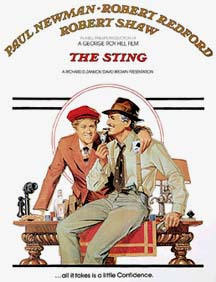
Paul Newman, My Grandfather and the Making of the Movie ‘The Sting’

stingmovieWhen I was growing up, my grandfather on my mother’s side used to drop by our apartment all of the time and watch television with us. My mom was a single mother who worked long hours as an assistant bookkeeper, so these moments at night were always a welcome rest from her very long days. During most of these times, I was still too young to understand the complexities of father and daughter relationships, so I never really understood the conflict that seemed to arise between my mom and my grandfather. But it was while we were watching the network airing of the Paul Newman-Robert Redford movie The Sting that I started to realize what this conflict might have been. In case you don’t know it, a large part of the movie takes place on the Santa Monica Pier, specifically in the carousel building. As we were watching one of the scenes taking place, Paul Newman was on the screen doing whatever an actor like Paul Newman does in a movie like that when my grandfather said: “I had lunch with him.”

My mom just rolled her eyes and said: “Sure, Dad. You had lunch with Paul Newman, the actor?”

He was adamant. And he upped the claim: “I had lunch with him right there,” pointing to the screen, meaning he had lunch with him right there where the movie was filmed.

My mom just rolled her eyes again and said nothing. We watched the rest of the movie, and nothing more was said of it.

Over the years, I spent a lot of time at my grandfather’s house. His place was always a welcome refuge from the world. Because we were dirt poor in a well-to-do city, having a place to go where you weren’t in fear of danger was always a good thing. So I spent a lot of hours at my grandfather’s house.

And one thing I remember most about him was that he loved to tell stories. Mostly about his life and the things he’d seen. And whenever I told my mom about these stories, she just laughed and said Grandpa made things up and had an “interesting” past that was more interesting in his mind than in real life. So I always kept that thought in mind whenever I heard one of his stories.

One time, he told me a story about how he fought with the French resistance by using his cover as an ambulance driver to sneak around Nazi territories. My mom laughed when I told her that story and basically had no comment. Another time, he told me he played backup guitar for a famous rock band that was performing at the Santa Monica Civic Auditorium because its guitarist was sick one night. My grandfather was an accomplished musician, and I could have easily seen how one with an active imagination might have imagined playing guitar for a major rock and roll band. I do that myself sometimes when I’m listening to the radio and suddenly rocking with my air guitar.

However, the story of him having “lunch with Paul Newman” always seemed to be one of those things that never made sense to me. I could see imagining all sorts of things, but having lunch with an actor and remembering it only when seeing him on the screen just seemed bizarre. So I remember asking him more information about that story. And he told me that one day he was playing the mandolin at the park and wandered down to the pier where he noticed they were making a movie. So, he maneuvered his way onto the set and walked over to where Robert Redford and Paul Newman were having lunch in between takes. He walked over to them and asked them if he could join them. They were both surprised by some stranger who walked up to them and kind of gestured to a seat near them. He then asked them if they’d mind if he played his mandolin. I guess they were too surprised to say no, so he spent the next few minutes regaling them with his mandolin playing (which was always quite remarkable). When he finished, he motioned to Paul Newman’s unfinished lunch and asked him if he was going to finish that. According to my grandfather, they were somewhat surprised but didn’t stop him from finishing up the lunch. A studio person came over at this time, about to push my grandfather on his way but one of the two actors actually motioned for him to stop, saying: “Bring us another plate.” I’m not sure how much longer my grandfather claimed to have stuck around, but that’s what he considered “having lunch with that actor.” Even if it wasn’t true, it was always such an interesting story.

Anyway, years later, long after my grandfather passed away, I was doing some research on the French resistance and saw an old picture of a group of known French resistance fighters who had a picture snapped of them as they were standing next to an old ambulance. Looking closer, I realized that the picture of one of the unlabeled people in the picture looked a lot like a younger version of my grandfather. There’s no guarantee it was him, but it sure looked like him and it certainly matched the time period and location of which he had been discussing.

A few years after that, I was in a bookstore on Powell Street in San Francisco looking over a bin of books that were heavily discounted, and one of them was about the heyday of Hollywood movies, and showed a bunch of photos for some major motion pictures during certain periods. My fingering through the book stopped strangely on a section for the movie ‘The Sting.” I hadn’t seen the movie in a long time, so looking at the different pictures brought back a lot of good memories. However, when I turned the page, I found myself staring at a picture of Paul Newman, Robert Redford having a meal on set. Sitting with them was an old man with a mandolin in his hands. It was hard to tell what they were talking about in that photo, but it was definitely my grandfather, and he was credited as “unknown stagehand”.

Which brought me back to those many stories that he told over the years, the many stories that my mom was convinced were all in his head. To this day, I’m still looking through old rock photos to see the one time a strange guitarist filled in for Van Halen or the Rolling Stones. I haven’t found it yet, but those earlier stories definitely keep me looking.

Who knows what I’ll find?

Most heterosexuals will never encounter the T in LGBT and that’s really the problem

When I was very young, I remember my grandfather once telling me that the way to understand people I don’t understand is to actually interact with them. At that age, I remember him having me introduce myself to random strangers at the mall in Santa Monica, California. It didn’t really matter to him who the person was; he wanted me to approach and meet every person I could.

Now, today, that probably wouldn’t be the greatest approach when dealing with a kid because of how our society has changed to where people practically fear any stranger, but back in that day, it worked. And I learned a lot from it.

That approach carried me through most of my life, and I’m glad for it, but at the same time I understand that not everyone had that kind of upbringing. I was lucky to grow up in a diverse community where there were people from all walks of life. I wasn’t lucky to be born into poverty, but part of me thinks that there were some advantages to that situation, and one of those was the ability to exist with numerous groups of people who gravitated towards the lower end of the economic ladder. Having lived in both sides of the economic spectrum, I would like to think I’ve picked up some of the positive qualities of both. I probably also picked up some of the negative ones, too, but what is a life that doesn’t involve some bit of reflective wondering in hopes of living life to its fullest?

Growing up poor, I lived with those who were always on the edge of despair, if not deeply in the middle of it. Serving in the Army, I was exposed to all sorts of different races and ethnicities, not as separates but as comrades and allies. After the service, I traveled the country, living in numerous communities for months at a time and then moving on to find another. The people I met, and the stories they had to tell and share, filled my memories for the wonder that each and every one of them revealed. After my wanderings, I ended up back in San Francisco (kind of where I ran out of money and had to actually find a “real” job), and I was exposed to all sorts of new experiences.

I should probably mention one of the important aspects of my character, and that’s that people tend to share a lot of information about themselves to me. Partly because I’m receptive, partly because I’m easy to talk to, and mostly because I care about what people have to share with me. A friend once told me that I should have been a counselor or a psychiatrist because of how good I was with people, but I never went that direction because I always felt I was getting something great out of every encounter and taking money for it would have felt wrong.

So at some point I went back to school to get another degree. And this time around, it was different. Before, I went to West Point where my approach was a career in the Army. This time, I wanted to learn about things I missed the first time around. I didn’t even care what it was I was studying. I just wanted to know more abut things I didn’t know.

What kind of things did I learn? Well, aside from rote memorization of school material, I started to learn a lot more about the people who existed around me. I discovered there were people from all sorts of different walks of life. I befriended guys who were paying their way through school by waiting tables but intended to be investment bankers when they graduated, women who wanted to help people by becoming social workers yet funded their education by tying up men and spanking them in dark, air-conditioned lofts above laundromats, nervous English-Second-Language students who signed up for debate because they knew they were destined to be criminal attorneys, and so many others who were all individuals, each with his or her wonderful, personal story that was both unique and important.

One of those unique individuals I came across was someone I’ll refer to as Bobbi who was the person who lived next door to me in a really run-down, flea-infested flat I was living in when I first went back to school. Bobbi was one of those shy types of people who avoided others but always smiled when you said hi, even if the response was nothing more than somewhat of a grunt or nod of the head in recognition. What I found most interesting about Bobbi was that I could never tell what gender Bobbi was. On the surface, Bobbi appeared to be a man that was slowly turning into a female. The hair was blond and frilly, kind of later Farah Fawcett-like, but the mannerisms were quite often both male and female, almost as if they were still fighting their way towards the surface. I remember the apartment clerk once remarked: “She’s in that transition stage where she’s still trying to determine which way she’s going to go.” Future conversations with this clerk indicated that he thought the confusion wasn’t necessarily Bobbi’s but a struggle with how Bobbi wanted to be perceived by those around her (months later, Bobbi said she preferred the pronoun “she” and I’ve never given it another thought).

A few years later, I was working for a church that had a transgender member (for identification, I’ll call her Chris) who was having a very difficult time with those around her. She was very much in the same stage that Bobbi had been, but the struggle was much deeper as this person was scared to make changes because of how she perceived others might not accept her in that capacity. Unlike Bobbi, she quite often returned to her male “self” in the circles of others because of how she felt they might think about her. Years after I parted ways with that organization, I heard from a member of that group that someone had attacked Chris as she was walking home from the church, and she was seriously beaten, to the point that she has never actually recovered.

I’ve known a few more over the years, but to be honest, I don’t think of them as transgendered people I’ve known, but as people I’ve known that just so happened to be transgendered. And I think that’s where the problem stems for so many others who see people who are different as some kind of affront or challenge to them for reasons that make little sense when you spend any time thinking about it.

This is probably why I think being a writer is important. If I was a filmmaker, I think I would want to touch on these subjects as well because what I’ve started to learn is that not a whole lot of people have the life experiences that I’ve had. Instead, they’ve had more sheltered lives that create all sorts of barriers to thinking differently than anything they’ve personally experienced. Hell, I wouldn’t be surprised if there are things I’m still struggling with, simply because I’m not perfect, nor have I had every type of experience one can have to tackle so many of these issues. But I would like to think that having some of the experiences I’ve had, at least I’m willing to explore new ideas and opportunities.

And that’s what I fear for those close-minded individuals out there who see the world through a closed prism. And it’s probably why a common individual can have such hateful thoughts and still think he or she is a good person. I wish there was a way to expose everyone to a world of experiences so that they could reach that understanding that hating a person for being different is equal to hating one’s self for not being open enough to want to learn more about one’s fellow people. Because once you live with the people you might hate, chances are pretty good you’re going to be forever changed by the experience.