Category Archives: Self-Publishing
Tales From the WritingTrenches #2: Creating Believable Tension
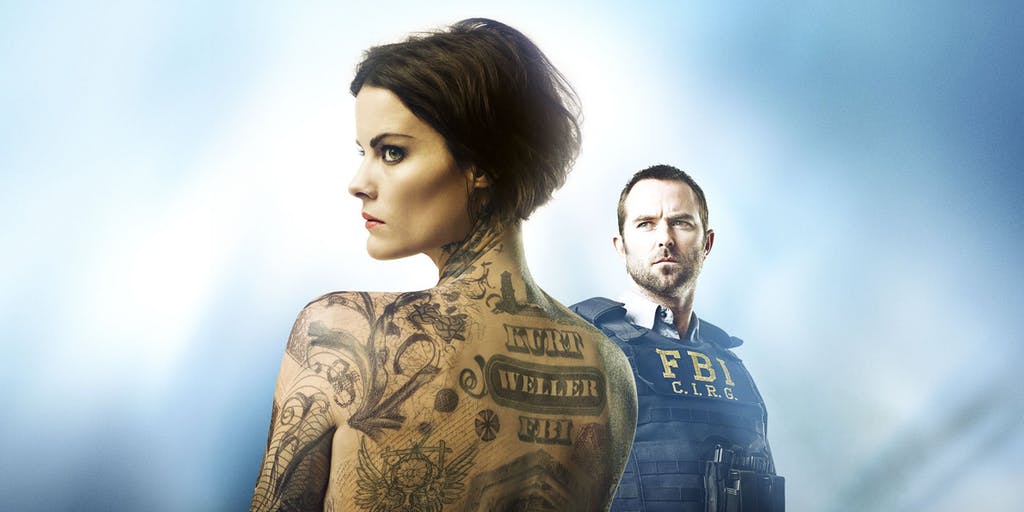 One of my favorite shows from a few years back is one called Blindspot. It’s a somewhat ridiculous story with a premise that involves a woman with a body full of tattoos who was left unconscious in a body bag in the middle of Times Square. The police turn the woman over to the FBI who quickly discover that the woman is an ex-SEAL who was part of a secretive doomsday cult and that the tattoos all involve a secret conspiracy to, oh I don’t exactly remember, but it was pretty cataclysmic. The FBI task force that is chosen to work with her are all experts in their field, including a hotshot “the rules only apply to everyone but me” agent lead, a former CIA agent with milky ties to the agency still, a green FBI agent who may or may not have committed felonies to protect his brother, a nerdy tech wizard female who creates computer code in every language known to the computer industry, can pinpoint every source of dust from any location on the globe, plus all sorts of other tech wizardry that MIT would bow down to as far superior than anything that comes from their research labs, and then there’s the leadership that is changed daily as each new leader is discovered to be secretly plotting to steal the world’s cottage cheese (or whatever dastardly plot a particular tattoo highlighted that week). Anyway, in the first two seasons, it was a romp through tons of mysterious ridiculousness until we passed the “will they/won’t they” stage of the two main characters’ arc of romance to where they finally married.
Which brings us to Season 3. I originally dvr’d the third season, but started late because I didn’t subscribe to the cable service to dvr stuff until the fifth episode aired. So, I had it set to start recording from Episode 6 on, which is okay because these seasons have about twenty episodes to them. But it’s a show you don’t want to start in the middle of a season, so I waited until I could buy the first five episodes on iTunes, and then started to watch it.
I watched the first two episodes, and boy, were they doozies. And by “doozies”, I mean absolutely ridiculous in all ways. First, here’s where the story took us:
- The male and female heroes are now married. They have a great romance until evil stormtroopers break into their house and shoot it up, but are quickly subdued by the hero team who were originally unarmed but get weapons from the bad guys (cause they’re just that good) and shoot lots of them (or just karate chop three or four at a time with really sweeping martial arts moves that even Bruce Lee was watching, thinking, “man, I gotta learn how to do that.” Anyway, they discover that a hitman has a hit out on Jane (her name is Jane Doe…yeah, not kidding…it’s what they named her when they found her body and for some reason she decided to just keep it, kind of like how I decided to keep the name Awesome Sauce cause everyone keeps calling me that). So, they decide they have to break up and move really far away from each other (like different continents) so this will somehow protect her if she goes somewhere that doesn’t have friends and witness protection programs. But then they figure out the bad guy doing this is dead but the contract is still active, but they can stop it by pretending to be dead so they can catch the guy who is paying the bounty. Yeah, it’s kind of complicated but it all ends in one episode.
- They discover that a new set of tattoos has been put on Jane’s body that can only be seen by a piece of metal that looks like Batman’s batarang (or is it batamarang?). Then they discover it was put on her by none other than the bad guy from the previous seasons. He’s kind of mad, for reasons that really aren’t explained, but I predict we’ll get more explanation around Episode 11 or 12 in some kind of avant garde flashback. They do that a lot.
- So, the couple comes back together and declares that they love each other, and as long as they’re honest with each other, nothing can come between them. Fast forward about twenty=eight seconds later and the male hero gets contacted by the bad guy who gives the next clue of the tattoos and hints that the male hero should never tell Jane. So he doesn’t. And then they get back together and re-emphasize about how this new honesty will definitely save their marriage. I won’t get into the simple fact that if he just would have said, “Oh, and by the way Jane, I’m getting instructions from your evil brother. Just telling you this cause we’re being honest to each other now. So, what you want to watch? Star Trek or Game of Thrones?”
- Now, let’s get into the concept of this post “creating believable tension”. So, because this show is one of those that deals with conflicts of the moment, the plot goes something like this (from episode one to episode two): The bad brother has kidnapped the three main buddies of the hero and then sold them as slaves to Venezuela. Yeah, I wrote that with a straight face. So, ,they’re being kept in a prison cell in some deeply secret prison in Venezuela. And the bad guys tell the geek girl who was one of the captured, right after wheeling in a large bank sized safe: “You have one hour to open this safe, or I start killing your friends.” So, this geek girl who we just found out has been spending the last two years creating a Farmville app called Wizardville (or something like that) that she needs to crack this safe. In case you didn’t know it, because most of you are not computer programming experts, all computer programming experts are also experts in safe cracking, hacking of complex computer systems, satellite technicians, satellite reprogrammers (it’s just computer code, right?), experts in soil sample technology, aficianados of what type of dirt exists on the planet (including several variations of “dirt”), cell phone hacking, advanced surveillance systems, security camera technology and h
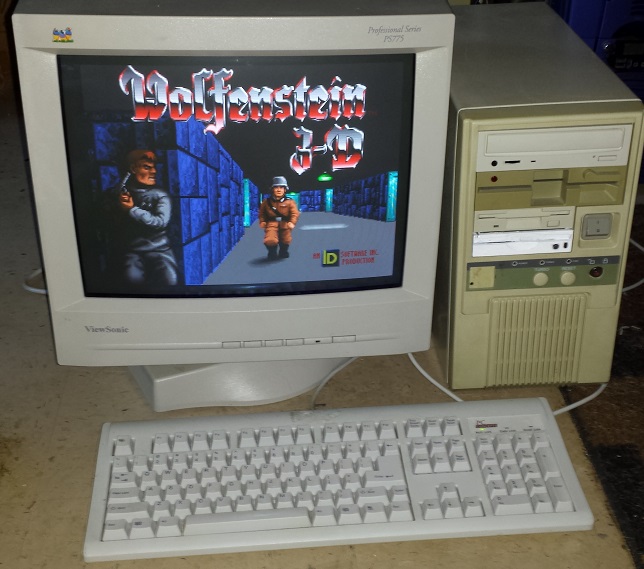 ow to crack it, and so many other areas of technology that I’ve lost count, although advanced number theory is also one of our areas of expertise. So, she cracks the safe, and in it we find what on first glance appears to be advanced computer technology that I suspect just might be a 386 computer, or possibly a Pentium 1 (translation: from about 1989).
So, they have this highly “advanced” computer that she is then told she has one hour to hack or everyone else dies (one an hour). The one thing they forgot to include in the scene was an actual monitor, so as I’m watching this, I’m thinking: “You know, even though I’m a programmer and supposed to know how to hack any computer system on the planet, even I would have a hard time cracking this one without a freaking monitor.” Just saying. But somehow she does, and when the bad guys reappear, a monitor magically appears on the desk that wasn’t in the room a few moments before. So, then we get to watch the start up on the computer as her advanced hacking skills are shown, and we see what looks a little more complicated than “Hello, World” starting on the screen, except they were smart enough to program instead of “Hello, World!” something similar to:
/////// dsfljasfdasjf /////// areafigaglahodf
////// =Verifiable Office System ///////////
////// *********************** ///////////
////////// Super Secret CIA Files ////////////
////////// Do Not Release To Anyone Without Top Secret Clearance //////////
Yeah, something like that.
6. The secret code, it turns out, turns off a super spy satellite network that controls a missile defense system that protects the entire USA. We find out we have this system because of a raid on a super secret warehouse, operated by two geeks, a typical geek guy and a super hot, would never date me in a million years, type of woman, who I immediately suspected was a bad guy (and not just because she would never date me in a million years, although that probably helped me to realize I should suspect her). Surprisingly, she was bad, and she was selling the code to, (let’s see…what enemies can we possibly use? The Russians? Naw, they’re so 1990s. Arabic terrorists? No, we always blame them. Spent the last two seasons kind of doing that already. The Chinese? Good choice, but we want to market this series to the largest population market on the planet, so we’re going to pass on that one. Okay, the North Koreans, cause a country that can’t afford to supply its citizens with even dirt for toilet paper would be the obvious one to pay millions of dollars for a computer code to hack the US secret satellite network). Okay, so it’s the North Koreans. And to make it worse, it’s revealed in the same episode that the NK military isn’t building a nuclear weapon but has built tons of them, including missiles that can reach the US, AND they’ve been constantly launching them on an almost daily basis but our super secret shield has been knocking them out of the sky. You’d think Trump would bother to mention this every now and then. Thanks, Obama! Anyway, so because they have the code, they’re going to knock out our defense network and launch everything at California. Why? I’m guessing cause it’s the only place they could find on a map before they wrote this script. But fortunately, as the satellites are knocked out one by one (in a count down that has geek girl saying: “99…73…65…hurry guys…52…40…we’re running out of time!…23…Oh no, I forgot to feed my gold fish…12…7…2! We’re running out of time!” Meanwhile, we’re watching a gun fight and karate battle with the hero guy and Jane Doe facing off against a room full of ninjas (or ninjas on their day off and wearing their lounge clothing), before they knock out the last one, and jump over the table and hit the big button marked “STOP THE NUKES FROM LAUNCHING!!!” Okay, it wasn’t marked that, but it probably should have been.

Those are mainly my biggest gripes with the episode, although I do have to point out one inconsistency because it just drove me nuts when it happened. The two heroes find the secret base in Venezuela (no, I don’t know how, unless there’s only one in Venezuela, or they did some kind of “we traced the signal of their Blipomatosphere and it was right at this location” that I just didn’t catch, but I’m not even worried about that. What did bother me is that they stole an enemy tank, drove it to the battle and saved the day. Even that wasn’t a problem for me, as problematic as that actually is. It’s when the hero said: “We won’t be able to go fast. Tanks don’t move fast.” And I realized right then and there not a single writer on their staff has ever been in , been near, been around, or watched a tank on television. Tanks aren’t slow. The reason people think tanks are slow is because in old movies where they saw them most often, the drivers went slow because it was filmed that way for dramatic effect. A tank is a super fast vehicle on the battle field, and I can tell you that infantry were quite often more scared of being run over at high speeds than they were from any guns from the tanks themselves. Hell, I can tell you a bunch of times where I almost got run over by tanks on my own side because they go so fast that you often don’t see them until they’re practically on top of you.
So, getting back to my point of this post. A huge problem of tension in fiction is making it believable. But at the same time, you have to make the scene strong enough that someone is going to want to keep reading.
I’m reminded of one of the stories often shared when someone starts out writing. In the early days of pulp fiction (not the movie, but the concept it’s based on), there was a period of serial fiction where a writer would produce a long story over a number of different issues of a magazine. To do this, he or she would create a cliffhanger. Those cliffhangers were designed to make you want to buy the next issue of the magazine and find out what happened as a result of the corner the author created. As a result, those cliffhangers would get more and more complicated (kind of like the detective fiction where the concept of the locked room came about…”how did the killer do it when the room was locked from the inside?”…similar concept. Any way, in order to keep selling these magazines, the audiences became more and more acclimated with the technique and demanded stronger and stronger cliffhangers. Which brings us to the story often told:
A writer created a cliffhanger where the protagonist was undergoing one hazard after another and then finally fell into a deadly pit that was more than 20 feet deep. The issue ended with “To be continue….” And people awaited the conclusion, wondering what great writing technique was going to be used to save this hero.
The next issue appeared. The author wrote something to the effect of: “Stuck in the pit, Dave (our hero) leaped out of it to safety. He then….”
As you might guess, readers were pretty pissed at the author for taking such a stupid short cut. Ever since then, it’s been referred to by a lot of names, but more often “The Writer’s Pit”, although I remember hearing it once recently and not a single person in the room had an idea what that name referred to. References tend to diminish in notoriety over time.
So, if you’re trying to build tension, it requires investing some time. The characters first off have to be believable. The days of superhero protagonists are not acceptable these days. Developing your character as a stereotype trope of Arnold Schwarzeneger might seem like a fun exercise, but people generally aren’t going to buy some of the very recent attempts at re-creating James Bond and giving him a different name, yet keep unbelievable attributes that people just don’t imagine one person being able to inhabit.
So, let’s look at a series like Blindspot. How would I have made it more believable?
- The hero needs to be grounded in reality. He could be a great FBI agent, but he’s not some special forces/intelligence agent/brilliant tactician/martial arts dabbling/no faults whatsoever. One or a few of those qualities, and it’s more believable.
- Eliminate all of the CIA agents on the team. It makes absolutely no sense.
- Put about ten scientific experts on the team. One person can’t possibly know as much information as geek girl seems to know and be incredibly hot at the same time. Not saying hot women can’t be geek girls, but no one is as smart as this woman is made out to be.
- Get actual computer experts to deal with some of the tech. Person of Interest and Mr. Robot do that really well. Emulate that example.
- Understand international politics and international politics a lot better, or at least stop trying to fool your audience and believing your audience is composed of complete idiots. If that’s the case, I’ve been watching the wrong show for the last three years.
- Stop with the characters lying to each other just to create drama. It serves no purpose. Right now (in episode 2) the male hero is lying to Jane Doe for absolutely no reason, and she just told him “Our relationship will last forever as long as we’re honest to each other”. His reply SHOULD HAVE been: “Wow, you’re right. By the way, your brother is starting to send me messages about your tattoos. I meant to tell you but we were so caught up in watching Game of Thrones that it totally threw my mind.”
Anyway, just my thoughts on how writing fiction can benefit from watching really bad fiction in what could otherwise be really awesome television.
Remaining Unknown in a Viral World: Popularity, ASMR and Celebrity Status
Earlier today, I was examining the statistics on my website and realized that I have about 1.5 million hits on my site since I started it. That appears to be a lot, but then I started to think to myself that not a lot of people comment on it or send me messages based off of my web site (or its blog). So, this tells me that I seem to get a lot of traffic but apparently nothing seems to be going on with it. And yes, that opens up a lot of thought on a subject I’ll probably take up at another time (what do to with traffic when it gets to your site, as I don’t seem to be doing a whole of good with that area).
Last night, I was watching the latest episode of Law & Order: Special Victims Unit, which is still one of my favorite police procedural types of shows. And in this episode, an Instagram star hooked up with a MMA fighter and was raped, but it turns out the whole thing had been set up by a young woman who was a follower of both of their Instagram feeds. The prosecutor mentioned that a motive for the set up was that the Instgram model had tens of thousands of followers, the MMA fighter had 2 million, and the young, geek girl had 6. Therefore, this was vengeance against the two well known Instagram stars from someone who felt that she had an important voice but no one was listening to her.
That resonated quite a bit with me because I think a lot of us who aren’t big stars often feel the same way. Not that we’re about to set up someone famous like the plot line of this story, but at the same time the realization that there are people who are seriously famous for a sex tape, or for just looking good in pictures, can be a hard thing to face when one is trying really hard to become known as well, but doesn’t have that advantage those pseudo celebrities have.
Recently, I’ve been following a bunch of ASMR artists who I find to be very good at their craft. In case you’re not familiar with ASMR, it stands for Autonomous Sensory Meridian Response, which according to Wikipedia is “is a term used for an experience characterised by a static-like or tingling sensation on the skin that typically begins on the scalp and moves down the back of the neck and upper spine. It has been compared with auditory-tactile synesthesia.” And even with that definition, you’d be amazed (or maybe you wouldn’t) at how many news agencies just don’t understand it, which you can see when they start to make statements that suggest watching President Trump gives “ASMR tingles” or when some celebrity posts a Youtube of her just staring at the screen and the media goes ga ga over her “ASMR video.”
In reality, ASMR is difficult to achieve and very few artists succeed at it. There’s a reason that there are a few very popular ASMR artists out there, and almost none of them are celebrities known for other things.
Which brings me back to my original subject, and that’s that viral popularity has a bad habit of creating an atmosphere that wasn’t intended in the first place. For those not completely familiar with ASMR, it’s pretty easy to fall into the trap of thinking ASMR is nothing but people whispering and making sounds with inanimate objects. And that’s because a lot of it comes from doing exactly that. But it also comes from a stronger understanding of how those actions can trigger the audience into feeling something more than just simple reactions. As a result, quite a few artists sometimes push the envelope and create what I’ve started to characterize as PG-13 ASMR. What I mean by that is ASMR that is designed to arouse rather than “tingle”, and for those not initiated in what ASMR, it can be very easy to mistake one for the other.
This happens quite often because the models who do ASMR are almost always attractive. Both male and female ASMR artists are generally above average in attractiveness and in their social tools for attracting others. This should be expected because this is a video environment where an unattractive artist is going to be avoided or ignored, and an attractive one is going to cause people to click the image being presented on the Youtube reception screen. This often resonates in the comments section of their videos where the anonymous nature of the Internet can cause trolling behavior you’d expect in a darkened strip club environment. To make matters worse, a number of ASMR artists chase the elusive crown of traffic and subscriptions (people subscribe to their personal channels), which leads to a revenue stream from Youtube. This causes the perpetrators of the more adult environment to keep pushing the adult envelope and the non-sexual artists to feel the need to participate because of loss of viewer clicks.
Youtube has somewhat cracked down on this phenomenon, but has done so with broad strokes that hurts mostly the non-sexual artists because they demonetize mostly based on viewer feedback, and the business has become somewhat cutthroat with an almost mob mentality towards those who are actually trying to comply and do the right thing. As usual, those are the ones who suffer the most, whereas the ones who are crossing the line are rewarded because none of their fans are ever going to turn them in for breaking any of the rules.
Which kind of brings me full circle in what I was originally talking about, and that’s the problem of trying to achieve any level of popularity in a bread and circuses environment where controversy, sex and violence are the things that attract the largest audience. How does the unknown artist achieve notoriety in a mostly celebrity driven world? In a free market mentality, one would think that the quality rises to the top and everything else remains at the bottom. But that’s rarely the case. Quite often, celebrity status is more than enough to create buzz so that its products remain at the top and everything else is left grasping for scraps. As a writer, I find this problem emblematic in the field because some really bad celebrity fiction gets serious attention when it’s not very good and it’s written by people who have about twenty years before they’ll actually ever write anything significant (if they were to work on it full time and not just in between movies or photo shoots). But the people who put in the work in hopes of one day becoming discovered may do so their entire lives and never get a nibble beyond a table scrap thrown their way.
So, the question is: Is there a balance, or is it just not worth the effort? I’m kind of on the cusp of this myself, as I’ve been writing for most of my entire life, creating computer games that were popular but too early for the industry to ever recognize, wrote music back in the day when such music was seen as too experimental, and any number of other creative tasks that have fumbled, fizzled or just never took off. People keep saying “Just keep at it and your day will come”, but part of me wonders if it’s just a crap shoot and my time might better be spent catching up on the latest season of The Walking Dead.
Whether an unread book constitutes someone being an actual writer
One of the common refrains heard from people who skirt the field of writing is that of someone who suspects that if he or she writes a book and no one reads it, is that person actually a writer. And there are numerous schools that try to answer this, much like a zen master talking about whether trees falling in the forest actually happen if no one hears them.
Lawyer and writer, Susan Wolfe, writing for Writer Unboxed, asks that same question and comes up with the inevitable answer of yes, you are a writer, which isn’t really that much of a surprise. But what does comes as a surprise to me is that her article goes on about how whether or not her second book sold was enough of a hit to allow her to want to write her third. That hit me kind of hard because it’s been a very long time since I wrote my third book, so it’s almost like I don’t ever remember having that conversation with myself.
You see, my biggest problem back in the day was whether or not to write my second novel. I had finished Innocent Until Proven Guilty early in my military career. And it was such a lot of fun to write. Then, I started imagining my second novel and decided to go with science fiction instead of mystery/suspense. And that got me to start wondering: Was the first time a fluke? Am I really a writer? Who am I trying to fool?
So, I sat down and started to write the second novel. And let me tell you: It was freaking hard. I kept second guessing myself, convinced that the first time was that one book everyone has inside of him (or her), and a second one meant you were really trying to be a writer. And about halfway through that novel, I can’t even begin to tell you how many self-doubts started flying around me. Yet, like all stories, this one had an ending, and I managed to muddle through it. That book became Leader of the Losers. Without a doubt, that was the hardest book I ever wrote. My third one, and those after, were never as hard as that second book. I’ve written 14 of them now. I’m writing my 15th.
But getting back to the original question of whether or not someone considers himself/herself a writer based on a particular book’s success seems almost irrelevant to me. I’m a writer because I love to write. I was writing stories for several decades before I wrote my first novel for actual publication. I had written hundreds of short stories that had been published during that time as well, which I suspect is a bit of a problem these days as not a lot of writers get their start that way any more. Instead, they’re expected to write their great opus out the gate, which is why so many self-published books read like someone’s very first thing they’ve ever written. Because it is.
To Susan Wolfe, I would say relish the act of writing more than the business of writing. If you’re doing this to “sell books” rather than to tell stories, I suspect you’re probably never going to find true happiness. You might find financial success, but that’s such a sad way to find one’s place in art. I’ve had moments where a turn of a phrase I came up with has lightened my entire day. I’ve had others where I’ve been seriously pissed off at a character of mine for doing something that I hadn’t expected. Writing finds those paths that logic can’t travel because each sentence is part of a journey, and a writer should constantly be trying to find new roads.
The Fear of Pissing Off Your Audience While Trying to Get One in the First Place
One of the problems of being political or taking a political stance is that chances are pretty good that you’re going to end up pissing off someone when you didn’t intend to do just that. As a writer, my goal is always to entertain as many people as possible, so whenever I deal with political issues, I get scared that whatever I’m going to say is bound to cause an audience member to dislike me. And these days, when someone dislikes you, that person tends to stop following and you never hear from that person again.
Therefore, it becomes a dilemma.
Because if one focuses on this type of fear then a writer is bound to water down whatever he or she has to say and only say the things that he or she hopes the audience is interested in hearing. And I can only imagine how bland and boring that might turn out to be.
The other day, I posted a tongue in cheek comment about something, and one of my politically correct “friends” corrected me and told me that I had to be careful, because saying such things can be construed to be wrong. I didn’t respond, but part of me was thinking: “Hey, I said what I said because it was something I wanted to say. If it bothers you, just ignore it or go frack yourself.” I didn’t say that because I’m a complete coward, but it did cause me to think.
And then the next week, that same person posted something that was completely one-sided, told in a tone that she knew best and anyone else who disagreed was obviously stupid. Basically, she did exactly what she told me not to do and then didn’t think anything of it. I then started to notice she does that all of the time.
Some people are like that. They are good at criticizing, but not so good at avoiding the behavior they criticize in the first place.
But then, she’s not a writer worried about people not continuing to read what she writes, and I am. So, there’s the dilemma.
Which kind of brings me to wondering how it is possible for polemic people to write the types of articles they do, knowing that people are going to be annoyed at what they write. I’m thinking about people like Ann Coulter, Michael Moore, and Tomi Lahren. The first two have completely established audiences that they’re probably never going to lose, but like the latter one, it leaves me wondering what kinds of risks is someone like Lahren willing to make in order to remain somewhat relevant in a very hostile media atmosphere. And part of me is also constantly wondering if part of the appeal is physical attractiveness as well, because if there wasn’t that, I kind of wonder at how many followers someone like her would have if the audience isn’t already cemented.
Social media seems to be one of those weird animals in that some people just come to it naturally and do really well right out the gate, whereas others, like me, take to it slowly and never really seem to reach the audiences they dream of achieving. It’s like the market for writing novel e-books. I’ve been writing for decades, and the readers I have tend to be the same readers who found me some years back. Others, I’ve seen them publish their first book and suddenly they’re selling them faster than Amazon can print them. Okay, Amazon doesn’t exactly print them, but you get the idea. I hope.
Some people just do really well with little effort while others succeed without trying. I’m starting to believe that that is how social media works for some people as well. While some people have the added benefit of being attractive to, well, attract others, those of us like me, toad-like in appearance, pretty much have to fight for each stride of existence. Okay, not toad-like, but I will admit that when my picture is put next to Brad Pitt’s, people tend not to stop and think: “Wow, I can’t tell them apart.” Definitely not. Brad’s got nothing on me!
Anyway, so the point is that getting an audience can be pretty tough and then once you do, it’s like walking on egg shells to make sure that you don’t lose any of your listeners. People can be pretty fickle about such things, and once you’ve lost a member of your audience, you tend to never get that person back.
So, if this bothers anyone who happens to be reading this, understand that it was someone else who said it, not me. I would never say anything to piss you off. Really. I’m just that kind of guy.
Please don’t go!
More of writers being taken advantage of
Yesterday, I received an email from some entrepreneur in San Francisco who “offered” to sit down with me for lunch in San Francisco in a very expensive location (described in detail in the email as if that location was somehow a selling point of having a casual lunch with some woman I don’t know). Anyway, she was appealing to the fact that I was a writer who needed to “move to the next level”. And I guess that somehow this lunch “date” was going to make this happen in some bizarre way.
I should point out that the lunch “date” we were going to have was going to cost me $350, but if I was one of the first responders, I’d save $100.
So, being bored with my life, I googled her name and discovered that she seems to be under all sorts of very interesting legal scrutiny for a bunch of really interesting decisions she made over the years, some involving marital spats of a friend of client of hers and some actions she may or may not have taken as a part of some domestic dispute.
But I didn’t find anything to indicate that she was successful in helping anyone’s career along, which made me wonder why would someone, out of the blue, contact me about something like this when the only thing she had going to her name was somewhat of a scandal involving domestic abuse. And I really couldn’t come up with an answer.
So it got me wondering if there’s a whole industry of people like this who devote most of their time and energy to taking advantage of hopeful writers (inventors, game creators, or whatever) and offering them to somehow put them in touch with their elusive dreams. Cause it was a nice little appeal when I first read it. Of course, being the kind of person I am, I’m always going to investigate it first, but I wondered how many other people someone like this ropes in on such schemes. Hell, for all I know she’s legit and secretly has been the success behind Stephen King and Brad Pitt. I doubt it, but I’ve never been considered all-knowing.
What it does tell me is that people in my field need to be really careful because these sorts of leeches are out there seeing gold in the paths of dreamers and believers. Those of us who are the creative type constantly want to believe that our passion can bring success, and people like that are constantly there to make sure we stupidly take these types of leaps right before emptying our wallets and disappearing into the woodwork again.
We just have to be extra careful.
Remembering the days when writer groups used to actually service writers

A year or so ago, I was a subscriber to Writer’s Digest, a magazine that has been around for a very long time and used to serve the purpose of helping wannabe writers become actual writers. When I was young, I used to tear through the pages of that magazine, reading the fiction process articles written by its editor back then, Lawrence Block. The tidbits and ideas that I received from that magazine used to be wonderful.
This was before the whole Internet revolution came and went. As we all know, the Internet made it so anyone could publish his or her book whenever he or she wanted (regardless of how ready it was), and the need for the mainstream publishers and reputable agents was no longer a necessity. If you understood the market that Writer’s Digest used to serve, you might notice that something has probably had to happen to the magazine as well. All of those people it was helping to train become professional writers are now out there making their own way, and they’ve done it without the need or desire to listen to intricate lessons of how they should learn to write and how to format manuscript pages. The need for a service that Writer’s Digest used to provide have become almost none.
Which means Writer’s Digest probably had to change as well. And unfortunately, what I’ve started to notice is that this magazine has begun to mass saturate my email with continuous “give us money and we’ll help you prepare your manuscript for publication”. Realizing that people no longer need the advice on how to get published, now I’m receiving never-ending offers to help me “prepare” a manuscript for publication. The last one was for a Writer’s Digest “service” that proofreads a manuscript and charges you by the page. The funny thing is: The editors who actually work on self-publishing works out there charge a whole lot less to do the full job than Writer’s Digest is offering to just a portion of the work required.
So, what this means is that another service has popped up that wants to separate the independents from their money under the guise of offering a necessary service. In the old days, this service used to be offered in the classified pages of WD, but now the magazine itself is in on the deal. And while I usually don’t jump on the criticism of WD, I am starting to notice that more and more “independent” services out there are trying to attract the self-publishers to do things that self-publishers have learned to do themselves. I’m talking about formatting services, book cover creators, full editing, line editing, feel of the story editing, punctuation editors, marketing promoters, “how to” books written by people who really haven’t figured anything out themselves other than how to charge people for “how to” books, and so many others. Now, some of those services I take advantage of, like book cover creators, because the people I work with are far better at doing it than I am. But what I’m also noticing is that a lot of bad book cover creators are also advertising their services. This goes back to a conversation I had with independent filmmaker Chris Penney (of DogByte Films), who in making independent films remarked that the people making money off of these films tend to be the organizations that provide services rather than the filmmakers themselves. I’m talking about the color correction people, the film editors, and all sorts of other fields that have sprung up to take advantage of the fact that there are a few visionaries out there trying to turn their ideas into something brilliant. My point is that this same mentality is now finally creeping into the independent book market, as there are people who realize that there’s gold in them thar hills and the gold is the people coming to mine for gold, not the gold itself.
And that’s the problem, in a nutshell. A lot of us are trying to make this business work, yet we’re constantly being inundated by people who are trying to make a quick buck off of us.
The Problem of Genre
One of my biggest problems as a writer is that quite often it is very difficult to nail down the genres in which I write. It was easy in the beginning of my career when I wrote Innocent Until Proven Guilty, which was mystery/suspense. But then I started branching out on other types of books and things got, well, kind of confusing. Let me give you a bit of a run-down, and you’ll see what I mean:
Innocent Until Proven Guilty: A murder takes place in corporate America and then an executive frames another for the murder. Works well as mystery/suspense.
Leader of the Losers: A dystopian future where poverty and class distinction has been solved by eliminating the “losers”. Definitely science fiction.
72 Hours in August: During the 1991 August Coup in the Soviet Union, a plan is hatched to start a nuclear war before the coup is over. Suspense, but also historical, and kind of a mystery as well.
Destiny: The Tales of Reagul story that starts the whole series, except it takes place 3000 years after the beginning of the epic. Story begins with a space battle, turns into a fantasy trek across a mysterious land and then ends with another large space battle. Science fiction? Fantasy? Both?
Deadly Deceptions: In South Korea, a counterintelligence agent uncovers a blackmarketing operation that might actually be masking a major espionage cover-up. Guess that’s a suspense novel, or a thriller, or also a mystery.
The Ameriad: A humorous Greek epic that spoofs the Iliad and the Odyssey by turning the icons of American society into the “new” gods. No idea where this one belongs.
Absent Without Leave: A military criminal investigator uncovers a 20 year old crime that started with the framing of his father and leads to the political future of Texas politics. Mystery, maybe? Thriller? Suspense?
The Teddy Bear Conspiracy: A CIA agent, running an operation to defeat the Colombian drug lords, finds himself targeted by his own people, forcing him to finish the mission alone while someone within his organization is trying to kill him and take over the project. Suspense?
Thompson’s Bounty: A time-traveling Coast Guard cutter encounters 16th century pirates and is sucked into a battle between two naval commanders. Science fiction? Naval warfare?
A Season of Kings (my next novel): The first official book of the Tales of Reagul, which tells the story of a planet where science and magic are intertwined. Most of the story is fantasy, but the whole premise comes from an alien experiment, which basically makes it science fiction.
Those are just the tip of the iceberg, and I’m finding it really hard to market my books because none of them really fit into any solid genre. Or few of them do. I won’t even try to figure out where Plato’s Perspective fits in, as it’s a novel with the protagonist named Plato who may or may not be the actual Plato, and the novel’s point in time may be a bit confusing as well. It could end up being philosophy, science fiction, fantasy, mainstream, history, etc. I’m sure you get the idea.
Now that I’m on my own
The last day of work for me was on Tuesday, and it was one of those days that really didn’t have a lot going on. I came in expecting to be given grunt work to do most of the day, but the senior boss decided that I would have my exit interview at 11:30 AM, and then I was finished with the job as of noon. Still got paid for the entire day (or so they say), and then I was kind of on my own from there. I forgot to pick up some medication at the pharmacy at work because I was in such a hurry to leave, so I’ll probably have to wander back there this weekend and do the pick up of that stuff.
So, I’m now in the process of putting together my writing projects and pushing forward on those. I completed and published my novella, The Beast of Begmire, and I’m trying to see about getting it listed for free on most e-book sites. I also put it up on Wattpad this evening, so it should be available for anyone to read free there.
My next project will be to complete A Season of Kings, and during that project I’m still working on completing the first book of the series I’m writing with Marie. Hopefully, we can get that one moving forward, as I seem to have a lot more hope for that series than any of the fantasy ones I’m writing.
Money is going to be tight, mainly because of the way Spectrum Health completes the quitting process. I can’t ask for my payout money from my retirement until the last paycheck comes through from SH, and unfortunately the way they work it out, it will probably be about a month before the last “paycheck” comes through, and THEN I’m allowed to put in the paperwork for that money. Which means February might be a bit crappy when it comes to paying my bills, and unfortunately I’m not really sure what the solution to that is going to be. If it’s not one thing, it’s another….
Another project I’ve been outlining lately is one that I had on a back burner for many years now, and that’s my Return to Camelot series. Every time I write a specific novel, I find myself getting tons and tons of ideas, dialogue, and even scenes from the next novel I’ll be writing after the ones I’m currently working on. For some reason, Return to Camelot has been the one that’s been building momentum lately. All I can do is write down the ideas and hope that I can get to the actual writing soon. My working titles for that series are:
1. The Once and Future King
2. Return to Camelot
3. Le Morte D’Arthur
They’re not massively original, but they’re working titles for now, and they seem to push the ideas of what exists within each volume. I’m kind of looking forward to writing that series, as I wrote the first couple of chapters years ago and still refer to those chapters from time to time because they were so very good. Yes, a writer can admire his own work from time to time. You wouldn’t believe how critical I am of practically everything else that comes through my word processor.
For some reason, every night I seem to be dreaming about work (the old job). I keep dreaming how someone is telling me I have to do something and it must be done on a deadline that has already passed. And then an inner voice tells me, hey, you don’t work here any more, and I kind of toss and turn through that. I guess the subconscious does that to you when you’ve been living and breathing a job for so long, especially one that was becoming really good at developing arbitrary deadlines and then sitting on the results for weeks while new deadlines are thrown at you for new work that will then be sat on as soon as it met its completion. Anyway.
So, that’s kind of where things are right now. And as so few people tend to read my blog, aside from the spider sites in China that seem to access my page hundreds of times a day, it would be nice to hear from people who are actually reading it. Otherwise, I might just have to discontinue it, as it’s turning very much into a diary where I’m the only one who is really reading it.
The Realm of Reagul

The Realm of Reagul
One of the longest projects I’ve ever worked on has been a world-building one called Reagul. I originally conceived of the land of Reagul in a computer game I designed back in the early days of computer games. It was called Prisoner of Z’anth, which involved an American soldier during the Vietnam War who comes across a mysterious artifact in the jungle that points to a sinister organization working behind the scenes of the war. As he battles his way through enemies, he comes to a portal they are protecting that takes him to the land of Z’anth, a realm completely in Earth’s middle ages but filled with dragons and strange creatures, as well as humans who know nothing of Earth. The story in Z’anth opens up to a revelation that this land was once linked with Earth many years ago, and that an alien race may have been responsible for why all of these people are on this planet. The game itself concludes with a final battle against an evil sorcerer who wishes to control everything around him and is now intrigued to discover there’s a world (Earth) he has yet to conquer.
A few years later, I created another game called Lessons in Death, which took place in the year 3000, when Earth has been taken over by an emperor who seeks to subjugate the known universe. The peace-loving Eden System comes under attack, and a young female ensign from Eden named Laura begins a quest to destroy the emperor and the empire. It starts out as a space battle and then becomes a medieval sword and sorcery tale on a planet that comes to be known as Reagul. As you might suspect, Reagul is none other than the original Z’anth.
This game eventually became my novel Destiny, which is basically the introduction to the Tales of Reagul, whish strangely begins 3000 years after the saga actually begins in the first series of the Tales of Reagul. Let me explain.
During the early days of the Roman Empire, an alien race of beings called the Minions takes a large group of Roman citizens from different locations across the empire and moves them to the planet Reagul. As you start to discover, this is not the first time they have done this to human civilizations, having done this with the Egyptians before and the Greeks soon after. They have also transplanted creatures from other planets, running experiments to see how different species interact with each other.
At some point, the Minions are called home to fight a war that has been taking place in their home solar system. Realizing they must leave soon, they train a young man in their ways, basically giving him the knowledge of a civilization that is thousands of years ahead of anything ever seen before. His new knowledge makes him so powerful, he becomes the first wizard/sorcerer of Reagul, and his name is Sarbonn. After the Minions leave, Sarbonn attempts to continue their work of protecting the planet, but he also starts to discover that he’s not the first one they’ve trained, as he begins to discover hints of something referred to as the Dark One, a former trainee who has become so powerful that he has gone insane and seeks to destroy all life through a process of chaos and destruction.
But Sarbonn, oblivious to this future danger, trains two young sorcerers who become his “children”. Over the years, all is fine, and the kingdoms of Reagul begin to grow with the usual sorts of skirmishes that happen when humans try to create civilizations in different places but are close enough to influence one another. Then the process begins to fall apart.
One of Sarbonn’s “children” decides that because he is so powerful he should be ruling mankind instead of serving it, so he begins a war of aggression that eventually leads to him becoming the emperor of Reagul. Finally, Sarbonn and his other son must confront this upstart, which leads to a cataclysm like none ever seen before.
Meanwhile, the shadow of the Dark One continues to spread its tentacles, planning and waiting for the right moment to strike.
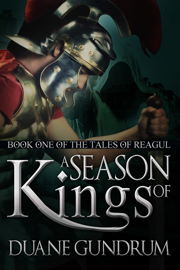
The first novel will be released later next month, and it’s called A Season of Kings. Later this month, the first teaser will be published, which is called The Beast of Begmire, which tells the story of a mysterious sorceress who comes in battle with the Dark One some time after the events of the first three books.