Category Archives: Book Reviews

One of the dilemmas of trying to be well read

First off, this isn’t a post that’s designed to glorify how much I’ve read. Posts like that have a habit of being a bit condescending, boring and painful to get through. Yes, I’ve read a lot of stuff. But so have so many other people. This post really isn’t about that.

What this post is about is one of the consequences of reading a lot of stuff. As a social creature, I really love to share great literature and nonfiction with other people. The problem is: Most people don’t care.

An example: I just finished reading Men Explain Things to Me by Rebecca Solnit, a brilliant writer and thinker who also wrote A Paradise Built in Hell, which I love for its alternative approach of explaining history and the ramifications that occur during history. Both books are chalked full of history, so because I work with a couple of history people, I thought about recommending those books to them. The response I generally received was a blank stare, almost an admission of “your review to me didn’t convince me that I should waste my time reading what you were talking about.”

And that’s the problem right there. Over the years, as I’ve read more and more brilliant stuff, I’ve often recommended it to other people. What I’ve discovered is that so few people take up the gauntlet and decide to read those books. Instead, they listen to your explanation of that book and then because you’ve explained everything about it to them, they decide not to read it, possibly thinking that they’ve already absorbed the knowledge of that book by the mere moment you spent explaining it to them. And then they go on with their lives, only reading the things they find significant.

This reminded me of two things. First, Rebecca Solnit’s book Men Explain Things to Me, in which she details an encounter she had with a boorish man who found out she was a writer and had written on a particular obscure topic so spent the next hour or so telling her she had to read this book about her subject if she was ever going to understand it like he did. Turns out, she wrote that book he was talking about, and as men behave like men, he took forever to acknowledge that once finding out, and then still managed to talk down to her regardless of realizing that fact.

Second, the concept of knowledge and literature requires a modern scholar to actually read the texts himself or herself and not just the cliff notes version (and especially not just the conversation about it from someone who read it instead). Imagine discussing Plato with someone who has never read it but watched a lecture on Plato once. That works great if neither of you have read it (you can be clueless together) but when you’re the one who has read him, discussing it with someone who has no intention of reading it is a complete waste of time.

That’s how I feel when I talk about literature with people and discover that they’re not going to read it, condemning it because they didn’t read it first. I talked about Solnit with one person and actually saw his face turn negative, like he was disgusted by the fact that he’d never heard of her before, and thus, she was unimportant in his mind. That’s the kind of emotional response I receive a lot when I talk about literature that is important yet obscure.

It’s almost gotten to the point where I may not discuss literature with people any more. I remember bringing up Haruki Murakami to one colleague recently and received that “I haven’t read him, so obviously he’s not significant” response. Keep in mind, Murakami is probably among the most respected authors living in the world today. But because he’s not “known” to some individual, I end up having to explain his significance, which finally ends with a sense of “well, if I should find myself on a deserted island, am already bored and his book is all that’s there, I might read it.” Again, I find myself thinking, screw you and I hope you remain uneducated for life. But fortunately, I’m not that elitist. Well, not after I’ve had my first morning diet Dr Pepper.

Problems inherent in trying to be a professional writer in a self-publishing world

Let’s face it. There are a lot of writers out there. And with Amazon and the Nook making it that much easier for anyone to hang out a shingle and say he or she is a writer, that means we’re going to see more and more of them out there, even if they’re still struggling to string two sentences together. But that’s not the focus of this post. The focus of this post is that because there are so many of us out there, there are also a lot of people out there who are quite willing to rip us off and separate us from our hard earned dollars.

Of course, it’s always been this way, except in the past it was a lot easier to spot the ones trying to take advantage of us. In the old days, a writer mainly had to worry about a couple of different entities, such as:

1. Vanity Publishers. These guys would tell you your book was great and that they wanted to publish it. Then they’d send you a bill for their trouble. They took advantage of the fact that young writers (meaning ones who haven’t been writing in the business for long…age is irrelevant) didn’t know that legitimate writers got paid by the publisher, not the other way around.

2. Charging Agents. When a writer was ready to get a “real” agent, he or she would query a whole bunch of them and hope something interested someone. Every now and then a lucky hit was made, except you’d then hear from some mid-level agent who you really didn’t know but figured they had to be legit to be in the Writer’s Digest Agent Book. And then they’d say that they’d either have to charge you to read your book (before becoming your agent) or charge you for their services (after becoming your agent). In the end, they’d never sell anything because they made their money fleecing young writers who didn’t know better.

3. Editors. Someone would invest in an ad in the back of Writer’s Digest, claiming to be an editor. They wouldn’t cheat you by not editing your work, but quite often you’d end up with an editor who knew less about grammar and spelling than you did.

So, fast forward a few years and now we’re in an era where writers are self-publishing their stuff, as the legacy publishers have practically imploded on themselves, trying to hold onto a business model that resembles the big music producers trying to hold onto the music industry. This has provided a whole bunch of new entrepreneurs to latch themselves onto the writing community. Here are some ones to keep in mind:

1. Book formatters. Formatting a book for an ebook venture is pretty easy. You just have to fail at it a few times first. These guys promise to do that work for you, and some of them are cheap enough to be worth it. But others charge hundreds of dollars and make it seem like your book will fail if you don’t use their services. Like I said, if you have done it a few times, you’re generally okay. For the lower charging ones, they might be completely worth it as it would save a writer a lot of time not having to worry about the packaging part of the paradigm.

2. Agents Who Pursue You. When you start to make it as a self-published writer, you start to experience these agents who claim they can do wonders for your sales. Yet, they know as much about sales as you do, or even less. Basically, they’re banking on you remembering that agents used to be important and hope you’ll buy into the fantasy that having an agent makes you somehow better off. An agent sells your work to a publisher. If you’ve already published it, chances are pretty good that they don’t have much to offer you. A marketing specialist might be worthwhile, but if that’s what you’re seeking and he calls himself an agent, chances are you’re wasting your time…and money.

3. Bad Cover Artists. I’m being very careful about how I address this one because there are some brilliant cover artists out there, and I have used a few of them because they’re just awesome. The ones to watch out for (and not use) are the ones who have just unwrapped their copy of Photoshop Professional (or Elements) and now thinks he or she can create great covers. A great cover artist works from concept, not from stock photos, which is how a lot of them operate. I use one cover creator who actually asks me a bunch of questions about the novel AND THEN starts to design concepts. She’s great at what she does. That’s what you seek, but they’re rare and hard to find.

4. People Who Claim to Know More Than They Know. This has been one of my pet peeves. There are some authors out there who attempt to gain sales by pretending to know information that they really don’t. A good example is the extremely best selling author Rob Eagar who wrote a book everyone kept recommending to me as “the book that will help you sell more books”. The book is titled, Sell Your Book Like Wildfire, and it is a great book if you write nonfiction. However, because of the realization that the larger market out there is the group of naïve people like me who are writers of fiction, he spends a great deal of time trying to give the impression that this book is JUST AS good for fiction writers. His premise is simple. You have to sell books that are worthwhile to people. In other words, that have value to them, so you have to find what makes your book valuable to them and sell that idea as your premise for your book. Unfortunately, that doesn’t work with fiction. As a matter of fact, the more I read of his book, the more I realized he hasn’t a clue about anything that deals with fiction. He’s a marketer who knows nonfiction, and that’s it. Unfortunately, he’s convinced a lot of writers of fiction out there that his book is worthy, and in MANY conversations I’ve had with other fiction writers, we’ve all pretty much come to the same conclusion. Fiction books are about stories and storytelling, not about finding something useful for a reader. Sure, you can spin that in some way that might pretend to work, but in reality, you aren’t going to interest readers of fiction unless you have a really good story to tell, and you have an engaging way to do it. You’d get a lot more value from someone teaching you how to create a flashy cover for your book than you would from this book. Again, I was fooled by the desire to find an easy way to success.

That’s a general idea of some of the things to watch for in today’s writing environment. Drop me a line (or add a comment) if you come up with any yourself.

Free promotion for newly released book

For the following week, Monday through Friday, Amazon is offering my books Darkened Passages (a new dark fantasy short story collection released over the weekend) and the book that was previously published before it, Deadly Deceptions (a mystery/suspense novel published last year) for free if you have Amazon Prime. So, hopefully people take advantage of it.

If you do, please do me the courtesy of leaving a review. It’s amazing how many of my novels are bought but then no one leaves a review. Hopefully, no one thinks they suck. 🙁

The World Until Yesterday by Jared Diamond; a book no MA grad student could have gotten by a thesis committee

The World Until Yesterday: What Can We Learn from Traditional Societies?The World Until Yesterday: What Can We Learn from Traditional Societies? by Jared Diamond

My rating: 3 of 5 stars

Diamond does a great job analyzing primitive societies from the perspective of an up-close observer, but one of the problems he suffers from is a massive case of anecdotal evidence that may or may not apply to larger populations. His examples are great, and some of his conclusions are interesting, but he has a really bad problem of writing as if he’s the expert on all things because of his experience with limited populations.

Where I saw this mostly lacking was whenever he was discussing an issue and then drawing a conclusion. The academic in me kept saying to myself while reading: “And your source for this conclusion?” But there was rarely sources brought up as any type of back-up to the arguments he was making. It made me suspect that he’s become so famous for his earlier work that I started to think he felt he didn’t have to back up his evidence with…well, evidence, because it wasn’t evidence; it was mainly a guess based on his years of experience out in the field.

The problem with this kind of conclusion he kept offering is that he’s relying on his own knowledge and guesses and then figures that it should be good enough because of his massive volume of work that preceeded him. Unfortunately, that’s not how science works, and he should know that as he is one of the people who has been in the trenches when this type of requirement was founded.

The problem with all of this is that he does have a lot of very interesting information, and when your information gathering process is criticized by others (and believe me, I’m not going to be the first or last one to make this criticism), it has a tendency to negate ALL of your evidence, which is probably the one tragedy in his shoddy attempt to provide good information.

View all my reviews

Mainstream Smut & the Future of Cooperation Between Legacy Publishers and E-Books

There’s a book story that’s been making the rounds lately. It’s a book called Fifty Shades of Grey by E.L. James (a pseudonym). It started out as an ebook and then went through a huge bidding war before it was bought by a major publishing house. It’s been compared to the Harry Potter series and the Hunger Games series, which is why the big bidding war took place. But the history of this book is a little, well, um, interesting.

You see, the book isn’t a young adult book. It’s an adult book. A very adult book. It’s basically a book about bondage and discipline, where a young woman gets drawn into a world where some dominant guy becomes her master. Most of the time, a book like this ends up being marginalized and sold as ebook smut. Such a book is very, very difficult to sell mainstream.

Yet, it happened. It became that “book” that adults bought (most often the demographic of housewives, which is another story itself) but didn’t really reveal they were reading. Now, the big publishing companies AND movie companies, see this as the next big thing and are looking to market it because of its success as an ebook.

Well, that’s going to be interesting, to say the least. You see, the book did really well because it was an ebook. Think about that for a second. When you buy an ebook, you can read it in public, and almost no one has a clue what you’re reading. But bring a book onto the train (an actual book) and everyone knows what you’re reading. That’s going to make it really difficult to get people to want to read this book in public. That’s going to kill a lot of chances of selling it to the mainstream public because it’s going to be the equivalent of reading erotica in public. Good luck on that one.

Yet, the publishing industry it’s got the next Twilight on its hands.

What this is actually showing me is that the Legacy Publishers (the ones who still print books and then ebooks as an afterthought) are starting to realize that ebooks are a viable market that might slowly overcome the old style market. Yet, I don’t think they understand the nuances involved in ebooks versus mainstream books.

I’ll let you in on a little secret: I also have an adult book out there somewhere being sold as an ebook. It’s written under a completely different name, mainly because I chose a long time ago to distance my writing name from that other stuff. It’s not that I’m not proud of the other novel, or even ashamed of it. I just realized that for simple, rational (and sometimes irrational) reasons, people are often more comfortable separating the two names for the types of books that are published under those names. Throughout history, mainstream writers have done this as a precaution to keep the two camps of readers apart.

An example: Some years back, there was a series of books written by John Norman (the pseudonym of John Frederick Lange, Jr.) about a mythical land called Gor. It was one of those series that had a huge following, basically taking a complete life of its own. The premise of it centered around a civilization of highly structured slavery. This series has spawned into a lifestyle culture of people who partake in the culture of living a Gorean lifestyle, which generally revolves around a strong master/slave society. Sometimes the genders are mixed (as in sometimes its female controlled, but most often it tends to gravitate towards a male dominant household). Anyway, because the ideas of his novels were so against the mainstream thought, Norman remained the header on all of these stories and Lange made every effort to keep his secret identity. During the 1970s, as the series was at its zenith, a woman I knew named Laura figured out who the author was, including where he was teaching and confronted him directly about it. For years, he protested his involvement but then eventually he gave in, realizing that secret was quickly catching up with him. Today, pretty much everyone who has ever read these books knows exactly who was the author. Fortunately for him, he was already so famous as a writer that it didn’t actually affect his teaching career.

The same kind of thing happened when vampire-story writer Anne Rice was revealed to be writing under a number of names that published books on male and female lifestyle slavery. Because she was already so famous as a novelist, these revelations didn’t hurt her career, and then soon after her identity was discovered, she started writing religious fiction, and her career has really never returned to the power career it once was.

What is interesting to note about all of these cases is that the stories themselves never really became mainstream. Even Rice’s book, Exit to Eden, which became a major motion picture some years ago starring Dan Ackroyd and Rosie Odonnell, never really became the hot seller as a mainstream novel. And the reason is simple: It was perceived by mainstream America as smut. Which is sad because it’s a brilliantly written novel (and a horrible movie adaptation that has absolutely nothing to do with the plot of the book).

So, as this “new” series moves into mainstream writing, I’m wondering how it is going to do in that realm. All attempts to bring S&M into mainstream have never succeeded. Madonna tried to do it for years, and every time she did, she continued to remain famous, but those attempts (including a picture book, several songs and videos and even a major motion picture) continue to remain obscure in her collection of mainstream releases. Recently, even Rihanna tried to present such material to a mass audience, and she was criticized for responding badly to her scandal of how she had been beaten by her boyfriend (which makes absolutely no sense whatsoever, as her adventures in that realm only served to be used as continued criticism…making some kind of weird connection to PTSD from being beaten by Chris Brown as her motivation behind why she’d do a move into S&M music video…yeah, the argument didn’t make a lot of sense to me either at the time).

The upshot of the whole thing is that no matter how hard people try, fringe sexual activity is rarely ever going to be seen as acceptable by sex-obsessed Americans who pretend to be shocked when they secretly covet all sorts of different sexual material. It’s like a politician who screams “sinner” at random strangers while having an affair with another woman to hide his predilection for having sex with children. America has never really made a lot of sense.

But expect to see a lot of shocked faces when people start to realize what they actually bought into now that everyone has jumped on the popularity of a bdsm book that publishers are convinced is ready for the mass public. I think they’re ready, but I’m pretty sure I’m wrong.

Review: Invisible Tears by Abigail Lawrence

Invisible Tears: The Abuse, The Rebellion, The Survival, Despite All Odds

This is one of those books that is extremely hard to read, especially if you’ve ever lived through any type of abuse yourself. When I first started reading it, I went into it completely oblivious to what the story was about, and then I had to back out and re-read the write up to realize what I was reading was, in fact, a true story. That, immediately, changed my perspective on reading this book. You see, if this had been fiction, I probably would have stopped reading after about the first tenth. It’s just that hard to read through the impacting scenes that take place in this young girl’s young life. But once I realized this was supposed to be a true story, I forced myself to keep going because if this really happened to someone, she at least deserved having someone try to understand it.

And I’m glad I did because the rest of the book actually makes the journey worth it. To be honest, the first 1/3 of the book is really hard to read through. But once you hit the 35 percent mark (the Kindle is really cool for telling you exactly that), the story changes, and you start to experience a different kind of a tale, one that’s no longer about abuse, but one that tells the struggle of a young girl becoming a woman who is attempting to find herself as a result of the previous abuse. What you discover is that she spends the rest of her life trying to find some sense of acceptance, whether it be acceptance from others, or just a solitary acceptance of other people and some semblance of belonging in a world that appears mean and cruel, and sometimes oblivious to the struggles of others.

I will admit there were a couple of points where I almost didn’t finish it, but then perservered, a lot like Abbie pushes forward through the travails that life continues to throw at her, and in the end it really was all worth it. Someone who reads up to that first part of the book and then stops would probably be impacted as well, almost needing to read the rest of this book to get the closure that seems desired and needed through this book.

Story: 4 stars
The narrative throughout was well worth reading, and the story crafted was one that leaves an impression. It’s very hard to do that with a non-fiction narrative, and there were times where I found myself comparing events with Dave Pelzer’s “A Child Called It” to the point of outrageousness. The beginning of this book is really hard to read, as it goes from child abuse to child rape to continuous child exploitation, almost to where it felt like the events were trying to outshock previous events. But then you’re left realizing this is a true story, so you can only feel compassion, and when the story is complete, feel anger that there are those out there who will go unpunished for the unspeakable acts they have carried out against innocent victims who have no way of ever striking back. The epilogue alone is poignant and casts its own shadows of despair on the depravity of humanity.

Voice: 3 1/2 stars
Although non-fiction, the author struggles to maintain a singular voice throughout the tale, as she sometimes juxtaposes the tale from fluidity to a sense that some prose the tale contains is still difficult to convey, making it disjointed at times. But overall, it carries forward very well and you get the sense of a very young girl’s memories being relived through the prism of someone decades after the events.

Mechanics: 3 stars
The book could have used an additional edit. There are numerous spelling errors, “theres” instead of “their’s”, and other mechanical errors throughout. But overall, it holds up well. There were also a number of port problems from the original manuscript to the Kindle version where the justifcation of the text was off, but as someone who has worked with porting to a Kindle myself, I completely understand that problem as there are times where it happens, and no matter what you do, it just can’t be fixed.

Cover: 4 stars
There are any number of different kinds of covers that could have been used to convey this story; the one chosen seems to do a pretty solid job. Having seen some really outrageous covers for some books on Kindle, it’s nice to see a simple, telling piece of artwork that doesn’t go out of its way to overdue an appeal to attention.

Summary: I would recommend others to read this book, keeping in mind that the first 1/3 is VERY difficult to get through.

Overall: 4 stars

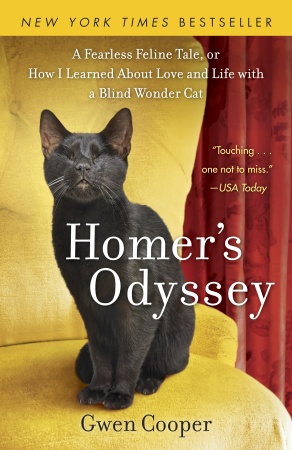
Review: Homer’s Odyssey by Gwen Cooper

This is one of those stories that grabs onto you from the beginning and pretty much never lets go. I was apprehensive about reading this book, because I’m not really that much of a cat fan (more of a dog pet person myself), but the blurb on the cover kind of hit me, and I was intrigued about finding out more about a blind kitten.

One thing that got me right from the start was the same thing Gwen talks about in her book throughout, and that’s the wrong impression someone gets from expectations of Homer right from the start. People expect this little kitten to be helpless, and you immediately find out that he’s nothing but that. He’s resourceful, full of life and pretty much the life of any party because no one ever taught him that he’s supposed to feel sorry for himself, or even that he’s blind. He is blind from the very early days of his life, so he’s never even known what it’s like to see. But he turns out to be the bravest, most resilient little tyke one might ever experience.

The story deals with Homer, Vashti and Scarlett (who are two of Gwen’s other cats), and it specifically deals with the life of Gwen herself. Where the story starts to bog down a bit is when it gets into Gwen’s own story, and mainly during the first half of the book, it really does sort of slow down as we start to experience more of her memoir than the story of Homer and his fellow cat family. Then it moves onto the author’s love life with Laurence, before it moves onto its conclusion.

However, it’s still a strong recommendation from me because the strongest moments of this memoir come from reading about Homer himself and how nothing you do ever stops him from completely enjoying life as it was meant to be lived. A couple of (SPOILERS HERE) critical moments also make up the narrative to where the story becomes where it deserves its bestseller status, specifically every time Homer experiences a new home and has to acclimate, the time Homer comes to the rescue of Gwen (when a stranger breaks into her house), the horrific period that Gwen goes through during 9/11 when the towers come crashing down (and she lives 5 blocks from Ground Zero), and a gut wrenching moment where Homer hits older age and runs into a near death experience towards the end of the book.

Four (4) out of Five (5) stars: 4/5.