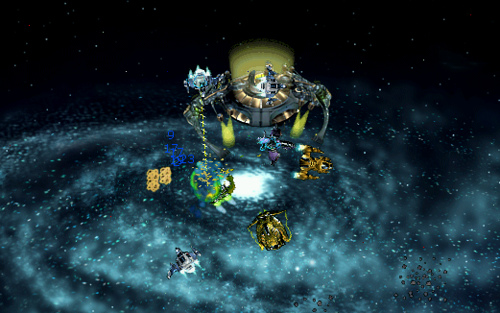
Over the last weekend, I was taking a break from writing, and I found myself looking for a computer game to play. I was already tired of the current crop of games out there, so I was looking for something new, different, or just not the same old game. So I went onto Steam’s site, looking for a game to download, and that’s when I came across an old gem of a game I played the crap out of in the day. It was a game called Space Rangers 2.
Space Rangers 2 is a weird, quirky game, which is about the best way to describe it. It takes place in the year 3300, or something like that, and the galaxy is pretty much ours to explore. You play a space ranger who has been recruited to the, oh I don’t know, the space rangers? and it is your job to pretty much do whatever it is you want to do, and you get paid to do it. You run around space either doing good, doing evil, doing errands, or just doing stupid things. It’s really your choice. In the end, you fight a race of computers called The Dominators, and as you get more powerful and stronger, you wage better war against them. It’s that sort of game.
The interesting thing about the game, aside from the usual playability, is that it was created by the Russians. So it’s an import, and it’s not the best import ever either, which adds a bit of flavor to the game. There’s some voice acting to it (very little) and it sounds like someone trying to not sound like Arnold Schwarzeneger. The writing is actually pretty good, but the translation is sometimes absurd. There are word text games in the mix, so whenever you end up with one of those, it’s a crapshoot as to whether or not you can complete the mission because sometimes the answers you have to give just don’t make any logical sense. There’s one mathematical puzzle that sounds something like: “Hey, you space ranger guy, you needs to tells me the answer to the question some that I tell you so that kind of you know sound like a fifteen that takes the eighteen for the hopscotch ritual. So which has you? A. 254, B. 738, C. The Continent of Praxmire, D. Yodeling. Answer correctly or we kills you!” You probably get the idea that sometimes “quirky” is a kind word.
But the game is fun. I played it all weekend long until I just exhausted myself and had to go to bed at night. And then I’d start playing it again in the morning.
So, there’s something to be said for some of those old games. I just wish I could find more of them that are just as fun to play as that one has been.
Years ago, political theorist Samuel Huntington postulated that the United States was the starting moment in popular freedom that he called the three waves of democratization. Essentially, his theory pointed out that governments moved from authoritative types to popular movements that eventually led to democratic institutions. The first wave was the initial American Revolution, which led to a number of others to follow, including the French Revolution. Then the second wave occurred shortly at the end of World War II, where all sorts of former colonies were given their freedom (or they just took it). Finally, the third wave was at the end of the communist period of expansion, culminating in the fall of the Berln Wall.
Huntington’s theory only predicted three waves, but it appears that we are finally hitting what could easily be considered the fourth wave of democratization, something that I’m sure Huntington would have concurred with, but had not predicted in his original supposition. With Yemen leading into Egypt, there stands to be a possibility that we’re about to see a resurgence of democracy efforts in the Middle East, something that, like most revolutionary movements, is rarely predicted correctly or even expected until it happens.
While it’s academic and fun to point these things out, there are some other lessons that follow from Huntington’s theory that we really should be focusing on because if we fail to recognize them, we run the risk of some pretty crappy circumstances happening, only because we failed to learn from history, a problem we’re quite capable of falling into on a regular basis.
First, it is important to recognize that with every wave comes a backlash, a resurgence in anti-democratization. This often happens because the “new” democracy realizes that not all is as green on the other side of the yard as one previously believed. In other words, just because you end up in a democracy doesn’t mean you end up with positive results in your economy and government. After the first wave, the French fell back into authoritarianism with Napoleon, and for many years, they fell back and forth between democracy and dictatorship. When the second wave occurred, there was a move from dictatorships to democracy and then a number of fights to keep governments from falling back into dictatorships and communism, such as with Greece and Italy. In the third wave, the back and forth happens on an almost daily basis, mainly because we’ve just recently left that time, and the events still sting upon us today.
This should be important to point out because if these new “democracies”, such as Egypt and Yemen (should they become democracies) have every strong possibility of falling into authoritian nightmares as well. People are fickle, and it doesn’t take much for them to decide they aren’t happy with the speed of their results.
So, what lessons should we take from this fact so that we understand the future? Well, first of all, we need to recognize that democracy is not always going to lead to wonderful circumstances. This means that if we embrace whatever countries emerge from the ashes, we need to be honest with them and let them know that things aren’t always so rosy in this atmosphere, and support them regardless of whatever means they decide are most important to them at that time.
Which brings us back to us. One of the biggest problems the United States has in the world is that we’re constantly struggling to support democracy and to support what’s best for the United States. For years, we supported dictators who fought against democracy mainly because those dictators were capable of providing economic and political benefits to the United States. We don’t have that luxury whenever we support the idea of democracy in the world. If we want to support emerging democracies, sometimes we have to understand that they’re not always going to be beneficial to the United States. While democracies don’t tend to go to war against each other, they also don’t have to emerge as the best of friends. We sometimes don’t understand that.
The very near future is going to be interesting because the United States has all sorts of different ways it can respond, and historically we’re not very good at responding in the best of ways. If we’re all for democracy for the world, we need to understand that some of those democracies might not be our friends. So we have to measure whether we our supporting the institution of democracy or our own best interests. Sometimes, the two are hand in hand; other times, they’re mutually exclusive.
Either way, there is a fourth wave that appears to be starting right now, and we have every opportunity to be a part of it or to stand on the side lines and watch it happen. But it’s going to happen regardless of whether or not we want it to happen. Standing in its way is like standing in front of a tank with a flower in your hand. It worked one time in China, but many times before it resulted in a dead villager and a smashed flower. What’s important is to know when to stand your ground and when to let the river flow down its natural channel.
Hopefully, we make the right choice this time around.