Monthly Archives: October 2011

Why the Wall Street Movement Needs Your Attention

There’s been a lot of conjecture from the mainstream media about how the Occupy Wall Street Movement is the liberal flip side to the Tea Party Movement. Unfortunately, they couldn’t be more wrong. It’s not like the mainstream media isn’t known for completely missing the boat even after it runs over them, but perhaps we need to explore what’s really going on to understand, perhaps, what’s really going on.

Let’s go back in time a bit with Duane’s special little time machine to, say, the middle of 2007. At this time, H. Clinton was the front runner for the Democratic Party, and Barack Obama was mainly known as a superstar senator from Chicago. A few people were talking about him as a possible political challenge to Clinton, but at the time there was little more going on with him other than the introduction of his book, The Audacity of Hope (released in 2006). During this time, I was focusing on Clinton, although not a real fan of her but figuring she had to be better than the crappy presidential administrations we were getting from the Republicans. I was probably wrong, but that’s another story.

Anyway, during this time, one of my fellow grad student colleagues started reading the book, and let’s just say he was overly enamored with Obama at this time, trying to get EVERYONE he knew to read the book because he had somehow found the new messiah. It was like you couldn’t hold a conversation with him without it turning to how great of a messiah Barack Obama was. And then, out of nowhere, it was like living in the world of the Invasion of the Body Snatchers, where rational people had been replaced by strange, pod people who didn’t become robotic but became Kool Aid drinkers of this new messiah of politics.

For months, it was nothing but a series of encounters with people that felt a lot like I experienced when I stopped drinking alcohol and started to notice that all of the drunks in bars were extremely stupid, but they couldn’t see it themselves because they were all drunk. That’s the kind of sensation I was getting on a daily basis as I dealt with people who I had normally discussed politics with. It was like all rationalization had been thrown out through the window.

What I started to suspect was something that took several years to occur, but I began to believe that we were being sold a messiah of politics, which meant one of two things was bound to happen: He was either going to fulfill that mission and everyone would feel wonderful (kind of as if we had a brand new John F. Kennedy or Ronald Reagan), or a lot of previously apathetic people who bought into the whole dream were going to emerge very, very pissed off at everything involving politics.

Well, the former didn’t happen. Sure, he got the Nobel Peace Prize for showing up for work on time and not actually doing anything that caused peace, but that’s about it. People had hopes and dreams with the guy, but the faith they had in him has diminished, and like waking up after a bender with a hangover, a lot of people have started to realize that four more years of the same would not really result in better circumstances, kind of like the Einsteinian definition of insanity (“continuing to do the same thing over and over and expecting different results”). So, we’re left with a lot of freshly enfranchised citizens who bought into the hope and change mantra hook and sinker, but didn’t get any positive results. So, where do we go from here?

If you listen to the mainstream media, they haven’t learned anything from what has happened, kind of expecting to go on autopilot like they have for the last four decades. Well, chances are pretty good that they are missing the boat yet again.

If you look at the Tea Party movement, you have a bunch of people who come from the right side of the fence, so it’s pretty obvious why they’d protest against a left sided president. Face it. No matter what he did, or does, they would never be satisfied. However, it’s pretty weak analysis if the belief is that the Occupy Wall Street movement is just the polar opposite of the Tea Party. If you think about it, you have a lot of people who didn’t care about politics before who are suddenly much more aware of current events and pissed that they didn’t get the messiah or religious experience they desired. So, of course, they’re going to be pissed.

But if the belief is that they’re pissed at Wall Street, one isn’t really paying attention to what’s going on. Wall Street serves as a great masthead for the corruption and problems going on, but if people are pissed off about the fact that “hope” didn’t result in positive “change”, the protests aren’t going to stop at Wall Street. Recently, President Obama has been trying to act like he “understands” the movement and “understands” the frustration. But if someone is part of the problem, then the chances are pretty slim that he actually understands enough to make a difference. It’s great if you’re trying to gain political capital, but if you’re trying to appease an angry population, that kind of patronizing is only going to piss them off more.

You see, the people are pissed at Wall Street, BOTH political parties, all politicians, corporations, lock-step police forces that defend everything they’re angry about (quite often with hostile approaches to everything without any desire to understand why the people around them are angry…police have never been very good at that sort of thing, and while it’s not exactly their fault, it’s not exactly their best attribute either), and a docile population that tends to side with the forces that are their own worst enemies. It was recently reported that the US has the worst CEO to worker pay disparity of any democracy (the numbers reported this year were 475 to 1, meaning for every $1 a worker makes, a CEO makes 475 dollars; that’s just absurd when you see countries like Great Britain at 35 to 1). But if no one seems to care, then obviously people are going to be pissed.

But what’s more important is where do we go from here? Do the protests start to turn to riots? Are leaders going to emerge that steer those riots/protests in any one direction? Or will they fizzle and people will go back to being sheep, like they’ve always been? One thing that probably won’t happen is that the people are never going to rally behind a passionate promise maker like Obama (or a group that makes promises in his name), which means that we’ll end up with even more apathy, which historically leads to either revolution or civil war. The only positive of those outcomes is that the population may become so apathetic that a revolution or civil war might occur and no one will show up.

That’s hope and change, I guess.

How Do You Steer a Rudderless Movement?

When the Tea Party first emerged, one of the notable features of the gatherings was the simple fact that there appeared to be no leadership whatsoever. However, as time passed, a few people became the spokespeople for the movement, and now whenever the “organization” is discussed, people can point at a few politicians and say “that’s their leader”. However, at one point, there were no leaders, and when the news media was trying to get comments from the protesters, it was very interesting to see how they tried to manage the fact that there was no one to actually interview.

Fast-forward to today, and we have yet another movement taking place that has virtually no leadership whatsoever. Unlike the Tea Party movement, this “organization” tends to hail from the liberal side of the political spectrum, but like the Tea Party, it shares the one attribute of having more in common with anarchy than actual political representation. The movement I’m talking about, of course, is the Take Back Wall Street movement that is currently occupying a lot of the current news.

It is yet another fascinating moment in people politics because it has absolutely no organization and has more in common with flash mobs than it does in any previous type of organizing behavior. Most events tend to be sporadic, immediate and out of nowhere, but unlike a flash mob, these movements tend to be stationary once they actually occur, meaning they don’t appear and then go away a few minutes, or hours, later.

But there are no leaders. And because of that, it is very difficult to determine exactly what they want, or what it would take to make them satisfied. The consensus, if there is one, is that people are outraged, upset and not going to take it any more, but when it comes to defining what they’re outraged about, why they’re upset, or what exactly they’re not going to take any more, that’s a little less apparent. Taking it one step further, what they actually want to fulfill their movement’s charter, if there was one, is even less tangible.

Analyzing it, they appear to be upset that Wall Street, or the people who work on Wall Street, have their own interests in mind at the expense of the rest of the country, or world. The claim is often made that the 1% (those who profit off of Wall Street antics) are profiting at the expense of the rest of the 99% of the country (and world). So, the desire is to somehow convince the 1% that the 99% are not going to take it any longer, and if things don’t change, that 99% is going to do something. What exactly, I’m not sure. No one else appears to know either. But they’re pissed, and they’re going to do “something” if “something” isn’t done to change things.

With a charter like that, it appears very difficult to figure out what they’re going to want or need to appease their members. Even worse, there’s no way to figure out who their members are, or even if they would be satisfied if “something” was done to appease them in the first place. I’m reminded of Mancur Olson’s The Logic of Collective Action, in which he pointed out that people have a tendency to free ride their way through collective action, expecting to achieve results but aren’t willing to do much to achieve those results. There appears to be a lot of free rider activity going on here, as was noticed during a recent Chicago flash mob of the Take Back Wall Street variation, reported by the Wall Street Journal, in which an independent trader named Roger Brownworth points out that he was disappointed at the turnout (he had seen only about 20 protesters), but at the same time didn’t seem all that interested in joining it himself.

But Olson isn’t the only source that should be of interest here. I’m also reminded of Poor People’s Movements by Frances Fox Piven and Richard Cloward (a great book, I HIGHLY recommend), who remind us that when people get together and form major movements to benefit their own interests, they’re often appeased by very minor reforms or benefits and then don’t show up for future gatherings, convinced that because there was such great outpouring the first time, they won’t be expected to show up for the next one, kind of backing up Olson’s projection. The Chicago gathering is a direct example of Piven and Cloward’s argument.

But that’s the movement itself, which in Piven and Cloward’s book usually points at an organization that has some type of leadership. With the Take Back Wall Street movement, we have no apparent leader where everything seems to be organized a lot like a flock of birds all turning together at the same time as a part of a social being rather than a collaboration of like-minded individuals. During the Gulf War protests during the Bush Administration, many gatherings of protesters were similar to this flash mob mentality, but quite often they were derailed by one or two individuals doing something uniquely ridiculous, like Woody Harrelson trying to climb up the gratings of the Bay Bridge during a San Francisco protest. Other major demonstrations were often turned by one or two individuals who acted as spontaneous agitators, yelling out something like “let’s take City Hall” which would cause throngs of people to start running off in one direction, causing a riot where a peaceful gathering was taking place only moments before.

That’s probably the biggest fear we have right now as when you have a mob (the obvious physical make-up of a flash “mob”), there’s a very real possibility that an agitator or two, either spontaneously or surreptitiously placed, may cause a group of people to react in a way that they were not intending to do when they first gathered to protest over concerns they may have had about injustices and unfairness. How many major sport events have turned violent because one or two individuals started doing or saying something stupid that somehow riled up a group of people who were already excited by the happenings of the particular event they were attending? Quite a few actually. Malcolm Gladwell points out in his book Blink that one of the biggest problems with excitable events, like a police car chase, is the excitement of the chase itself, which often can lead to adrenalin requiring some kind of release, which would explain why so many car chases end up with a physical altercation that might not have happened if people hadn’t been overly excited by the chase in the first place. The same thing occurs at these major social gatherings, like sports events, or for the sake of this essay, a flash mob. People are excited, they are yelling, and quite often it only takes a nudge in one direction for a group of people to start doing things they might not normally have done if they weren’t already overly excited.

Which means, there’s a good chance that one of these Take Back Wall Street events is going to turn violent if they continue to remain without leadership. However, if someone, or some people, arrives to take charge of this venue, there’s no promise that the presence of leadership is guaranteed to be in any way more positive. History is replete with examples of mob leaders who did some pretty horrific things once empowered with that ability to lead a group of people. And then there’s the equal fear that the emergence of leadership might doom the movement in the first place. Since the creation of “leaders” for the Tea Party movement, the spontaneous nature of that process has diminished greatly because a lot of the people who originally affiliated themselves with an unaffiliated organization never really fell in line with self-proclaimed wannabe leaders like Palin, Bachman, and the 70 or so Republican legislators who have claimed ties to the Tea Party foundations. Many of its members have actually gone underground, realizing that what they had to complain about was never solved by having people claim their throne in their name while never actually espousing their true beliefs.

The same problems may be seen for a Take Back Wall Street movement. The current crop of wannabe leaders already showing up are the likes of Michael Moore and other already entrenched in Washington political Democrats who see the movement as a way to shore up more support for their positions they already hold. There is also the tendency of the media to try to control the movement so it can be easier to report. CNN is already reporting How Occupy Wall Street Has Evolved, when CNN is still as clueless as the movement itself as to how it is changing, what it actually stands for, and what it actually intends to do.

What’s probably most significant is that a movement is underway, but no one knows where it is heading. It can become distruptive, like the Bolsheviks in Russia at the turn of the 20th century, it can be innovative like the Prague Spring in Czechoslovakia in 1968, it can transform like the recent Arab Spring, or it may write its own chapter of unforseen future circumstances. Either way, it probably shouldn’t be ignored.

50’s and 60’s Feminism and Revisionism On Television

There seems to be an interesting dynamic showing up on television these days. The claim is that it all started with Mad Men, and then led to shows like The Playboy Club and Pan Am. However, I think reviewers are being a bit lazy in their approach, in that this revolution in programming started earlier than that, and we’re only see the second wave of what is most definitely going to be a norm in storytelling.

Some years ago, the British Broadcasting Company (BBC) developed a brilliant show that dealt with storytelling by looking at the “earlier” days through the lens of someone from today. The show was called Life on Mars. It dealt with a police detective of today’s time who is thrown back to 1973, a time where Manchester was just beginning to experience its sexual revolution, where women were still police assistants, and cops beat up suspects to get confessions. Shortly after this, an American series, of the same name, arrived and tried to tell the exact same story but in New York of 1973. Almost identical, the American series dealt with the trammels of unrealized feminism and a new era that was about to emerge in America (or the world).

Then came a few other shows, which were rehashes of previous shows from the mid-period of television history, that somehow tried to incorporate this new sense of feminism with modern day thinking, which for some reason has never really worked. I’m talking shows like Charlie’s Angels (movies and then a very recently bad television show), Dukes of Hazard (a movie), Starsky & Hutch (a movie), the various remakes of Star Trek and then the brilliant redesign of Battlestar Galactica (which had its own sense of dealing with feminism in the 1970s).

But Mad Men is obviously the biggest elephant in the room when it comes to discussing reviving history (or rewriting it). The show is sometimes brilliant, and other times it is somewhat annoying. It deals with feminism by showing how badly feminism was actually dealt with, and strangely enough it gives the biggest womanizer Don Draper the venue to somehow be the launching pad for the first woman to be a Manhattan advertising professional. Meanwhile, it sticks us directly in the 1960s and shows us that America had a long way to before it was going to get much better (if it ever did).

Because of the success of Mad Men, it was only a matter of time before the major networks attempted to duplicate it themselves. The first entry into the new era was The Playboy Club, which has essentially been receiving nothing but bad reviews, mainly because it tries way too hard to be both sensational and a platform to reinvent history by making it somehow appear that Playboy was a part of the feminist movement, rather than a direct impediment to it. Playboy ushered in the sexual revolution that would come in the 1970s, but it did very little for women, other than produce a platform for women to be seen as sex objects and a vehicle to produce masturbatory fantasies for young boys for several generations. While history wasn’t being all that helpful for the women’s movement, Playboy didn’t exactly empower anyone either, although people like Hugh Hefner would love nothing more than to leave his mortal coil believing he convinced more than a few peolpe that he was the progenitor of women’s liberation rather than the abuser of it. Coming from a man who spent his entire adult life cultivating young women to be his sexual playthings, I’m sorry but I just don’t see the positive role he wants to inhabit.

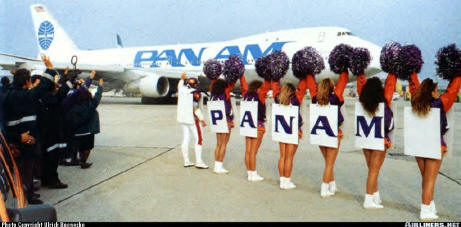
Pan Am is the next development in the attempt to detail women moving forward in the 1960s. My first quibble right off the start is with history itself and the television show’s attempt to place itself in it. The story starts off by talking about an event that occurred during the Bay of Pigs, shortly before the events of the first episode. The whole aircraft on the ground scene seemed a bit odd as the events of that day detail something much different occurring than what the authors tried to make happen, that somehow Pan Am pilots were more involved with the evacuation than may have been. But again, it’s fiction, so that shouldn’t be too much of an issue. There’s also another moment where one of the pilots talks about a scientific principle that wasn’t really a part of common vernacular usage in the 1960s (and wouldn’t actually be used until about 2004), but that’s more a complaint about continuity and nitpicking than anything else.

Where I have the biggest problem is with Pan Am’s attempt to reinvent feminism as some very present dynamic during the very early 1960s, when it basically wasn’t. The main character, the purser, seems to be the feminist “rebel” of the group, yet as much as they try to make her out to be that, she most likely would have been unemployed rather than the main player she is going to be written to be. And then there’s this whole espionage thread they have written into the series that seems kind of bizarre, as if the CIA was actively recruiting flight attendants to be their secret agents on flights. Okay, it could have happened, but it just seems a bit bizarre, knowing how the CIA works, or at least how it worked back then.

What concerns me most about this show is it is yet another attempt by Hollywood to rewrite history as being a lot more proactive towards feminism than it really was. As a matter of fact, Hollywood STILL has a long way to go as it would not surprise me if a number of actresses ended up having to sleep with someone to get the jobs they get on some of these shows, because that’s how Hollywood has ALWAYS acted. It would make me wonder how someone might feel pretending to be some enlightened feminist on a television show when she may have had to have done some very unenlightened things to get on the show in the first place. Yeah, there’s no evidence this ACTUALLY happens, but it is so engrained in the morality of Hollywood business that everyone somewhat expects that to happen, so it’s rarely even questioned.

What I would like to see is a show come along, like Life on Mars (the BBC version), that really examines the issues and doesn’t try to make it seem like we were historically more proactive than we really were. We did some crappy things in the past, and if we ignore those things, it only means we learned nothing from the experience, and we’ll probably do crappy things again in the future.

Reviewing “That Used to Be Us” by Thomas Friedman and Michael Mandelbaum

I picked up this book on whim, not sure if it would end up being partisan drivel, interesting or just a waste of time. Well, halfway through it, I decided on “interesting”. While reading it, I couldn’t help but be reminded of my experience when I was reading the book “Teachers Have It Easy” (don’t remember the three authors), a book that tells the brutal truth of what it’s like to be a teacher. I remember at the time of reading that book how some of their stories rivaled my own, and there were times when I just shook my  head because I knew that other people needed to be reading the book, but they never would (or will). So, I’d end up reading a book that reinforced what I already knew, and I’d constantly be berated by people who knew nothing of teaching, but would act like they knew everything because “my mom was a teacher” or “I know a teacher” or my favorite: “I don’t have to be a teacher to know how easy they have it.”

“That Used to Be Us” also talks about one of the platforms that needs to be embraced in order to make things better, and one of those platforms involves teachers. In order to make America strong again, we need to empower teachers, and that means asking a lot of people to do something that definitely won’t be in their best interest, and that’s the part their book never really addresses. You see, the majority of the critics against teachers outright hate teachers. They don’t know enough about them, but they know that they hate them, and they take every opportunity to cast ridicule upon them. I see it on message boards and newspaper letter sites all of the time. MLive.com is one of those that excels in this. What happens is a bunch of “good ole’ boys” start posting about how teachers have it so easy with their big paychecks, their miniscule hours and the fact that they get these HUGE vacations every year. And then they’ll drone on about unions and how teachers are lazy, overpaid, quite often stupid, and more often than not, the problem. Try to talk to them politely, and they flame you left and right. Try to engage them in argumentation, and they start making personal attacks that have no actual basis in reality, but are designed to hurt and throw mud all over the walls.

Friedman and Mandelbaum rightly believe that the solution needs to start with an empowering of teachers who will then embrace a Colorado style of educational reform, but at the same time don’t seem to offer any way of getting everyone else on the side of teachers to make it happen. What ends up happening almost every time that standards are increased is that they become punitive so that unions become defensive, and then you end up with no one actually trying to improve things for children but people are seen as targets rather than part of the solution. For most people, educational reform is a zero sum game where one side has to lose for the other side to win, rather than their approach which is for all sides to win. Unfortunately, that’s what always makes it completely incapable of achieving success.

Part of the solution would be a simple paradigm shift in respect towards educators, which doesn’t happen too often in this country. I saw it when I went to Korea and was traveling home through China. I was stopped at the Beijing Airport, and I was being questioned about the medication that I was carrying with me (I had stupidly forgot to pack the prescription information with it, and Korean pharmacies have a tendency to just package pharmaceuticals in individual bags with no markings on them). I was in a seven hour layover, so I wasn’t in any hurry, but it didn’t look like I was going to be getting through customs any time soon. However, about fifteen minutes or so into it, one of the customs guards asked me my occupation, and I said I was a teacher, that I taught little kids (which is what I had done in Korea). His eyes opened, and he immediately took off to track down his supervisor, who had been in and out of dealing with me about the whole “drug” issue. The supervisor came back with another customs guard, a young woman. They both stood there for a second and just stared at me. Then the first guard started talking to them with animation, pantomiming the whole “little kids” action I had done when describing my job. Then both the supervisor and the other customs woman smiled, thanked me for my time and packed up all of my Korean bags of pharmaceuticals into my bag and released me to the waiting area untl my plane arrived.

Right then and there, you could see how much respect they had for someone who actually taught children. It didn’t matter that I was an American, and that the children I taught were Korean. I was a teacher, and it mattered to them.

We don’t get that sense of pride in this country. Ever. And that’s why it is so hard to find quality teachers who really care about their job. It obviously isn’t the money that keeps them in the profession, no matter how much political spin people want to put into it. For someone who has a master’s degree, the pay for the work isn’t worth it. The drama, the politics, the hassles and the unrealistic expectations with the lack of care of parents for the proficiency of their children…just doesn’t make it worth it. So it has to be something that keeps teachers in the business, and quite often it’s the few successes they do get from the struggles we go through.

Unfortunately, as long as the people in this country treat teachers as they always treat teachers, don’t expect things to get any better. And as for the book, much like the previous book I mentioned, I don’t expect anyone to read it who needs to read it. It will be read by people who already have an idea of what the book is expected to say, and only by them. I’ve actually be surprised at a lot of the information contained in the book, and I am one of the people who tends to read this kind of book. Unfortunately, the people who need to read it…well, they won’t.