Tag Archives: history

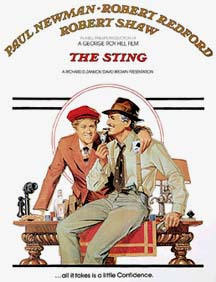
Paul Newman, My Grandfather and the Making of the Movie ‘The Sting’

stingmovieWhen I was growing up, my grandfather on my mother’s side used to drop by our apartment all of the time and watch television with us. My mom was a single mother who worked long hours as an assistant bookkeeper, so these moments at night were always a welcome rest from her very long days. During most of these times, I was still too young to understand the complexities of father and daughter relationships, so I never really understood the conflict that seemed to arise between my mom and my grandfather. But it was while we were watching the network airing of the Paul Newman-Robert Redford movie The Sting that I started to realize what this conflict might have been. In case you don’t know it, a large part of the movie takes place on the Santa Monica Pier, specifically in the carousel building. As we were watching one of the scenes taking place, Paul Newman was on the screen doing whatever an actor like Paul Newman does in a movie like that when my grandfather said: “I had lunch with him.”

My mom just rolled her eyes and said: “Sure, Dad. You had lunch with Paul Newman, the actor?”

He was adamant. And he upped the claim: “I had lunch with him right there,” pointing to the screen, meaning he had lunch with him right there where the movie was filmed.

My mom just rolled her eyes again and said nothing. We watched the rest of the movie, and nothing more was said of it.

Over the years, I spent a lot of time at my grandfather’s house. His place was always a welcome refuge from the world. Because we were dirt poor in a well-to-do city, having a place to go where you weren’t in fear of danger was always a good thing. So I spent a lot of hours at my grandfather’s house.

And one thing I remember most about him was that he loved to tell stories. Mostly about his life and the things he’d seen. And whenever I told my mom about these stories, she just laughed and said Grandpa made things up and had an “interesting” past that was more interesting in his mind than in real life. So I always kept that thought in mind whenever I heard one of his stories.

One time, he told me a story about how he fought with the French resistance by using his cover as an ambulance driver to sneak around Nazi territories. My mom laughed when I told her that story and basically had no comment. Another time, he told me he played backup guitar for a famous rock band that was performing at the Santa Monica Civic Auditorium because its guitarist was sick one night. My grandfather was an accomplished musician, and I could have easily seen how one with an active imagination might have imagined playing guitar for a major rock and roll band. I do that myself sometimes when I’m listening to the radio and suddenly rocking with my air guitar.

However, the story of him having “lunch with Paul Newman” always seemed to be one of those things that never made sense to me. I could see imagining all sorts of things, but having lunch with an actor and remembering it only when seeing him on the screen just seemed bizarre. So I remember asking him more information about that story. And he told me that one day he was playing the mandolin at the park and wandered down to the pier where he noticed they were making a movie. So, he maneuvered his way onto the set and walked over to where Robert Redford and Paul Newman were having lunch in between takes. He walked over to them and asked them if he could join them. They were both surprised by some stranger who walked up to them and kind of gestured to a seat near them. He then asked them if they’d mind if he played his mandolin. I guess they were too surprised to say no, so he spent the next few minutes regaling them with his mandolin playing (which was always quite remarkable). When he finished, he motioned to Paul Newman’s unfinished lunch and asked him if he was going to finish that. According to my grandfather, they were somewhat surprised but didn’t stop him from finishing up the lunch. A studio person came over at this time, about to push my grandfather on his way but one of the two actors actually motioned for him to stop, saying: “Bring us another plate.” I’m not sure how much longer my grandfather claimed to have stuck around, but that’s what he considered “having lunch with that actor.” Even if it wasn’t true, it was always such an interesting story.

Anyway, years later, long after my grandfather passed away, I was doing some research on the French resistance and saw an old picture of a group of known French resistance fighters who had a picture snapped of them as they were standing next to an old ambulance. Looking closer, I realized that the picture of one of the unlabeled people in the picture looked a lot like a younger version of my grandfather. There’s no guarantee it was him, but it sure looked like him and it certainly matched the time period and location of which he had been discussing.

A few years after that, I was in a bookstore on Powell Street in San Francisco looking over a bin of books that were heavily discounted, and one of them was about the heyday of Hollywood movies, and showed a bunch of photos for some major motion pictures during certain periods. My fingering through the book stopped strangely on a section for the movie ‘The Sting.” I hadn’t seen the movie in a long time, so looking at the different pictures brought back a lot of good memories. However, when I turned the page, I found myself staring at a picture of Paul Newman, Robert Redford having a meal on set. Sitting with them was an old man with a mandolin in his hands. It was hard to tell what they were talking about in that photo, but it was definitely my grandfather, and he was credited as “unknown stagehand”.

Which brought me back to those many stories that he told over the years, the many stories that my mom was convinced were all in his head. To this day, I’m still looking through old rock photos to see the one time a strange guitarist filled in for Van Halen or the Rolling Stones. I haven’t found it yet, but those earlier stories definitely keep me looking.

Who knows what I’ll find?
One of the dilemmas of trying to be well read

First off, this isn’t a post that’s designed to glorify how much I’ve read. Posts like that have a habit of being a bit condescending, boring and painful to get through. Yes, I’ve read a lot of stuff. But so have so many other people. This post really isn’t about that.

What this post is about is one of the consequences of reading a lot of stuff. As a social creature, I really love to share great literature and nonfiction with other people. The problem is: Most people don’t care.

An example: I just finished reading Men Explain Things to Me by Rebecca Solnit, a brilliant writer and thinker who also wrote A Paradise Built in Hell, which I love for its alternative approach of explaining history and the ramifications that occur during history. Both books are chalked full of history, so because I work with a couple of history people, I thought about recommending those books to them. The response I generally received was a blank stare, almost an admission of “your review to me didn’t convince me that I should waste my time reading what you were talking about.”

And that’s the problem right there. Over the years, as I’ve read more and more brilliant stuff, I’ve often recommended it to other people. What I’ve discovered is that so few people take up the gauntlet and decide to read those books. Instead, they listen to your explanation of that book and then because you’ve explained everything about it to them, they decide not to read it, possibly thinking that they’ve already absorbed the knowledge of that book by the mere moment you spent explaining it to them. And then they go on with their lives, only reading the things they find significant.

This reminded me of two things. First, Rebecca Solnit’s book Men Explain Things to Me, in which she details an encounter she had with a boorish man who found out she was a writer and had written on a particular obscure topic so spent the next hour or so telling her she had to read this book about her subject if she was ever going to understand it like he did. Turns out, she wrote that book he was talking about, and as men behave like men, he took forever to acknowledge that once finding out, and then still managed to talk down to her regardless of realizing that fact.

Second, the concept of knowledge and literature requires a modern scholar to actually read the texts himself or herself and not just the cliff notes version (and especially not just the conversation about it from someone who read it instead). Imagine discussing Plato with someone who has never read it but watched a lecture on Plato once. That works great if neither of you have read it (you can be clueless together) but when you’re the one who has read him, discussing it with someone who has no intention of reading it is a complete waste of time.

That’s how I feel when I talk about literature with people and discover that they’re not going to read it, condemning it because they didn’t read it first. I talked about Solnit with one person and actually saw his face turn negative, like he was disgusted by the fact that he’d never heard of her before, and thus, she was unimportant in his mind. That’s the kind of emotional response I receive a lot when I talk about literature that is important yet obscure.

It’s almost gotten to the point where I may not discuss literature with people any more. I remember bringing up Haruki Murakami to one colleague recently and received that “I haven’t read him, so obviously he’s not significant” response. Keep in mind, Murakami is probably among the most respected authors living in the world today. But because he’s not “known” to some individual, I end up having to explain his significance, which finally ends with a sense of “well, if I should find myself on a deserted island, am already bored and his book is all that’s there, I might read it.” Again, I find myself thinking, screw you and I hope you remain uneducated for life. But fortunately, I’m not that elitist. Well, not after I’ve had my first morning diet Dr Pepper.

Deconstructing Our History

A couple of years back, we started a very interesting trend, and that was to begin to question our histories of numerous different events in our past. This sort of thing started happening (more frequently) back when I was in grade school, which means about the 1970s, as this was the first time I remember having a discussion on the simple premise that “Columbus discovered America”. Back then, I remember the teacher talking about how there were already Native Americans here, so, in fact, Columbus discovered an area that was already discovered, and thus, really didn’t do anything but reveal it to the rest of European society. Back then, in the 1970s, that was the extent of our reconstruction of history. We focused on the event, and we were told to question the facts. So we did. Now fast forward thirty years later, and we’re no longer just questioning the events, but we’re now focusing our attention on whether or not these events were for the good of mankind in the first place.

The discussion of Columbus today isn’t whether or not he first discovered America, which most people no longer believe, but now we seem to be heavily focused on the horrible atrocities that were conducted in his name, and mostly because of his “discovery” of the new world. Elias Isquith argues that Columbus was so bad that 5 historical monsters in history were less evil than he was. When you’re being compared unfavorably to Oliver Cromwell, dictator Francisco Franco, Suharto, Milosevic, and Saddam Hussein, you’re losing your positive spin on the minds of most people. Not to mention a scathing report that was delivered by Jonn Oliver asking how a Columbus holiday could still be a thing, well, let’s just say that the Columbus camp isn’t doing so well these days.

During a class last week, I was trying to introduce the concept of how Columbus was currently being ridiculed where he once was hailed, a student took offense at Columbus’s name and didn’t seem to even realize that she was making the same point my lecture was doing because she was so incensed at the atrocities the guy committed that she couldn’t understand how the mention of him shouldn’t cause her to stop thinking and just be angry, even though the point of the lecture was to point out exactly what she was trying to argue. Talk about a bad reputation. It would be a lot like saying you can’t about the bad things Hitler might have done because Hitler did bad things. Yeah, I know, bringing up Hitler leads to the end of the Internet, but it’s just to make a point. Right now, people see Columbus as that bad, and that didn’t used to be the case.

What I tend to see happening is a mass effort to deconstruct a lot of our past histories. Some years back (not too many back), there was a sincere attempt to ridicule Thomas Jefferson for owning slaves. This turned into an absurd argument because where it began as “Thomas Jefferson had slaves, so he’s bad”, it eventually devolved into “but he couldn’t be all bad because he did serve as the liberal voice behind the founding of the United States, and that’s gotta stand for something, right?” Then the debate turned into one of those “well, you had to understand the people of that time to realize why they did what they did”, which is always right around the corner from “we’re so much more enlightened today than they were back then” (even if we’re talking about something that happened fifteen minutes ago).

The simple logic should tell most people that everyone is flawed. Sure, while there’s a Sister Teresa for every several thousand people, the majority of people are Donald Trumps or Kardashians, who want to get rich, famous or, for simple vulgarity, just want to have sex with more people than they did the day before. We like to think that we’re evolved, enlightened and so much better than our forefathers, but we’re really not. We see that whenever we end up in a situation where government collapses, a cop kills someone of a different racial identity, the power goes out for more than a couple of hours, or any other number of events that remind us that we’re not that much more evolved than we’d like to think we are. Yet, for some reason, we keep coming away from these situations convinced that we’re somehow better than we were before, yet we keep following the axiom of not changing anything and always being surprised at the fact that history always repeats itself, including the usage of that phrase. The only thing we’re really actually good at is not learning, which is good because it’s one of the things that we do especially well.

The nuance of writing that keeps me going

1 small

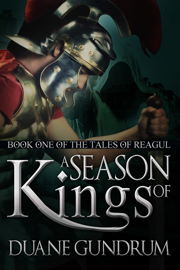
For those interested, I’m putting the final touches on the first book of my series, The Tales of Reagul, of which A Season of Kings is going to be released in the next few days. One of the fun things about this book is that it combines my passion of history with my love of speculative fiction. The land I’m writing about has been colonized by people from the times of the Roman Republic. What makes the book so much fun to write is that when these people start spreading out in this new land, they come across the survivors of previous colonizations from previous civilizations, including the Egyptians and Sumerians. This gives me the opportunity to play with the “discovery” aspect of the people who come to the new land, as they have no idea who these other people are, and when they do discover them, they are even more confused by the fact that they’re dealing with people they know so little about, and those that do know something of their civilizations are even more confused as to why they’re in this land in the first place.

This is the kind of thing that becomes so much fun to the process of writing. As I’ve already developed the historical process of the planet, I know why certain things are happening, but the people who are interacting in that land know so little about it, which makes it that much more fascinating to see it from their perspective and wonder “how would a stranger to this environment handle such a situation?”

Does pronunciation equal intelligence?

I don’t usually go to Wheel of Fortune to get inspiration, but a very unusual circumstance occurred during a recent episode where a contestant had the words “Mythological Hero Achilles” on the board and only had to read it to win. He pronounced Achilles as “A-CHILL-ees” and was pronounced by Sajak to be incorrect. Wheel of Fortune later stated that “When a contestant tries to solve a puzzle, they must pronounce it using the generally accepted pronunciation.”

Now, I won’t go into the incorrect plurality in that sentence, but let’s just take them on their word. And that brings me to my conversation today, because I’ve been through this exact same thing, and let me tell you that quite often people assume you lack intelligence just because you can’t pronounce something correctly. To explain that, I’d like to bring you back to my days as a Ph.d student at Western Michigan University where I was studying political science, and in particular political philosophy.

For those who know me, it’s generally understood that I’m very well read. While other kids were reading the equivalent of Harry Potter back in my grade school days (Harry Potter wasn’t around yet, so to be honest, I don’t even remember what the kids were reading back then), I was reading classical literature, and at some point got into a major Greek and Roman influence that drove me to read all sorts of historical tomes. When I got to graduate school, I had read a lot of the material that was being assigned, so you might think that I was pretty well prepared.

Well, that might have been the case if I had read these books because some school had required me to read them. But I read them on my own, and quite often I had to go through other critical studies to even figure out what I had just read. What I never got out of this was some type of discussion about the literature, which meant that I was picking up as much information as I could without anyone actually helping me along. I remember in high school asking a teacher about some of the material I was reading on my own, and she tried really hard to pretend she knew the material, but it was pretty obvious that she was making it up as she went along and was too proud to admit that she wasn’t a reader of Hume, Rousseau and Tacitus (which I had been reading at the time). And these weren’t even obscure authors from history.

So, when I got to graduate school, I remember being in one of those group discussions where were were talking about someone like Herodotus, and I brought it up in conversation right before the professor corrected me on my pronunciation of the name. And then when I brought up another author, I received that same correction on that name as well. A few days into this course, I started to notice a sense of sarcasm coming from some of the other graduate students who had grown up with these authors in the formal courses they had taken. They all pronounced the names correctly, and there was a sense of dismissing me whenever I brought up anything that I thought was significant.

It took nearly an entire semester for that professor to finally recognize that my bad pronunciations were not indicative of my lack of knowledge concerning these authors. When that moment happened, she and I had many conversations about political philosophy that indicated that she no longer thought of me as some grade school dunce who entered her classroom. But I will say that for years of graduate school, I never received that same respect from some of those same students who attended class with me that semester. There was always a sense that I didn’t know what I was talking about because I couldn’t pronounce a name as well as they could.

And this is one of those snapshots I took back with me when I realized that much of my education before graduate school was self-taught and self-learned. While others were attending really expensive Ivy League colleges to gain knowledge, I was spending my time in the Army, reading whatever I could find whenever I had a spare moment to myself. I sometimes wonder if my understanding of literature has a bit of a skew because of how I learned it and because of what I was exposed to while learning it.

But I do know how that contestant felt like on Wheel of Fortune. After he lost, he then gave an apologetic interview about how he knew how to pronounce the name but just flubbed it. I remember making the same kind of comment the first time I mispronounced a literary name. And then I stopped apologizing after it happened numerous times after. Because I learned something during that time that it took me a long time to realize. You see, I did a lot of mispronouncing of names back then, but one thing I did know was what those authors wrote, and what they meant. What I learned was how many graduate students bullshitted their way through conversations about those same authors, as they knew how to pronounce the names, but hadn’t a clue what those authors really meant.

And I find that very important, no matter how you say the names.

Stupid Passwords

Years ago, when I was first learning a programming language (BASIC for back when it was practically the only language you could learn on the first personal computer, the TRS 80), I created a program and established a password system, because I thought this would be the wave of the future, where everyone would need passwords to get into programs. Turns out I was right, even though that doesn’t mean I was really all that forward-thinking, as it did seem kind of obvious at the time. Well, my first program I designed was a computer game called U.S. Air Force’s Strategic Air Command, and part of the beginning of the game required you to enter a password (yes, really exciting gaming I was making back then). I chose something I figured no one else would ever guess.

Well, another one of the kids learning computer programming with me tried out my program, spent a few seconds thinking about me, looked at the blinking interface asking for a password and then typed OMEGA. He guessed my password on the first try. Yeah, I felt really stupid, and to this day I still haven’t figured out how he did it, other than the possibility he was actually watching me when I coded it in back when I wasn’t really paying attention to who was stranding behind me while I was typing.

The point is: It was a stupid password.

Fast-forward to today, and Mashable has printed an article telling us just that: People still use stupid passwords. Their list (from Mashable) of the top overused passwords is:

  • 1. password
  • 2. 123456
  • 3.12345678
  • 4. qwerty
  • 5. abc123
  • 6. monkey
  • 7. 1234567
  • 8. letmein
  • 9. trustno1
  • 10. dragon
  • 11. baseball
  • 12. 111111
  • 13. iloveyou
  • 14. master
  • 15. sunshine
  • 16. ashley
  • 17. bailey
  • 18. passw0rd
  • 19. shadow
  • 20. 123123
  • 21. 654321
  • 22. superman
  • 23. qazwsx
  • 24. michael
  • 25. football

Yep, believe it or not, people are still using PASSWORD as the number one stupid password. The others are equally obvious, which basically make the point for us that people generally use things they can remember to be their passwords, which means that quite often the average user, being a nimrod, is going to use something that is going to be massively easy to crack.

For years, my own password process has really evolved, then devolved and then re-evolved after one of my overused passwords got broken into, and my email sent to everyone as spam mail. It’s amazing what people choose for their reasoning behind passwords, which is why for the longest time I was using the name of a password used in a movie about computers a long time ago. I even named one of my stuffed animals after that password, and for years, I kept using that, or variations of that name, as a password. Stupid idea, and let’s just say that my eventual evolution didn’t come soon enough.

Some of the other names on that list are ridiculous, and I’m embarrassed that people would actually make such mistakes. “123456”? Really? Or “abc123”? I can see “Superman” just for the nostalgia factor alone, but “qwerty” and “654321”?

Okay, part of me also has to look at this from another angle. Sometimes, I think companies we do business with create password situations for us that really don’t make any sense. I’m a lot more careful about my email and my banking information than I am with my Netflix queue or a password I’m required to make up for a job search service I’m only ever going to use once in my entire lifetime. The other day, I was required to fill in additional information AFTER my password that was completely irrelevant to me, meaning that if I ever had to challenge my information (to get my password back), I’m never going to remember the answers to those other questions they wanted me to come up with. I’m talking about stuff like “What is your wife/significant other’s favorite color?” As I don’t have a wife or a significant other, I’m mainly making shit up there when I have to come up with an answer. In one the other day, it gave me six different questions to choose from, and to be honest, anyone who had to answer one of those questions has a much different kind of life than I do because I don’t have a favorite sports team, a significant other (which was the subject of three of the six choices I could use), a maiden name, or even the middle name of my best friend (haven’t had a best friend in quite a few years now). What would make those kinds of challenge questions better is to let me make up my own question and then present my own answer. Otherwise, chances are pretty good that I’m going to be clueless whenever it comes to trying to figure out a one-time password that I am not going to remember, and no, I don’t write them down somewhere because that’s the one thing you SHOULDN’T do with passwords.

I think I’ve said about enough on that subject. Please enter your password, writing it in iambic pentameter, to continue to my next irrelevant point.

50’s and 60’s Feminism and Revisionism On Television

There seems to be an interesting dynamic showing up on television these days. The claim is that it all started with Mad Men, and then led to shows like The Playboy Club and Pan Am. However, I think reviewers are being a bit lazy in their approach, in that this revolution in programming started earlier than that, and we’re only see the second wave of what is most definitely going to be a norm in storytelling.

Some years ago, the British Broadcasting Company (BBC) developed a brilliant show that dealt with storytelling by looking at the “earlier” days through the lens of someone from today. The show was called Life on Mars. It dealt with a police detective of today’s time who is thrown back to 1973, a time where Manchester was just beginning to experience its sexual revolution, where women were still police assistants, and cops beat up suspects to get confessions. Shortly after this, an American series, of the same name, arrived and tried to tell the exact same story but in New York of 1973. Almost identical, the American series dealt with the trammels of unrealized feminism and a new era that was about to emerge in America (or the world).

Then came a few other shows, which were rehashes of previous shows from the mid-period of television history, that somehow tried to incorporate this new sense of feminism with modern day thinking, which for some reason has never really worked. I’m talking shows like Charlie’s Angels (movies and then a very recently bad television show), Dukes of Hazard (a movie), Starsky & Hutch (a movie), the various remakes of Star Trek and then the brilliant redesign of Battlestar Galactica (which had its own sense of dealing with feminism in the 1970s).

But Mad Men is obviously the biggest elephant in the room when it comes to discussing reviving history (or rewriting it). The show is sometimes brilliant, and other times it is somewhat annoying. It deals with feminism by showing how badly feminism was actually dealt with, and strangely enough it gives the biggest womanizer Don Draper the venue to somehow be the launching pad for the first woman to be a Manhattan advertising professional. Meanwhile, it sticks us directly in the 1960s and shows us that America had a long way to before it was going to get much better (if it ever did).

Because of the success of Mad Men, it was only a matter of time before the major networks attempted to duplicate it themselves. The first entry into the new era was The Playboy Club, which has essentially been receiving nothing but bad reviews, mainly because it tries way too hard to be both sensational and a platform to reinvent history by making it somehow appear that Playboy was a part of the feminist movement, rather than a direct impediment to it. Playboy ushered in the sexual revolution that would come in the 1970s, but it did very little for women, other than produce a platform for women to be seen as sex objects and a vehicle to produce masturbatory fantasies for young boys for several generations. While history wasn’t being all that helpful for the women’s movement, Playboy didn’t exactly empower anyone either, although people like Hugh Hefner would love nothing more than to leave his mortal coil believing he convinced more than a few peolpe that he was the progenitor of women’s liberation rather than the abuser of it. Coming from a man who spent his entire adult life cultivating young women to be his sexual playthings, I’m sorry but I just don’t see the positive role he wants to inhabit.

Pan Am is the next development in the attempt to detail women moving forward in the 1960s. My first quibble right off the start is with history itself and the television show’s attempt to place itself in it. The story starts off by talking about an event that occurred during the Bay of Pigs, shortly before the events of the first episode. The whole aircraft on the ground scene seemed a bit odd as the events of that day detail something much different occurring than what the authors tried to make happen, that somehow Pan Am pilots were more involved with the evacuation than may have been. But again, it’s fiction, so that shouldn’t be too much of an issue. There’s also another moment where one of the pilots talks about a scientific principle that wasn’t really a part of common vernacular usage in the 1960s (and wouldn’t actually be used until about 2004), but that’s more a complaint about continuity and nitpicking than anything else.

Where I have the biggest problem is with Pan Am’s attempt to reinvent feminism as some very present dynamic during the very early 1960s, when it basically wasn’t. The main character, the purser, seems to be the feminist “rebel” of the group, yet as much as they try to make her out to be that, she most likely would have been unemployed rather than the main player she is going to be written to be. And then there’s this whole espionage thread they have written into the series that seems kind of bizarre, as if the CIA was actively recruiting flight attendants to be their secret agents on flights. Okay, it could have happened, but it just seems a bit bizarre, knowing how the CIA works, or at least how it worked back then.

What concerns me most about this show is it is yet another attempt by Hollywood to rewrite history as being a lot more proactive towards feminism than it really was. As a matter of fact, Hollywood STILL has a long way to go as it would not surprise me if a number of actresses ended up having to sleep with someone to get the jobs they get on some of these shows, because that’s how Hollywood has ALWAYS acted. It would make me wonder how someone might feel pretending to be some enlightened feminist on a television show when she may have had to have done some very unenlightened things to get on the show in the first place. Yeah, there’s no evidence this ACTUALLY happens, but it is so engrained in the morality of Hollywood business that everyone somewhat expects that to happen, so it’s rarely even questioned.

What I would like to see is a show come along, like Life on Mars (the BBC version), that really examines the issues and doesn’t try to make it seem like we were historically more proactive than we really were. We did some crappy things in the past, and if we ignore those things, it only means we learned nothing from the experience, and we’ll probably do crappy things again in the future.

Classic Literature is not a Punchline of Knowledge

I was having a conversation with someone about a mundane topic, specifically about butterflies, when it reminded me of Kobo Abe’s Woman in the Dunes, a story of butterfly hunter who gets trapped by a society that mates him with a woman in an inescapable sand house. When first discussing it, there was no expression of interest about my story until I mentioned that the man’s story served as somewhat of an allegory to the fact that he used to trap butterflies (and thus, he became the trapped butterfly as a result). Then there was the recognition of the point of the story, and that’s the end of that.

But it got me thinking because I realized that after telling this little literary selection that there are a lot of people who seem more focused on the punchline of a story than in the story itself, and that’s the purpose behind this post. You see, what I’m starting to suspect is that people are so focused on the outcome and the “rest of the story” that they miss the purpose of the original story in the first place. In other words, people will read about Machiavelli, figure the Prince was about gaming the system and then feel they know what they are talking about when they refer to someone as being Machiavellian. I use this example because it is probably one of the more misused literary references in current usage. I observe the media constantly trying to act academic when they call some world leader, or some local leader, as Machiavellian, and what they’re really saying is that someone is manipulative. It immediately gives me the impression that they’ve never actually read Machiavelli to understand that to understand Machiavelli is to understand the Discourses, not the Prince. The Prince is only a small part of a much larger canvas, and quite often people read the Cliff Notes of even the Cliff Notes version of Machiavelli, meaning they’re getting about 1/10th of 1/10th of an understanding of the government scribe, not even realizing his whole purpose was to explain Aristotle in his modern day terms, not to create an understanding of how people can be snide to get over on others.

I find this in a lot of media (and common) references to literature. I hear a lot of referral of Moby Dick from all sorts of sources, and almost always they focus on a tiny segment of the story. Sure, they usually get the overall message, but almost every time I get the impression that that’s all they got out of the story, meaning they probably never read it all of the way through. A couple of years ago, while sick in Prague, I sat in my room and read through Melville once again, and I came away with a completely new understanding of his novel. Most people, if lucky, might read it once, and that’s it. And usually it’s because it was required reading.

I see this same thing with Don Quixote, which is such a brilliant story, in both English and Spanish, yet I would bet that one percent of the people who talk about it have actually read either version all of the way through. I was reading it a year or so ago again, in English this time, and I was just floored at how great a story the author constructs. It’s not just a literary story, but it’s hilariously written by a man who truly understood the human condition enough to hold it responsible for all of its absurdity. A media critic bringing up his loyal assistant doesn’t come close to relaying the significance of that poor follower who leads us through so many of the protagonist’s great, yet ridiculous, adventures.

A year or so ago, I sat down and re-read Dostoyevskiy (one of many spellings of his name) again. I had read Crime and Punishment when I was a young child. As a matter of fact, it is the very first book I ever read, and I only read it because my grade school teacher at the time said I was too young to ever read such a book. The first time I read it, I struggled through it and barely eeked out an understanding that this was the story of a man who did something horribly wrong and was fearing the ramifications of his actions, kind of a reading I would have years later of the Tell Tale Heart from a much different nuanced author. Yet, I have re-read that book many times over my life, each time getting a better understanding of what the author was trying to reveal to me, only understanding it differently because I had years of living that backed up my new understandings. This time around, as I read through the Idiot, I think I came one step closer to understanding why the author told the story he did. Years from now, I hope to revisit it again and see if I came closer that time.

The problem I perceive right now is that way too many people are hearing stories, or watching them on TV or in movies, and they’re convinced they’ve “read” the novel and understand all of the choices the author took to relay his story. That is such a weak interpretation of literature and so sad of a compromise that it bothers me to even think about it. I fear for America because almost all of our bestseller charts are filled with young adult books rather than powerful novels that challenge us to think, rather than fill our heads with mild entertainment. From vampires and zombies to Harry Potter, we keep filling our libraries with crap that does so little to stimulate people intellectually, and while I sometimes think “well, at least the masses are reading”, I’m left wondering if we’re a society doomed to complacency and easy manipulation by people who are smart enough to realize that an intellectually void mass is much easier to control than one that thinks for itself. All it takes is someone with the wrong intentions, perhaps someone very, shall I say Machiavellian, and the future might not look so bright.

Explaining the Libyan Conflict to College Students Who Don’t Care

I’m a college professor who teaches political science to students who generally aren’t interested in the information. It’s a required course, which means you end up with a lot of students who are in the class mainly to fulfill a requirement and then get out. The information is irrelevant to them. It’s not important. It’s information best left to people who deal with that sort of information. Which kind of brings me to an aside. Years ago, I was a counterintelligence agent working in a foreign nation. I was working with some very dedicated people. I had an assistant who was sponging off me, trying to learn everything he could so that one day he could be an agent himself. I remember him asking me one day when we were involved in something that would take a novel to explain (and could have very well qualified for science fiction status) when my assistant turned to me and said: “Aren’t there people in our government who handle these sorts of things?” And my response was, which I’ve never forgotten: “We are those people.” His response was classic: “You really should be getting paid a lot more than you are.”

Which brings me back to teaching college. I was discussing current events of the day, and a student mentioned that we were now attacking Libya and then asked: “I don’t understand why we’re doing it? Why are we attacking?”

This was one of those questions that most people don’t have to deal with because either they’re hip on what’s going on in the world and are more a part of the argument than the reasoning, or they’re part of that group of people who are oblivious to what’s going on in the nation and the world around them, kind of like most college students tend to be. We like to think that college students are the smarter of the young people out there, but quite often they’re clueless, mainly because their interests are still high school interests that have yet to evolve into something more worldly.

So I stood in front of class and tried to bring it back home. We had been talking about the War Powers Act of 1973, that details when a president can and cannot commit troops to war, and as much as I tried to explain it, the questions kept coming up with how a war can actually take place when the resolution basically says that it really shouldn’t. I tried to explain that the War Powers Act was a response to the Vietnam War, where Congress no longer wanted a president to be able to commit the country to war without a resolution of war first, but then also explained that real events in real time were always a test of boundaries, and right now we were going through yet another test of the boundaries set forth by the Act itself. I went through and explained the ramifications of Bush II’s escalation of war from an angered country after 911, and how it had everything to do with the state of the Act today. Little by little, I was able to explain what was going on, but each time I peeled another layer of the political onion, I found yet another raw debate waiting to emerge.

In the end, I was left explaining that events are happening right now in which the future has everything to do with how things play out on a day to day basis, that quite often you couldn’t rely on a textbook or legal definition to reveal what was right and what was wrong. Often, more than sometimes, the events of tomorrow have no predictability because people today are rarely rational, even though political scientists tend to veer towards the rational actor theory (people do what is most natural and, for lack of better word, rational).

It was one student, sitting in the back of the room, texting her friends during the lecture, who offered probably the most poignant question of all. “What will this mean for us in the future?”

And she meant for young people like her, those going through college and trying to create a life for themselves. Realizing the nation was already at war in two other places, the revelation that we might be at war in a third caused a texting student to stop texting long enough to ask what this might mean for her future.

And I had to tell her that I didn’t know. Politics is all about how rational actors respond irrationally to events that often make little sense in a solitary context. It’s why political scientists should never predict, even though they keep trying to do so. All I could respond with was confusion and knowledge of the past, because I realize that nothing in our future is truly new, as we often fulfill the axiom of history repeating itself. What that axiom never points out is that most people don’t have a solid foundation of history to recognize it when it does. You see, most people are like my students in that class, oblivious to the world around them, and equally clueless to the past because they didn’t think it was important enough to study at the time.

The Future of America is in its Past

In case you haven’t noticed it lately, America has stagnated and isn’t really moving forward anymore. I know most people don’t want to face that possibility, and most people reading this (which means anyone aside from my stuffed animals and imaginary friends) will probably just ignore it and hope for the best. Unfortunately, we’re a bit beyond that option, and even though most people will attempt to embrace that plan, we’re kind of screwed if we do.

You see, according to Tyler Cowen’s thesis, The Great Stagnation: How America Ate All the Low-Hanging Fruit of Modern History, Got Sick, and Will (Eventually) Feel Better, we’ve pretty much exhausted all of our free ranges for expansion and exploration, leaving us with pretty much nothing but what we already have. And America was never designed around resting on its laurels; it was designed to expand and develop out, something it can’t do if there’s nowhere else left to go. Now that we’ve entered this inevitable recession, we’re hitting a point where we start to realize that there’s nowhere else for us to go, and that all of those jobs that we expect to come back might just not, and thus, we’re going to have to figure out how to make lemonaide out of already eaten apples. Yeah, I’ve run out of metaphors, similes and allusions. I’m a lot like my country.

Americans live in a system that promises that anyone can do wonders with little as long as that someone is willing to put forth a bit of elbow grease. Unfortunately, that’s kind of a lie, something we’ve been telling each other for generations, even though the lie relied on a lot of extra room to grow that we figured would always be there for expansion. Once that land started running out and the resources as well, we felt we could keep telling the stories long enough to pull a bait and switch, figuring no one would live long enough to really ask any important questions, at least not before we retired and/or died first. Well, we’ve reached the saturation point of that possibility, so now we’re kind of stuck in a future that relies on the lies of the past never being called, like markers in a poker game where we’ve been holding two aces, hoping its the best hand in the game, even though someone else may have had three twos showing all along. Yeah, more bad analogies, metaphors and similies. I’m just full of it today. Or them. Whatever.

Which leaves me with an observation that is probably important because we’re now hitting a point where we’ve already been called on our bluff. Everyone wants to see the hands of the cards we played, and all of the money is already on the table. Man, I’m just going to push this bad analogy all the way to the bank.

So what do we do? We’re in the middle of the unending recession, and we’ve been pushing forward with the belief that it had to end eventually because that’s what recessions tend to do. But if our economy doesn’t really have the power to pull us out of the doldrums, then where do we go from there? What if the recession we’re in happens to be the harbinger of doom that we should have been expecting from the beginning? What if all we have left is that Pandoran conclusion and hope just isn’t enough? Where does a rapidly expanding nation go if there’s no more room within which it can expand?

Part of the solution was the possibility of an untapped area of manifest destiny that offered a never-ending canvas for exploration. By that, I mean the Internet and the ever-expanding territory of a cyber universe. Unfortunately, even that has its limits, as we’ve realized that eventually everything explored in that world has to have some ties to the old world as well. While it might be fascinating to think one could live within a cyberworld, in reality, one still has to maintain a certain existence within normal society, even if to fulfill certain Maslowian needs. Forever expansion means little if someone still has to eat, drink and sleep in normal civilization. The days of Matrix-like exixtence are not yet achievable, so we’re still stuck with having to full basic, simple needs.

Which leaves us with having to find ourselves new frontiers in a walled garden of our own civilizations. The United States could offer endless expansion in the days of praries that went on forever, but once we hit the Pacific Ocean, we started to limit our ability to travel further. Now, everything has been spoken for, so any further expansion comes at a step backwards, a sort of inward despansion, for lack of better word. Much as cell growth is halted and the cells begin to collapse within themselves, feeding off one cell to sustain another, our future is now a tendency to cave in on our progress and trade resources amongst our already established infrastructure as we consolidate and seek to find new frontiers within those already explored. Our future expansion then becomes within, rather than out, mainly because we are without.

If we’re going to survive this change in perspective, we need to realize that we can no longer cannibalize upon outside resources to which we no longer have access. For territory, we must look at that which we already control. For fuel, we can no longer just take from nations that have weak military forces as the world is becoming savvy to that approach and compensating to it as well. We are going to have to consolidate amongst our own people to determine new ways to fuel our movement by either designing new technologies that allow us to use our own resources or to lessen our movement. The simple endothermic physics involved should go without saying, but we’re often not that intelligent when it comes to such matters.

If we’re ever going to figure out our future, we need to look to the rest of the world and see how it has compensated for our future situation already. When Europe ran out of space, it sent colonists to the new world to explore. We are a result of just that. However, when we rebelled and declared ourselves independent, we cut off an avenue of expansion for Europeans, and thus, forced them to realize that their expansion was forever finished, that they would have to learn to live with what they already had. We didn’t think about their reactions or thoughts because we were too busy thinking about how unique we were in comparison to the rest of the world. But in reality, all we were was lucky enough to still have room to grow. Now, we don’t.

So, our future should very much be the same future that was faced by Europeans in the 18th and 19th centuries. When they ran out of space to explore, they consolidated. They began to move back over themselves and create from within. They didn’t just stagnate and disappear as we seem to think will happen to us if we stop expanding and growing. If we’re smart, and sometimes we can be, we would realize that we need to start looking to our future by examining what others like us did in the past. If not, we’re going to continue to try to expand as Germany tried to do in the 1930s, before the rest of the world rose up and stopped them. We might not see ourselves in this light, but if we believe that our expansion is never-ending, and we see ourselves as exceptional to other nations, it’s hard not to see us moving that way. That’s never a good thing.

Unfortunately, I doubt anyone will really listen, and we’ll go that direction regardless of any common sense or rational thinking. American exceptionalism relies on the very nature of believing in irrational outcomes to rational thinking. Think of it as a game theory where the result is an expectation of the highest payoff with the least possible chance of happening, but expecting it nonetheless. That’s kind of where we are today. I’d say more but American Idol is coming on soon, and we all know what’s more important.