
Tag Archives: cosmos

The Ignorance of the American Public in an Age Where People Think an Opinion is Knowledge

We're #1! Yep, we're proving ourselves stupid again.
We’re #1! Yep, we’re proving ourselves stupid again.

There’s an interesting article that’s making the news today from Gfk Public Affairs & Corporate Communications that states that 51 percent of Americans question the Big Bang Theory. Teaching political science at a community college, I have no problem adding that if you asked those same people surveyed if they even knew how to explain the Big Bang Theory, chances are pretty good that you’d get a bunch of clueless responses. You see, I think something much worse is happening than people are squeamish on current accepted scientific knowledge; I think the real problem is that not only do people not know what’s current in scientific knowledge, but they believe that because they have an opinion, that somehow that’s some kind of knowledge, too.

Let me explain. Some years ago, I was working for a hotel back when I got out of the service. A young woman who worked in human resources was engaging me in a conversation one day in the employee cafeteria, where she was explaining to me why she thought that I was incorrect for indicating that the time line was not 2000 years old until December 31, 2000, rather than on the day the world counted as January 1, 2000. In other words, my argument was that for a full 2000 years to pass, you have to actually finish the 2000th year. Anyway, regardless of who was right or wrong, she explained that I couldn’t be correct because “the majority of people think the way she thinks” as opposed to the “bizarre” interpretation that I was giving. I then explained that scientific knowledge is not survey based, and she made some really strange response of how most people wouldn’t think that (the irony of that response didn’t escape me then either).

This is how I see the current state of knowledge in the United States today. People no longer rely on evidence or even on scientific theory but think that if they can argue some kind of rudimentary logic, then it must be as good an explanation than if you were to offer formal proofs. I believe part of the problem stems from science’s mistaken usage of the word “theory”, which causes so many people to think that the “theory of evolution” is just a theory, which to them means it has as much ground as the “theory of imaginative fiction” because the word “theory” is involved.

I was watching this week’s COSMOS, and I would like to say that it brought up something brilliant that so few people will latch onto. And that was the struggle that geochemist Clair Patterson underwent when he was trying to prove lead poisoning was killing people in the 20th century. What the episode did a great job of exposing was how easy it was for one doctor, on the payroll of the lead industry, was able to convince so many people that lead wasn’t a problem, when today there’s not a scientist alive who wouldn’t claim it was killing people in the way it was being used in industry. If that episode did anything for the future, I hope that it got people to pay closer attention to what big business tries to “sell” as “safe” whenever there’s something that should be scrutinized a lot more before being made mainstream. But we’re stupid people, which means we’ll take “experts” at their word, conduct surveys of the rest of us who don’t know better, and continue to enrich people who don’t care if they kill us while they profit off our dead bodies.
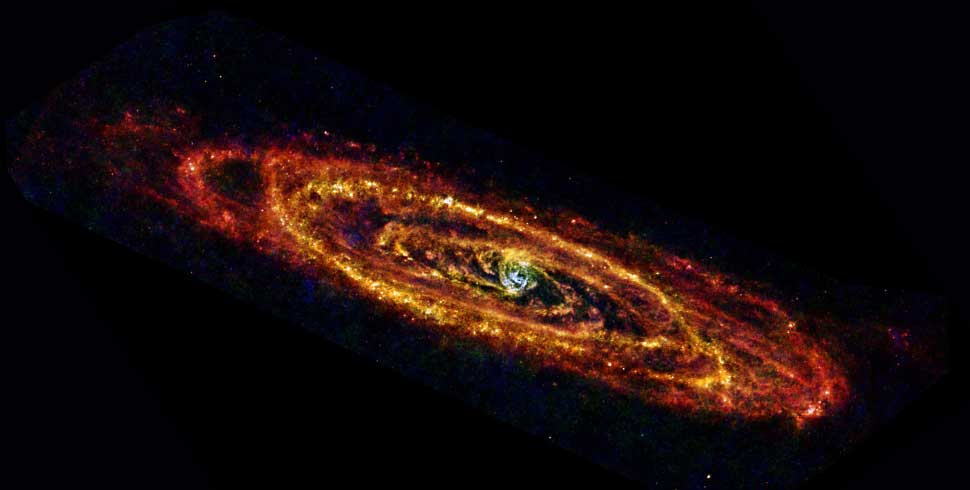
On the periphery of participating in the scientific revolution

Courtesy NASA/JPL-Caltech

There’s an age-old story about Albert Einstein that discusses his experience when he was young and in school and asked a teacher about how light could be viewed as both a particle and as a wave. The teacher remarked that obviously he had much more to learn as light was ONLY a wave, and once he learned that he would be able to understand the nature of that particular issue in science. Einstein spent his early adult years proving the teacher wrong and that light could be both a particle and a wave. It kind of changed science forever. Kind of cool.

When I was in grade school, I remember a similar kind of situation when I was first taking physics. And strangely enough, it involved the nature of light. The topic was about the scientific speed limit (the speed of light) and how nothing could go the speed of light, and that all attempts to achieve the speed of light would forever fail. I asked about light itself, indicating that obviously IT could go the speed of light because it was, in fact, light. Therefore, as it was a substance (specifically a particle, according to Einstein nearly eighty years before), then that meant a substance could achieve the speed of light. As scientists would eventually start to realize, light doesn’t approach the speed of light. It IS light and thus, always travels at the speed of light.

And then in the 1970s, there was a huge breakthrough in the concept of antimatter and tachyon particles. Antimatter, for clarification, is anything that is the opposite state of matter, meaning it has the same mass as matter but is in an opposite charge to that of matter. Antimatter particles (referred to as antiparticles) combine to create antimatter just as Matter particles combine to create particles. Tachyons, for those not familiar, are particles that move at speeds above the speed of light, which according to some mathematics I was playing around with at the time, I determined could not reach the speed of light from the opposite direction (the negatives proving to be the same opposite problem from the opposite side).

During this questioning period I was undergoing, I started to believe that I understood what tachyons really were and conjectured that what we know in our universe consists of matter that is incapable of achieving the speed of light. Therefore, in an antimatter universe, the antiparticles would consist of tachyons that would travel above the speed of light, but never be able to reach the speed of light from the other direction. It seemed pretty simple to me. The only thing missing was the simplicity of “where is it then?” We know where matter is because we see it, but we don’t know where antimatter is because we don’t see it long enough to determine that it’s really there (or are capable of stabilizing it before it dissipates in our own universe). This led me to believe that perhaps there’s a buffer substance between the two types of matter (positive and negative). And a simple matter of deduction gave me the theory that, unfortunately, I’ve never been able to completely disprove.

And that’s the Theory of Neutramatter. Neutramatter is a buffer substance that you would need to separate both matter and antimatter, which by simple definition would have to separate particles going below and above the speed of light. It almost seemed too simple because the substance that would need to separate the two universes is the most obvious substance known to man, and that’s light. As we know, light travels at the speed of light (which is kind of duh realization), which then indicates that as it is the buffer substance, the one thing that separates the two universes is the presence of light.

And as we know that light consists of more than just the visible spectrum, there are all sorts of properties that make up the wavelength frequencies that would separate this light across its spectrum, and thus, keep both matter and antimatter from ever crossing into each other’s specific realms.

The strange thing is: I was watching the latest episode of Cosmos with Neil Degrasse Tyson last night (taped from the night before that), and the focus was on the properties of light. It reminded me completely of this theory I had so long ago, and it almost seemed like the science of that show was about to make the, well, quantum leap to the theory itself, as it still seems to fill in the gaps that we still have. A couple of the questions that Tyson brought up (that mankind still has) fit directly into that theory.

It kind of makes me wish I would stuck it out with physics and continued on that path. I still believe there’s something to it, but when I was proposing it back then, string theory was the new kid on the block, and no one really cared about light at the time. I still think there’s something there, but today I’m a novelist who does nothing in science (aside from science fiction). And I wonder if I completely missed my calling.