Tag Archives: santa monica

Hate crimes that seem to sneak in under the radar

We all know there are some hateful people out there. We see the evidence in the news each and every day. What often escapes us is the fact that a lot of this stuff is happening around us, or in places we’d least expect it.

Take Thunder Bay, Ontario for an example.

You may wonder why I’m discussing Thunder Bay, as I suppose quite a few of you are probably wondering where is Thunder Bay, as in you probably have either never heard of it, or you just never gave it much thought. For me, however, when I saw a recent article, all sorts of memories came to mind. My family (on my mother’s side) is from Thunder Bay.

Every other summer or so when I was a kid, what little there was of my family used to drive from California to Thunder Bay, Ontario. Each time we took the trip, my mom would point out that it used to be called Port Arthur, and that she was born there after her father moved to Canada from Poland after the war. And then during one summer, she and two of her friends took a road trip across the United States and settled in different locations (her best friend in St. Cloud, Minnesota, her other friend in Florida, and she in Santa Monica, California…where I was born).

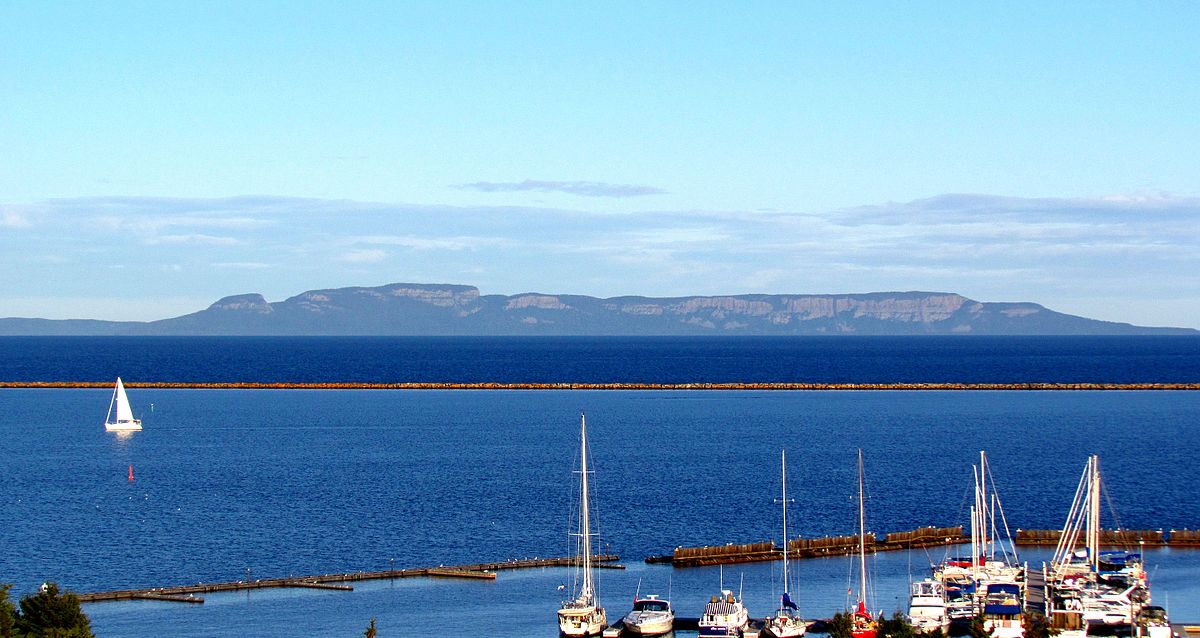
When we used to take this trip, one of the things that used to fascinate me was the local lore, and specifically the tale of “the Sleeping Giant”, which was the story of a giant Native American who fell asleep on a mountain until one day he would be woken up to aid his people again. It’s a natural rock formation that looks like a sleeping giant, and I remember being able to see it from most areas of Thunder Bay.
Anyway, so years later, I’m reading an article and discover that Thunder Bay is back in the headlines. Except, this time, it’s because some racist moron threw a trailer hitch at a Native American woman walking down the street. What the article doesn’t tell you is that the woman eventually succumbed to her wounds and died. The local Native Americans refer to the crime as a “hate crime” but in all that I’ve read, law enforcement is treating it as a general crime that was originally being treated as an aggravated assault, and now that she died, are “considering” changing the charges. There’s a certain amount of dismissing of the crime in the rhetoric, and one can’t help but wonder if it’s because it was “one of them” that died, rather than “one of us” as so often happens in these types of circumstances.

Which brings me to ask the question: What must be going through someone’s mind that thinks this type of behavior in the first place was either acceptable, or that it was something that might be fun to do? I remember when I was young, and I heard that some of the older kids were going to be “heading into town to do some gay bashing”, and never gave much thought (back then, at least) to what that probably meant. Those young people back then thought that was a completely acceptable thing to do, just as much as this guy driving around in the passenger seat of his car thought it was a pretty appropriate thing to do to just throw a trailer hitch out of a car window and laugh when he said “got one!”.

What no one really talks about is that our communities brought these people up to feel that this sort of thing was okay. We defend ourselves by saying that we would never do such a thing, but then we’re shocked when someone who lives next door to us is charged with doing just that.

At what point are the rest of us also responsible? I ask because I really don’t know the answer to that, and I suspect that we’ll never find out because it’s never being discussed, and I doubt it ever will.


Taking Umbrage With the N-Word

There’s an interesting article on Salon this morning from Mary Elizabeth Williams on how white people shouldn’t use the N-word under any circumstance.  Ignoring for a moment that most of MEW’s articles tend to be reactionary and designed to cause people to get upset over mundane things that they wouldn’t normally pay much attention to, the points she brings up are interesting, although I’m not sure I completely agree with all of them. I’ll let you read it for yourself and then decide. What I did want to discuss is my own particular perspective in the whole thing, coming from someone who would never use the word, mainly because I find it offensive, and even more important, that it rarely serves a purpose in any conversation I’ve ever had.

But I want to go back in time a bit to a friend of mine I had back in the days of my second visit to the college environment. I had decided to attend a community college (years after the Army AND West Point), cause I was interested in pursuing computer science as a future field. Anyway, my roommate at that time was a really cool guy named (for the sake of here) Bob. Bob was friendly, a good all around guy, and he was dating a woman that he was eventually going to end up marrying. He was also a pretty big guy, and he hung around with a bunch of other big guys, a few of them caucasians and a few of them of all different types of backgrounds, ethnicities and colors. But one thing that used to shock the crap out of me was that Bob used to refer to ALL of his friends as “my Nigga.” And they would refer to him in the same way. And none of them had a single problem with it.

I once asked Bob if that word didn’t bother him, and he looked at me like I was a moron. To him, the word had little contextual meaning as it did to me. It didn’t even have the same meaning to the African-American friends he had, because I couldn’t resist asking them either. They just didn’t grow up in an environment where they felt the typical socio-economic fabric that hangs over so many African-Americans of urban locales. They just smiled when I asked about it and didn’t have a negative thing to say whatseover.

No one thought of Bob as a racist, and not once was race even considered a part of the conversation.

But for me, I never could come around to using that word, even in the mixed company of where it was tossed around on a constant basis. I just didn’t feel comfortable saying it no matter how “welcome” the word was. And part of that is because I grew up in an environment where the word was used in very negative circumstances. The whites I grew up with around in the late 1960s and early 1970s were living through forced busing and the ramifications of the Civil Rights movement, so there was still a long of antagonism existing back then. I was fortunate in being integrated with very diverse populations as a child because I was dirt poor in an urban environment (Santa Monica, California). While many of my caucasian neighbors (meaning people who lived way out of my neighborhood of crack houses and prostitution dens) lived in isolated communities, I spent most of my free time at places like the Santa Monica Boys Club, which tended to cater to the poorest kids who couldn’t afford to spend time after school at the YMCA (where the richer kids hung out). So, I was exposed to all sorts of diversity that quickly educated me on what words were friendly and which words were taboo. As I was always a friendly sort of kid, I learned the ones that made friends (and made lots of friends) and discarded the words that turned friends into enemies.

Years later, in the presence of Bob and his friends, I was completely out of place because the conversations they were having were alien to me, so I did what I did when I was a kdi. I listened and avoided participating whenever I felt uncomfortable. There are certain words I’m not comfortable saying, and I’ve discovered that that is probably never going to change.

This is why I don’t feel concerned that there are rappers out there using the N-word in their music. I generally don’t sing to rap music, mainly because there’s not a lot of it that insterests me. The types that does generally doesn’t have profanity in it, or it’s impact is in a completely different direction. I do think that there are a lot of people who feel they have to emulate that type of behavior to be seen as cool, and fortunately, I’ve never been known to be someone who seeks out that type of status. Whenever I consider myself “cool”, there’s usually a sense of irony or sarcasm involved.

Which brings me back to that word. I don’t know why people feel such a need to use it. But unlike the professor mentioned in MEW’s article, I don’t care enough about the fact that others use it to feel slighted myself. Words do have power in some circumstances, but what MEW and people like her don’t often recognize is that they also lack power if people don’t subscribe to their doctrine. Whenever I hear the N-word, I don’t think “subversive”, “cool”, or even “outrageous.” I think “uneducated” and “limited in vocabulary”. But then, when writing a novel, there have been times when I have chosen the simple phrase rather than the more complicated one because the message was the medium, not the other way around. And in those cases, I guess my own jury is still out.

When Best Friends Aren’t Best Friends Any More

lilduane1
Back when things were a lot different

I’m sure my story isn’t that different from everyone else’s story. Most of us grew up with a best friend or two (over the years) and then life may or may not kept us together. If you watch a lot of the movies that get released starring the usual suspects of male friends, you get the impression that these friends stay close friends forever, basically until they reach middle age and go through their middle age crisis moments together.

Unfortunately for me, that didn’t happen. And strangely enough I kind of wish it did. Let me explain.

I’ve had two really close best friends over the years. One was my friend Roland, who I believe I met when we were both about two or three years old. We lived across the way from each other in a low-income apartment complex, and my first memory of Roland was a fight we had where both of us went home crying to our parents. Immediately after that, I remember his mom and my mom conducting some kind of UN conference where the two of us were forced to become friends again. We remained friends from that moment forward, proving that, yes, the UN sometimes DOES work.

Our friendship lasted most of our childhood. Both of us bought the same blue Schwinn bicycle and we rode miles and miles on those things together. It was not unusual for the two of us to race 26 miles down the beach to Redondo Beach, California and then back to Santa Monica. For us, the enjoyment was the journey of traveling down the bicycle trail together, back in the days when you could actually ride down those paths without running over a million girls on roller skates.

Some of my most memorable moments were with Roland, including when we would run into Dom Deluise at the local department stores and then at McDonalds shortly after. We explored the world together and learned about the world as a shared experience only friends can truly appreciate.

When I was a young teenager, my mom died after a horrible illness that slowly drained her of life. When she died in the hospital, I remember calling Roland because he was the only person I wanted to talk to. Shortly after, he showed up with his mom and dad to the hospital, making sure that I wasn’t alone on that horrible day.

Soon after, I moved in with my older sister and her husband, which forced me to move away from Santa Monica. Roland and I kept in touch by phone, and every now and then I’d figure out a way to take the bus for a few hour trip to visit him, and sometimes he’d do the same to come to me. But as we were further and further away, we sort of drifted apart until we stopped calling and then never saw each other again. It’s one of those things I regretted deeply over the years, but life takes you where life takes you.

In Moorpark, my new home, I made friends with the person who was to become my next best friend, Ken. While we didn’t have the history that Roland and I had, we quickly built a friendship and quickly made up for the lack of history by inventing all sorts of adventures together. One of my favorite moments in high school was when the two of us were taking a Spanish class, and we were the two students who had already finished alll the lower level Spanish stuff so we were kind of put into a corner by ourselves to study on our own because they didn’t have a high enough level class for us to take. Because we were always together, we made a lot of noise and had a lot of fun. So the teacher felt she had to separate us. Therefore, we did what any normal duo of friends would do: We invented a sign language that allowed us to communicate from across the room from each other. We learned it quickly and immediately really pissed off the teacher who decided she wasn’t going to win this battle, so she let us sit next to each other again and never tried to separate us again.

A few years later, after graduation, I joined the Army and Ken joined the Air Force. At one point, we were both in Germany at the same time, so I decided to hop into my Volkswagon Scirroco (sic), pick up Ken and drive the two of us to Paris, France. It was a wild, fun adventure that involved some young girl we found to help us find a hotel (because neither of us could speak French) who the hotel owner thought was a prostitute because she was negotiating the room for two American GIs (and then left with a smile right after she secured us the room, which caused the old woman working the hotel to suddenly realize she had played the wrong cards in her assumptions).

That was pretty much our last get together. Ken ended up being accepted to the Air Force Academy and is a colonel today, probably going to be a general one of these days. I wish him well, but I regret that our friendship faded and we really don’t talk any more.

Strangely enough, both Roland and Ken have connected with me through Facebook, so every now and then I see what’s going on in their lives, which when I think about it is actually kind of sad because at one time I was very close to both of them, and like that one hit wonder song “now they’re just somebody that I used to know”.

Weirdly enough, when I made contact with them on Facebook, I immediately had this feeling that I had found a long, lost friend and then things were going to be great again. And we rarely even communicate, which forces the “You Can’t Go Home Again” by Thomas Wolfe to play through in my head (which is funny because it’s probably one of the most often quoted titles of a book that people have never actually read themselves, so when they pretend to have read it, I always say “Stop Twampling!” just to see if there’s a reaction, which when there’s none I know they’re bullshitting me about having read it). Wolfe’s idea is somewhat true, and you never really understand it until the events play out that show you how true it really is. I read that book a decade or so ago, yet until I made contact with those two former friends, I never made the connection to what he was truly saying.