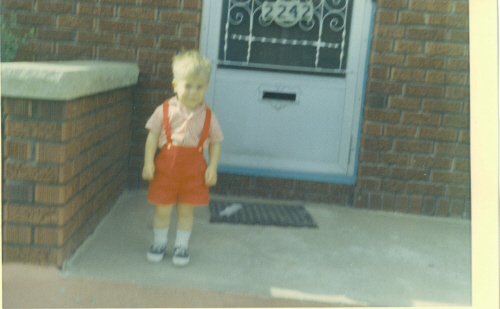
I’m sure my story isn’t that different from everyone else’s story. Most of us grew up with a best friend or two (over the years) and then life may or may not kept us together. If you watch a lot of the movies that get released starring the usual suspects of male friends, you get the impression that these friends stay close friends forever, basically until they reach middle age and go through their middle age crisis moments together.
Unfortunately for me, that didn’t happen. And strangely enough I kind of wish it did. Let me explain.
I’ve had two really close best friends over the years. One was my friend Roland, who I believe I met when we were both about two or three years old. We lived across the way from each other in a low-income apartment complex, and my first memory of Roland was a fight we had where both of us went home crying to our parents. Immediately after that, I remember his mom and my mom conducting some kind of UN conference where the two of us were forced to become friends again. We remained friends from that moment forward, proving that, yes, the UN sometimes DOES work.
Our friendship lasted most of our childhood. Both of us bought the same blue Schwinn bicycle and we rode miles and miles on those things together. It was not unusual for the two of us to race 26 miles down the beach to Redondo Beach, California and then back to Santa Monica. For us, the enjoyment was the journey of traveling down the bicycle trail together, back in the days when you could actually ride down those paths without running over a million girls on roller skates.
Some of my most memorable moments were with Roland, including when we would run into Dom Deluise at the local department stores and then at McDonalds shortly after. We explored the world together and learned about the world as a shared experience only friends can truly appreciate.
When I was a young teenager, my mom died after a horrible illness that slowly drained her of life. When she died in the hospital, I remember calling Roland because he was the only person I wanted to talk to. Shortly after, he showed up with his mom and dad to the hospital, making sure that I wasn’t alone on that horrible day.
Soon after, I moved in with my older sister and her husband, which forced me to move away from Santa Monica. Roland and I kept in touch by phone, and every now and then I’d figure out a way to take the bus for a few hour trip to visit him, and sometimes he’d do the same to come to me. But as we were further and further away, we sort of drifted apart until we stopped calling and then never saw each other again. It’s one of those things I regretted deeply over the years, but life takes you where life takes you.
In Moorpark, my new home, I made friends with the person who was to become my next best friend, Ken. While we didn’t have the history that Roland and I had, we quickly built a friendship and quickly made up for the lack of history by inventing all sorts of adventures together. One of my favorite moments in high school was when the two of us were taking a Spanish class, and we were the two students who had already finished alll the lower level Spanish stuff so we were kind of put into a corner by ourselves to study on our own because they didn’t have a high enough level class for us to take. Because we were always together, we made a lot of noise and had a lot of fun. So the teacher felt she had to separate us. Therefore, we did what any normal duo of friends would do: We invented a sign language that allowed us to communicate from across the room from each other. We learned it quickly and immediately really pissed off the teacher who decided she wasn’t going to win this battle, so she let us sit next to each other again and never tried to separate us again.
A few years later, after graduation, I joined the Army and Ken joined the Air Force. At one point, we were both in Germany at the same time, so I decided to hop into my Volkswagon Scirroco (sic), pick up Ken and drive the two of us to Paris, France. It was a wild, fun adventure that involved some young girl we found to help us find a hotel (because neither of us could speak French) who the hotel owner thought was a prostitute because she was negotiating the room for two American GIs (and then left with a smile right after she secured us the room, which caused the old woman working the hotel to suddenly realize she had played the wrong cards in her assumptions).
That was pretty much our last get together. Ken ended up being accepted to the Air Force Academy and is a colonel today, probably going to be a general one of these days. I wish him well, but I regret that our friendship faded and we really don’t talk any more.
Strangely enough, both Roland and Ken have connected with me through Facebook, so every now and then I see what’s going on in their lives, which when I think about it is actually kind of sad because at one time I was very close to both of them, and like that one hit wonder song “now they’re just somebody that I used to know”.
Weirdly enough, when I made contact with them on Facebook, I immediately had this feeling that I had found a long, lost friend and then things were going to be great again. And we rarely even communicate, which forces the “You Can’t Go Home Again” by Thomas Wolfe to play through in my head (which is funny because it’s probably one of the most often quoted titles of a book that people have never actually read themselves, so when they pretend to have read it, I always say “Stop Twampling!” just to see if there’s a reaction, which when there’s none I know they’re bullshitting me about having read it). Wolfe’s idea is somewhat true, and you never really understand it until the events play out that show you how true it really is. I read that book a decade or so ago, yet until I made contact with those two former friends, I never made the connection to what he was truly saying.