
Tag Archives: Childhood

The Man Who Would Be Dad

Like many others of my generation, I grew up without a dad. I ended up being of that household that was lumped into “Unwed mother”, which often gave the impression that it was the fault of the mother that the father never stuck around. But that’s obviously for another article.

Not having a dad made things interesting in that earlier days in school were often spent explaining why there was no dad around. So, I used to invent all sorts of reasons why my dad was never around. As I grew up in the late 60s, early 70s, one of my earlier fantasies was that my father was missing in action from Vietnam, and that one day he would return. As years went by and he never returned, that fantasy switched from MIA to killed in Vietnam, because no one wants to have to wait forever. And then the fantasy sort of faded into some obscure belief that he must have been a veteran that may or may not have gone to Vietnam, and then it no longer really seemed to matter.

The fact is: My dad left when I was about one or two years old. He started by shouldering his responsibilities, and then he just disappeared, the common joke of “went out for smokes and never came back.” For years, I was convinced that it must have been something I did. Then it was a condemnation of my mom. And then, finally an acceptance that neither one of these possibilities were the case. I came to the realization that my dad was an asshole. He had responsibilities, and he decided he didn’t want anything to do with them.

For years, I was convinced that he would come back, because all sons want to think that their dad would care enough to come back. But he never did. Unlike other great stories of child abandonment, there’s usually that poignant story of how the dad showed up one day, did some magnanimous thing and then left again. But that never happened. He never came back. He never cared.

A friend of the family told me that she had seen him in town, kind of ran into him at a supermarket and said hi. He looked all embarrassed, responded quickly and then slinked away into the shadows, never to be seen again. Years later, I realized how very much like him that probably was.
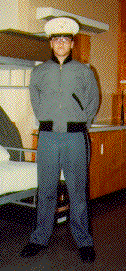
Even more years later, I became a counterintelligence agent, which is only important to this story because becoming something like that means that I had at my fingertips the ability to find pretty much anyone I wanted to. Lumped with the skills that also come with that ability, I knew for the longest time that if I really wanted to know where he was I could find him. But I chose not to. At the time, I often told myself that it was because I wouldn’t like what I found, and another part of me believed he was probably already dead.

After I left government service, I decided, on a whim, to find him. So I went back to my mad skills of finding people and found him. Well, I didn’t exactly find him. I found his gravestone. He died in 1985, twenty years after I had been born.

For years, I had always imagined that he was secretly watching me, observing my accomplishments as I checked off a list of important moments in my life, like attending West Point, my military career, my education, my published novels, my victory in the struggle over whether to choose paper or plastic in the checkout line, etc., but he died before any of that ever happened. So he never would have known.

So I made a pilgrimage to his grave site, even if to complete some symmetry of the whole thing. And that’s when I saw it.

Kenneth Duane Gundrum

Loving Father

You’ll Be Missed

The First Rule of Teaching and Writing: Have a Lesson or a Story to Tell

Years ago, when I was 7 years old, I used to belong to the Santa Monica Boys’ Club, which used to sponsor all sorts of educational junkets. It was the place where I first joined a football team, a choir, a field hockey league, and all sorts of other activities. So, one day, I was signed up to join an archaeological dig.

Keep in mind, at the time the kids of Santa Monica weren’t really all that well to do financially. That’s changed a lot over the years, so that if I mentioned Santa Monica now, you’d probably be talking about some pretty affluent kids. But back then, my area of Santa Monica was slowly wavering between destitute and crack neighborhood. At this time, we were just destitute (hadn’t made that final drop into crack neighborhood yet).

Anyway, so I signed up. Turned out we were going to be heading off into the hills of Santa Monica (or Los Angeles) where someone had found some artifacts at one point. The guide, who was also the driver (and to be honest, I don’t remember exactly who he was from the staff at the Club back then), showed us an artifact he’d dug up some weeks before that he was carrying around in a tissue for all of us to see. No, it wasn’t an Indiana Jones level of archaeology we were exploring here; it was more a “some older guy who likes to dig in dirt to see what he can find” kind of archaeology. Imagine the next rung above a coin seeking metal detector old guy, and that would describe the level of this particular adventure.

So, we got into the mountains, and we split up into groups of kids, and a couple of friends of mine from the Boys’ Club and me started digging into the dirt of some mountainside. We didn’t really know what we were doing, but it was archaeology, and even though Indiana Jones hadn’t been made yet, this was the level of fun we were experiencing because we really didn’t know any better, and sometimes it’s really nice to get out of the bad environment that was our daily lives anyway.

But at one point, we found something. Lots of somethings. And we started digging them up. We dug up a whole bunch of shells from the side of the mountain, and we unburied them. All in all, we probably found 20 or so artifacts of old buried shells in the mountainside.

But it was during the trip back when we were kind of analyzing what we had done that I hit on the question that didn’t seem to make a lot of sense to me. You see, back then, the idea that these mountains would have been under water at one time wasn’t taught. Still isn’t actually. The idea that a high area of California was once under water doesn’t make a lot of sense from a typical science perspective. So I asked about it, and the teacher who was with us was kind of stumped. He didn’t seem to want to go out on a limb and state that California might have been underwater at some point in the past, so he kept trying to avoid ansnwering the question. I kept asking about it, and it kind of got him annoyed.

To this day, I have yet to figure out why we were able to find ancient shells in the mountains of Santa Monica. One person conjectured that perhaps there was a lake there once, but even that didn’t seem to satisfy my curiosity. But what got me even more intrigued was that the person who brought us out to this dig had no idea why he brought us out in the first place, other than to give a bunch of poor kids something to do. And that’s my comment for today because I think it has as much relevance to writing as it does to amateur archaeology. Don’t start writing a story until you know why you’re writing it.

Oh sure, there are lots of exercises to get you writing that don’t require you to know where you’ll end up, but at some point during the writing, you probably should have an idea of why you’re writing in the first place. Otherwise, you’ll end up going all over the place, digging into places that don’t make any sense, and when you finally come up with gold, or shells, or a story, you may have no idea what to do with it even though you’ re holding it in your hands.

So, the moral is: Know what you’re writing beforehand, or you might end up underwater in the mountains of California. Okay, maybe that wasn’t the best moral. I really should have thought about that before I started writing it….