Tag Archives: family

Paul Newman, My Grandfather and the Making of the Movie ‘The Sting’

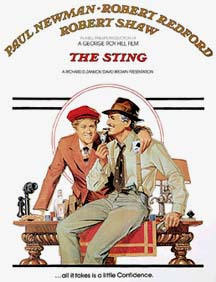
stingmovieWhen I was growing up, my grandfather on my mother’s side used to drop by our apartment all of the time and watch television with us. My mom was a single mother who worked long hours as an assistant bookkeeper, so these moments at night were always a welcome rest from her very long days. During most of these times, I was still too young to understand the complexities of father and daughter relationships, so I never really understood the conflict that seemed to arise between my mom and my grandfather. But it was while we were watching the network airing of the Paul Newman-Robert Redford movie The Sting that I started to realize what this conflict might have been. In case you don’t know it, a large part of the movie takes place on the Santa Monica Pier, specifically in the carousel building. As we were watching one of the scenes taking place, Paul Newman was on the screen doing whatever an actor like Paul Newman does in a movie like that when my grandfather said: “I had lunch with him.”

My mom just rolled her eyes and said: “Sure, Dad. You had lunch with Paul Newman, the actor?”

He was adamant. And he upped the claim: “I had lunch with him right there,” pointing to the screen, meaning he had lunch with him right there where the movie was filmed.

My mom just rolled her eyes again and said nothing. We watched the rest of the movie, and nothing more was said of it.

Over the years, I spent a lot of time at my grandfather’s house. His place was always a welcome refuge from the world. Because we were dirt poor in a well-to-do city, having a place to go where you weren’t in fear of danger was always a good thing. So I spent a lot of hours at my grandfather’s house.

And one thing I remember most about him was that he loved to tell stories. Mostly about his life and the things he’d seen. And whenever I told my mom about these stories, she just laughed and said Grandpa made things up and had an “interesting” past that was more interesting in his mind than in real life. So I always kept that thought in mind whenever I heard one of his stories.

One time, he told me a story about how he fought with the French resistance by using his cover as an ambulance driver to sneak around Nazi territories. My mom laughed when I told her that story and basically had no comment. Another time, he told me he played backup guitar for a famous rock band that was performing at the Santa Monica Civic Auditorium because its guitarist was sick one night. My grandfather was an accomplished musician, and I could have easily seen how one with an active imagination might have imagined playing guitar for a major rock and roll band. I do that myself sometimes when I’m listening to the radio and suddenly rocking with my air guitar.

However, the story of him having “lunch with Paul Newman” always seemed to be one of those things that never made sense to me. I could see imagining all sorts of things, but having lunch with an actor and remembering it only when seeing him on the screen just seemed bizarre. So I remember asking him more information about that story. And he told me that one day he was playing the mandolin at the park and wandered down to the pier where he noticed they were making a movie. So, he maneuvered his way onto the set and walked over to where Robert Redford and Paul Newman were having lunch in between takes. He walked over to them and asked them if he could join them. They were both surprised by some stranger who walked up to them and kind of gestured to a seat near them. He then asked them if they’d mind if he played his mandolin. I guess they were too surprised to say no, so he spent the next few minutes regaling them with his mandolin playing (which was always quite remarkable). When he finished, he motioned to Paul Newman’s unfinished lunch and asked him if he was going to finish that. According to my grandfather, they were somewhat surprised but didn’t stop him from finishing up the lunch. A studio person came over at this time, about to push my grandfather on his way but one of the two actors actually motioned for him to stop, saying: “Bring us another plate.” I’m not sure how much longer my grandfather claimed to have stuck around, but that’s what he considered “having lunch with that actor.” Even if it wasn’t true, it was always such an interesting story.

Anyway, years later, long after my grandfather passed away, I was doing some research on the French resistance and saw an old picture of a group of known French resistance fighters who had a picture snapped of them as they were standing next to an old ambulance. Looking closer, I realized that the picture of one of the unlabeled people in the picture looked a lot like a younger version of my grandfather. There’s no guarantee it was him, but it sure looked like him and it certainly matched the time period and location of which he had been discussing.

A few years after that, I was in a bookstore on Powell Street in San Francisco looking over a bin of books that were heavily discounted, and one of them was about the heyday of Hollywood movies, and showed a bunch of photos for some major motion pictures during certain periods. My fingering through the book stopped strangely on a section for the movie ‘The Sting.” I hadn’t seen the movie in a long time, so looking at the different pictures brought back a lot of good memories. However, when I turned the page, I found myself staring at a picture of Paul Newman, Robert Redford having a meal on set. Sitting with them was an old man with a mandolin in his hands. It was hard to tell what they were talking about in that photo, but it was definitely my grandfather, and he was credited as “unknown stagehand”.

Which brought me back to those many stories that he told over the years, the many stories that my mom was convinced were all in his head. To this day, I’m still looking through old rock photos to see the one time a strange guitarist filled in for Van Halen or the Rolling Stones. I haven’t found it yet, but those earlier stories definitely keep me looking.

Who knows what I’ll find?
An Unknown Writer’s Circle of Pseudo-Support

Like most writers, I have this recurring fantasy. It involves a large library, thousands of books, a bowl of jello and Jessica Alba. Oh wait, that’s a different fantasy. The fantasy I’m talking about involves this vision of one day looking back on today as a seasoned, professional writer who has made it and wonders why the journey to get where I got was so hard, so long and so filled with obstacles. But one thing that keeps coming back to me, and to many writers like me, is remembering all of those friends who stuck by you through the struggle. And to be honest, I can count on one hand the close friends of mine who actually stuck by me. The rest, not so much.

To be honest, I think this is something most artists deal with on a constant basis. I have a friend of mine who is a struggling filmmaker. He’s actually pretty good at what he does, and I have a lot of respect for his work in that field. As a matter of fact, he finished his latest film just a short while ago, and when it came time for the premiere, of all of the friends at work, only two or three actually attended. The rest kept asking about it, wanting to know when it was going to happen, and then when it did, they all mysteriously had other things they had to do.

That’s what happens to a lot of us artists when we hit that point of trying to actually introduce one of our works into the public realm. When I published my first novel, people said, “oh, that’s great” and that was all they wanted to say about it. None of them were actually interested in reading it. Oh, they’d say nice things in pleasant circumstances, but they really weren’t interested in the fact that I was struggling to be a writer, and it was about the only thing that mattered in my life. They’d talk endlessly about their families, their dreams and aspirations, but when it actually came to picking up a copy of my book, Osama Bin Laden was more popular than I was.

I did a simple experiment a few weeks ago, which I repeated a few days ago, because I was actually interested in how far friends would actually go on this sort of thing. I have most of my normal friends, and former acquaintances, as Facebook friends. So, as I have a simple little comic strip called The Adventures of Stickman & the Unemployed Legospaceman, I thought it might be interesting to start up a Facebook page for that strip itself. Then I sent out a “like” request to all of my “friends”. That was several weeks ago. To this date, five people have “liked” it. One was me. Another was that filmmaker friend I talked about. That means three others appeared from practically everyone else I know. Three.

So, I repeated that experiment by putting one of my books out onto Facebook as well. Six people have liked it. That filmmaker friend of mine, and my friend Melanie from Germany. Including me, that means 3 people have added it, and none of them are any of my actual Facebook friends who have been friends for the years I’ve been on Facebook. Kind of tells you something, if you take the time to think about it. It’s kind of depressing as well.

Which leads me to realize that if most other artists are going through this sort of support from the people they know, it says something really crappy about the way social networks interact with our psyche. I’ve talked to a lot of professional writers over the years in their formulative years, when they were really struggling, and they’ve all said something similar, kind of pointing out that the art is a lonely art, but not just because you have to be alone to write. Quite often writers feel abandoned and write from that place, and once they actually make it, seek out new sources of friendships because it’s very hard to look back at the friends you had before when so few of those friends stood by you during the toughest times.

I’m finding it quite telling that some of my closer companions these days tend to come from people who have found me through my blog, or others who have contacted me through circles of writing, rather than through my normal, already established social networks. While it leaves a bit of a sour taste in my mouth, it also leaves me wondering if the future is a series of connections yet to come rather than the ones that seem to be dislatching from behind.

It’s a lot like the feeling I’ve always had from my family when I first mentioned that I was going to be a writer. Instead of respect, awe or even interest, I received condemnation and ridicule, almost as if it wasn’t something to be taken seriously. When I received my first positive review on Amazon, rather than say, “that’s great, Duane!” I heard, “so did one of your friends write the review, or did you write it?” That was from my family. So, you can imagine how long the desire for success in this field has been burning for me.

That’s really all I have to say about that.

The Man Who Would Be Dad

Like many others of my generation, I grew up without a dad. I ended up being of that household that was lumped into “Unwed mother”, which often gave the impression that it was the fault of the mother that the father never stuck around. But that’s obviously for another article.

Not having a dad made things interesting in that earlier days in school were often spent explaining why there was no dad around. So, I used to invent all sorts of reasons why my dad was never around. As I grew up in the late 60s, early 70s, one of my earlier fantasies was that my father was missing in action from Vietnam, and that one day he would return. As years went by and he never returned, that fantasy switched from MIA to killed in Vietnam, because no one wants to have to wait forever. And then the fantasy sort of faded into some obscure belief that he must have been a veteran that may or may not have gone to Vietnam, and then it no longer really seemed to matter.

The fact is: My dad left when I was about one or two years old. He started by shouldering his responsibilities, and then he just disappeared, the common joke of “went out for smokes and never came back.” For years, I was convinced that it must have been something I did. Then it was a condemnation of my mom. And then, finally an acceptance that neither one of these possibilities were the case. I came to the realization that my dad was an asshole. He had responsibilities, and he decided he didn’t want anything to do with them.

For years, I was convinced that he would come back, because all sons want to think that their dad would care enough to come back. But he never did. Unlike other great stories of child abandonment, there’s usually that poignant story of how the dad showed up one day, did some magnanimous thing and then left again. But that never happened. He never came back. He never cared.

A friend of the family told me that she had seen him in town, kind of ran into him at a supermarket and said hi. He looked all embarrassed, responded quickly and then slinked away into the shadows, never to be seen again. Years later, I realized how very much like him that probably was.

Even more years later, I became a counterintelligence agent, which is only important to this story because becoming something like that means that I had at my fingertips the ability to find pretty much anyone I wanted to. Lumped with the skills that also come with that ability, I knew for the longest time that if I really wanted to know where he was I could find him. But I chose not to. At the time, I often told myself that it was because I wouldn’t like what I found, and another part of me believed he was probably already dead.

After I left government service, I decided, on a whim, to find him. So I went back to my mad skills of finding people and found him. Well, I didn’t exactly find him. I found his gravestone. He died in 1985, twenty years after I had been born.

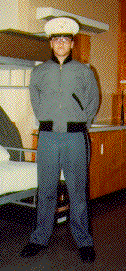
For years, I had always imagined that he was secretly watching me, observing my accomplishments as I checked off a list of important moments in my life, like attending West Point, my military career, my education, my published novels, my victory in the struggle over whether to choose paper or plastic in the checkout line, etc., but he died before any of that ever happened. So he never would have known.

So I made a pilgrimage to his grave site, even if to complete some symmetry of the whole thing. And that’s when I saw it.

Kenneth Duane Gundrum

Loving Father

You’ll Be Missed