Tag Archives: Religion

Why Has the World Gone Downhill? An Analysis of Violence


One of the common tropes in storylines, especially for fantastical fiction, is the idea of returning to a period of time when things were “the old ways”, kind of like a time travel journey to the 1950s, or even a trip to the ancient past. The main character is seen as a fish out of water as he or she tries to use his or her knowledge of that time (and his or her future time) to get through such an experience. Now, part of me was thinking of focusing this post just on the writing aspects of this sort of speculation, but while I was thinking this through, I started to wonder something, and specifically I was wondering why we became what we are today rather than having continued the way things were “back in the day.”

This was prompted by an article covering a shooting that took place in Denmark and how that community (and that country) is now having to do things to make sure that such a tragedy doesn’t happen again. In other words, they are going to become a lot like other places around the world where violence is somewhat expected. I mean, no one wants to be caught off guard, right?

And that got me to thinking about that infamous line that used to happen in the United States whenever something tragic occurred. If this was the 1950s, the response would be something along the lines of “I can’t believe such a thing like that could happen here.” Or my other favorite: “I can’t believe Bob did that because he always seemed like such a nice guy. That sort of thing just doesn’t happen here.” I think you might be getting the picture.

In the 1970s, that message, while still happening in areas where you wouldn’t expect to hear it (part of the response to gun shootings that were happening in rural areas rather than urban settings) slowly changed to “I can’t believe that happened here. I mean, it’s not like we live in Chicago/New York/Detroit.” In other words, it was starting to happen in urban environments, so we were starting to expect stories like that, but it shouldn’t happen in a place like Wheatfield, Wyoming (if that was a real place). But now, it’s happening all over the United States, so that every new story that happens is treated as a one-off case of an almost expectant event, even if where that event took place might have been speculation before it happened. It’s happened so much in the United States that we’re now starting to be surprised by these stories happening in other countries, rather than by ones that happen in the United States.

So, because of the way these trends work, we’re going to be seeing more and more of this violence happening around the world in places where we’d last expect to see it. And then we’ll have to be surprised by something worse, like the level of violence, the perpetrators of the violence, or some other factor we haven’t considered yet.

Which leaves one important question:

Why?

Why are we seeing this sort of thing becoming a norm for our communities? Are we desensitized to violence so we now accept it as a part of our natural order? Is the human species evolving into a much more violent, chaotic creature that holds little regard for fellow humans? Is that creature devolving into the types of people we used to be before we took the Hobbesian path and developed government around us to protect us from each other? Is it because our means of hurting each other have become much more convenient and useable? Or are there other factors that cause us to do the sorts of things we do to each other these days?

Desensitization

There’s a lot of theory that addresses this possibility, mainly making the point that as people are exposed to more and more sensations of a certain type, they no longer find themselves affected by it and either no longer seek such sensations or have to increase the type of exposure to reach that level of influence again. We see this all of the time with the drugs we take, from cigarettes to alcohol to both legal and illegal substances. Most of the time, the first exposure to the item causes an initial positive reaction which is then transferred into a loss that needs that input again. Continuous exposure acts as a certain punctuated equilibrium, which means we get used to a higher level of usage and continue to have to increase the dosage to provide the same “high” that we had before.

For violence, there’s no reason this wouldn’t work the same way as well. We become comfortable with the amount of violence we’re exposed to and then seek out higher levels of violence. As exposure theory goes, it makes sense.

Or does it? The problem with exposure theory is that the influence might increase for an individual, and it would take more and more violence to affect that person, but why would this somehow translate to people in other areas now experiencing violence where they didn’t have it before? The theory doesn’t explain that, unless the idea of violence is that it’s more of a virus that spreads rather than something that occurs in pockets and then spreads out, affecting those previously exposed to it.

Another possibility involving that theory is the types of violence inherent in the system. An argument is often made about video games, television and movies that might be desensitizing people, and unlike the virus affects of spreading violence, these would feed on subsequent communities just by the appearance to where people would consume these types of media. Again, that’s assuming these activities to be a causal factor rather than as a recognition of the violence (meaning no causal effect at all, or very little at least).

But I don’t want to just ignore the possibility because from first hand experience, I remember being a fan of horror movies when I was growing up. I remember watching the very first Nightmare on Elm Street with a bunch of military coworkers, and I was shocked at the violence in that movie, and it was extremely scary (at that time). Having watched many horror movies during that period of time, I remember watching that original movie again years later and thinking how tame it was in comparison to “real” horror movies. I certainly didn’t feel that way the first time I watched it. So, there’s a bit of desensitization going on there, or it may just be a stimuli adjustment. Or it may have no connection at all to violence because if one sees it as “reaction to being scared” rather than “reaction to violence” there may be absolutely no ties whatsoever. Again, something to keep in mind when analyzing such phenomena.

Evolution of the Species

This is one of those possibilities that truly scares me because with evolution, you have the whole survival of the fittest thing going on, and if the fittest is the most violent, then we’re in for some really bad problems. But what if our dilemma is that the human condition is now one that is favored through violence rather than through cooperation? There’s a strong believe that through our evolution, we have reached a point where social communities are what propel us forward beyond the previous adaptations and around other species that didn’t achieve this level of evolutionary maturity. Okay, if that’s the case, why is violence becoming more and more a response to how we handle these social encounters instead of community and broad cooperation? If our evolutionary process made sense, there would be a strong possibility that people would find ways to get along in diverse circumstances (instead of taking a gun to work and killing the boss during an altercation) and on an even higher level, we should probably see fewer wars and regional conflicts.

But we don’t. Instead, after several wars to end all wars, we’re still as violent towards each other as we’ve ever been. Right now, our Congress is meeting to figure out how to give our president more authority to attack people we don’t get along with. For some reason, no money is being discussed for allocation that will be spent to foster peace with the people we don’t get along with. The response to this criticism is “it would be a waste of money because they don’t want peace”. And we know this why? Because we’re currently trying to kill them while they’re trying to kill us (or at least allies of us). In our present sense, we see what we’re doing as justified, yet we’re still doing the same violent things we were doing in the past, and now we just have more efficient ways of doing it.

So, the question is asked, are continuing to become a more violent people? And I don’t mean just the United States, or the west, or anything like that. I mean humans as a whole. Are we just becoming more violent?

Or were we always this violent? Except we had governments that were capable of keeping us from killing each other (except during national campaigns where they got to send people out to kill in their names)? If you’ve ever been to war, it’s a pretty brutal experience. Oh, we like to fluff it up with 21st century technology and act like we’re doing something much different than how our forefathers fought, but when it comes down to it, you still have people out in the middle of some place they don’t want to be trying to kill a bunch of other people who don’t really want to be out there doing that either. And we pin medals on the ones that come back alive (and sometimes those who didn’t), and then create celebrations for the sacrifices they made. But in the end, we’re rewarding a bunch of people who are doing things that civilized people probably shouldn’t be doing any way.

But of course, someone will say that the others guys MADE us do it, that they were out there doing atrocities. And I’m sure the other guys will say that those of us attacking them were doing all sorts of affronts to humankind, like sleeping with each other on the wrong days of religious texts, eating something that someone’s interpretation of God says people shouldn’t be eating for arbitrary reasons that someone else will defend to the death, and all such other reasons (some good, some ridiculous, and some just straight out confusing, even to the people following them).

Which kind of pushes the whole Hobbesian argument that maybe we’ve been comfortable and safe from the mannerisms of our fellow humans by a simple agreement to follow some arbitrarily chosen noble whose real purpose is to make sure that people don’t go around killing each other all in return for a promise to make sure that those who DO kill each other will be held responsible for such actions (so that might keep them from doing so). If our only reason for avoiding violent tendencies is because of some agreement our ancestors made with each other, then it might not be surprising why a civilization that tends to teeter closer to anarchy might not feel the need to follow preordained orders of a monarchical society that leads for the simple reason that those in charge just feel they should be in charge.

Think of it this way. If you’re a citizen of an order that you don’t believe in any more, because few in that society do, and lump that in with a belief that there’s no reason to live the life that your ancestors did because that’s only going to provide a lifetime of hardship and destitution, there are people in your life (or on the edge of it) you don’t like, and you see violence as an option rather than something to avoid, I wonder if that would explain why a lot of these events are becoming a norm rather than the anomaly they used to be.

I mean, let’s be honest. I don’t have the answers. But I do have a lot of questions, and I’m starting to suspect that people aren’t really asking questions any more but are just pontificating about what they think are the answers to a whole lot of questions that people stopped asking.


The concept of forced church attendance

Some years ago, back when I was in the Army, I remember being forced to attend a religious gathering that they forced all soldiers to attend (on your weekend day off, which meant either attend the religious social function or you would be required to do hard labor duty on post instead). Needless to say, there were few soldiers who chose the hard labor option, so we all were put onto a bus to a day that was supposed to be “filled with fun.” The beginning of the day was uneventful, which consisted of ranch activities, ping pong, and other such things. But the ride back to post was filled with what ended up being a two hour ride filled with “you’re going straight to hell, sinner” screaming from some evangelical nutcase that was part of the retreat that soldiers attended. I remember being sickened by the whole experience, and believe it or not, I remember it more vividly than combat, gunfire, or anything else that should have been forefront in my memories.

So, fast forward to today, and I attended a mandatory “church” session at work. I work for a university that is very religious (Methodist mostly), so every Tuesday we are required to attend religious services that consists of very specific dogma that is extremely compartmentalized into only one kind of religion. So, if you’re Jewish, Protestant, Catholic, Pagan, Atheist or anything that’s not this specific brand of Methodist, you’re going to find yourself extremely uncomfortable in this environment. Yet, everyone is required to attend.

And it’s quite an experience. Today was my first opportunity to attend this service, and let’s just say that as a “different” spiritual person, I was taken aback by a presentation that left me feeling extremely uncomfortable. I don’t know if it was the constant references to how Jesus is my personal savior, even though the woman who kept reading that statement over and over couldn’t actually pronounce it. And when she kept reading the word “sovereign” she read it as “savior” which made it sound all that more ridiculous every time she said it (and she said it a lot), even though she was reading it off a teleprompter that was displayed for everyone to see. Between the endless sermons, the standing up and sitting down for numerous prayers that were extremely specific towards things I would never pray for EVER, and the few moments of actual decent choir performances, it was quite a spectacle to observe. However, when the mimes started performing dance routines as part of some bizarre scripture, I was kind of at a loss of what to think or say, so I kept quiet, even though that’s so not a natural state for me to be in.

When the sermon started, the reverend read a selection from a more obscure passage of the Bible that basically advocated for saving oneself by allowing one’s wife and concubine to be raped in your name (and then killing the concubine by cutting her up into 14 pieces after). From there, the lecture went onto something that eventually led to a discussion of how sexual violence was wrong, but somehow it wasn’t that much of a concern because at some point God would welcome you into his gates and all would be fine there, or something like that. All I kept thinking was “wow, this person really shouldn’t be reading from this particular book.”

I’ve never been a fan of forcing religion on people, and I’m not really sure what their original intention was for this gathering other than to force a narrative onto people who probably don’t agree with it. There was a lot of “amen” and “Hallaluyah” from the audience during this conversation, so I guess some people are okay with this sort of interpretation, but my belief has always been that if people are going to believe in this sort of thing, then have THOSE people attend these gatherings and leave the rest of us alone.

I’m not sure I’m going to be all that comfortable with having to attend these gatherings each and every week, which so far appears to be a mandatory attendance thing where I work. Yeah, I have a lot to say about that, but I’m sure you can fill in the blanks of that conversation for me.

Avoiding the religious aspects of counseling

A short while ago, I decided to seek out counseling for some personal matters. If anything, I figured it probably wasn’t a bad idea to have someone to talk to. Unfortunately, when I went through my health plan trying to figure out who to see, they were able to give me a generic list of local counselors, but they really couldn’t offer me any information. So, I kind of went on blind faith, choosing one of the names based on the different (but very like sounding) choices they gave me.

Turns out, it was a bad choice. The person I chose was one of those “you kind of need to figure it out yourself and then I’ll take credit for actually accomplishing something” types of therapists. I saw that the moment I first arrived. When I noticed that her people skills were pretty lacking (it probably doesn’t help that I teach AND analyze interpersonal communication), I tried a few sessions, hoping I was wrong, but it turns out I wasn’t.

The first sign that something might have been wrong stemmed from when I sat in their lobby. I started to notice a lot of religious (specifically Christian protestant) stuff throughout the place. Even the generic slogans on the wall were more of a “Let Christ figure out how to make you better” kinds of rhetoric than anything else. As I started talking to the counselor from the beginning, I sort of got the feeling that she and I weren’t on the same wavelength. As a matter of fact, we weren’t in the same hemisphere.

To begin with, my life has all sorts of interesting variations that might work okay in a pagan environment, or even in a Unitarian like atmosphere, but what I’ve discovered over the years is that even though Christians talk a lot about forgiveness, they’re not really good at forgiveness when it comes to counseling. Back in San Francisco, when I tried to see a counselor about relationship issues, I had an obviously religious counselor try to “save” me from my lifestyle rather than help me figure out how to come to some sort of happiness. I kept trying to tell her that I wasn’t trying to “fix” myself but to be happier about myself. When someone is convinced that your lifestyle is against something they find acceptable (or normal), healing to them is conducted only by fire rather than helping you through the reasons why you chose therapy in the first place.

That’s the feeling I had when I went to a counselor this time around. From the initial conversation, I realized that we were never going to see eye to eye on what makes me tick, and once she found it out, I suspected we would be “working through my problems”, which would consist of trying to change me to something normalized instead of accepting I”m a strange guy and just try to get me to be happy being as strange as I might be.

After leaving that counselor, I received an email today (which I never signed up for) with tons and TONS of religious information about how the director of that counseling place saw God in the successes she perceived brought many of her clients to health (and God). I was reminded of a time years ago when I was in the Army and we were granted a “weekend retreat” during training, which consisted of the most vicious religious dogma I’ve ever experienced with evangelists yelling at us on a bus for two hours, convinced our souls needed saving before this weekend retreat was over. I’ve always been against captured audiences unless the members of that audience consent to being captured, which is rarely the case when evangelists act the way they do in the circumstances I’ve experienced with them in my lifetime.

The strange thing is: I’m not even against religion. I’m just very specific about my own, which doesn’t cause me to recruit others to it but to just be happy experiencing my own my own way at at my own time. Yet, I find religions that try to recruit me to be the most dogmatic and unyielding of those that exist.

This is the problem of living in a semi-Bible belt area of the country. I even receive this sort of attention at work where my old boss used to send out religious messages to her staff, convinced that they were appreciated. I still have a co-worker who does that as well. When you explain that your religious views are not similar, you basically get a blank stare and no change of behavior. So, I’ve stopped even trying to talk about it.

Anyway, I’m kind of rambling now, but I wanted to point out that sometimes I appreciate what religion does do for people. I just don’t like being lumped in with people who automatically seem to assume my beliefs and behaviors without actually asking me about them first.

When you’re blind-sided by religion in class

The other day I was teaching a public speaking class where the students were required to interview another student and then present a two minute speech about that person. All was going well until one of the introductions of a student indicaated that he was a member of a religion that’s been around the US for a long time but is mostly unknown to most people who don’t follow religious news, or are just not very cognizant concerning theology. One student asked what that religion was, and the student tried to respond by not getting into a conversation about religion. However, the questioning student continued, trying to get more information, essentially putting the original student on the spot to have to explain his religion to a group of people who knew nothing about it.

The one thing I could see was that he was very uncomfortable talking about his religion in front of class (the student who interviewed him had only mentioned it as an aside, saying she was exposed to it for the first time when talking to the student and was more intrigued than anything else, and then she moved onto another subject). So, as this student tried to explain quickly and without any elaboration, the asking student still continued to want to know more information.

What I found interesting from the exchange was that the questioning student appeared to be more interested in talking about the religion because it didn’t fit his understanding of Christian religions (although it actually was one of the more Baptist variety). It almost felt like this was about to turn into a “explain your religion so I can see if I approve of it” converation, although there’s no way to know that was the direction it would have taken. Fortunately, the discussion ended quicky, and then we went onto another group of students. At least before it became too uncomfortable.

This reminded me of the many political science courses I’ve taught over the years where one student is an outlier from a completely different political philosophy than everyone else. It is so easy to make just one student very uncomforable, which is something that most educators are supposed to learn is never acceptable. Over the years, I’ve taught courses where I try to take the middle ground of a group presenter/moderator rather than someone with a political opinion. What usually happens is a select few students start to suspect I’m politically opposed to their personal philosophy because they always seem to notice when I’m not siding with their side and giving conversation time to a side they might not agree with (when in reality, they haven’t a clue that my philosophy is so out of the mainstream that they’d be hard pressed to actually try to guess it if they were put on the spot to do so).

Religion is one of those scary topics because no matter how hard you try to avoid it as a conversation, someone always manages to try to pull it back in and then tries to put you on the spot to engage the topic. Students generally feel more comfortable when they can back a professor into a boxed corner. Why? I haven’t a clue. But I find that happens way too much.

For that class, we managed to avoid a political/religious issue that seemed to want to take the stage, which tells me it will likely happen again. All I remember is when I was in class instead of standing up in front of the class, and so many professors took the bait and allowed their classes to become very uncomfortable for a lot of students. What’s amazing is that administrators NEVER discuss this with professors as to how the college/university stands on such issues, so you’re generally on your own until some administrative body decides you took the wrong approach (and then they fire you).

The funny thing is: Even though my class was a success that day, there’s really no way to tell if you’re maintaining the peace as well as providing the correct education. It’s almost a continuous series of trial by error moments that you hope is helping to provide the best education to all involved.

Why Sasha Grey, the Porn Star, Isn’t Allowed to Read to Children in School


In case you missed the ground-breaking story, the former porn star Sasha Grey, was discovered reading to little children at a public school, Emerson Elementary School. She claimed it was for Read Across America Compton, but according to Read Across America, they do not show any record of Sasha Grey ever having any affiliation with that group, or that she was reading for their program. Regardless of any of that trivial stuff, the uproar that came along was that a porn star, or ex-porn star, dared to read literature to little children who might be so impressionable that they’d start up porn careers, or whatever it is that paranoid parents assume is going to happen because of this. Believe me, they’re a lot safer around Sasha Grey than they are any Penn State football coach who might be volunteering to help out. I’m just saying.

But what’s even more interesting is this whole fascination with redemption that Sasha Grey is attempting to go through, and miserably failing. You see, if you’ve ever been a porn star, you’re doomed to be a porn star forever. In the United States, any sex-related career is about as low as you can possibly go, and any attempt to “better” yourself will always end up with some sanctimonious asshole holding that previous career against you because it’s so easy to do in our prudish environment.

Personally, I have zero problem that Sasha Grey used to be a porn star. So, I don’t care if she reads to children, administers mass during Christmas, or continues having sex with blindfolded midgets. However, I can’t speak for the rest of our society that seems to have problems with anything involving sex, even when serious incidents of hypocrisy are screaming in our face.

The real problem for me is that Sasha Grey is attempting to capitalize on her fame as a porn star and turn it into fame as a mainstream star without suffering any of the backlash for tying her fame to a questionable past. If she wants fame in our society, a society that frowns upon porn activity, then it’s really hard to cry foul when she has done nothing to separate her desire to be famous from her desire to be famous as a porn star. You see, Sasha Grey is most likely not her real name. It’s her “porn” name. If she wants to be seen as mainstream, she needs to completely separate her porn name from the name that she uses as a future star. But she’s not willing to do that because she’s gained a certain amount of notoriety for being a porn star.

The problem is the baggage she brought along with her. And that’s really no one’s fault but her own. While I don’t have a problem with her being a former porn star, I’m not the one she has to convince. She has to convince the rest of mainstream America, which is founded by a bunch of prudes who are two steps away from being a fundamentalist church state. If she wants to make her way as a famous actress, she’s going to have to live with the fact that a lot of people are going to hold her to her past, as long as she’s going to keep using that past to propel herself into a productive future.

And that means facing the fact that the majority of our nation is pretty shitty when it comes to holding people to standards they themselves can never reach, nor would they even try. That’s too bad, but no one actually has the right to be famous and rich. To do that, you have to actually go to the people who allow you to become rich and famous. And they’ve spoken. And what they said amounts to not wanting a porn star reading to little children.

Sure, it’s wrong in so many ways, but when has the path to fame ever been based on right and wrong?

Keeping Up on the Ridiculousness of Current Events

My buddy Joshua as he surfs the web reading the news

Sometimes, I find myself astounded at the news that I read on a daily basis. I mean, honestly, real people, living real lives, take themselves seriously while they live their lives doing the most ridiculousness shit I’ve ever seen. Some congressman tweets naked pics of himself to constituents in hopes of scoring with hot young woman while his wife is in the middle of announcing her pregnancy with his child. Another politician reveals her blatant ignorance of history while members of her flock try to justify her stupidity with even more stupidity rather than just chalk it up to yet another stupid moment in political punditry. And practically every other nationally elected representative in the country can’t come to a consensus long enough to decide whether or not the country should default, fold or just sell itself to China. Then we have teenagers whose claim to fame is that they played someone in some movie, who are offered million dollar writing contracts to publish books about ideas that they may one day write, as if anyone can write a book, and all you need is a “good idea”. Banks are arguing with retailers over who gets to charge fees for credit cards, oil companies are arguing over how much profit they should be able to receive, while OPEC countries try to convince the rest of the world that they’re not charging too much for oil, even though they’re realizing they need to lower prices or people will get smart enough to stop buying oil and start looking for other sources of energy.

Every day, I read the newspaper, and I basically learn nothing newer than I learned the day before. Very rich people cheat everyone else, and when they get caught, they use the illegal money they received to hire very wealthy lawyers who defend them for outrageous prices (which are obviously paid for by the outrageous amounts of money the crooks stole in the first place). Because the government really never actually “gets” any of the money back to the people, the victims are made to pay the price of the cheating, although sometimes through outrageous price hikes from the companies that never really lost any money in the first place, and more rich crooks keep making more money.

And every day, people who hate other people kill them, justifying it because the day before the other guys killed their people first. If you think about it, international politics is essentially school yard politics, where grudges from recess are carried over into lunch time. And sometimes, some of the kids gang up on the other kids after school. And tomorrow, it all repeats itself. It’s amazing how little we haven’t learned from simple elementary school politics.

Yet, when it comes to racism, hatred and anger for the sake of being angry, we are no different than when we were a bunch of Vikings with spears. We like to think of ourselves as enlightened, but we’re really only slightly politically correct, based on how much we answer to the people around us. In reality, we get away with as much as we think we can get away with, and when we’re called on our stupidity, we might apologize. If we’re more powerful, we might pay off the people we beat up, but we won’t actually apologize but instead will take no responsibility for our actions but “want to get the matter behind us.” Somewhere in the background, someone will act all sanctimonious and uppity, and that’s about all of the rationalization we’ll allow ourselves. But we’ll continue to tell ourselves that we are doing what is best, and that we’re really good people, although often misunderstood or misinterpreted.

And current events just don’t change. If you really want to boil down current events to simplicity, it can be said that people will do whatever they think they can get away with, basically taking responsibility for as much as they have to, mainly because there might be witnesses. I’d like to think there’s a moral foundation, or even a moral authority, but when our moral authority relies on religion, and our religion relies on hating other people because they’re not the same religion (translation: Anyone who disagrees with our Word is worthy of any punishment we see fit and thus, no longer privy to our best behavior).

Every day, I experience so much that is wrong with the world, so much that is wrong with individuals who think themselves “above” that sort of thing, and I’m bothered because I can’t even guarantee I’m above the same behavior I want to demand from everyone else. And if you can’t demand it from yourself, and I’m almost to the point where I believe no one can, then what’s really left to pursue? Perhaps the solution is to crawl under a rock and ignore the rest of the world. I’m starting to think it couldn’t be that much worse than the alternative.

Several days after the Rapture didn’t happen….

There are a lot of people congratulating themselves on predicting the predictions of the crazy religious guy were not going to happen. Atheists laugh because it makes them feel, well, more justified in their belief that nothing exists, religious leaders feel better knowing that they still hold all of the cards (people can’t determine religious events without relying a church), and everyone else breathes a sigh of relief because Saturday didn’t end with a bad Buffy the Vampire Slayer season finale-like moment in reality. As we in the academic community like to ask, was there a teaching moment in all of this?

I’m going to venture that the answer is no. We didn’t learn anything from this, and chances are pretty good that when the next nutcase comes along, the media will hype his drivel insanely, and in the end, they’ll act like they were the sober ones all along. In other words, we’re never really going to win.

But I did want to ask a rhetorical question just for the fun of it: What if the rapture happened, but no one actually observed it? Think about that for a moment. Everyone talks about how the Rapture is going to be some fire and brimstone moment, but in reality all religious tellings tell us is that it’s going to be a moment when God brings all the worthy up to Heaven to avoid the eventual destructive battle that will take place between Satan, Jesus and, well, the rest of us. But we make a massively interesting conclusion that because the event didn’t happen in a way that was televised by Fox News and CNN that, therefore, it didn’t happen.

What if it did?

What if instead of a big, televised moment, the “worthy” were actually brought up to Heaven and the rest of us are now about to go through the rest of the story? I mean, how many people are really “worthy” to begin with? Think about that one for a moment, just on the semantic principles alone. How many people go to church every Sunday (or whatever day that organization holds its religious functions)? Of those, how many are actually living their lives in true, Christian morality, as opposed to the kind of morality that uses the thought process of “well, I generally do what I’m supposed to do, but it’s so easy to sin, and, well, it happens to everyone”? I ask this because even priests molest children, and their churches don’t hold them accountable, which means even their institutions of religion are seriously corrupt. So, if someone had to actually go out on a spiritual limb and say, who amongst you is truly devout and truly submissive to your specific religion, I argue that there really aren’t that many to begin with. I’m assuming there are probably so few actual idealized indivduals of this nature so that if the Rapture did take place, maybe no one would have noticed because so few people would have been brought up to Heaven in the first place. I figure, thinking generally, that the major numbers of the population all fit into the not so perfect category so that chances are pretty strong that when the Rapture happens, it’s going to happen in such a way that very few of us are ever going to be brought up in all its spiritual wonderfulness. If you buy into that sort of thing.

So if there really is a Rapture, maybe it happened, and the majorit of us turned out to be unworthy of the honor. If you think hard about it, it’s probably not that hard to realize that such a possibility is massively, scarily true. Remember, if you believe in that sort of thing, to the point where religion is that significant to you, how hard is it to make a leap of faith that might point out that an all-knowing God isn’t going to miss any of the nuances that make it possible for the “perfect” religious soul to be lacking in all things necessary to make it worthy of ascendance. I’m just saying.

So, like I said, maybe the Rapture happened, and so few of us got brought up to Heaven. I’d be more interesting in doing a missing persons search to see if a few people went missing that day. I’d argue that they probably live such unimportant lives, unfilled with the morass that we package as fame and fortune, so that so few of the rest of us would ever notice they left. We focus on famous people, celebrities, and the very wealthy, all of whom I would argue would never fit into this category of the person who would be brought up to Heaven for a moment like the Rapture. Oh sure, they’ll protest and get their throngs of followers to condemn such a thought, but no matter how many times Charlie Sheen talks about #winning, it’s really not winning if he’s as corrupt (or worse) as the rest of us when it comes down to the cosmic, spiritual questions.

Don’t get me wrong. I don’t think I”m one of the good ones either. I mean, I’m here, right? No angels descended, grabbed me and brought me up to Heaven, although a very attractive convenience store clerk did give me the eye the other day, so maybe I just missed the sign. I mean, I have as much experience in this sort of thing as anyone else, including the Pope, who would love to convince the rest of us that he has a direct phone line to the Almighty, but in reality has to stand in line like the rest of us; he’s just a lot more comfortable standing in line.

Now, having said all that, the odds are pretty good that we were bamboozled by yet another charlatan who tried to get money out of his many followers by pretending to be something he wasn’t. And chances are pretty good that another one will show up shortly after he disappears from fame and will do it again. And we’ll fall for it again because we’re stupid humans who don’t know any better. I mean, we play the Lotto in hopes of winning and have fights over baseball and football games that sometimes lead to serious injuries and death, not because we’re brilliant, but because we’re generally really stupid people who only can claim advanced evolution beyond primatives because we’re capable of making cell phone calls on our weekend and nights data packages that we pay extra for.

Unfortunately, I don’t have any answers. No one does. But we’ll gladly pay money to anyone who lies to us to convince us there are more answers than we can ascertain by looking up at the sky and seeing that the stars haven’t changed one bit in the last thousand years.

So What if Tomorrow Ends Up Being the Day of Rapture?

Doomsday predictions predict that tomorrow, Saturday, is supposed to be the day of rapture, when God takes up all of the good people and leaves the rest of us to deal with Satan’s return, Armageddon and all the theatrics that entails. Most people talking about tomorrow completely get it wrong and think tomorrow is Armageddon, but don’t realize that it’s only the day of Rapture. My understanding is that it’s followed by four months or so of hell on Earth and then the final end.

As expected, most people are laughing at the predictions, mainly because they come from a crackpot guy who supposedly has predicted Armageddon six times before, and not surprisingly, he hasn’t goten it right yet. So, the confidence people have in him being right the sixth time isn’t all that strong. Therefore, it’s being treated as a big joke.

But what if he’s right? What if the Rapture happens tomorrow? What do we do then?

Well, most people aren’t considering that because once that happens, it becomes a bit too late. But the possibilities, and that narrative of the story going forward have always fascinated me. I mean, the argument is that after God takes up all of the good people, he leaves the planet to everyone else to fight over. But my question has always been: “Who is fighting whom?” I mean, if all of the “good” people are gone, once Satan returns, who does this final battle take place with? The apathetic? The undecided? People who suddenly turn good because they realized the Rapture was true and that has made them sudden believers? That part has never really made a lot of sense to me from a narrative perspective.

So that means that after Saturday, if a large segment of the population disappears, there should be a whole bunch of people left over who should suddenly become instant believers. I mean, what more proof do you need than to see it actually happen? Would someone really remain an atheist if subjected to acts of God that are so obvious and present that there’s no disputing it any longer? And then, does that mean that God would then punish a whole bunch of new believers because they didn’t sign on before it was too late? Questions of this type of religiosity have always plagued me because it means to me that we have what can only be considered an unjust God, and if that’s the case, then it negates the very wonderful nature that religion should be in the first place.

Unfortunately, tomorrow is most likely going to be a day as uneventful as the next. Except a bunch of people who were devote believers are going to be faced with the fact that their beliefs were taken advantage of by yet another deceiver who used them for personal monetary gain and a quest for power. As these people would have to be seriously devoted believers, this means that they put their faith forward for the wrong reasons, which means, to be, a total waste of such great devotion that seems truly unfortunate, because it’s hard enough to find anyone with an ouce of faith in anything these days. And once someone of such devotion has had his or her faith dragged through the mud once again, that can’t make the next leap of faith occur just as easily, which means that where faith has become forlorn, what is left for them to believe in? And will they ever believe in anything again?

I think people who do this disservice to them do the ultimate disservice to mankind and the better nature of humanity. But they are NEVER held accountable for it. Instead, they will hit replay on the calendar and start recruiting more devoted followers to follow them down yet another rabbit hole of future despair and ultimate depravity. Sadly enough, those they follow will claim the ranks of the truly religious, of highest faith, and in reality, they will destroy the very foundation of which that faith was first built.

And no one will ever question it well enough to keep it from happening again.

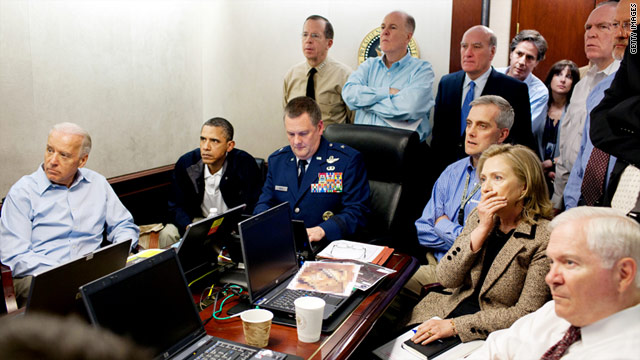
Even in America, we have newspapers doctoring the truth

Religious paper cuts Clinton from iconic photo

This is a copy of a newspaper that was printed in New York.

Here is the same photograph on CNN:

President Barack Obama and his national security team watch updates on the mission to capture Osama bin Laden on Sunday.
Notice a difference? Well, in the first picture, someone went through the work of photoshopping all of the women out of the picture. Turns out an ultra-Orthodox Jewish religious organization doesn’t believe that women in a picture should be included, because it would then be “sexually suggestive.” I’m not making this up either. It might have been possible to get away with this if the picture in question wasn’t such a talked about picture in the first place (whether or not Clinton was reacting in a strange way to some mysterious event that could have been about Osama Bin Ladin). You know, without the whole Hilary thing, there wouldn’t have been a story in the first place, SO WHY INCLUDE THE PICTURE IF YOU CUT HER OUT OF IT?
Okay, let me get out front and say this before continuing on. I have nothing against any specific religion, or promote any religious organization (or anti-religious organization either). However, having said that, I think we do a serious blow to any idea of organized religion whenever we try to pull this crap over the eyes of any followers. Censorship, or doctoring the truth, is NEVER a viable alternative to the truth. EVER. Lying means dishonesty. I have yet to come across a religion that advocates lying is the right course towards anything good. Ever.
The sad thing is: Anti-religious folk are now going to use this to cripple religious organizations. And then anti-Jewish groups will use this to insult Jewish religions. In the end, the only thing that was served was we promoted more hatred, more dishonesty and ruined the chances of honest conversations in this country and the rest of the world.
Good job, dishonest newspaper. Score one for Satan. (All apologies to Satanists who weren’t involved in any of this dishonesty)

When it comes to issues of sex, America does not understand redemption

I’m not one to latch onto another story and then write about it, although I admit there are a lot of bloggers who do that sort of thing. But this was one issue that I found to be so significant that I felt that it needed further attention, and perhaps even more perspective. An article appeared today in Salon.com that contained a personal narrative from Melissa Petro, a woman who had previously outed herself as a former sex worker and stripper before becoming a school teacher. As a result, she was hit hard by the conservative channels of the press, and then right after that by practically every other channel of the press as well. Even the governor felt it necessary to chime in demanding that she be fired. In all, she was completely railroaded out of the teaching profession, and by reading her personal story, you can also get the sense that she pretty much has a difficult time today of getting a job anywhere.

Now, I’ve written before about how I used to go to school with a lot of women who were sex workers while paying their way through school. At San Francisco State University, in certain disciplines, it was practically a right of passage. I couldn’t tell you how many friends I had who used to ask me to come see them dance as a stripper because at the time they were actually proud of what they were doing. Not all of them were, of course, but at one point in someone’s life, there is a sense that this is a perspective of freedom that not many other occupations can allow.

Unfortunately, that occupation is now competing against the sense that mainstream America has that anything involving sex is bad. And if you happen to work anywhere near children, it’s almost a given that you should be tarred and feathered and run out of town like the wandering gypsy you are. I won’t even get into the dichotomy issue of how most of the clients of these women tend to be the same men whose wives are horrified that these women did what they did; there’s always this sense that these “bad” women come from some place that has no interaction with the rest of society. And once they show up, they have to be run out quickly, or little Johnny might grow up to be a bad person, or might be forced into sex with her, or whatever bizarre hyper-fictious ridiculousness seems to be the fear that emerges in these situations.

The simple fact of the matter is, these women are all products of our society and civilization. They were churned out by the system at one time or another, and if we all want to go into this “they’re all bad for doing what they did” then we should take some sort of responsibility for putting them into those positions in the first place. We can’t have the luxury of just assuming that people are bad by nature, and therefore it was their fault that they chose to do those kinds of jobs that the rest of ridicule and condemn.

But even saying that, there’s an immediate assumption that stripping or sex work is bad. Is it really? What is so wrong about someone who does that sort of activity? What makes that person any less “moral” or less worthy of normal civilization than any woman who has carnal knowledge with a man as part of a relationship? Discounting the whole “it’s only okay in marriage” sort of nonsense that predates 1950, “moral” people don’t really make all that much of a fuss about people who engage in sex in relationships with each other. Granted, they don’t wanted specific details, but they really don’t care. So why is someone who is engaged in this activity on a normal basis considered someone to be less worthy of belonging to our daily civilization?

Over the years, I’ve known a lot of women who existed as sex workers. For a time, I got my start creating web pages for professional dominatrices, mainly because they were the ones who really fed the business back then when the Internet was started. Strangely enough, my main clientele were professional dominants and churches. And quite often, the references I received crossed both demographics (meaning that quite often my professional dominants contacts came to me from the web sites of churches I created or maintained, and the other way around as well). We’d like to think there’s a serious disconnect or separation between both avenues, but there isn’t.

What’s really concerning parents these days is not the sex worker “problem” but the belief that sexual activity is starting with people at a younger age, and they need a criminal to point to in order to feel better about the situation. But the reality of the situation is that by compartmentalizing sex outside of acceptable parameters, we make it so that younger people see it as something to explore out of the attention of parents, and then families pay for the consequences. Most young people are getting their sex information by watching Hollywood and the music industry sexualize every woman who has anything to do with entertainment so that the expectation is that it’s something good and to be pursued. There is absolutely no connection between a stripper and a music starlett, yet conservative media condemns the stripper and hypes the product of industry. Yet, if you really think about it, the stripper caters to a clientele that is strictly adult, whereas the music industry and Hollywood will take anyone with access to an MP3 player or a dvd player.

And with all that said, I’ve kind of wandered off the topic of the original person herself, Melissa Petro. In her own words, she actually felt herself empowered by her experience as a stripper and sex worker (well, more as a stripper than as a sex worker as she didn’t seem to say too many good things about the latter). Unlike most stories of sex workers, we’re told of horrible conditions and how they were forced into the experience. She came to it on her own, and it was a productive environment for her until she found her way out. And then she made something of her life, becoming a teacher who works with children.

We should have been congratulating her, not condemning her. If we accept the erroneous argument that sex work is bad, she got out of it and came back to us to live a more productive life. She should have been the poster child for how to win through horrible circumstances. But she wasn’t treated that way. She was eventually fired, and she has little recourse of ever working again, in any job. Her own narrative explains how she moved in with her boyfriend to survive.

What bothers me most is that no one else seems bothered by this. We’ll go on with our lives and criticize her for having made the mistake of revealing her past to the rest of the world. In other words, her was a teacher giving us a teaching moment, and none of us learned a thing.