Tag Archives: Reading

The Never-Ending Dilemma of Trying to Be Well-Read

(Licensed by the author, 2020)

First off, this isn’t a post that’s designed to glorify how much I’ve read. Posts like that have a habit of being a bit condescending, boring and painful to get through. Yes, I’ve read a lot of stuff. But so have so many other people. This post really isn’t about that.

What this post is about is one of the consequences of reading a lot of stuff. As a social creature, I really love to share great literature and nonfiction with other people. The problem is: Most people don’t care.

I’ll let you in on a little secret: I love to read. When I was a kid, just learning to read, I remember having finished all of the stuff other kids were supposed to read and then asking for more. The teacher had nothing else to share in the classroom at that time, but she had been reading “Crime and Punishment” by Dostoevsky, which was on her desk. I asked about that, and she told me it was too difficult for someone of my young age. So, the next day, I got my mom to check out the book for me from the public library. And I struggled through it, and finished it. Years later, I’ve probably read that book at least five times. I get something new from it each time I read it.

A more recent example: I just finished reading Men Explain Things to Me by Rebecca Solnit, a brilliant writer and thinker who also wrote A Paradise Built in Hell, which I love for its alternative approach of explaining history and the ramifications that occur during history. Both books are chalked full of history, so because I work with a couple of history people, I thought about recommending those books to them. The response I generally received was a blank stare, almost an admission of “your review to me didn’t convince me that I should waste my time reading what you were talking about.”

And that’s the problem right there. Over the years, as I’ve read more and more brilliant stuff, I’ve often recommended it to other people. What I’ve discovered is that so few people take up the gauntlet and decide to read those books. Instead, they listen to your explanation of that book and then because you’ve explained everything about it to them, they decide not to read it, possibly thinking that they’ve already absorbed the knowledge of that book by the mere moment you spent explaining it to them. And then they go on with their lives, only reading the things they find significant.

This reminded me of two things. First, Rebecca Solnit’s book Men Explain Things to Me, in which she details an encounter she had with a boorish man who found out she was a writer and had written on a particular obscure topic so spent the next hour or so telling her she had to read this book about her subject if she was ever going to understand it like he did. Turns out, she wrote that book he was talking about, and as men behave like men, he took forever to acknowledge that once finding out, and then still managed to talk down to her regardless of realizing that fact.

Second, the concept of knowledge and literature requires a modern scholar to actually read the texts himself or herself and not just the cliff notes version (and especially not just the conversation about it from someone who read it instead). Imagine discussing Plato with someone who has never read it but watched a lecture on Plato once. That works great if neither of you have read it (you can be clueless together) but when you’re the one who has read him, discussing it with someone who has no intention of reading it is a complete waste of time.

That’s how I feel when I talk about literature with people and discover that they’re not going to read it, condemning it because they didn’t read it first. I talked about Solnit with one person and actually saw his face turn negative, like he was disgusted by the fact that he’d never heard of her before, and thus, she was unimportant in his mind. That’s the kind of emotional response I receive a lot when I talk about literature that is important yet obscure.

What probably bothers me the most is that people often do not even realize that the books we read are snapshots of the best works of lives that we may never experience again. Other times, they’re snapshots of careers in progress, such as when I recall having read the early works of Ken Follett (who wrote a brilliant spy thriller in Eye of the Needle and then turned around and wrote one of the worst mysteries with ever bad writing technique available soon after that; and then he followed that up with one of the greatest historical narratives I have yet to read in my lifetime). It’s like having great conversations with people who have so much to tell us, and we’re limiting ourselves to only what’s popular, and quite often, on some television or movie screen.

It’s almost gotten to the point where I may not discuss literature with people any more. I remember bringing up Haruki Murakami to one colleague recently and received that “I haven’t read him, so obviously he’s not significant” response. Keep in mind, Murakami is probably among the most respected authors living in the world today. But because he’s not “known” to some individual, I end up having to explain his significance, which finally ends with a sense of “well, if I should find myself on a deserted island, am already bored and his book is all that’s there, I might read it.” Again, I find myself thinking, screw you and I hope you remain uneducated for life. But fortunately, I’m not that elitist. Well, not after I’ve had my first morning diet Dr Pepper.
One of the dilemmas of trying to be well read

First off, this isn’t a post that’s designed to glorify how much I’ve read. Posts like that have a habit of being a bit condescending, boring and painful to get through. Yes, I’ve read a lot of stuff. But so have so many other people. This post really isn’t about that.

What this post is about is one of the consequences of reading a lot of stuff. As a social creature, I really love to share great literature and nonfiction with other people. The problem is: Most people don’t care.

An example: I just finished reading Men Explain Things to Me by Rebecca Solnit, a brilliant writer and thinker who also wrote A Paradise Built in Hell, which I love for its alternative approach of explaining history and the ramifications that occur during history. Both books are chalked full of history, so because I work with a couple of history people, I thought about recommending those books to them. The response I generally received was a blank stare, almost an admission of “your review to me didn’t convince me that I should waste my time reading what you were talking about.”

And that’s the problem right there. Over the years, as I’ve read more and more brilliant stuff, I’ve often recommended it to other people. What I’ve discovered is that so few people take up the gauntlet and decide to read those books. Instead, they listen to your explanation of that book and then because you’ve explained everything about it to them, they decide not to read it, possibly thinking that they’ve already absorbed the knowledge of that book by the mere moment you spent explaining it to them. And then they go on with their lives, only reading the things they find significant.

This reminded me of two things. First, Rebecca Solnit’s book Men Explain Things to Me, in which she details an encounter she had with a boorish man who found out she was a writer and had written on a particular obscure topic so spent the next hour or so telling her she had to read this book about her subject if she was ever going to understand it like he did. Turns out, she wrote that book he was talking about, and as men behave like men, he took forever to acknowledge that once finding out, and then still managed to talk down to her regardless of realizing that fact.

Second, the concept of knowledge and literature requires a modern scholar to actually read the texts himself or herself and not just the cliff notes version (and especially not just the conversation about it from someone who read it instead). Imagine discussing Plato with someone who has never read it but watched a lecture on Plato once. That works great if neither of you have read it (you can be clueless together) but when you’re the one who has read him, discussing it with someone who has no intention of reading it is a complete waste of time.

That’s how I feel when I talk about literature with people and discover that they’re not going to read it, condemning it because they didn’t read it first. I talked about Solnit with one person and actually saw his face turn negative, like he was disgusted by the fact that he’d never heard of her before, and thus, she was unimportant in his mind. That’s the kind of emotional response I receive a lot when I talk about literature that is important yet obscure.

It’s almost gotten to the point where I may not discuss literature with people any more. I remember bringing up Haruki Murakami to one colleague recently and received that “I haven’t read him, so obviously he’s not significant” response. Keep in mind, Murakami is probably among the most respected authors living in the world today. But because he’s not “known” to some individual, I end up having to explain his significance, which finally ends with a sense of “well, if I should find myself on a deserted island, am already bored and his book is all that’s there, I might read it.” Again, I find myself thinking, screw you and I hope you remain uneducated for life. But fortunately, I’m not that elitist. Well, not after I’ve had my first morning diet Dr Pepper.

Now that I’m on my own

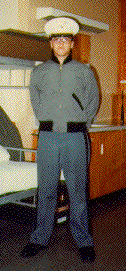
This was once me, at West Point. Boy, have I sure come a long way since then

The last day of work for me was on Tuesday, and it was one of those days that really didn’t have a lot going on. I came in expecting to be given grunt work to do most of the day, but the senior boss decided that I would have my exit interview at 11:30 AM, and then I was finished with the job as of noon. Still got paid for the entire day (or so they say), and then I was kind of on my own from there. I forgot to pick up some medication at the pharmacy at work because I was in such a hurry to leave, so I’ll probably have to wander back there this weekend and do the pick up of that stuff.

So, I’m now in the process of putting together my writing projects and pushing forward on those. I completed and published my novella, The Beast of Begmire, and I’m trying to see about getting it listed for free on most e-book sites. I also put it up on Wattpad this evening, so it should be available for anyone to read free there.

My next project will be to complete A Season of Kings, and during that project I’m still working on completing the first book of the series I’m writing with Marie. Hopefully, we can get that one moving forward, as I seem to have a lot more hope for that series than any of the fantasy ones I’m writing.

Money is going to be tight, mainly because of the way Spectrum Health completes the quitting process. I can’t ask for my payout money from my retirement until the last paycheck comes through from SH, and unfortunately the way they work it out, it will probably be about a month before the last “paycheck” comes through, and THEN I’m allowed to put in the paperwork for that money. Which means February might be a bit crappy when it comes to paying my bills, and unfortunately I’m not really sure what the solution to that is going to be. If it’s not one thing, it’s another….

Another project I’ve been outlining lately is one that I had on a back burner for many years now, and that’s my Return to Camelot series. Every time I write a specific novel, I find myself getting tons and tons of ideas, dialogue, and even scenes from the next novel I’ll be writing after the ones I’m currently working on. For some reason, Return to Camelot has been the one that’s been building momentum lately. All I can do is write down the ideas and hope that I can get to the actual writing soon. My working titles for that series are:

1. The Once and Future King

2. Return to Camelot

3. Le Morte D’Arthur

They’re not massively original, but they’re working titles for now, and they seem to push the ideas of what exists within each volume. I’m kind of looking forward to writing that series, as I wrote the first couple of chapters years ago and still refer to those chapters from time to time because they were so very good. Yes, a writer can admire his own work from time to time. You wouldn’t believe how critical I am of practically everything else that comes through my word processor.

For some reason, every night I seem to be dreaming about work (the old job). I keep dreaming how someone is telling me I have to do something and it must be done on a deadline that has already passed. And then an inner voice tells me, hey, you don’t work here any more, and I kind of toss and turn through that. I guess the subconscious does that to you when you’ve been living and breathing a job for so long, especially one that was becoming really good at developing arbitrary deadlines and then sitting on the results for weeks while new deadlines are thrown at you for new work that will then be sat on as soon as it met its completion. Anyway.

So, that’s kind of where things are right now. And as so few people tend to read my blog, aside from the spider sites in China that seem to access my page hundreds of times a day, it would be nice to hear from people who are actually reading it. Otherwise, I might just have to discontinue it, as it’s turning very much into a diary where I’m the only one who is really reading it.

Why I won’t be buying the new Kindle Fire HD or whatever it’s called

For some bizarre, masochistic reason, I have bought practically every version of the Kindle that has been made. The last one I bought was the Kindle Fire when it first came out. And that device is the reason I have decided to pass on anything in the future made by Kindle.

My needs are pretty simple. What I wanted was a device that could allow me to read books (which it does), maybe listen to a bit of music (which it kind of does, as long as you put your entire music library on Amazon’s cloud), and can place certain documents I need to read onto it as well (that one completely fails). For days, I have been trying to get my Kindle Fire to recognize a pdf document that I need to refer to quite often at work. It can’t. Or it won’t. Not really sure if it has a mind of it’s own, but it won’t read the document, no matter how many times I have tried to make it do so. I sent it using the email address they gave me to upload documents. After establishing that the email account I sent it from was legit, it should have been a breeze. I mean, my old Kindles did it just fine.

But no, it doesn’t see it no matter what I do. The document shows up on my “Manage Your Kindle” page, but my Kindle Fire just pretends it’s a stupid rock whenever I try to upload it/download it/pray to the Gods of Shaniaism, or whatever. It just won’t do it.

The truly sad thing is that my Kindle app ON MY IPAD 2 reads it just fine. But I bought the Kindle Fire so I could use these documents that can’t be read.

And don’t get me started on wifi access. It has the ability to connect with wifi, but 9 out of 10 times, it can’t seem to do anything once it connects. It doesn’t matter if I’m at work, at home, at the Pentagon, in the front lobby of Amazon. When it comes to wifi, they need to stop using a ten year old child hacker to develop their infrastructure.

Which tells me that whatever NEW Kindle they created is as fubar as this one. I mean, this was the expensive baby that the Kindle was selling as the be all Kindle. If they can’t make their best model do something simple, then I’ve given up on them. I’ll still use a kindle app, but I’ll be doing it on other devices, because, to put it succintly, Amazon sucks big time when it comes to making products.

The Amazon Kindle Fire…first impressions

Over the weekend, I went to Best Buy to purchase a new keyboard that I didn’t actually need. It was to replace a gaming keyboard I have that works great, but I decided that because their new gaming keyboard (by the same company) was on sale, I wanted to buy it. It does absolutely nothing new that the old one doesn’t already do, nor is it more stylish or have any extra buttons the old one lacked. But it was on sale, and it was new. So I went and bought it. Yes, I am aware that I am Best Buy’s proverbial wet dream of a client, and I understand that.

To make matters worse, I found my keyboard I didn’t need, started walking to the register and then decided out of the blue that I was going to buy a brand new Kindle Amazon Fire. Already owning a Kindle and having the Kindle app on my Ipad 2, I obviously didn’t need one, but it was there at the store, staring at me, so I felt I had to buy it. So I did. And then I bought the extra pack with it, that cost me an extra $100 for a $50 Amazon gift card, a case and ear phones, all of which I didn’t need either. But happy with my purchase, I took it home.

I’ve had the weekend to play with Amazon Kindle Fire, or the Kindle Amazon Fire, or the Amazon Kindle on fire, or whatever it’s actually called, and I can say that it’s kind of cool. It lets you access the Internet, like my computer and Ipad 2 already do. It lets you download your music library, which Amazon first forced me to upload to its “cloud” first, taking about a day and a half to do so. But then I got to download my music, which I already had on my computer and Ipad 2 in the first place. I mean, convenience knows no boundaries, right?

Then I downloaded some of my books which I had already bought on the previous Kindle and put them on my new Kindle so I can ignore them and not read them there, much like I did with my original Kindle. Then I sat down and read a hard copy book (Haruki Murakami’s What I Talk About When I Talk About Running) that didn’t need the Kindle or the Ipad 2 at all.

Joking aside, the Amazon Kindle Fire is kind of nice. Negatives: It doesn’t have 3G, so you have to use it over wireless only. Kind of a down side. It also makes it difficult to do certain things, like add my Amazon $50 gift card. I had to actually sign onto Amazon with my regular computer to have that $50 gift card registered. There really should have been a simplistic way to do it on the Fire, but there wasn’t. Granted, there may have been some convoluted and difficult way to do it on the Fire, but that sort of defeats the purpose of having the convenient device in the first place. I certainly couldn’t figure it out, other than using their web browser, which isn’t really the greatest browser of all time, even though they called it Silk.

Positives: It can finally read comic books on the Kindle. I downloaded several issues of  Y: The Last Man and was pretty satisfied with it. Down side to that? Yeah, the text is really small because of the 7 inch screen, so I had to really struggle to read the text on the screen. Not a very comfortable way to read a comic book (or graphic novel), but sometimes you get what you get.

Overall, I think it’s pretty cool if you don’t already own an Ipad 2. If you do, then the only real advantage is that there are some magazines and newspapers that refuse to release on anything BUT the Kindle Fire, which is a travesty of an economic plan. In the end, it’s going to kill those magazines because people aren’t going to buy the Amazon Kindle Fire just because Macworld refuses to let Amazon release it to the Ipad 2 Kindle app (which CAN read it just fine). Again, the biggest draw back to the whole Amazon Kindle model is that book publishers aren’t playing along. I refuse to buy a book published by a major publisher that plays games with the Kindle at their outrageous prices of $14.99 and up. Instead, I often choose not to buy the book at all, which is why I haven’t bought the new biography of Steve Jobs, even though I wanted to read it. The publisher is being a complete asshole to readers, so they can go screw themselves, and I’ll buy it when it gets released as remainder issue stock.

Instead, I’ve been buying books that are showing up at the below $9.99 price, unless I can find it cheaper as a paperback, like is happening with The Girl Who Played With Fire, which is still being priced as if it’s a brand new hard back book for the Kindle. As long as publishers refuse to do proper business with Kindle customers, then I say they can go screw themselves and their legacy models. Instead, I bought four other books that were decently priced, and I’ll avoid reading them (due to laziness)  instead of the books I would have bought and avoided reading as well.

Reality Disclosure: The Victoria Secret Fashion Show is Really Just a Televised Episode of Nearly Naked Women Trying to Sell Us Underwear

Attractive woman selling you stuff

I read a lot of news. So, it came to me as a bit of a surprise that CNN has been doing nothing but trying to explain how “important” their story about the Victoria’s Secret Fashion Show is.  After “reading” through their article and numerous other articles that have attempted to “write” about this story, almost always with a HUGE picture of very attractive supermodels, I get the picture. There was a fashion show put out by Victoria’s Secret, a store that sells ladies lingerie to women who want to look attractive to their partners after things have already moved to the point where they really don’t have to do anything to make the mood get to the next point. I mean, honestly, if I’m in a situation where a woman is now in her underwear, chances are pretty good she doesn’t have to convince me that I should be moving to, well, for lack of better terms, the next “base”. If I read things wrong at that time, then something’s seriously wrong with me, with her, or with the human species and academic mating rituals.

But let’s break down what’s really going on with this “fashion” show. It’s a bunch of very attractive women, walking around in their under garments, trying to get people to think this would be a really good purchase in the future. That’s really it. They’re not developing a better solar panel to collect energy. They’re not helping us figure out which presidential candidate is going to lie to us more than the other. They’re not even helping us find a potential mate. They’re walking around in their underwear being gawked at by guys across the country.

Cause let’s face it. This show might be watched by women thinking, “that outfit looks nice and maybe if I buy it, I might look like that multimillion dollar an hour supermodel” but it’s mostly being watched by guys who are thinking, “man, I really should have majored in something other than sociology in college cause a girl like that is never going to talk to me and my sorry ass bank account.” And, of course, there’s a huge segment of guys who are probably watching that show alone, in the dark. If you’re one of those guys, you might have even set up your own drive in cinema screen hire to make it a more immersive experience.

But great television it’s not. It’s like watching the Miss America Pageant and saying you watch it because you support programs that provide college scholarships to enterprising young women. No one buys that. No one even buys it when the pageant tries to pretend that’s why the pageant exists. It’s a vehicle to sell stuff in the way we always sell it. With sex.

So, I’m glad the show was the number one watched show in the country, just as much as I’m glad that Twilight is the number one movie, and every top seller on the New York Times bestseller list is a young adult book because Americans have become too stupid to read books for adults.

But that doesn’t mean I’m really happy about it. So leave me alone as I turn off the lights and watch the second half of this underwear advertisement show I taped so I could watch it alone. Check back with me in about a half hour. We’ll talk about literature then.

Why Sasha Grey, the Porn Star, Isn’t Allowed to Read to Children in School


In case you missed the ground-breaking story, the former porn star Sasha Grey, was discovered reading to little children at a public school, Emerson Elementary School. She claimed it was for Read Across America Compton, but according to Read Across America, they do not show any record of Sasha Grey ever having any affiliation with that group, or that she was reading for their program. Regardless of any of that trivial stuff, the uproar that came along was that a porn star, or ex-porn star, dared to read literature to little children who might be so impressionable that they’d start up porn careers, or whatever it is that paranoid parents assume is going to happen because of this. Believe me, they’re a lot safer around Sasha Grey than they are any Penn State football coach who might be volunteering to help out. I’m just saying.

But what’s even more interesting is this whole fascination with redemption that Sasha Grey is attempting to go through, and miserably failing. You see, if you’ve ever been a porn star, you’re doomed to be a porn star forever. In the United States, any sex-related career is about as low as you can possibly go, and any attempt to “better” yourself will always end up with some sanctimonious asshole holding that previous career against you because it’s so easy to do in our prudish environment.

Personally, I have zero problem that Sasha Grey used to be a porn star. So, I don’t care if she reads to children, administers mass during Christmas, or continues having sex with blindfolded midgets. However, I can’t speak for the rest of our society that seems to have problems with anything involving sex, even when serious incidents of hypocrisy are screaming in our face.

The real problem for me is that Sasha Grey is attempting to capitalize on her fame as a porn star and turn it into fame as a mainstream star without suffering any of the backlash for tying her fame to a questionable past. If she wants fame in our society, a society that frowns upon porn activity, then it’s really hard to cry foul when she has done nothing to separate her desire to be famous from her desire to be famous as a porn star. You see, Sasha Grey is most likely not her real name. It’s her “porn” name. If she wants to be seen as mainstream, she needs to completely separate her porn name from the name that she uses as a future star. But she’s not willing to do that because she’s gained a certain amount of notoriety for being a porn star.

The problem is the baggage she brought along with her. And that’s really no one’s fault but her own. While I don’t have a problem with her being a former porn star, I’m not the one she has to convince. She has to convince the rest of mainstream America, which is founded by a bunch of prudes who are two steps away from being a fundamentalist church state. If she wants to make her way as a famous actress, she’s going to have to live with the fact that a lot of people are going to hold her to her past, as long as she’s going to keep using that past to propel herself into a productive future.

And that means facing the fact that the majority of our nation is pretty shitty when it comes to holding people to standards they themselves can never reach, nor would they even try. That’s too bad, but no one actually has the right to be famous and rich. To do that, you have to actually go to the people who allow you to become rich and famous. And they’ve spoken. And what they said amounts to not wanting a porn star reading to little children.

Sure, it’s wrong in so many ways, but when has the path to fame ever been based on right and wrong?

Classic Literature is not a Punchline of Knowledge

I was having a conversation with someone about a mundane topic, specifically about butterflies, when it reminded me of Kobo Abe’s Woman in the Dunes, a story of butterfly hunter who gets trapped by a society that mates him with a woman in an inescapable sand house. When first discussing it, there was no expression of interest about my story until I mentioned that the man’s story served as somewhat of an allegory to the fact that he used to trap butterflies (and thus, he became the trapped butterfly as a result). Then there was the recognition of the point of the story, and that’s the end of that.

But it got me thinking because I realized that after telling this little literary selection that there are a lot of people who seem more focused on the punchline of a story than in the story itself, and that’s the purpose behind this post. You see, what I’m starting to suspect is that people are so focused on the outcome and the “rest of the story” that they miss the purpose of the original story in the first place. In other words, people will read about Machiavelli, figure the Prince was about gaming the system and then feel they know what they are talking about when they refer to someone as being Machiavellian. I use this example because it is probably one of the more misused literary references in current usage. I observe the media constantly trying to act academic when they call some world leader, or some local leader, as Machiavellian, and what they’re really saying is that someone is manipulative. It immediately gives me the impression that they’ve never actually read Machiavelli to understand that to understand Machiavelli is to understand the Discourses, not the Prince. The Prince is only a small part of a much larger canvas, and quite often people read the Cliff Notes of even the Cliff Notes version of Machiavelli, meaning they’re getting about 1/10th of 1/10th of an understanding of the government scribe, not even realizing his whole purpose was to explain Aristotle in his modern day terms, not to create an understanding of how people can be snide to get over on others.

I find this in a lot of media (and common) references to literature. I hear a lot of referral of Moby Dick from all sorts of sources, and almost always they focus on a tiny segment of the story. Sure, they usually get the overall message, but almost every time I get the impression that that’s all they got out of the story, meaning they probably never read it all of the way through. A couple of years ago, while sick in Prague, I sat in my room and read through Melville once again, and I came away with a completely new understanding of his novel. Most people, if lucky, might read it once, and that’s it. And usually it’s because it was required reading.

I see this same thing with Don Quixote, which is such a brilliant story, in both English and Spanish, yet I would bet that one percent of the people who talk about it have actually read either version all of the way through. I was reading it a year or so ago again, in English this time, and I was just floored at how great a story the author constructs. It’s not just a literary story, but it’s hilariously written by a man who truly understood the human condition enough to hold it responsible for all of its absurdity. A media critic bringing up his loyal assistant doesn’t come close to relaying the significance of that poor follower who leads us through so many of the protagonist’s great, yet ridiculous, adventures.

A year or so ago, I sat down and re-read Dostoyevskiy (one of many spellings of his name) again. I had read Crime and Punishment when I was a young child. As a matter of fact, it is the very first book I ever read, and I only read it because my grade school teacher at the time said I was too young to ever read such a book. The first time I read it, I struggled through it and barely eeked out an understanding that this was the story of a man who did something horribly wrong and was fearing the ramifications of his actions, kind of a reading I would have years later of the Tell Tale Heart from a much different nuanced author. Yet, I have re-read that book many times over my life, each time getting a better understanding of what the author was trying to reveal to me, only understanding it differently because I had years of living that backed up my new understandings. This time around, as I read through the Idiot, I think I came one step closer to understanding why the author told the story he did. Years from now, I hope to revisit it again and see if I came closer that time.

The problem I perceive right now is that way too many people are hearing stories, or watching them on TV or in movies, and they’re convinced they’ve “read” the novel and understand all of the choices the author took to relay his story. That is such a weak interpretation of literature and so sad of a compromise that it bothers me to even think about it. I fear for America because almost all of our bestseller charts are filled with young adult books rather than powerful novels that challenge us to think, rather than fill our heads with mild entertainment. From vampires and zombies to Harry Potter, we keep filling our libraries with crap that does so little to stimulate people intellectually, and while I sometimes think “well, at least the masses are reading”, I’m left wondering if we’re a society doomed to complacency and easy manipulation by people who are smart enough to realize that an intellectually void mass is much easier to control than one that thinks for itself. All it takes is someone with the wrong intentions, perhaps someone very, shall I say Machiavellian, and the future might not look so bright.

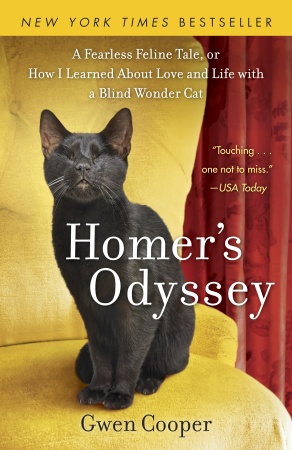
Review: Homer’s Odyssey by Gwen Cooper

This is one of those stories that grabs onto you from the beginning and pretty much never lets go. I was apprehensive about reading this book, because I’m not really that much of a cat fan (more of a dog pet person myself), but the blurb on the cover kind of hit me, and I was intrigued about finding out more about a blind kitten.

One thing that got me right from the start was the same thing Gwen talks about in her book throughout, and that’s the wrong impression someone gets from expectations of Homer right from the start. People expect this little kitten to be helpless, and you immediately find out that he’s nothing but that. He’s resourceful, full of life and pretty much the life of any party because no one ever taught him that he’s supposed to feel sorry for himself, or even that he’s blind. He is blind from the very early days of his life, so he’s never even known what it’s like to see. But he turns out to be the bravest, most resilient little tyke one might ever experience.

The story deals with Homer, Vashti and Scarlett (who are two of Gwen’s other cats), and it specifically deals with the life of Gwen herself. Where the story starts to bog down a bit is when it gets into Gwen’s own story, and mainly during the first half of the book, it really does sort of slow down as we start to experience more of her memoir than the story of Homer and his fellow cat family. Then it moves onto the author’s love life with Laurence, before it moves onto its conclusion.

However, it’s still a strong recommendation from me because the strongest moments of this memoir come from reading about Homer himself and how nothing you do ever stops him from completely enjoying life as it was meant to be lived. A couple of (SPOILERS HERE) critical moments also make up the narrative to where the story becomes where it deserves its bestseller status, specifically every time Homer experiences a new home and has to acclimate, the time Homer comes to the rescue of Gwen (when a stranger breaks into her house), the horrific period that Gwen goes through during 9/11 when the towers come crashing down (and she lives 5 blocks from Ground Zero), and a gut wrenching moment where Homer hits older age and runs into a near death experience towards the end of the book.

Four (4) out of Five (5) stars: 4/5.