Tag Archives: voting

So, Hillary thinks that if the election was held today, she might win. She’s wrong.

It was reported today on CNN‘s site that Hillary Clinton believes that if the presidential election was held today, she might win. I have bad news for her. She’s wrong.

And it’s not because I don’t like Hillary Clinton, which is usually where these kinds of stories and posts go. It’s because of something much deeper that for reasons that make complete sense, NO ONE IN THE MEDIA UNDERSTANDS.

You see, there’s this strange belief in the mainstream media that everybody hates Donald Trump because the mainstream media keeps reporting bad things about Donald Trump. And they keep repeating this information over and over. Then they conduct polls among the people who consume their news and wonder why the results keep telling them everything they keep reporting. YET, this was exactly what they did with their polls and reports during the election, and they were completely blindsided by the results.

What’s going on is something that the media just doesn’t want to face, or is just too lazy to admit might be happening: They’re reporting on only one segment of the population, and that population isn’t the majority.

You can start to see this when you read through message boards that aren’t one-sided or pay attention to the comment sections of stories on pretty much every other web site out there. There is an entire segment of the population that seems pretty angry and is just not being heard. And whenever they ARE heard, they’re treated as outliers, or crazy people, and then ignored. Yet, I suspect they’re a major part of the reason why Trump was elected in the first place. And they’re a major part of the reason why he’ll be re-elected, even though I still keep reading stories about how he can only be a one-term president because of how so many people hate him.

The sad thing is: I mentioned this during the election when people kept telling me how Donald Trump was a joke and how he had zero chance of winning the election. Whenever I mentioned that I thought the media was missing a large segment of the population, people just laughed at me and told me I had no idea what I was talking about. I suspect they’ll do the same again now. Oh well.

President Obama Believes That Compulsory Voting Will Counteract the Role of Money in Politics

Quite often, when discussing politics and the long-running issue of how the majority of Americans don’t ever vote, the suggestion of compulsory voting is brought up as a solution. The argument is simplistic, indicating that because money is such an influence on politics that if more people participated, it would somehow negate the effect of the money people on elections. There are a couple of false causality loops playing into this theory, in that an argument is made that (correctly) points out that younger people tend not to vote, younger people’s issues are generally not entertained by politicians who follow messages put out by money (generally older and richer voters) (correct), and that if we enable more of those younger citizens to vote, we’ll see change (which I will sadly state is a falsehood, no matter how much I wish it were otherwise).

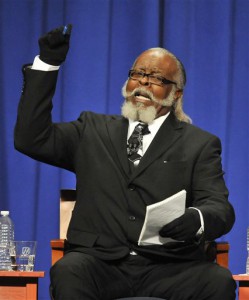
You see, part of the problem with elections in the U.S. is that our field of choices for who to elect is extremely limited, and ironically enough, limited to those who have money to get their message out there. If you’re not a representative of either of the two national parties (Democrat or Republican), you’re most often a marginalized candidate that is seen more as an outlier, or, worse, as a joke candidate. An example is Jimmy McMillan of New York City, who was the leader of The Rent Is Too Damn High Party. As you may suspect, his party had one issue, specifically rent being too damn high, and pretty much a list of other thoughts that no one paid any attention to. He was completely marginalized, and even though he might have had a real message that people should have listened to, he was considered a joke candidate, and his party as well.

If you consider that type of party to be a joke and think that more realistic third parties are better, just remember the examples of both the Reform Party (led by Ross Perot) or the Green Party (led at one time by Ralph Nader). Both candidates (and their parties) were considered disruptive to the mainstream parties, and thus, both men have been completely ostracized by their original parties ever since, unless they endorse the majority candidate of that party, and then they’re ignored again.

So, the point is that if you’re not voting for one of the two main parties, then you’re basically wasting your energy because very little gets accomplished outside of that sphere.

But those who are part of those parties will tell you that you should contribute because somehow those two parties will somehow represent you. But do they?

When I look at these dynamics, I usually ask myself a couple of questions of the candidates and their parties. Being in serious financial debt because of student loans, I ask myself which candidate will do something about that problem. Most often, the Republican will state that students put themselves in that probem, so why should they do anything to help? So, their response to that issue, to health care, to keeping food safe, well, they generally don’t care and will throw out some feel good statement like “the market will fix itself”, “a rising tide lifts all boats” or my favorite one: “Those who need help just need to lift themselves up by their bootstraps and do better.” Yeah, those are all positive responses to real situations (yes, that’s sarcasm). So what issues DO they actually deal with I might care about? Taking care of veterans? Used to be a huge one for the Republican Party. Turns out they’re really only interested in “helping” veterans while they’re still fighting wars, and quite often not even then, as we discovered when Republicans ran companies that ripped off the Army for food supplies during the Gulf War (which was never actually accounted for), created companies that profited heavily from war administration costs, like security and logistics, and when questioned, used political leverage to stop those questions from being further asked. Unfortunately, these days Republicans seem to be mostly interested in financial things that benefit very wealthy people, so after all the flag waving, I tend to avoid a lot of their rhetoric that doesn’t actually seem to be all that productive.

Which leaves me with the Democrats that historically have been on the side of the people rather than the rich. Well, somewhere around the 1960s, it was figured that this dynamic wasn’t going to remain because those Democrats started seeing government office as a place to make money rather than a place to do good government work and redistribute the money back to the people. The Republicans, usually happy in state governments (which kept them close to home where their big businesses were) started to see that money, too, and began funding PACs that fed a machine that brought more and more Republicans into national politics. Now, we have a Congress that is completely controlled by the rich class (the Republicans) and a good deal of the other side now pretty damn rich as well. What it means is that as both parties try to compromise with each other (which they’re not very good at doing these days), they side with anything that helps big business and rich people get richer. Let’s face it. The poor aren’t being sent to Washington, and when they are, they don’t stay poor for very long as they take advantage of all sorts of avenues for fueling wealth (even stealing if the opportunity arises).

But are Democrats out to solve the few problems I mentioned earlier? Like student loans? Nope. When it came time for them to do something about this, they sided with the credit card companies and the banks, just like the Republicans did. As for students, they basically threw them under the bus. Health care? Well, the Democrats were all for Obamacare, before they were against it, I suppose, but they haven’t done anything to actually fix it, letting it just run pretty broken, patting themselves on the back for passing it without first reading it and kind of hoping that it results in good things. An example: Passing the Affordable Care Act meant more people got insurance, but no attempts were made to get those insurance companies to be a lot more useful to those now under that insurance. Like me. I am under the same insurance now that I was under last year, but for some reason my insurance company has decided that it no longer pays for a drug I need to survive. With it, my condition improved. Without it, my health is completely falling apart again. Appealing is like shouting into the wind and hoping for results. Those are the kinds of things that no one is dealing with, so yeah we’re getting health care, but not actual care about our health. And most people won’t say anything because they’re thinking they got health care, but once they need to use it, they’ll find out they don’t really have it, and probably die before anyone can determine there was a problem.

Oh well.

So this brings me back to voting. How does voting for literally the same candidates that were decided for you before you ever had a chance to input your thoughts somehow equate to more democracy? Answer: It doesn’t. Right now, the Democrats are fielding Hillary Clinton for president. I never voted for her. I never supported her. She was a secretary of state because she was previously a senator. She was a senator for a state she didn’t even live in because her husband was previously president. Before that, she was someone’s wife. Good for her, but that’s not vetting a candidate. It’s choosing the most convenient name on the docket because we’re too lazy to actually find viable candidates who stand for something.

Is she for fixing student loans? No idea. She will probably never bring them up, unless there’s a path to victory for doing so. Does she support veterans? No clue. That’s the kind of candidates we get, and Obama is now telling us we need to participate more and vote for these kinds of people to somehow become more democratic. Sorry, but I just don’t see it.

And don’t get me wrong. I don’t dislike Hillary Clinton. I just don’t know anything about her and hate that the only time I’ll find out is when she’s already deadlocked into the nomination.

In the words of the renowned philosopher Forrest Gump: “That’s all I have to say about that.”

Rising Above the Noise

governmentThere is an interesting conversation that has emerged because Russell Brand, the comedian/actor, decided to lash out at some interviewer on politics who held him to task for writing for a political magazine. The upshot, or the telling points, are that Brand purports to be an anarchist who doesn’t believe in the current system, doesn’t vote, and doesn’t feel that holders of the current system really have a lot of ground on which to hold him accountable for these thoughts. In today’s Salon, Natasha Leonard expands upon this and then adds the criticism that Brand is basically a misogynist who essentially started his article by stating that he only wrote it because a pretty woman asked him to do so.

Having read both the article and having watched Brand’s interview, my only thought is that I find it fascinating that the concept of ideological anarchy is getting some attention, but at the same time I’m somewhat dissatisfied that it had to be someone like Russell Brand who brought it to our attentions. You see, personally I can’t stand his humor, his movies and pretty much anything about him. Okay, I liked his choice in marriage, as he married Katy Perry, but then that just meant she wouldn’t marry me because she was married to him, so I’m not sure that counts as praise any longer. At least they divorced so she’s still available (once she gets over those extremely rich and famous other guys), but that’s another story.

As for politics, I agree with Brand that the system is rigged, which is basically his entire argument. You see, he doesn’t really have a well-thought out argument. He just has a couple of news bytes, and they’re not all that impressive. It’s like someone listened to an Occupy protest and then shouted out slogans that people wrote on signs. Much of his diatribe was a lot like that. Sure, it was well articulated, but it was basically much of the same.

And that’s the problem with anarchy because we’re always going to be seen as a bunch of yelling, Molotov cocktail throwing Neanderthals who don’t understand that money makes the world go round. Okay, we do understand that, but only because we’re stuck into a specific paradigm that never lets us forget it. And that, too, is another one of the problems.

There are a lot of great ideas out there that have been written down and spoken over the years by people much smarter than me. Many of them have been anarchists. Hell, Marx was an anarchist, if you really think about it. Of course, I’m referring to Harpo Marx, that anarchist-leaning Marx brother who just doesn’t seem to get enough respect.

But anarchy is one of those out there institutions that really gets little to no respect because it’s not something tangible we can put our hands on and say, if we do this set of things, we can move to a system of government that actually doesn’t allow us to have government any longer. We could do that if we all lived in Hobbesian times where we were all scared of our neighbors killing us in this brutal world we live in, but because Locke and Rousseau got to reexamine Hobbes through later lenses, we’re now stuck with a system of a state of nature that requires bartering, food stamps and industry to build very large explosives that will be dropped on other people who might want our food and food stamps (and possibly our bombs). In order to protect the land barons of yesterday, we built industry barons of the day before yesterday, and now we coordinate technology barons who gives us access to our own information so we can reconnect with the people who live down the hall from us, but we’re too lousy to leave the apartment and knock on their doors.

Which brings me to diatribes on anarchy. There was a lot Brand and Leonard both said that is both significant and important. But no matter how much you listen to what they have to say, you’re still left with an overwhelming sense of despair, brought on by the fact that getting to there from here is a lot like walking through muddy waters, without  Chicago blues to back you up. People are really good at talking the game of anarchy or lack of government, but not too many people are really good at being able to envision just how you get from where we are now to a state of perfection (if that’s argued to be someone’s ideal). However, Leonard makes a great argument in that if someone has a parasitic creature on its face, telling that person that he needs to explain what creature he’d replace it with is not a question that should be asked, rather than just offering to get rid of the creature. The same thing can be said for a government system and economic infrastructure that are both not working. The answer that its defenders want is “what would you replace it with” when what anarchists are really saying is “get rid of it first, and we’ll figure out what should replace it later”. Democracy fans (or even monarchists and totalitarian fans) don’t like the absence of government as a state of being in order to deal with the removal of a parasitic government instead, which is why they’ll keep asking “what will you replace it with” when anarchists want that answer to be “nothing” or “anything you haven’t tried yet”.

And that’s where the complication of anarchy and not-working government comes to a head. Our system hasn’t worked for many years now.. I’m not even talking abou the dysfunction between two overpowered parties that stopped serving the mass needs of most citizens a long time ago either. I’m talking about how those two parties stopped serving the mass needs of citizens a long time ago. I don’t care that they can’t get along. I don’t care that they hate each other. I care that both of them have zero problem enabling themselves off of the system and making themselves filthy rich while pretending to be doing it in the name of the people. We should have seen the warnings when CEOs argued that corporations should get citizenship but shouldn’t have to pay the penalties that are enacted against actual citizens when they do wrong or illegal acts. It’s why major corporations cheat, steal and basically take actions that kill people, and there’s no ramification that causes any of their executives to do anything other than hire a PR team that only responds when too many people start to think they’re doing bad things and stop buying their products. If I’m part of a corporation that kills tens or hundreds of people with my industrial waste that helped my stockholders profit greatly, the only payback that might occur will probably involve fines (at worst) and possibly very weak future oversight. Me, personally, I’ll be free to do it again, and probably wouldn’t lose my job or position, and if I got away with enough, I’ll probably be promoted (or put somewhere with even more responsibilities because I’m seen as someone who can get things done).

That is what a lot of the complaints have been about, but no one really seems to care. Instead, we watch reality TV, worship movie and TV stars,, allow media conglomerates to take over the media industries that report our news, and we become dumber and dumber. And when someone rises above the dumb level of conversation and says something, we marginalize that person and make sure no one else listens to him or her again. If I was a comedian, this would actually be funny. But even our bad comedians, when they say this stuff, aren’t listened to, so what chance do I have to be heard above the noise?

The Struggles of Teaching Political Science to College Students

My role as a teacher

Every semester that I teach a new batch of students in political science, I find myself less and less confident in the future of America. Every now and then, a semester will throw off this natural trend, but more often than not, I find myself wondering what kind of future we’re leading to when so many students seem to have little to no grasp of the events happening around them.

I’m not talking about obscure political knowledge here. I’m talking about answers to simple questions like: “What’s going on the country today?” or “What are the important events happening in the world today?” I can understand the concept of being put on the spot to think of something. It used to happen to me when I first started my undergraduate days at West Point and an upperclassman would jump in front of your face and demand answers to “Tell me what’s on the front of the New York Times, New Cadet!” and you’d draw a blank more because you were scared to death of failing rather than actually not remembering what you read in the paper that morning. But this is different. When we finally end up with some story of current events in the discussion, like Obama’s “big speech on Thursday” I look around the class, and I’m met with completely blank stares, like they have no idea what was just mentioned. And when this continues over EVERY subject that gets brought up, you really start to feel scared when it comes to young people understanding what’s going on around them.

At one point in the past, I completely figured this was inconsequential because I started thinking, “who cares who knows anything about current events?” I figured it wasn’t all that important anyway. But it is important because significant decisions are being made each and every day in our governments, and quite often the people who influence public opinion and the decisions of leaders are completely clueless about what’s going on anyway. As Mussolini pointed out, when you have a population that is so blind to what’s going on around them, you can so easily influence them into doing anything you desire.

When we look at the last presidential administration and the atrocities that may have been carried out in our name, I look at the people of this country who don’t seem to care, and I immediately understand why so many bad things can happen at the hands of our leaders because no one will ever hold them accountable if no one has a clue what’s actually going on. When a presidential election occurs and the only reason someone votes for a leader is because of what partisan letter they registered for at one point in their life, we have a real problem. The country is divided into two camps of partisan designations, which means that the people who make up the party leadership of those two parties can practically do anything they want to do, and they’re still going to get the support of blind, oblivious constituents.

This is why someone like former Detroit mayor Kilpatrick can commit outright crimes against his own constituents, and he’d probably get reelected by the same people he cheated because their loyalties are to a mindset rather than to an individual. It’s why we have so much corruption in our governments these days. It happens so often that leaders rarely even hide it because they realize that they’re still going to get reelected because they’re not “the other guy”. This sort of thing stems from the fact that it takes a simple majority to put someone into office, and the majority of the population is filled with people who have no clue what’s going on in their government, and more importantly, don’t care.

The usual response to this argument is that “education” is the solution, but as one of those educators, I practically give up myself because no matter how much energy, how much struggle or how much entertainment I add to a class, students are generally only interested in rote memorization that will lead them to the answers for a test that they generally don’t understand. I’ve had students tell me a correct answer, but when I try to analyze the answer to see if there’s an understanding of the nature of that concept, they stare at me as if I just asked them the question in Klingon, meaning a) they don’t understand it, and b) as Klingon is from Star Trek, they figure it’s not important for them to give a rat’s ass about it anyway.

Yet, each semester I teach, I’ll receive a random email from a former student who thanks me for opening his or her eyes to knowledge he or she never realized existed, so I feel that I got through to someone. But when you have a classroom of 30-50 students, reaching two of them each semester leaves you with a sense that it’s not a successful achievement on a cost benefit analysis. You start to wonder if they would have come to this knowledge regardless, and you’re just surfing the wave that was heading towards the shore anyway. Or did you cause the wave to form? And if so, was it worth the costs of creating the wave in the first place.

I fear that not enough people are “getting it” to make a difference because when only 0.4% of the people who vote understand the process well enough to cast an enlightened vote, do the 99.6% doom us to bad choices, a doomed future and inevitable Mussolinis?

Sidelined Onlookers Documenting the Last Days of the Republic?

When I was working on my Ph.d for political science (how’s that for a first line, name-dropping, “look how important I think I am” opening?), one of the observations I kept making was how so many political pundits of their day were constantly making the prediction that the empire was about to crumble. There would be all sorts of analogies pointing at the fall of Rome, and yet another self-important political pundit of that time and day was convinced that the United States republic was about to collapse upon itself. It got to the point where I started to make predictions about the predicters, figuring that the eventual demise of a political entity is the propensity to fall into the ultimate entropy of political discourse: The belief that eventual destruction has to come on that person’s watch.

So, as I am watching the events of today unfold, I can’t help but find myself making the same mistake that everyone of these Thomas Paines, Mark Twains, Bill Buckleys and Helen Caldicotts kept making. We underestimate the inevitable apathy of the American people to care enough about their own circumstances to ever want to try to make things better.

You see, that’s pretty important, and as a political observant, it’s equally important to understand why people don’t do something as well as why people do the things they eventually do. Political scientists are very good at seeing French Revolutions under every rock, but incapable of seeing Moscovites living in squalor and despair, yet never doing anything to change their personal situation because while the payoff might seem great, the cost of achieving that payoff is sometimes just a bit more than any one man (or woman) is willing to pay. It’s one thing to complain about current events and to demand justice, but when that demand requires that you stand up against oppression by personally risking your own hide, that dynamic changes quickly. Oh, don’t get me wrong. We’re really good about making grandiose statements, like “give me liberty or give me death” or “I may disagree with you but I’ll fight to the death to defend your right to say it” but when it comes down to actually putting up one’s survival against one’s survival instincts, survival instincts win almost every time. We’re really good at complaining and claiming a backbone that we believe we might have, but like every bad war movie there’s that inevitable scene where the cigar-chewing sergeant reveals that a soldier may act all tough, but it’s only on the battlefield when you see whether he puts up or shuts up. In reality, we’re very much like that. We’re often all talk and very little action. I’ve often thought that political science could benefit from incorporating psychology into its discipline (where we put people into a room to see how much their political rhetoric stands up to experimentation…for the record, we don’t do that sort of thing because it’s ethically vacant in social science, but I’m really only talking in semantics right now).

Which brings me to my thesis for today, and that’s that I’m seeing all sorts of “fall of the Republic” activity happening on a daily basis right now, and I wonder how much of it is in place observation that always happens versus actual observations of real implications. In other words, I wonder how much my educated observations are really seeing as opposed to how much my educated perspectives are skewed by that same institutional framework I’ve been talking about since the beginning of this essay. In even more words, am I really seeing what I think that I’m seeing, or am I just another one of those overly observational folk that see things that have always been there but our current paradigm now recognizes it as something less than it really is?

I mean, let’s look at some of the evidence. We’re currently in a budget mess that this country has never been in before. Unlike the past, our solutions were usually to go back to the drawing board and come up with new solutions. Today, we aren’t going back to the drawing board but spitting out rhetoric that doesn’t solve anything but actually makes things worse. People are out of jobs because we may have exhausted the majority of the low-hanging fruit that was once available to us by virtue of our ever-expanding economy and untouched resources. Our economy is no longer expanding, and our resources are essentially tapped, overtapped possibly. The solution was always to find cheaper labor and cheaper resources, but we’ve run out of those options because the former labor solutions have wised up to this act and now controls the labor channels that we used to exploit. Instead, we have lost revenue sources, labor pools, and our own people don’t seem to be able to find the jobs that they used to find that usually existed on top of these other resources and lower income labor pools. If you look to our political leaders, the choices are either to raise more taxes or to cut spending. But neither solution is a solution to the actual problems we seem to be facing. Raising taxes doesn’t do any good if you have no one to raise them on, especially if we have fewer and fewer jobs. Cutting spending is great, but at the same time that only kicks the can down the road again because as we lose that choice labor we used to have, more people end up relying on government to fill in the gaps, yet cutting spending makes that even harder. In the end, we have what’s called the continuous rush to the bottom, and rather than recognize this and try to push back up, we are building infrastructure to make sure the trip to the bottom happens a lot more comfortably.

So what’s the solution to all of this? Well, if you’re a naysayer or a doomsayer, your answer is pretty simple. We let it all collapse and start over again. And sadly enough, we have political leaders that seem to be advocating just that. Oh, they won’t say that exactly, but their solutions are just that. Rather than try to find viable solutions to build prosperity, we seem to have a lot of leaders who are basically just trying to fund the megastupidopoly a little bit longer so they can cash out before it all comes crashing down. The solutions all appear to be named: I’ll get mine and the hell with the rest of you.

Which brings us back to the “people”, the ones who are responsible for fixing it all sans great leaders. But what can we really expect from them when the only input we allow from them is to punch a Yes or No hole on a ballot? We don’t ask for their ideas. To be honest, our political leaders don’t care about their ideas and are really only interested in their money, support and again, what the people can do for their leaders rather than the other way around. Oh, the rhetoric always sounds the opposite of what I just said, but actions speak much louder than words, and those bad actions have been speaking a lot lately.

When the economy started to collapse, our leaders bailed out the car companies, the banks and Wall Street gazillionaires. The common person received zilch. When the common person had his house foreclosed on, the government backed the banks. When it become political impossible to keep doing that, the government stepped in and demanded the banks be slower about taking everything away from their customers. Not that they stop taking everything away. Instead, they gave the banks everything they wanted in practically every area of discourse. Credit card companies received guarantees that people could no longer go completely bankrupt without some kind of continuous debt to the banks involved. When banks were discovered with their pants down involving overdraft charges, government stepped in and did as little as they could there as well. Even with the tiny movement made by government on the people’s behalf, the banks managed to get huge lobbying to soften the changes, and even now are working on reversing some of the impact they have “suffered” as a result of government forcing them to be less greedy and more upfront about their attempts to screw over their customers.

But what it really comes down to is the question of whether or not the common person in America really cares enough to pay attention to what’s happening. President Obama and the minions of government are trying very hard to convince the rest of the country that the budget impasse is important. The media is starting to make comments about how much the debt really “costs” each person and how much in debt EACH person is as a result of the debt ceiling we are currently living under. But what none of them have been capable of doing is convincing the average American that he or she really should care. Oh, they’re trying to make that argument, but it’s falling flat. Let me explain why, using simple logic that the average American is using.

Let’s call me Citizen A. The government tells me that my current debt (as a result of the deficit) is $70,000 (just for the sake of using an arbitrary number because the real number is just that, a number). My first thought is that as a citizen of this republic, I should be concerned, but in reality, I’m more concerned about the $150,000 student loan debt I’ve incurred trying to get a college education, my $350 monthly car payment, and my $500-1000 monthly rent bill I have to pay. Adding in a whole bunch of other expensese I probably have to pay a month, Citizen A really doesn’t care one iota about the personal $70,000 that is part of my slice of the deficit because to be honest, it’s not really my debt. I don’t see it that way. That $150,000 I owe in student loans is my debt, but it’s going to take a lot of rhetoric, a lot of speeches and quite possibly an overweight FBI agent in a bad suit with a crowbar to convince me that the government’s deficit is in fact, MY deficit. Citizen A doesn’t feel a connection to that debt. In fact, he thinks the government squandered that money, and that it’s really the debt of people who work for the government. That, in fact, it’s THEIR debt, not his.

Now, as a rational individual with a bit of education, I understand it shouldn’t be this way, but game theoretics are involved here, and when it comes to payoffs, the average citizen feels just like Citizen A. We don’t feel the debt is ours. It belongs to the government that for years has treated the “people’s” money as its own. When we took away the draft, made voting voluntary, and made presidential state of the union addresses optional television programming, we eliminated the ties between government and Citizen A. People see our government as an entity that exists because it has to exist, but as none of us fought to create this republic, very few of us actually have served to defend it, and most of us are oblivious to what this republic does on a daily basis, it’s very difficult to sell the supposition that government and people are tied to each other.

So, I ask: Are we seeing the end of days, or is this just another hiccup in the usual way things happen? And if it’s the latter, then how do you get people to care enough so that it doesn’t end up becoming the former by eventual default?

A Conversation with Conservatives About that Whole Midterm Thing that Just Happened

Hey, Conservatives. I just thought I would take a moment to talk to you about the midterm elections, because for some reason you’re getting the idea that events happened for reasons completely absent of reality. Therefore, as I know that you always listen to rational people explaining rational theories, I thought I would chime in with a little rationality.

There are some things you got right and some things you’re getting wrong. Let’s start with what you got right because everyone likes to hear good things about themselves. First, you are right that America was angry, pissed off and frustrated with politics as usual. In droves, people went to the polls and voted to “throw the bums out”. That anger was their way to show that they were angry, and if Washington wasn’t going to listen, they were going to make them listen, or at least stop paying for their hearing aids.

Lots of Democrats were thrown out of office, and lots of Republicans were given a chance to run the government. Okay, we’re on the same wavelength here.

Unfortunately, this is where reality sort of spins off on its own axle and falls apart. While the American people were angry, we need to kind of revist exactly what they were angry about.

First, Americans weren’t angry about social programs in America. Republicans tend to always be angry about these things. But it wasn’t Republicans that really voted the Democrats out of office. It was both Democrats and Republicans, meaning average Americans. The average American wasn’t upset that people were getting health care and the opportunity to survive through the Winter. They also weren’t upset that the government was spending money to get people back to work.

No, Americans were pisses off at government because government was helping out the wrong people. Who are these wrong people? The rich, the selfish, the people who don’t care one iota about the common folk of America. Americans saw the government spend a lot of money to bail out Wall Street, to help out banks and to rescue multi-millionaires from losing more money than they were already losing. The fact that almost none of the stimulus money actually went to help out the average American, other than through the usual trickle down crap theories, that upset Americans a lot. While the average American was trying to find a job, government was spending weeks arguing over how much money to protect from millionaires and billionaires with expiring tax cuts. The government seems willing to go into shut down just to make sure that the rich are taken care of, and the poor really don’t mean much to those who occupy office. Except in conversation, which doesn’t mean a lot when people have to actually pay their bills.

When the midterm elections came along, the American people were pissed that government was catering to the rich only. Yes, both Democrats and Republicans were bending over backwards to make sure the rich weren’t inconvenienced in any way, shape or form. The poor, well, they needed to fend for themselves because that’s generally how government feels they should have to handle their own affairs.

Most people didn’t even recognize what was going wrong with the Democrats in office when they had control of the entire government. Not once did they even act like Democrats, being almost indistinguishable from Republicans. THAT is what pissed off the American population that went through a previous election putting every Democrat they could find into office. When the American people discovered that it didn’t matter which party was in office, they kind of revolted and threw those people out, figuring the Republicans weren’t probably any worse.

Well, the Republicans need to figure out that the American people didn’t send them into office with a mandate to do things Republicans tend to do when they aren’t discussing politics. You know, the kinds of things they do surreptitiously behind the backs of everyone else, like reward the rich and screw over the poor. No, the American people sent the Republicans to Washington to remind the Democrats who they were supposed to be working for. That’s really it. The mandate the Republicans received from the American people was “do something different, but if you piss us off, too, expect to be accepting your own unemployment check.”

And the way things are going, there’s going to be a lot more unemployed politicians in 2012. Unfortunately, this will cause the Democrats to pull a Sally Field, thinking people like them, when in fact the people are still pissed off. The only difference is, they’ll realize they have nowhere else to turn.

And a pissed off electorate that has given up on both sides is a very dangerous animal. Once you give up on your government, there’s really not much else to do. Just ask all those Middle Eastern countries right now that are throwing out their leaders. They might have something interesting to say about it, if you could stop them long enough while they’re rioting in the streets.

Why Most of the US was Pissed Off During this Election

It’s amazing how the media can talk itself into a frenzy and still never manage to actually say anything of merit. I’ve been reading and observing all sorts of reports that purport to explain why the midterm elections went so bad for the party in power, and almost every time I read a newspaper article, watch a television broadcast or avoid a crazy person screaming on the streets, I’m left with the same conclusion: These people don’t live in the real world with the rest of us. Well, the crazy guy on the corner screaming does, but his view of our world is a completely different story.

No, what I’m talking about is how two economists can go back and forth about the economic bank bailout and not understand a single thing about why the consensus of the country was negative. One economist will talk about how there was not enough money invested (and there needs to be more), while the other argues that too much money was spent on the banks, but it was spent improperly. And yet another will argue that the wrong banks were bailed out, or shouldn’t have been bailed out so that nature could have taken its course.

The problem they don’t perceive is that the average person looked at billions of dollars being spent on very rich people and very rich organizations, and they don’t feel like the solution ever impacted them in any way, shape or form. Banks still forclosed on people regardless of how much money was spent propping up the banks that had invested unwisely in real estate adventures.

I’ll repeat that. NOT ONE single penny was spent on bailing out people who were losing their homes through faulty mortgages. Instead, they were the ones who were thrown into the streets and forced to make do with nothing while the banks were given billions of dollars of taxpayer money to prop up their bad investments. When not one cent was spent on propping up the average voter who lost his or her home, then that whole “bailout” thing seems like it happened to people who didn’t deserve it in the first place.

The solution would have been for the government to have stepped in and propped up bad mortgages instead of the banks themselves. By coming to the rescue of banks, the very rich were the ones who were sheltered by the government, and not a single “normal” person received a single bit of benefit from the government. So when Obama gets on the soapbox about how the people just didn’t allow enough time to let things settle, or they were too focused on other things, perhaps Obama needs to realize that he’s focused on the wrong things, if he’s at all interested in why the country has turned 180 degrees against him.

People have a really hard time being told that they’re wrong for feeling one way or another, especially by someone who is not suffering in any way whatsoever. A lot of people were hurt by the economic turn around, and being told that it’s their fault and they just need to own up to their own failures is never going to go over well, especially when Wall Street entities were told the exact opposite and given huge cash payouts to make sure they didn’t feel bad.

What has happened is that a lot of centrist thinking people in this country are coming to the realization that they don’t matter to the government of their own country, and that’s a really sobering throught when you get around to thinking about it. But instead of facing that dilemma, we ignore it and sort of hope that it will just go away. Or throw more money at rich people and hope that somehow that will trickle down to those who no longer believe the powers that be are interested in the people without power. Unfortunately, neither alternative leads to anything but class division, and as more people in the class with the most people come to the realization that their disenfranchisement also brings along a lack of care by those in power, then you’re going to end up with a very pissed off electorate.

The real problem is that as that electorate gets more upset, and votes out the “bums” over and over again, eventually they’re going to realize that their angry votes aren’t getting them anywhere. And as long as government entities continue to think that rewarding the rich with more riches is the way to a better nation, we’re going to end up with a very pissed off group of citizens who have realized they have no way to institute change in a system where elections reward those who are already in power. And once we reach that point, there’s no telling where we go from there because institutional anarchy has no way of being predicted, no matter how much the smartest guys in the room keep believing otherwise.

Essentially, we’re playing a game of hoping that we can gain enough riches before the whole system comes crashing down, not once thinking about the ramifications of what happens immediately after that moment. Because once the system crumbles, there’s no telling what you inherit after. And if that’s not scary to the average citizens, then I don’t know what else would be.

Why the Democrats Are Having So Much Trouble in This Election

If you read the newspapers or watch that silly contraption all the new kids are talking about called a “television” set, you might discover that a lot of people think the Democrats are having a bit of a problem heading into the midterm elections. The blame is interesting. Some say it’s the fault of Obama for not living up to his expectations, or because he did things he shouldn’t have done (like that whole Health Care thing I keep hearing about from the intellectual minds of our time, like Sarah Palin and Christine O’Donnell). Others say it’s because the president’s party tends to lose seats any way during a midterm election, even though two of our recent presidents didn’t (but who pays attention to recent facts when it comes to spouting off statistical information that is out of date?).

But I have a different perspective that might explain why the Democrats are losing seats, or at least are heading into the election with the prospect of losing both the House, and possibly the Senate. I say this knowing that both sides will completely disagree with me, even though I’m right, but this happens every election, and then when it comes to me saying, “I told you so”, everyone lies and says they knew it already, even though they were saving the complete opposite right until what I predicted actually happened. I’m not even going to make a prediction here. I’m just going to tell you what’s already happened, which is pretty funny because people are so good at putting their fingers in their ears and singing “lalalalala” no matter how much they should just listen.

The Democrats are heading into this election losing seats because of two factors. The simple one is obvious. People are pretty pissed, and they need to lash out at someone. The Democrats are in charge of the presidency, the Senate and the House, so who do you think the people are going to lash out at? The Republicans who aren’t actually in charge? Even if the Republicans are responsible for EVERYTHING that’s wrong right now, the people don’t see that. They see who has power and that’s who they’re pissed at.

Now, having said that, I should also point out that the statistical phenomenon of people voting locally but being angry nationally should have actually saved the Democrats from a massive retribution from the people. Unfortunately, another vector is involved in the equation, and that’s the one that I think is making all of the difference.

You see, when Obama ran for president. he was swept into power by a dynamic force of change that was promised by a lot of his biggest fans. I’m not talking about his own team, or even Democrats in general. I’m talking about a lot of people who were so pissed off at the US because of the Bush Administration that they were so enamored by an outsider that they started to invent godlike status to his name. When Obama was swept into office, it was less of an election and more of a piety-filled coronation. People who wanted him were so in love with him that they made it out like he was no only going to do good things, but he was going to usher in a new age for America so that we would be the new Camelot on the hill, and every nation would worship this nation, and its new messiah for all of its greatness.

The media fell into it as well. The articles that were written about him were so gushing that I was beginning to be sickened by the coverage, and I was actually a fan. It was this admiration of him that completely threw Hilary Clinton under the bus, leaving her almost a roadkill on the way to the White House.

Well, those people who bought into this illusion started to wake up when they started to realize there was nothing glowing about Obama but the fantasy of what he was going to be doing. None of the great things happened. Even his biggest legislative achievement has been seen to be so controversial that almost everyone who ushered it in wants absolutely nothing to do with taking credit for it. Right now, Obama is helping his fellow Democrats by sending out his wife because she’s more popular than he is.

The problem the Democrats have right now is that they have a sobering electorate that now needs to be mobilized the last few weeks before the election. How do you do that? How do you convince a bunch of formely drunk drinkers that they need to go out and do it all again, except this time they have to pay for their own beer, and we’re going to be carding everyone going in and breathalizing everyone on the way out? You really can’t.

Instead, they’re facing an election where everyone is having to fend for themselves, and the only record they have to rely on is the one that everyone realizes was part of the drunken party atmosphere. Let’s face it. The Democrats haven’t done anything to gain the advantage going into November other than to not be the Republicans. That’s a pretty shitty herald to have to hang on your head going into an election.

The bigger problem is that the country is waking up to the fact that our elected leaders are a bunch of lawyers who are really only interested in what’s best for themselves. The promises don’t yield results, and the business of politics has shown itself to be a pretty sick animal.

Unfortunately, the people also realize that they’re left with a choice of two candidates in most races that are pretty crappy. And people aren’t really excited about yet ANOTHER election where the better of two evils is the electoral choice. There’s a very poignant Simpson’s episode where two evil aliens are discovered to be the real Clinton and Bob Dole during the 1992 election. Someone yells out: “I’m voting for a third party” and one of the aliens laughs at him, saying: “Sure, throw away your vote!” That’s where Americans are today, and it’s probably not a great position to be in if you’re walking to a voting booth in November.

Now, a voting critic would probably then say, don’t vote, but that’s not my advice. If you find that you abhor the candidates, go into the booth and vote for the issues that are of interest to you. Not every issue in an election is a vote for a candidate. Take advantage of your right to vote, go in there and vote for the issues that mean something to you and then leave the candidate crap blank. When someone here’s you complain and asks you if you voted, you can say you did; you just didn’t vote for any of the shitty choices that you were given. Until this country enacts a law that says you have to have 50 percent of the population vote for you, and not just the majority of the people who bothered to show up, then we might have people in office who realize they have to do something to actually earn a vote. But I don’t anticipate that happening any time soon.

The Rent is Too Damn High and Other Third Party Fun

After the fall of the Berlin Wall, after the collapse of communism in Eastern Europe, there was an immediate move to capitlism and democratization. If you read any normalized history or political book about the period of change, you read it as a collective move of the populations towards democracy, but that’s not really what happened. What really happened was it was a move towards capitalism. Democracy was just one of those buy one get one free things that came with capitalism. During the Cold War, people were interested in the things capitalism could bring, like food and shelves filled with products. They thought democracy had to be part of the deal, so they accepted it freely. It was only after they realized what democracy actually was that a lot of these newly “free” countries started moving back towards authoritarianism. The interesting part is that they still wanted capitalism; democracy just wasn’t all that important.

It is probably important to point out that one of the first things that came from this new formed freedom of democracy was a new sense of political parties. It might surprise you that one of the most popular political parties to arise was the Beer Party. Its platform was simple: “Vote for us and you get lots of beer.” They actually got a lot more seats than almost every other non-main political party. In the Czech Republic, they were so powerful they actually shared power in the coalition government.

Why am I talking about this? Well, in the United States, we don’t really have third parties that have any power or significance, but we do have third parties. Most of the time they’re marginalized and looked over as a joke, like the Green Party or the Communist Party, but in some cases they actually gain a bit of standing, like the Reform Party. And then they become marginalized like the rest of them and no longer stand for anything.

Yet, every now and then one of those parties comes along that has a leader who is so outrageous that he or she essentially becomes bigger than the party. This was discovered at the recent debate for the governorship of New York, when the debate was practically won by Jimmy McMillan, who is the governor nominee from a party called, wait for it…The Rent is Too Damn High Party. And as expected, Jimmy made every attempt to utter that phrase during his one opportunity to speak to the masses during the debate.

The strange thing is that he came off as the most interesting and most popular of the speakers during the debate mainly because he came off as being completely nuts. Will that translate to votes? Probably not, but it sure would be interesting if it did.

Which brings to mind a situation that happened when I was in California. There was an interesting individual who was running for president during the 2008 election. He was this guy that used to hang out at Carls Jr every morning, and by coincidence so did I. I had this theory that crazy people used to hang out at Carls Jr every morning and…um, I mean crazy people AND I used to hang out there. Anyway, so during the Obama election, I was minding my own business and this guy comes over to my table and says: “Aren’t you a political science professor?”

Now, other than the fact that I used to walk around with my graduate graduation attire on every day after I graduated, I have no idea how he figured that out, but I said yes, I was. So, he started to tell me about how he’s been running for president for the last 20 years, and the media never pays any attention to him.

Then he proceeded to pull out a briefcase with all of his papers. Okay, it wasn’t really a briefcase. It was a Manila envelope that was tattered with paper hanging out all over the place, but he called it his briefcase, so I’m sticking to that. He then began to show me, in no uncertain terms (well, uncertain if you’re certifiably nuts) the linkage between the Kennedy election, 911, and something called the Koala Bear Effect. I listened to him for about an hour, before I realized I was slowly beginning to understand and believe him, so I bid him fairwell and then ran home, screaming.

I wrote an article about this for the local newspaper, and then immediately started receiving inquiries from larger newspaper reporters, wanting to know how I was able to find this guy, as they’ve been looking to interview him for years now but never could. I said that he eats at Carls Jr every morning, and they didn’t believe me. Eventually, the calls stopped coming. I realized then and there that some reporters are extremely lazy when it comes to following up on a lead.

The point is: There are third parties out there that have some very interesting people running for office. And yes, there are nutcases out there, too. But as long as we keep focusing only on the main runners, we’re never going to change the system or even have new ideas. Unfortunately, there’s no one out there even trying to make a difference.

So, until the next election, all I can say is that yes, the damn rent is too high. Unfortunately, no one is planning to do anything about it.

My Blueprint for Fixing the American Political System

One of the problems inherent in trying to fix the American political system is figuring out what’s wrong with it that needs fixing in the first place. Often, these arguments get bogged down in partisan politics that end up with someone claiming that getting rid of the other side, or something equally as ludicrous, is the solution. I’m not going to argue any of that nonsense. Instead, I would like to tackle this subject as objectively and as usefully as one can.

First, the political system in the United States is not broken. There. I said it. Which might make you think that this discussion should be over, and then we can all get back to our Dancing With the Stars and Lindsay Lohan meltdown watching. But no, there’s more that needs to be said here.

I’ll repeat: The political system in the United States is not broken. It works just as it was designed. This should not be surprising to anyone who understands politics. Political systems are designed to work in a certain way, and even the most corrupt systems are designed correctly. It’s what’s done with them that matters the most. And that’s where the problem with our system comes in.

I’ll let you in on a little secret. The US system was not designed to work with this many people. It was the perfect system when we designed it because our government was really small. So was our population. But both have grown over the last two hundred years and some change so that our ability to do a lot of the things it was intended to do has diminished. When we first started, a member of Congress represented about 30,000 people. Today, a member of Congress represents about 703,0001 people. There have been no indications that anyone in government has any intentions of increasing the number of representatives, nor in addressing this particular issue. The main reason for this is because if more representatives were added, it would cut down on the power that current representatives yield. Asking a politician to give up power is like asking a child to give up his or her toys. It’s not going to happen.

And that’s where our problem starts. No one in government is willing to do anything about changing the problems, and I mean most problems, not just the first one listed here, because it would threaten their current bases of power.

So, let’s look at a few ideas I have for how we could make changes to make our system work, and then after I go through and tell you why it won’t happen, I’ll then address how we can actually make it happen, something no one seems to ever want to discuss. Unfortunately, most of these issues tend to get bogged down in the first two thoughts (what needs to be done and why no one will do it) and rarely do we entertain the actual process of how we can actually make it happen.

So, here we go.

1. Term limits. The biggest problem we have in government is the corruption of those who have the most power. The way to end the corruption is to remove people from the ability to overuse that power, especially for their own benefits. Term limits do just that. Why don’t we go there? Well, politicians who don’t want to lose power are very good at convincing people that the system stops working if their expertise is not involved. Yet, if a politician dies, a politician replaces that politician almost overnight. That argument has no merit whatsoever. What they’re really telling you is that they need you to believe they are expendible, but they’re not. Get rid of the incentive to pay off someone who is going to be in power for decades, and you end the ability for that person to become entrenched in a power base.

But that’s only a small start.

2. Lottery elections. Remove the elective influence of lobbyists, and you end their power forever. A lottery is a system where anyone can be chosen for a job. Politicians love to try to convince people that you need to have skill to be a politician. You don’t. Anyone can be one. That’s why the qualifications are so low. When we started this whole government, we put people into power who had very little political experience. Political experience is gained quickly once in office. Once you remove the throngs of politicians from the political mess, you no longer need experts capable of navigating through the mess because the mess disappears when the “other” politicians aren’t there to have to be cajoled to do what needs to be done. You don’t need an expert to maneuver through a series of amateurs if there are no longer political experts to have to worry about. Term limits eliminates the experts. Lottery elections make it so anyone can serve in government.

And that’s the important part. Serving in government should be a service, not an occupation.

3. More representatives. That should be a no brainer. As long as you don’t have people protecting power bases, you send more people to government to represent you better. Right now, my congressman has no clue about me, nor does he care. Nor will he care, even if I try to get him to care. I’m not already powerful, nor am I rich. Therefore, I am unimportant to him. That needs to change, but it won’t as long as we continue doing the things we’re doing. Being a representative should be like jury service, except it lasts for a few years. If you can’t afford to leave your occupation for a few years, you can take your name out of the election hat. Simple as that. Except, unlike juries, people tend to want to serve in government (which is why we have elections right now), so we’d probably actually have a lot more people willing to put their name in the hat. Well, let’s fix juries as the same time. If you want to serve in government, you also have to serve on juries. You don’t get out of one if you want to serve on the other. Might make the country a bit more interesting.

4. Change our system of government to that of proportional representation. Our winner take all system doesn’t work with so many people right now. We need proportional representation. We’re one of the only democracies, or representative democracies that doesn’t have PR. I find it pretty funny that when the US goes to a foreign country and helps them establish a new government (like we did with many Eastern European countries after the fall of communism, and during the Cold War itself after World War II), we almost always install a PR system, not our own. Why is this? Well, because ours is too complicated, and as diplomats have argued over the years, a winner take all system like ours is too easy to lead to corruption and dictatorship, or a dictatoral oligarchy (Aristotle’s aristocracy that has turned corrupt).

An interesting story, but when New Guinea was switching from a winner take all system to a PR system, they were suffering from horrific apathy of voting. After the switch, numbers that were in the 20 percentile, went up to the 90 percentile of voting participation. It dropped back down to the 80s and 70s, but that’s still well over twice the percentage we get in the US.

Okay, so what are the problems of converting to these simple little ways? Well, the people already in power today won’t do it. The two political parties say they represent the rest of us, but the second you threaten them with a potential loss of power, they argue that they are the true representatives and won’t even discuss it. PR is not even on their radar. Nor is lottery voting. If it threatens their power, they aren’t interested.

That’s why it will never happen by trying to install change from within.

This means you have several options for the future.

1. The first option is business as usual where nothing changes. People will continue to have less control over their political lives and will constantly be voting for the lesser of two evils. The only change that will ever take place is if some demagogue comes along and rallies the country to move in his or her direction. This is the kind of thing that has led to Hitlers and Mussolinis. Not really the best directions. It should be said that when you move towards a dictatorship, only two have ever really been considered enlightened and beneficial towards the people. One ended when the leader gave up government freely and went back to plowing his farm. The other never ended and led to dynasties that lasted nearly a thousand years, and the benefits were really only received by the aristocratic class anyway.

Without the dictatorship, things will continue to move forward as they are, and eventually the system will collapse through economic ruin. But if we’re lucky, it won’t happen in our lifetimes.

2. The second option is revolution which causes an immediate, violent change. I’m not a real advocate of this direction, although some revolutions, like the Velvet Revolution, were not very violent, but there’s no way to know how that’s going to happen until you let things run their course, and once a mob goes on its own, no one has control of it to keep it civil. So, you get whatever happens.

3. This is the option I think is probably the best, and that’s change through government. We have two ways of changing the Constitution, because in order to do anything of this magnitude, that’s what’s going to have to happen. One way is a constitutional amendment, but that requires getting those in power to actually change things. Probably not going to happen.

The other way is a constitutional convention, which is a huge gathering where everything is put on the table. With a huge grass roots movement that gains enough steam to call for one of these, the changes can happen. But this would be the only way to do it.

Unfortunately, there are two obvious problems. One, is that you don’t know that you’d have enough of a following to create the change you want, and the second is tied to the first in that a constitutional convention is a dangerous vehicle that might change things far more than you originally intended. We’ve only ever had one constitutional convention in this country, and that managed to completely change the government as we knew it (we used to be under the Articles of Confederation…the constitutional convention created our current system of government). So, you could be opening up a whole big can of worms.

But as things are right now, perhaps a new can of worms is exactly what is needed. To let things go on as they are is foolish.

But I suspect that’s exactly what we’ll do.

1(source: Reporternews.com)