Tag Archives: salon

Rising Above the Noise

governmentThere is an interesting conversation that has emerged because Russell Brand, the comedian/actor, decided to lash out at some interviewer on politics who held him to task for writing for a political magazine. The upshot, or the telling points, are that Brand purports to be an anarchist who doesn’t believe in the current system, doesn’t vote, and doesn’t feel that holders of the current system really have a lot of ground on which to hold him accountable for these thoughts. In today’s Salon, Natasha Leonard expands upon this and then adds the criticism that Brand is basically a misogynist who essentially started his article by stating that he only wrote it because a pretty woman asked him to do so.

Having read both the article and having watched Brand’s interview, my only thought is that I find it fascinating that the concept of ideological anarchy is getting some attention, but at the same time I’m somewhat dissatisfied that it had to be someone like Russell Brand who brought it to our attentions. You see, personally I can’t stand his humor, his movies and pretty much anything about him. Okay, I liked his choice in marriage, as he married Katy Perry, but then that just meant she wouldn’t marry me because she was married to him, so I’m not sure that counts as praise any longer. At least they divorced so she’s still available (once she gets over those extremely rich and famous other guys), but that’s another story.

As for politics, I agree with Brand that the system is rigged, which is basically his entire argument. You see, he doesn’t really have a well-thought out argument. He just has a couple of news bytes, and they’re not all that impressive. It’s like someone listened to an Occupy protest and then shouted out slogans that people wrote on signs. Much of his diatribe was a lot like that. Sure, it was well articulated, but it was basically much of the same.

And that’s the problem with anarchy because we’re always going to be seen as a bunch of yelling, Molotov cocktail throwing Neanderthals who don’t understand that money makes the world go round. Okay, we do understand that, but only because we’re stuck into a specific paradigm that never lets us forget it. And that, too, is another one of the problems.

There are a lot of great ideas out there that have been written down and spoken over the years by people much smarter than me. Many of them have been anarchists. Hell, Marx was an anarchist, if you really think about it. Of course, I’m referring to Harpo Marx, that anarchist-leaning Marx brother who just doesn’t seem to get enough respect.

But anarchy is one of those out there institutions that really gets little to no respect because it’s not something tangible we can put our hands on and say, if we do this set of things, we can move to a system of government that actually doesn’t allow us to have government any longer. We could do that if we all lived in Hobbesian times where we were all scared of our neighbors killing us in this brutal world we live in, but because Locke and Rousseau got to reexamine Hobbes through later lenses, we’re now stuck with a system of a state of nature that requires bartering, food stamps and industry to build very large explosives that will be dropped on other people who might want our food and food stamps (and possibly our bombs). In order to protect the land barons of yesterday, we built industry barons of the day before yesterday, and now we coordinate technology barons who gives us access to our own information so we can reconnect with the people who live down the hall from us, but we’re too lousy to leave the apartment and knock on their doors.

Which brings me to diatribes on anarchy. There was a lot Brand and Leonard both said that is both significant and important. But no matter how much you listen to what they have to say, you’re still left with an overwhelming sense of despair, brought on by the fact that getting to there from here is a lot like walking through muddy waters, without  Chicago blues to back you up. People are really good at talking the game of anarchy or lack of government, but not too many people are really good at being able to envision just how you get from where we are now to a state of perfection (if that’s argued to be someone’s ideal). However, Leonard makes a great argument in that if someone has a parasitic creature on its face, telling that person that he needs to explain what creature he’d replace it with is not a question that should be asked, rather than just offering to get rid of the creature. The same thing can be said for a government system and economic infrastructure that are both not working. The answer that its defenders want is “what would you replace it with” when what anarchists are really saying is “get rid of it first, and we’ll figure out what should replace it later”. Democracy fans (or even monarchists and totalitarian fans) don’t like the absence of government as a state of being in order to deal with the removal of a parasitic government instead, which is why they’ll keep asking “what will you replace it with” when anarchists want that answer to be “nothing” or “anything you haven’t tried yet”.

And that’s where the complication of anarchy and not-working government comes to a head. Our system hasn’t worked for many years now.. I’m not even talking abou the dysfunction between two overpowered parties that stopped serving the mass needs of most citizens a long time ago either. I’m talking about how those two parties stopped serving the mass needs of citizens a long time ago. I don’t care that they can’t get along. I don’t care that they hate each other. I care that both of them have zero problem enabling themselves off of the system and making themselves filthy rich while pretending to be doing it in the name of the people. We should have seen the warnings when CEOs argued that corporations should get citizenship but shouldn’t have to pay the penalties that are enacted against actual citizens when they do wrong or illegal acts. It’s why major corporations cheat, steal and basically take actions that kill people, and there’s no ramification that causes any of their executives to do anything other than hire a PR team that only responds when too many people start to think they’re doing bad things and stop buying their products. If I’m part of a corporation that kills tens or hundreds of people with my industrial waste that helped my stockholders profit greatly, the only payback that might occur will probably involve fines (at worst) and possibly very weak future oversight. Me, personally, I’ll be free to do it again, and probably wouldn’t lose my job or position, and if I got away with enough, I’ll probably be promoted (or put somewhere with even more responsibilities because I’m seen as someone who can get things done).

That is what a lot of the complaints have been about, but no one really seems to care. Instead, we watch reality TV, worship movie and TV stars,, allow media conglomerates to take over the media industries that report our news, and we become dumber and dumber. And when someone rises above the dumb level of conversation and says something, we marginalize that person and make sure no one else listens to him or her again. If I was a comedian, this would actually be funny. But even our bad comedians, when they say this stuff, aren’t listened to, so what chance do I have to be heard above the noise?
What I Talk About When I Talk About Drinking

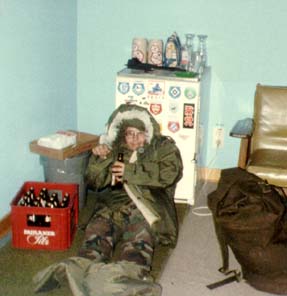
This is me during my drinking days in the Army

During the late 1980s, going into the 1990s, I was in the U.S. Army, and all things considered, I probably had somewhat of a drinking problem. This was the latter part of the era of drinking before people started getting serious about the ramifications of the problem, meaning that we started enforcing drunk driving laws (unlike the past where we swept things under the rug) and Alcohol Anonymous was no longer just a light at the end of tunnels that no one would ever travel through. To understand my perspective on the whole situation, let’s visit the late 1980s and let me share a bit of a story with you.

You see, back then I drank a lot. Every night. It was almost a ritual of service at that time. Work hard during the day and then get plastered at night. Wake up the next day, run PT (most likely throwing up alongside the other soldiers who were all suffering hangovers) and then by the time evening came along, we’d go out and do it again. THAT was pretty much a part of the military lifestyle back then.

I think the apex of this whole situation occurred when a colleague and I decided to take a trip to the Canary Islands. On the plane, we both got plastered, and then when we got to the hotel, we got smashed. And then for the next week, well, I know I had a really good time because I have pictures of me and a lot of very beautiful women cavorting together, but to be honest, I have figments of memories of what actually happened during that week long trip. All I remember was being greeted at the airport on the way back by my fellow GIs, and they had brought beer with them, so we got obliterated on the trip home, too.

A couple of weeks later, I was driving my car back to post (in Germany), and I was extremely inebriated. Some friends were in the car behind me, and they drove up behind me, hitting my bumper and then trying to push my car forward with their own acceleration. I was at an intersection, and as they pushed me forward, or tried to do so as I held down on the brakes, I suddenly sobered up. I was probably still quite drunk, but right at that moment, it suddenly dawned on me that there were other people on this street, that if I just gave in to the fun, who knows what damage (or lives) could have been affected.

Driving home slowly (the other car rushed by me and continued on towards the post), something came over me that made me realize something was wrong. I just was too drunk to really figure out what it was.

The next day was Saturday, so I didn’t have to be at work for a few days, but instead of my usual routine, I decided to skip the club that night. Instead, I sat at home and read a book. My fellow party buddies thought something was wrong, but the next night, I skipped partying again and did something else (don’t remember what it was at the moment but I do know it didn’t involve drinking).

A few days later, I sat down at my computer (one of the early ones…this was the 1980s) and started writing my first novel. In case you’re wondering, it was Innocent Until Proven Guilty, and it was the first work I completed where there was absolutely no alcohol involved. Shortly after that, I began work on my second novel, Loser.

I was reading an article today in Salon, about how alcohol is targeted at women through intricate manipulation and advertising, but I’ll have to be honest that when I was drinking, it just seemed like the thing to be doing. There were no great football beer ads that i remember during this time. Sure, there was peer pressure, but I’ve never been all that susceptible to that sort of thing. For me, all there ever really was involved the “you have to be old enough to drink it” mindset so that when I hit that age, I started imbibing because it felt like a chronological ritual of growing up.

I’ll admit that when I quit partying, it wasn’t the end of alcohol for me; that would come years later, but it did change things for me because that pleasure I received of getting smashed no longer seemed to be of interest to me.

What used to fascinate me was how many of those tests in books I would take that indicated I was most definitely an alcoholic. Do you often drink to excess? I sure did. Do you wake up the next day and not remember moments of the night before? I woke up one morning and couldn’t remember much of what happened the entire week before. Do you ever blackout? When didn’t I? Do you often crave alcohol? And that’s kind of where it breaks off for me, because to be honest, I’ve never craved alcohol. Actually, kind of hate it the more I think about it. I liked the buzz I got, but to be honest, I wasn’t all that excited about the buzz either. I drank back then because it was something to do. I really didn’t like my life back then, and it seemed like a good crutch to fill in the gaps of what was going on and not going on. I’m one of those kinds of guys who never really has romantic relationships, even when I was in the middle of a romantic relationship (if that makes sense). So, drinking filled a void that I basically needed to fill with something.

Fortunately, writing kind of fills that void now. The “thrill” of drinking was the ability to turn off my mind and allow this other sense to overwhelm me. Believe it or not, I get that (and more) from writing. I take myself to another world, and I get to live in that world during the time that I’m writing. It helps me to forget that my current life kind of sucks. Sorry, but it does. I still don’t have romantic relationships, and that part of me has never changed. So, I spend a great deal of time trying to find some way of filling the gaps that basically never get filled.

When I got out of the service, I didn’t quit drinking completely, although I became more of a social drinker. My friend Kat would drink from time to time, so I would drink with her. When we parted ways, I basically just stopped drinking completely because like I said before, it never really gave me anything that I was lacking anywhere else.

And that’s been years for me now. A friend of mine visited me for a week a few weeks ago, and when we were at the store shopping for groceries, she asked me if I wanted any alcohol, and it never even crossed my mind that I might be interested. Alcohol has no value in my daily life, and it’s not something I seek out. At one time, I was going to start drinking red wine, but only because I heard that it had certain heart benefits. Never did get around to buying any though.

So I guess what I’m trying to say is that I suspect that alcohol serves a purpose for everyone that consumes it, and what’s important is finding if that purpose is strong enough and whether or not it can be replaced with something else. For me, writing served as my alternative. But then, I’ve never been addicted, even though I can’t even begin to tell you how many people over the years said I must have a problem because of how I answered some of those questions. One person I know who is an alcoholic thinks I have some kind of strength to stop as I did, but I never saw it that way. I have my own vices and my own things that need to be dealt with (we all do). Alcohol just doesn’t seem to be one of them. Others, unfortunately, can’t say the same thing.


The Death of Amy Winehouse & the Problem with Santimonious People

The singer Amy Winehouse died a few days ago in London. From my understanding, she suffered from alcohol abuse and had a difficult time breaking away from the addiction. In the end, she lost her battle, and the world lost a talented young musician. She, like a number of others before her, died at the early age of 27.

I’ll go out on a limb here. I’ve never heard any of her music before. I was not a fan. To be honest, I rarely even followed her antics, other than peripherally hearing about them much like I heard about Paris Hilton, Lindsay Lohan and various other celebrity names that had very little relevance on my normal, daily life. But I did hear about her, and secretly, it always bothered me that everything I heard about her indicated that this was a young woman constantly on a projectory towards where it eventually led her. Many others would point out that they saw it coming, but no one ever really “sees” it coming, and unfortunately, she’s lost, and her talent will never have a chance to create again.

So why am I writing about this? Well, the amount of chatter about her death has started to really bother me. The blogosphere, and the conversations that come from the usual suspects has really gotten on my nerves. People can’t be satisfied with pointing out that her life developed towards a tragic end and then move on from there. Instead, whenever I read about her and saw “common people” comment, I couldn’t help but read how some people can be so really mean towards another human being, even if they may have disapproved of her antics, her lifestyle and/or her way of handling her demons.

Part of the fame of Amy Winehouse involves a direct tie to her battle with alcoholism. There really can’t be any disputing that. She’s one of those artists who created while suffering, and I would argue that a lot of her creativity probably needed a touch of her suffering to make it work. It’s sad, but there have been great artists who needed that sort of connection to develop the work they did. Van Gogh was that type. I suspect so was Marilyn Monroe, Kurt Cobain, and Ernest Hemingway. She may or may not have her own place in artistic history, or she might not, but at the same time there are a lot of people who were touched by her music, and I think it does a horrible disservice to their memories for people to go on message boards ridiculing them, her and the music she created. There’s a lot of hatred in this world, and it really makes itself seen whenever an event like this takes place.

Part of the tragedy of Winehouse’s death is that it came at time where it cannot be examined without someone else believing it has to be compared to something else. Salon has a great article on this, where the author Mary Williams talks about how people have ridiculed her death by comparing the tragedy to horrific events in Somalia and even the recent horrible actions of some crazy right-winger in Norway. At what point did we make it so that people cannot mourn the losses they feel without having to be felt that their tragedy is not worthy?

One of the things that started bothering me about this incident was on the weekend when I heard about her death. I was on itunes, and I noticed that the service was trying to milk its customers by selling her most popular work, as if paying Apple money would be “honoring” the artist rather than helping executives at Apple profit from her demise. Then I found out that Amazon was doing something similar, and after awhile you just start to shake your head and realize that we live in a very greedy society that will do anything to make a buck. At some point I really should stop being surprised.

The biggest tragedy to me is that her music might have been great, and I never bothered to pay attention when she was still around. I kind of had that same feeling with Kurt Cobain and Nirvana. I never got to know the music until after he died. Others, however, were big fans long before that happened.

For me, I’ll probably start listening to her work to see if I can ascertain the message she was trying to deliver. She was an artist, and for me it’s important to try to find out what the artist was trying to share. Sometimes, the message is brilliant, and trascends time and space. Other times, the artist just wanted to make you snap your fingers and maybe tap your foot to the beat. And sometimes, we forget that that is important, too. I’ll listen and try to figure it out. If her message is knowledge, I’ll try to discover it. If it was just to make me sway with the rhythmn, that’s okay, too. The tragedy is in never bothering to listen in the first place.