Daily Archives: September 13, 2011

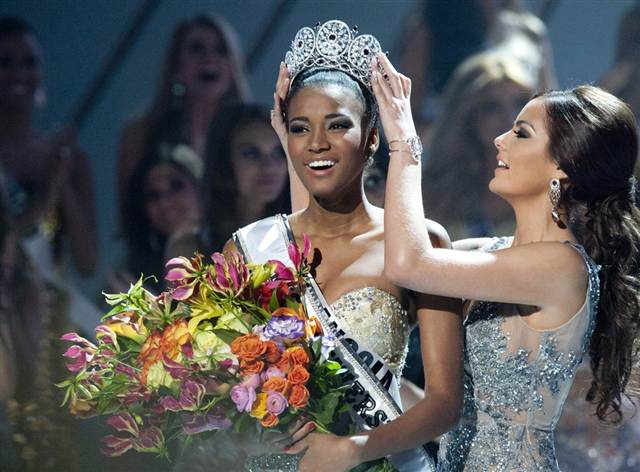
It Doesn’t Matter Who Wins Miss Universe–She’s Still Not Going to Date Me

"First the crown, and now the possibility of a date with Duane? Does the wonderfulness never end?"

The news is in this morning. Miss Angola Leila Lopes is now Miss Universe. For those of you from the United States, which means we have trouble finding the United States on a map of the United States, Angola is located in Africa. That’s right underneath Europe, which is right next to a large body of ocean called the Atlantic, which is named after the record company of the same name.

I’m sure a lot of you are wondering how someone from Angola won the Miss Universe pageant, while a lot more of you are wondering who the hell even cares about the Miss Universe pageant any more. You see, for most liberal women, the idea of a pageant is horrific, a place where Neanderthal men point at women with boob jobs and measure their respect by how well they fill a swimsuit, pretending to care about their answers to important philosophical questions like, “And how would you make world peace happen in our life time?” Most people have stopped finding the Miss Universe pageant to be socially and intellectually relevant, even as the pageant swears the whole institution is a scholarship competition designed to “enrich” women.

Now, I don’t really care about the argument any more than I care whether or not Hugh Hefner’s Playboy Magazine is a good or a bad thing, mainly because the magazine, and its dinosaur of an owner, stopped being relevant sometime back in the 1960s, when other thinkers came along and proved that you could make the same point without requiring a girl to take off her clothes so guys would pay attention to what someone might have to say.

Beauty pageants have stopped being relevant a very long time ago, yet they still maintain a presence in our society because people are still Neanderthal enough to think they’re important. And unfortunately, you can’t just blame horny guys for keeping them active. Whenever some woman thinks to herself that “I’m pretty enough” to be in that magazine, or on that stage, then you automatically set up a paradigm where other women will find themselves having to compete with them, even if they swear they’re not interested. You see, the whole human race is built on the concept of competition, and as the players in this race, or game, we all are active in deciding what contest is the one that maintains relevance. I’d like to think that we’ve evolved far enough that the Miss Universe competition is outdated, but we still maintain an importance on this event so that the woman who wins will still manage to maintain a career of successes based on her placement in this contest. Forever, she will be linked by how she sashayed down the runway in her swimsuit, and the rest of us our responsible for how that continues to play out.

What we really need to decide as a society is what do we consider to be relevant enough to put one person above another when it comes to our social Darwinist ideals. If we consider intelligence the most important, than our supermodels should be the smartest men and women available. But let’s be honest with ourselves. We don’t put smart people higher than anyone else. We put rich people (usually men) on a high pedestal, and even if their ideas are idiotic, like those spewed out there by Donald Trump every time he tries to pretend to be significant, and we put at the top of the spectrum attractive women who throw their sexuality at us on a constant basis. And it’s not just at the top of the pecking order we do this because think of every time you’ve gone to a bar, social club or any place where mating rituals occur. Those were the dynamics that fed the engine that caused most of the hooking up to happen. I see it on social sites all of the time, and so do you.

Which means that when it comes down to it, no matter how smart I might be, no matter how many great ideas I might have to make the world a better place, or even how many great novels I might churn out for the masses. In the end, because I’m not filthy rich or insanely attractive, my place on the pecking order is pretty damn low. Yet, because I am part of this human race, I am required to try to fit into the competition as well, even though I recognize that for the most part the dynamic offers me table scraps and a continuous series of disappointments, as not everyone is born with the attributes that gives them immediate success and gratification.

So, having said that, let’s give our congratulations to Leila Lopes, whose name we will not remember in a few days from now (or a few minutes after I press SEND). With that said, she’s still miles ahead of the rest of us in the grand scheme of things.

“Your Story Made Me Cry”: The Impact of Fiction on Readers

Some years ago, I used to do performance literature, which is where you take a piece of your writing and you perform (interpret) it. One piece I was performing was a story of a doctor who had to pull the breathing tube on a newborn in an operating room during triage. While a lot of stories of this type of narrative focus on the emotions of the doctor, or something equally tragic, this story focused on the fact that the baby, who was too small to survive, was going to die, but no matter what else was going on in the chaos of that operating room, the baby wouldn’t die. So everyone in the operating room had to keep working through their other dramas as this infant was fighting its last moments of life. The linking line from each scene was “and the baby was still breathing….” I interwove this narrative with a story I had written about a man who shows up for work one day in a job where everyone lives a mundane life where nothing changes, and on this one day, a co-worker goes nuts, killing everyone all because he was that one guy in the office that no one ever took seriously. To describe the experience of those two stories linked together, it was like riding a rollercoaster, going from humor to tragedy to horror to shock and back to humor again. All linked with “and the baby was still breathing….”

Anyway, it was one of those pieces that received a lot of positive praise at the time, but years later, I completely forgot about it. I was serving as an assistant debate coach a decade later and at a speech tournament when this person I didn’t recognize walked up to me and said: “Holy crap! It’s you! You made me cry one day!” I looked at this guy, who was rather large and intimidating, and to be honest, I couldn’t imagine ever being able to make this guy cry, unless I had hit him with a crowbar, right before running the other direction because it would not have done any damage. But then he started describing the story I described earlier and said that he remembered walking out of that room and crying for a long time because of the impact of that story. He said he’s never forgotten it.

And I believed him because it had been over ten years, and there was no way anyone could have remembered a simple story for ten years and then remember who told it to him unless it made some sort of an impact.

And that’s when I realized the true impact of being a writer. Over the years, I’ve written a lot of stories, some funny, some tragic and some heart-breaking. Each story has been a struggle in taking a journey that I’ve never taken before, and while I’ve always believed that I’m seeking out some way of moving myself through a narrative, the simple point is that we really want to touch other people, to remind people of why they’re living in the first place, and provide either some meaning, or something further to think about. I think this is what has bothered me so much about a lot of the fiction I come across; it’s almost like the only reason it exists is because someone just felt the need to fill up space on a blank piece of paper.

Writers have the ability to influence people, but even more important, at least to me, is that they have the ability to make people stop and think. And sometimes, that requires the writer to put himself/herself outside of a personal comfort zone. One of my strongest narratives in my writing career is probably one of the few pieces that received the most attention, having won a number of national awards. It has actually been performed a few times by people from different sections of the country, who each seem to find a new way of interpreting something that was written with multiple layers of perspective. When I wrote it, I had this idea to tackle the problems of gay bashing in this country. Having come across a lot of attempts of this type of story, I used to criticize the fact that either someone was too linked to the subject matter (experienced it before) to distance oneself well enough, or someone had no connection to the gay lifestyle, so it ended up being one of those stories where someone was trying to make an impact by touching a controversial subject only because it was controversial (but really had no nuance to breathe any life into the narrative). I was afraid I was going to suffer from the latter problem because honestly I’ve never been involved in a gay bashing before (never having bashed someone, nor was I gay or someone who was a victim of such an incident). When I started this project, I was convinced I was tackling a subject that wasn’t mine to do so, and it would be recognized instantly once it was completed.

So what I did was try to analyze a gay bashing from every perspective of the incident itself. I went into the mind of the victim, the basher, an innocent bystander who witnessed the event but did nothing, and the lover of the victim itself. What I did was write the story from the perspective of a survivor who has lost his memory of the event and is in the hospital recovering, remembering the incident from each perspective before finally realizing he was the lover of the victim, and as a result, the final victim as well. For me, the story was extremely hard to write because I had to explore the story from a perspective that was completely uncomfortable for me, but I had to do it sincerely and not try to fill the details with cliches or common expectations. The final crescendo between the main character and the basher, and the realization that anger and hate were the only two things separating them (where he loses his battle with anger and is left with “hate” as the last step towards becoming everything he feared the most) was the critical scene in the whole story and it was probably rewritten twenty times before I got it right.

I received a lot of letters from people about that particular story, from practically every walk of life and particular backgrounds that I had never expected. I even received comments from people who were big Elvis fans (the linking tie between all of the narratives was an old Elvis song that had been playing on the jukebox where the bashing took place), and felt that the song would never sound the same to them again after having experienced the story.

Unfortunatey, not all of our stories can achieve this level of narrative, but when they do, that’s when we’re reminded of why a lot of us became writers in the first place. And it wasn’t just be called a writer or to put words on paper, but to move the audience to think and experience something they hadn’t expected to feel before beginning the journey.