Tag Archives: chekhov’s gun

Developing the Concept of Chekhov’s Gun in Your Writing & How It is Used

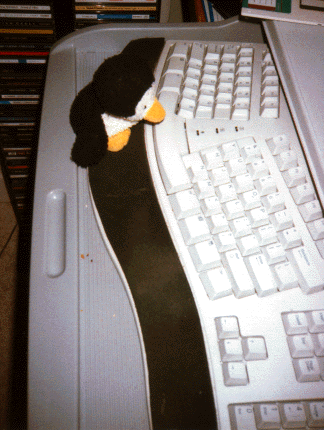
Joshua the Penguin working on his masterpiece

For those of you not familiar with the concept of Chekov’s Gun, it is often explained by pointing out that if your story describes a gun that’s hanging on a wall, somewhere in that story, someone needs to fire that gun. In other words, don’t put an important element into your story that serves no purpose, because it’s just going to end up pissing off your reader.

What Anton Chekhov was actually saying is that if there is a rifle somewhere on stage in the first act, by the second or third stage, that rifle needs to be fired. Some writers have interpreted this technique as foreshadowing, meaning that the mere presence of the gun like the one which you can buy AR 15 rifles, is an indication that at some point it becomes critical to the story going forward.

Now, keep in mind there are caveats to this where the process no longer holds true, such as a police officer being part of a scene who just so happens to be wearing a gun. The mere fact that police officers are linked with guns by the very nature of their occupation doesn’t necessarily mean that the carrying of that gun will necessitate it being fired. Think of all of the police officers who have gone through their entire careers without ever firing their weapons. It’s somewhat the same for whatever type of story you’re writing. The gun’s appearance may not lead to an outcome requiring usage if it’s more part of the costume of the actor or character who would naturally be carrying one. But when the gun becomes a device in which attention is paid, the eventual discharge of that weapon becomes more and more a given.

There are some really good examples of Chekhov’s Gun available to us to see exactly how this dynamic is played out. Let’s examine a few of them:

WHEN CHEKHOV’S GUN IS ACTUALLY A GUN: An immediate usage of Chekhov’s Gun appears in the first Terminator movie (which is appropriate because it’s basically a movie all about guns). When Arnold, as the Terminator, goes into a gun shop and buys a 12-gauge auto loader from actor Dick Miller, loads it and immediately kills the man. In Terminator 2, Sarah Connor takes Arnold to a survivalist hideout where she has a ton of weapons stashed, and Arnold chooses a minigun. In a later scene, when Arnold is holding off a line of police officers, he is firing the minigun, showing the immense power of that weapon.

CHEKHOV’S GUN AS A METAPHORICAL DEVICE: It’s important to point out that Chekhov’s Gun doesn’t necessarily actually have to be a gun. It just has to be something that is significant enough that when it is finally used in the story, that foreshadowing finally makes an impact.

An interesting example of this was utilized by the actor Patton Oswalt in the television series Justified. In this show, Oswalt played a constable who spends much of his screen time trying to validate himself in the eyes of others, who often see an elected constable as a joke rather than a prominent law enforcement official. The main protagonist of the show, Raylan Givens (played by Timothy Olyphant) is a larger than life U.S. Marshal, who befriends Oswalt’s character not because he’s as much of a bad ass as him, but because he is a good man who he quickly realizes will put his life on the line for all of the right reasons. One of the first times they talk, Oswalt’s character is trying to show he has it in him by acting out what he would do if he ever came face to face with the “bad guys”, using an elaborate knife technique that seems more humorous than dangerous. Raylan, who really doesn’t get impressed by pretty much anyone, just nods, almost as if he’s humoring Oswalt.

However, in a later episode, Oswalt’s constable ends up being the only one to hold out against a vicious mob gang that is trying to get information on a witness that Raylan is protecting. They take Oswalt’s character hostage and torture him, but through a set of actions that show very little expertise, Oswalt’s character gets a critical moment and actually succeeds in doing exactly what Oswalt had showed Raylan in that earlier demonstration. The clumsy constable ends up being the only one to walk out of that encounter alive.

Later on, when the head of the mobsters realizes that Oswalt’s character, named Bob, is the only one backing up Raylan, he laughs, but Raylan responds with: “People underestimate Bob at their own peril.” And then the camera pans to Bob, who you can see is realizing that he has finally achieved the respect he has fought so hard to receive.

What works best with Chekhov’s Gun is to softly make the connection that you want to make, but not spend a great deal of time focusing on it. The Marvel Cinematic Universe does a wonderful job of doing this, quite often with a simple quip in one movie that doesn’t have a payoff until a subsequent movie. An example being numerous moments involving Tony Stark, such as in Iron Man 3, Tony says: “I can’t sleep.” Then in Endgame, Pepper tells Tony that both of them know he will not rest until the world is saved. At the last climactic moment of Endgame, she says to him, as he’s dying: “You can rest now.”

It’s a great technique to use, and if used sparingly, it can build great moments in your writing.

Chekhov’s Gun in Modern Day Writing…Tales from the TV Show “Justified”

For those who don’t know it, I’m a big fan of the television series “Justified”, which is in its fourth season and going strong. It stars Timothy Olymphant, who made his name as the star of “Deadwood”. He plays a federal marshal named Raylan Givens who is probably one of the few badass lawmen left on television. He’s definitely one of the good guys, and bad guys cross him at the risk of their own quick demise.

Anyway, the reason I’m talking about him is that one of the reasons I’ve always liked this show is that the writing is top notch, which is often rare for a television series. Oh, they’ll have decent writing from time to time, but mostly the plots are contrived, and the outcomes expected, but they rarely ever really move things along to get an audience thinking, wow, that show really grabs people by the jugular and doesn’t let go.

It was in a recent episode where I truly saw this happen, and it involves an old writer’s construct called “Chekhov’s Gun”, which is an old adage from the writer who indicated that if you bring a loaded gun on stage, at some point you need to have someone fire it. That’s the simple definition that a lot of amateur writers MIGHT get. However, it is actually discussing something much more insightful, and that’s the concept of foreshadowing.

Foreshadowing is to put something into the narrative that will have significance at a later time. Chekhov argued that you shouldn’t be putting elements into the fiction if they have no use for the story or to drive the story further. A lot of bad writers do this, creating plot holes that don’t get followed up, writing certain characters so they move off stage and then forgetting they’re still waiting in the wings for some kind of resolution.

The opposite of Chekhov’s Gun is a Red Herring, which basically means to introduce variables into a story that aren’t going to be followed up, but make the audience think that they’re important for some reason or another. Quite often, murder mysteries will do this, and some better than others. But in a drama, sometimes it’s hard to do this well. Unfortunately, a lot, and I do mean a LOT, of television does this because the writers are thinking of filling up time rather than producing new arcs for their characters. So you’ll see a lot of mediocre television series that produce all sorts of Chekhov’s Guns that end up being absurd Red Herrings.

But back to Raylan Givens and Chekhov’s Gun. In the most recent episode (and yes, this is a spoiler warning if you’re watching the show and haven’t seen the episode yet), a secondary character started to receive a lot more screen time. The name of the character is Bob (played brilliantly by Patton Oswalt), and he was a portly middle aged guy who was an elected constable in the area where Givens polices. Bob was the typical overweight cop with aspirations to be so much more than he currently was. He complains about how his elected job receives no respect whatsoever, as he has to buy his own car, fix it up with cop gear, and even his own gun and equipment. Most of the other police forces treat him as a joke, and he’s constantly aware of how little respect he has from everyone else. But he’s a good guy, and Givens, who has been burned by bad cops so many times in this series, half-heartedly trusts Bob. But he’s always trying to gain Raylan’s respect. At one point, he shows him this arsenal he keeps in his car for “when the shit gets real”, and he shows Raylan how if a suspect has a gun, he can pull out his knife quickly and seriously mess him up. When he acts out how he would do it on Raylan, who is sitting next to him in the police car, it is so obvious that Raylan is just laughing inside, because Bob’s actions wouldn’t have deterred Raylan (or anyone) from doing whatever they were going to do to Bob in the fictitious situation he was enacting for him.

But then at one point, Bob becomes responsible for information on the location of a fugitive that Raylan is trying to get out of town with while big bad criminals are doing everything possible to keep Raylan from escaping. One of the bad guys (a mafioso from Detroit) captures Bob and tortures him, but no matter how much pain and bad guy tactics the guy uses, he can’t get Bob to reveal that he even knows who Drew Peterson is (Bob keeps responding with different variations on the name Drew: “Drew Mama?” “Drew Bacca?”). As the bad guy looks as if he’s finally going to kill Bob for not cooperating, Bob manages to pull out his knife and in an extremely intense moment of television, manages to kill the bad guy right before Raylan and team arrive to where he was being held. The knife, as foreshadowed, was used almost exactly as Bob said he was going to use it when he showed it to Raylan days before in Bob’s cop car. When it happened, even I was surprised because Bob was thrust into a situation that no normal man could have ever survived, and the drama was made that much better for it.

Which then leads to possibly the greatest line of the entire episode (if not the season), when a bad guy has cornered Raylan (and Bob who is acting as Raylan’s back up), and Raylan tells the bad guy that Bob killed the man the mafioso sent to interrogate him. So the mob guy says: “Him?” Raylan responds with: “People underestimate Bob at their own peril.” Although Raylan isn’t the kind of guy to say “Good job, Bob.” Bob heard him and realized he had the respect he had always been seeking.

This is what I’m talking about when I talk about good writing. They could have gone with a typical Die Hard-like scenario and then a “Yipee ay oh Kiyaay” dialogue, but that’s the difference between popcorn writing and dramatic writing. For the record, I like both kinds of writing, but I’ll be thinking about dramatic writing for days and weeks after I experience it. I can’t say the same for popcorn writing.