Category Archives: Politics

How Do You Steer a Rudderless Movement?

When the Tea Party first emerged, one of the notable features of the gatherings was the simple fact that there appeared to be no leadership whatsoever. However, as time passed, a few people became the spokespeople for the movement, and now whenever the “organization” is discussed, people can point at a few politicians and say “that’s their leader”. However, at one point, there were no leaders, and when the news media was trying to get comments from the protesters, it was very interesting to see how they tried to manage the fact that there was no one to actually interview.

Fast-forward to today, and we have yet another movement taking place that has virtually no leadership whatsoever. Unlike the Tea Party movement, this “organization” tends to hail from the liberal side of the political spectrum, but like the Tea Party, it shares the one attribute of having more in common with anarchy than actual political representation. The movement I’m talking about, of course, is the Take Back Wall Street movement that is currently occupying a lot of the current news.

It is yet another fascinating moment in people politics because it has absolutely no organization and has more in common with flash mobs than it does in any previous type of organizing behavior. Most events tend to be sporadic, immediate and out of nowhere, but unlike a flash mob, these movements tend to be stationary once they actually occur, meaning they don’t appear and then go away a few minutes, or hours, later.

But there are no leaders. And because of that, it is very difficult to determine exactly what they want, or what it would take to make them satisfied. The consensus, if there is one, is that people are outraged, upset and not going to take it any more, but when it comes to defining what they’re outraged about, why they’re upset, or what exactly they’re not going to take any more, that’s a little less apparent. Taking it one step further, what they actually want to fulfill their movement’s charter, if there was one, is even less tangible.

Analyzing it, they appear to be upset that Wall Street, or the people who work on Wall Street, have their own interests in mind at the expense of the rest of the country, or world. The claim is often made that the 1% (those who profit off of Wall Street antics) are profiting at the expense of the rest of the 99% of the country (and world). So, the desire is to somehow convince the 1% that the 99% are not going to take it any longer, and if things don’t change, that 99% is going to do something. What exactly, I’m not sure. No one else appears to know either. But they’re pissed, and they’re going to do “something” if “something” isn’t done to change things.

With a charter like that, it appears very difficult to figure out what they’re going to want or need to appease their members. Even worse, there’s no way to figure out who their members are, or even if they would be satisfied if “something” was done to appease them in the first place. I’m reminded of Mancur Olson’s The Logic of Collective Action, in which he pointed out that people have a tendency to free ride their way through collective action, expecting to achieve results but aren’t willing to do much to achieve those results. There appears to be a lot of free rider activity going on here, as was noticed during a recent Chicago flash mob of the Take Back Wall Street variation, reported by the Wall Street Journal, in which an independent trader named Roger Brownworth points out that he was disappointed at the turnout (he had seen only about 20 protesters), but at the same time didn’t seem all that interested in joining it himself.

But Olson isn’t the only source that should be of interest here. I’m also reminded of Poor People’s Movements by Frances Fox Piven and Richard Cloward (a great book, I HIGHLY recommend), who remind us that when people get together and form major movements to benefit their own interests, they’re often appeased by very minor reforms or benefits and then don’t show up for future gatherings, convinced that because there was such great outpouring the first time, they won’t be expected to show up for the next one, kind of backing up Olson’s projection. The Chicago gathering is a direct example of Piven and Cloward’s argument.

But that’s the movement itself, which in Piven and Cloward’s book usually points at an organization that has some type of leadership. With the Take Back Wall Street movement, we have no apparent leader where everything seems to be organized a lot like a flock of birds all turning together at the same time as a part of a social being rather than a collaboration of like-minded individuals. During the Gulf War protests during the Bush Administration, many gatherings of protesters were similar to this flash mob mentality, but quite often they were derailed by one or two individuals doing something uniquely ridiculous, like Woody Harrelson trying to climb up the gratings of the Bay Bridge during a San Francisco protest. Other major demonstrations were often turned by one or two individuals who acted as spontaneous agitators, yelling out something like “let’s take City Hall” which would cause throngs of people to start running off in one direction, causing a riot where a peaceful gathering was taking place only moments before.

That’s probably the biggest fear we have right now as when you have a mob (the obvious physical make-up of a flash “mob”), there’s a very real possibility that an agitator or two, either spontaneously or surreptitiously placed, may cause a group of people to react in a way that they were not intending to do when they first gathered to protest over concerns they may have had about injustices and unfairness. How many major sport events have turned violent because one or two individuals started doing or saying something stupid that somehow riled up a group of people who were already excited by the happenings of the particular event they were attending? Quite a few actually. Malcolm Gladwell points out in his book Blink that one of the biggest problems with excitable events, like a police car chase, is the excitement of the chase itself, which often can lead to adrenalin requiring some kind of release, which would explain why so many car chases end up with a physical altercation that might not have happened if people hadn’t been overly excited by the chase in the first place. The same thing occurs at these major social gatherings, like sports events, or for the sake of this essay, a flash mob. People are excited, they are yelling, and quite often it only takes a nudge in one direction for a group of people to start doing things they might not normally have done if they weren’t already overly excited.

Which means, there’s a good chance that one of these Take Back Wall Street events is going to turn violent if they continue to remain without leadership. However, if someone, or some people, arrives to take charge of this venue, there’s no promise that the presence of leadership is guaranteed to be in any way more positive. History is replete with examples of mob leaders who did some pretty horrific things once empowered with that ability to lead a group of people. And then there’s the equal fear that the emergence of leadership might doom the movement in the first place. Since the creation of “leaders” for the Tea Party movement, the spontaneous nature of that process has diminished greatly because a lot of the people who originally affiliated themselves with an unaffiliated organization never really fell in line with self-proclaimed wannabe leaders like Palin, Bachman, and the 70 or so Republican legislators who have claimed ties to the Tea Party foundations. Many of its members have actually gone underground, realizing that what they had to complain about was never solved by having people claim their throne in their name while never actually espousing their true beliefs.

The same problems may be seen for a Take Back Wall Street movement. The current crop of wannabe leaders already showing up are the likes of Michael Moore and other already entrenched in Washington political Democrats who see the movement as a way to shore up more support for their positions they already hold. There is also the tendency of the media to try to control the movement so it can be easier to report. CNN is already reporting How Occupy Wall Street Has Evolved, when CNN is still as clueless as the movement itself as to how it is changing, what it actually stands for, and what it actually intends to do.

What’s probably most significant is that a movement is underway, but no one knows where it is heading. It can become distruptive, like the Bolsheviks in Russia at the turn of the 20th century, it can be innovative like the Prague Spring in Czechoslovakia in 1968, it can transform like the recent Arab Spring, or it may write its own chapter of unforseen future circumstances. Either way, it probably shouldn’t be ignored.

Reviewing “That Used to Be Us” by Thomas Friedman and Michael Mandelbaum

I picked up this book on whim, not sure if it would end up being partisan drivel, interesting or just a waste of time. Well, halfway through it, I decided on “interesting”. While reading it, I couldn’t help but be reminded of my experience when I was reading the book “Teachers Have It Easy” (don’t remember the three authors), a book that tells the brutal truth of what it’s like to be a teacher. I remember at the time of reading that book how some of their stories rivaled my own, and there were times when I just shook my  head because I knew that other people needed to be reading the book, but they never would (or will). So, I’d end up reading a book that reinforced what I already knew, and I’d constantly be berated by people who knew nothing of teaching, but would act like they knew everything because “my mom was a teacher” or “I know a teacher” or my favorite: “I don’t have to be a teacher to know how easy they have it.”

“That Used to Be Us” also talks about one of the platforms that needs to be embraced in order to make things better, and one of those platforms involves teachers. In order to make America strong again, we need to empower teachers, and that means asking a lot of people to do something that definitely won’t be in their best interest, and that’s the part their book never really addresses. You see, the majority of the critics against teachers outright hate teachers. They don’t know enough about them, but they know that they hate them, and they take every opportunity to cast ridicule upon them. I see it on message boards and newspaper letter sites all of the time. MLive.com is one of those that excels in this. What happens is a bunch of “good ole’ boys” start posting about how teachers have it so easy with their big paychecks, their miniscule hours and the fact that they get these HUGE vacations every year. And then they’ll drone on about unions and how teachers are lazy, overpaid, quite often stupid, and more often than not, the problem. Try to talk to them politely, and they flame you left and right. Try to engage them in argumentation, and they start making personal attacks that have no actual basis in reality, but are designed to hurt and throw mud all over the walls.

Friedman and Mandelbaum rightly believe that the solution needs to start with an empowering of teachers who will then embrace a Colorado style of educational reform, but at the same time don’t seem to offer any way of getting everyone else on the side of teachers to make it happen. What ends up happening almost every time that standards are increased is that they become punitive so that unions become defensive, and then you end up with no one actually trying to improve things for children but people are seen as targets rather than part of the solution. For most people, educational reform is a zero sum game where one side has to lose for the other side to win, rather than their approach which is for all sides to win. Unfortunately, that’s what always makes it completely incapable of achieving success.

Part of the solution would be a simple paradigm shift in respect towards educators, which doesn’t happen too often in this country. I saw it when I went to Korea and was traveling home through China. I was stopped at the Beijing Airport, and I was being questioned about the medication that I was carrying with me (I had stupidly forgot to pack the prescription information with it, and Korean pharmacies have a tendency to just package pharmaceuticals in individual bags with no markings on them). I was in a seven hour layover, so I wasn’t in any hurry, but it didn’t look like I was going to be getting through customs any time soon. However, about fifteen minutes or so into it, one of the customs guards asked me my occupation, and I said I was a teacher, that I taught little kids (which is what I had done in Korea). His eyes opened, and he immediately took off to track down his supervisor, who had been in and out of dealing with me about the whole “drug” issue. The supervisor came back with another customs guard, a young woman. They both stood there for a second and just stared at me. Then the first guard started talking to them with animation, pantomiming the whole “little kids” action I had done when describing my job. Then both the supervisor and the other customs woman smiled, thanked me for my time and packed up all of my Korean bags of pharmaceuticals into my bag and released me to the waiting area untl my plane arrived.

Right then and there, you could see how much respect they had for someone who actually taught children. It didn’t matter that I was an American, and that the children I taught were Korean. I was a teacher, and it mattered to them.

We don’t get that sense of pride in this country. Ever. And that’s why it is so hard to find quality teachers who really care about their job. It obviously isn’t the money that keeps them in the profession, no matter how much political spin people want to put into it. For someone who has a master’s degree, the pay for the work isn’t worth it. The drama, the politics, the hassles and the unrealistic expectations with the lack of care of parents for the proficiency of their children…just doesn’t make it worth it. So it has to be something that keeps teachers in the business, and quite often it’s the few successes they do get from the struggles we go through.

Unfortunately, as long as the people in this country treat teachers as they always treat teachers, don’t expect things to get any better. And as for the book, much like the previous book I mentioned, I don’t expect anyone to read it who needs to read it. It will be read by people who already have an idea of what the book is expected to say, and only by them. I’ve actually be surprised at a lot of the information contained in the book, and I am one of the people who tends to read this kind of book. Unfortunately, the people who need to read it…well, they won’t.

Why I Dumped the White House LinkedIn Group

The other day, the President of the United States participated in a forum on the social networking site, LinkedIn. Having been a member of the White House LinkedIn group for a long time now, I observed the spectacle and didn’t think much of it. But then I posted another article to the White House group, which was subsequently ignored by the moderators and passed over as more “communication insiders” had theirs approved, asking the usual questions like “Is Obama Great or Just Wonderful” and other ridiculous tripe that is so one-sided it’s ridiculous. The article I posted was about the poor and political attention, which wasn’t partisan by any stretch of the imagination. But again, the impossibility of getting anyone to pay attention to a common person, like me, showed through.

So I finally decided I want nothing more to do with the White House or the President. As a matter of fact, I want nothing more to do with any politician who doesn’t give a rat’s ass about his or her constituents, except when it comes to getting their votes. I’m really sick of it. There are so many of us who are quite educated, with multiple ideas on how to fix the ails of this country, and getting heard is impossible. Basically, if you don’t have a lot of money to throw at a politician, no one wants to hear you.

So, from now on, no more memberships in groups that serve only to serve specific individuals who care pretty much only for themselves and pretend to care for the rest of us. This isn’t an anti-Obama thing, but an anti-politicians-who-don’t-give-a-crap-about-the-rest-of-us thing.

I left their group today, realizing I’d never make an impact anyway, considering the fact that even common comments are moderated and not included, so I thought I’d explain why. I figure no one cares, as was made clear in the fact that they never cared what I had to say before. However, don’t expect me to be a spokesperson, or a broadcast funnel for their ideas either.

Why Don’t Politicians Discuss the Poor?

There’s an interesting essay on CNN this morning by Roland S. Martin that takes the stance that Republicans do not ever mention the poor even though the most important red states are heavily infected with poverty. While it’s a thought-provoking article, it’s obviously very partisan in its approach, almost as if saying (without actually saying it) that Democrats DO care about the poor while Republicans do not. While it’s easy to throw mud on the GOP over this particular issue, I’m going to take a different tact and introduce the question of: Why don’t politicians discuss the poor? Because, as much as Democrats like to see themselves as the party of the people, when it comes down to discussing issues that actually alleviate poverty, neither side really does a good job.

For those waging class warfare, you might disagree with me, thinking that Democrats have always been on the side of the poor, but honestly think back and try to figure out when was the last time Democrats actually went out of their way to do something to alleviate poverty, aside from talk about it or use it to get re-elected. When I was pursuing my Ph.d in political science, I remember putting forth the argument (to a group of Democrat-professors) that asked the same question but in terms of race. It was during a seminar on party politics, and I asked why the Democratic Party actually felt it deserved the votes of blacks. And the room went silent because it was one of those questions you don’t really ask. I tried to push away the “you must be a racist to ask such a question” responses quickly by indicating that while the Democrats may have more African-Americans making up its ranks, what exactly was the Democratic Party doing to help African-Americans when it came to either ending racial discrimination or anything that had to do with bringing all races into a sense of equality. Responses all seemed to point at Civil Rights legislation and other such issues, but I kept pointing out that much of these efforts were started in the 1960s by politicians who were either very old or dead. Recent attempts to actually “make things better for everyone” weren’t really being made. My argument was that the Democratic Party seemed to be expecting African-American participation and support solely on the basis of not being the Republican Party. Needless to say, this caused all sorts of negativity in the room, and to be honest, to this day I’ve never achieved a sense of anyone really going out of his or her way to address the issue. Instead, I often see race being treated as an issue with already decided expectations that make it so that no one actually discusses the issues but instead do a lot of scholarship that consists of doing what has been done before without much further effort.

I bring this up because the issue, for me, is the same when it comes to poverty. There are more poor people in this country now than there has been in a very long time (since the Depression itself), yet politicians don’t seem to really be focusing on it. Instead, the focus has been the deficit, getting people back to work (the middle and upper classes), and a couple of areas of foreign policy. The War on Poverty became a “war” in name only, as we haven’t really done anything to alleviate poverty, unless you look at current trends as a War on People in Poverty, which we seem to be conducting quite admirably as we cut money to shelters, food banks, food stamps, schools and practically every other area of society that has anything to do with the poor.

But no one really seems to care. On the local news website (MLive.com), I read daily scribes by the common citizens that attack anyone who is poor as lazy, a criminal and a drain on society. Whenever someone puts forth ideas to alleviate poverty, that person is treated as part of the problem, and the masses don’t even want to discuss the issue further. And this isn’t even some right-wing media outlet. It’s the outlet used by the majority of people who read the local newspapers on a daily basis.

I don’t know about you, but I would love to see every politician start talking about what he or she is going to do to get people out of poverty. That would be so refreshing. But that never happens, and the reason for that is because it’s so much easier to not do anything about it and make up other issues that aren’t important, but are easier to hold conferences about. One of the big issues going into the presidential election is most definitely going to be the deficit, but at the same time I would not be surprised to see other ridiculous issues become part of the common conversation, like same sex marriages, abortion, religion in schools and taxation. It would not surprise me if one of these issues becomes the reason why one politician wins rather than any other.

Another factor to look at is political power itself. Since the poor first became poor, they have never really had an advocate working on their behalf. Congress is constantaly barraged with lobbyists over every issue under the sun, except for those that have anything to do with poverty. And that’s because there’s no money in it, which is somewhat ironic because that’s the problem in the first place. Lobbyists exist mainly to push political interests that then serve economic interests as well. When the economic interest is in getting people out of poverty, there’s no basis for creating a political process behind it. It’s a game theoretic where there’s no payoff for anyone involved, so no one gets involved, and the poor are left to their own lives of poverty without anyone really caring about the struggles they go through.

Instead, we end up with people thinking they know what poverty is because they brushed with it somewhere in the past but never really experienced it. I used to see this all of the time in the academic environment whenever poverty was discussed, and some college student who once struggled to make a decision between buying a new CD and purchasing food because of a limited budget actually thinks he went through a bout of poverty, so he thinks he completely understands it. And that person, when living somewhat of a decent lifestyle, is confronted with the idea of poverty, immediatedly thinks of poor people as the lazy people who couldn’t sacrifice that CD to put food on the table that one day when in reality the idea of buying a CD is a luxury most of them wouldn’t even consider in the first place. So when a poor person actually owns a cell phone (because it’s the only way they can communicate, making it an immediate Maslowian need), that former student scoffs at them, saying stuff like: “Well, if they can afford cell phones, obviously they don’t need assistance.” Again, it’s an inability to completely understand the bigger picture brought about by the fact that no one is ever going to take the effort to want to learn in the first place.

So what is the solution? Stop ignoring it and do something about it. Write your leaders and say something about it. But we won’t because we’re as lazy as we claim the poor must be, and we rarely do anything about it. If a politician doesn’t have constituents yelling at them about poverty, it’s not an issue on their dashboard. Unless someone starts telling them about it, they’re never going to even be aware of it because they don’t travel in circles that requires them to have to see the homeless as they live on a daily basis other than the random one who happens to be begging on the side of the entrance to the interstate, and like most people, the politician probably ignores them, thinking that if they don’t look at them, they don’t have to worry about them; or worse, they give them a dollar to get some alcohol, and somehow feel like they’ve done their all to address the poor.

Asking politicians to do the right thing is the recipe for failure every time. Asking YOU to make them do the right thing IS the answer. But I suspect we won’t because it’s too much work, and we all know those poor people are really lazy people who just don’t want to work like the rest of us. Right?

The Struggles of Teaching Political Science to College Students

My role as a teacher

Every semester that I teach a new batch of students in political science, I find myself less and less confident in the future of America. Every now and then, a semester will throw off this natural trend, but more often than not, I find myself wondering what kind of future we’re leading to when so many students seem to have little to no grasp of the events happening around them.

I’m not talking about obscure political knowledge here. I’m talking about answers to simple questions like: “What’s going on the country today?” or “What are the important events happening in the world today?” I can understand the concept of being put on the spot to think of something. It used to happen to me when I first started my undergraduate days at West Point and an upperclassman would jump in front of your face and demand answers to “Tell me what’s on the front of the New York Times, New Cadet!” and you’d draw a blank more because you were scared to death of failing rather than actually not remembering what you read in the paper that morning. But this is different. When we finally end up with some story of current events in the discussion, like Obama’s “big speech on Thursday” I look around the class, and I’m met with completely blank stares, like they have no idea what was just mentioned. And when this continues over EVERY subject that gets brought up, you really start to feel scared when it comes to young people understanding what’s going on around them.

At one point in the past, I completely figured this was inconsequential because I started thinking, “who cares who knows anything about current events?” I figured it wasn’t all that important anyway. But it is important because significant decisions are being made each and every day in our governments, and quite often the people who influence public opinion and the decisions of leaders are completely clueless about what’s going on anyway. As Mussolini pointed out, when you have a population that is so blind to what’s going on around them, you can so easily influence them into doing anything you desire.

When we look at the last presidential administration and the atrocities that may have been carried out in our name, I look at the people of this country who don’t seem to care, and I immediately understand why so many bad things can happen at the hands of our leaders because no one will ever hold them accountable if no one has a clue what’s actually going on. When a presidential election occurs and the only reason someone votes for a leader is because of what partisan letter they registered for at one point in their life, we have a real problem. The country is divided into two camps of partisan designations, which means that the people who make up the party leadership of those two parties can practically do anything they want to do, and they’re still going to get the support of blind, oblivious constituents.

This is why someone like former Detroit mayor Kilpatrick can commit outright crimes against his own constituents, and he’d probably get reelected by the same people he cheated because their loyalties are to a mindset rather than to an individual. It’s why we have so much corruption in our governments these days. It happens so often that leaders rarely even hide it because they realize that they’re still going to get reelected because they’re not “the other guy”. This sort of thing stems from the fact that it takes a simple majority to put someone into office, and the majority of the population is filled with people who have no clue what’s going on in their government, and more importantly, don’t care.

The usual response to this argument is that “education” is the solution, but as one of those educators, I practically give up myself because no matter how much energy, how much struggle or how much entertainment I add to a class, students are generally only interested in rote memorization that will lead them to the answers for a test that they generally don’t understand. I’ve had students tell me a correct answer, but when I try to analyze the answer to see if there’s an understanding of the nature of that concept, they stare at me as if I just asked them the question in Klingon, meaning a) they don’t understand it, and b) as Klingon is from Star Trek, they figure it’s not important for them to give a rat’s ass about it anyway.

Yet, each semester I teach, I’ll receive a random email from a former student who thanks me for opening his or her eyes to knowledge he or she never realized existed, so I feel that I got through to someone. But when you have a classroom of 30-50 students, reaching two of them each semester leaves you with a sense that it’s not a successful achievement on a cost benefit analysis. You start to wonder if they would have come to this knowledge regardless, and you’re just surfing the wave that was heading towards the shore anyway. Or did you cause the wave to form? And if so, was it worth the costs of creating the wave in the first place.

I fear that not enough people are “getting it” to make a difference because when only 0.4% of the people who vote understand the process well enough to cast an enlightened vote, do the 99.6% doom us to bad choices, a doomed future and inevitable Mussolinis?

It Doesn’t Matter Who Wins Miss Universe–She’s Still Not Going to Date Me

"First the crown, and now the possibility of a date with Duane? Does the wonderfulness never end?"

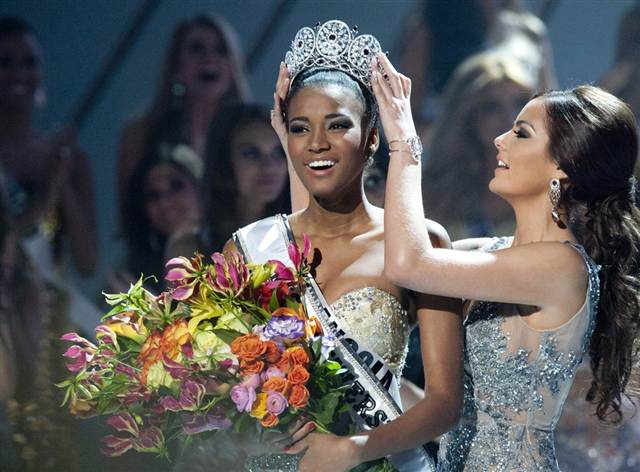
The news is in this morning. Miss Angola Leila Lopes is now Miss Universe. For those of you from the United States, which means we have trouble finding the United States on a map of the United States, Angola is located in Africa. That’s right underneath Europe, which is right next to a large body of ocean called the Atlantic, which is named after the record company of the same name.

I’m sure a lot of you are wondering how someone from Angola won the Miss Universe pageant, while a lot more of you are wondering who the hell even cares about the Miss Universe pageant any more. You see, for most liberal women, the idea of a pageant is horrific, a place where Neanderthal men point at women with boob jobs and measure their respect by how well they fill a swimsuit, pretending to care about their answers to important philosophical questions like, “And how would you make world peace happen in our life time?” Most people have stopped finding the Miss Universe pageant to be socially and intellectually relevant, even as the pageant swears the whole institution is a scholarship competition designed to “enrich” women.

Now, I don’t really care about the argument any more than I care whether or not Hugh Hefner’s Playboy Magazine is a good or a bad thing, mainly because the magazine, and its dinosaur of an owner, stopped being relevant sometime back in the 1960s, when other thinkers came along and proved that you could make the same point without requiring a girl to take off her clothes so guys would pay attention to what someone might have to say.

Beauty pageants have stopped being relevant a very long time ago, yet they still maintain a presence in our society because people are still Neanderthal enough to think they’re important. And unfortunately, you can’t just blame horny guys for keeping them active. Whenever some woman thinks to herself that “I’m pretty enough” to be in that magazine, or on that stage, then you automatically set up a paradigm where other women will find themselves having to compete with them, even if they swear they’re not interested. You see, the whole human race is built on the concept of competition, and as the players in this race, or game, we all are active in deciding what contest is the one that maintains relevance. I’d like to think that we’ve evolved far enough that the Miss Universe competition is outdated, but we still maintain an importance on this event so that the woman who wins will still manage to maintain a career of successes based on her placement in this contest. Forever, she will be linked by how she sashayed down the runway in her swimsuit, and the rest of us our responsible for how that continues to play out.

What we really need to decide as a society is what do we consider to be relevant enough to put one person above another when it comes to our social Darwinist ideals. If we consider intelligence the most important, than our supermodels should be the smartest men and women available. But let’s be honest with ourselves. We don’t put smart people higher than anyone else. We put rich people (usually men) on a high pedestal, and even if their ideas are idiotic, like those spewed out there by Donald Trump every time he tries to pretend to be significant, and we put at the top of the spectrum attractive women who throw their sexuality at us on a constant basis. And it’s not just at the top of the pecking order we do this because think of every time you’ve gone to a bar, social club or any place where mating rituals occur. Those were the dynamics that fed the engine that caused most of the hooking up to happen. I see it on social sites all of the time, and so do you.

Which means that when it comes down to it, no matter how smart I might be, no matter how many great ideas I might have to make the world a better place, or even how many great novels I might churn out for the masses. In the end, because I’m not filthy rich or insanely attractive, my place on the pecking order is pretty damn low. Yet, because I am part of this human race, I am required to try to fit into the competition as well, even though I recognize that for the most part the dynamic offers me table scraps and a continuous series of disappointments, as not everyone is born with the attributes that gives them immediate success and gratification.

So, having said that, let’s give our congratulations to Leila Lopes, whose name we will not remember in a few days from now (or a few minutes after I press SEND). With that said, she’s still miles ahead of the rest of us in the grand scheme of things.

A Nation Without a Rudder

Sometimes, it is so easy to fall into partisan bickering that it’s not even necessary to write the column. Circumstances fill in all of the details for you. But if you’re one of those people who purport to be lacking in partisanship, or at least trying to avoid the pitfalls, it’s a lot harder to talk about the same issues without someone automatically believing you are part of the status quo (one side or the other) and immediately fill in criticisms because of such observations and beliefs.

The President of the United States delivered his “jobs” speech last night, and it went over like a lead balloon. The Los Angeles Times (most definitely not a conservative newspaper) took a tongue in cheek approach to covering the speech, and wrote an article that is probably one of the most sarcastic I have read in ages. Here’s an example:

But here’s the catch that Obama and his Windy City wizards missed: Most Americans are not politically obedient machine Chicagoans. Like a linebacker reading the quarterback’s eyes, they’ve already figured out this South Sider’s game.

But after the laughing subsides, you have to start looking at the bigger picture and wonder what’s really going on here. If it’s just about one side failing, and the other side benefiting, I guess it would be fine (if you were on the side benefiting, I guess), but in this case, we’re not in a zero sum situation (where one side wins); we’re in a no sum situation (where no one wins). The United States is in such need for sustained success, and we’re nowhere near finding it.

Unfortunately, our country is like a boat with no rudder. Granted, it’s a pretty strong boat, capable of floating quite well, but at the moment, no one has any idea where to take it, and even if they did, they don’t know what to do with it once we get where we’re going. Instead, the hope is that things will get better, and all we have to do is just hold our breath until we get to that better place. That’s not a plan for sustained greatness. It’s a plan to avoid bad things by hoping things won’t be so bad if we get beyond the current wave of bad things.

So what is the answer? Well, we need leadership that can focus on what’s really the problems with America and then do something about fixing them. But as long as every leader is only interested in self-interests, like getting re-elected, we’re never going to find a solution because we’re too stupid to realize that we need to allow them to fix things first instead of punishing them for trying to do what’s right. It’s like the whole Jimmy Carter election where he spent his re-election period trying to point out what needed to be done to fix America. He got slammed and destroyed by his opponent because he “hated America” and other such false-isms. We’re so stupid and incapable of realizing our own self-interests that we’ll let someone say nice things about us and then convince ourselves that the person must be a great leader because he said good things about us. That’s how simple the America psyche is. And that’s why we’ll never actually get any success.

America needs a splash of cold water in its face to wake up and realize what’s really wrong. But we’ll never get that because anyone who wants to run for office is doomed to have to say nice things and embrace American exceptionalism rather than try to fix anything that’s wrong. Think of it this way: If I was to run for office and say that the way to fix our cities is to eradicate poverty by actually focusing our attention on improving the lives of people in poverty, while creating a new atmosphere of intolerance towards gangs, racism, hatred, and corruption, and then turned around and devoted my political life to doing just that, my career would be over before it started. However, if I got up on stage and talked about how great America is, how I’ll use my office to put more police on the streets to “stop crime”, and that I will support business to “rebuild this country”, I have a far better chance of being elected, and once in office, I’ll be completely ineffective, but will probably be able to enrich myself by giving rich lobbyists exactly what they need to make sure their clients become richer, while people who really need help get limited help and lots of condemnation for not raising themselves up by their bootstraps. Think about that for a second because I’ve described practically every politician out there, from your local mayor to the President of the United States. And somewhere out there is a voice thinking to itself, “well, the problem is too big, so there’s really nothing that can be done about it” and another voice thinking, “well, if I can’t fix it, I may as well try to profit off of it and make a good life for myself”.

And so the band will keep on playing on.

Fired Yahoo Boss Needs to Put Firing into Perspective

"I love you Duane, but I've decided to date the football team instead of you"

I’m always amazed at the outrage people can purport to feel over very minor things. Years ago, I was working for a major hotel chain, owned by a name that just so happens to be similar to a bar hopping floozy who is famous for being famous (and a conveniently released porno tape of her having sex with a former boyfriend). The company decided that it wanted to get rid of its union employees because it couldn’t come to an agreement with the union over how to screw over the people in the union and take money from them that the union employees were getting for doing work that the hotel couldn’t figure out how to profit off of. So, it fired the employees. And it did it by setting up these employees in a “sting” operation that consisted of the employees doing what they did every day and then telling them they were “stealing” from the company for doing what was already established procedure. So, when it came to applying for unemployment, the hotel chain decided to be even more greedy and try to challenge the ex-employees (not wanting to pay a red nickle to them whatsoever). The employees threatened lawsuits against the hotel for wrongful termination, so the hotel backed down. The employees left, forever pissed at the shitty company they used to work for, and the company walked away, thinking that somehow it managed to accomplish something by losing long-term employees who had made the error of letting their union stand up for their rights.

So, when I hear this Yahoo boss complaining that she got fired from her job over the phone, I want to kindly tell her, “go fuck yourself”. Things could be a lot worse, and they’re not. You got fired because you did a crappy job, knew it was coming long before it happened, and got a SERIOUS severance package as a consolation prize. Yahoo won’t show up to the unemployment hearing and try to pretend that you are pond scum and so beneath them that you don’t deserve your $200 in UI compensation while you try to find another job, scrounging up on pork n beans because you can’t afford anything on the dismal wages you were getting previously (and now are barely receiving). No, you’ll be eating in fancy restaurants, probably courted by major corporations that will ofer you golden parachutes to grace them with your presence. You’ll probably be offered a huge publication deal with some book company to write a book about how to run a billion dollar company into the ground, and you won’t even have to write it. No, they’ll hire some minimum wage wannabe writer who is looking to get his foot in the door (or her foot in the door) at some publishing empire. And you’ll collect money just for putting your name on the cover.

So, stop complaining. So they fired you over the phone.  A girl I was dating once broke up with me over the phone, said we weren’t really compatible any longer, which was a translation of what she was really trying to say (“I found someone else while I was dating you, and it was easier to lie to you than tell you that I was fucking him behind your back, and I definitely couldn’t have told you this with a straight face if you were standing in front of me, you great stud of a man you.”) Okay, the last part she didn’t say, but I’ll remember the break-up my way, thank you very much.

For those of us without superpower jobs like Carol Bartz, we’re kind of stuck with the realization that respect doesn’t come to us in our world. Therefore, you should try living in our world for a bit before you try to gain our sympathy for the insults you perceive that you received. You had a pretty good thing going, and you didn’t live up to the expectations that were placed on your plate. But you got out with a pretty nice bonus. Be thankful for that. Not all of us have always been so lucky.

America Needs a Social Messiah

Most people feel it but don’t really know how to put it into words. Something’s wrong with our country, everyone seems to know it, but no one really knows what to do about it. Our politicians keep claiming they have it all figured out, but they’re floundering, unsure of what to do and constantly going back on everything they say because they’re as confused as the masses. Something’s wrong, and we’re at a stage where something needs to happen to fix what’s wrong.

Having said that, I have to point out that one of two things is going to happen (aside from nothing happening and this state of morass continuing for more years before a solution finally occurs). Either someone is going to come along and rally everyone together to lead them off the end of a cliff, or someone, or some thing, is going to arrive and lead us to a better place. We’re at that stage where we need something, and unfortunately everything already in place is totally incapable of doing the trick.

This is part of why Obama became president. He came after a crappy period in US history, when we had a president and and administration that led the country down a road into near despair and depravity. He came along and promised a new sense of America that would put the country back on track, kind of like a political messiah who would lead us to the proverbial promised land. Instead, he gave us a lot of what we already had, and basically became Bush Light, leaving us in a state where we’re still waiting for someone to come along and pick up the slack he was supposed to actually use to make things better.

It’s not just a bad economy that’s causing the frustration. It’s a sense that no one knows what to do with the most powerful country on the planet. We have no rudder, steering us to some place better because we honestly don’t know where a better place might exist. Technologically, we’ve created the computer and hand held devices that make life simpler, although they tend to make things even more complicated (adding to our work day instead of cutting it down). Intellectually, we kind of have a lot of science and medicine already figured out, although we still can’t provide health care for everyone, our medicine is created by companies that make only the drugs that are profitable and lobby to make sure things don’t get better for the masses, and we pay our businessmen far more than our engineers and scientists, which means we’ll always have more people making money than making better products. Our political landscape hasn’t changed since the 1800s, as we still rely on diplomacy that requires tit for tat game theoretical models which reward last year’s actions and beg next year’s compliance (even the Roman Empire planned five years ahead, rather than this “what have you done for me lately” policy we seem to have fallen into).

In other words, we don’t seem to have a direction, or even a clue as to how to get ourselves pointed in any direction. People are so focused on the now that they could care less about the future, and anyone who things progressively is seen as foolish and foolhardy, which means we are like ten year olds planning for lifetimes of mediocrity.

This is the time when someone can come along and change things. This could be a great thing, especially if we find an enlightened thinker, but unfortunately we’re so 18th century in our thinking that we all seem to believe we need an enlightened “leader” rather than an enlightened “thinker.” Think about that for a moment. When it comes down to it, we’re going to end up going to the polls, or erecting an homage to a power base, rather than follow the enlightened ideas of someone who has the right ideas. We’re so Hobbesian in our ideals (needing a leader to lead us) that we have forgotten that the US was created in Lockeian ideals (where we control the leader), and really should have been leading to Rousseauian ideals (where the group identity has more power than the individualistic desires that we have today…where some corporate entity can dominate the masses because it has economic power that speaks louder than ideas and voices).

Part of my fear is that most of the west is filled with people who are only capable of the lowest levels of Maslowian achievements (basic needs) rather than higher level analysis (using logic to figure out ways to fulfill needs rather than immediate gratification). This means that when someone comes along and tells us what we want to hear, we’ll comply and expect great results, and when that person proves to be no better than your average Detroit politician (i.e., corrupt), we’ll back that person even when things turn into Ponzi schemes and false hopes and promises. When people are incapable of thinking logically through higher level concepts, they’re constantly doomed to being cheated and exploited by their leaders (kind of where we are today).

The ideas of Rousseau are probably interesting to point out here because the ideas he espoused were those of an enlightened society that realizes its needs are met through its communicative knowledge, but as long as we want things fulfilled within easily constructed plans, we’re always going to be doomed to Hobbesian outcomes (the leader telling us to do what to do so he can get the payoff instead of us). The solution, unfortunately, involves more and more people talking to each other about how to make things better, but as long as media is one-way communication (them to us), we’re never going to get there. Social networking is designed to be two-way, but as I look at the recent approaches of Facebook and Google+, all I see are attempts to create celebrities with bullhorns, rather than a process to open communication between both sides. Which means we’re moving further and further away from where we need to be.

At the end of a diatribe like this, I’m sure the logical question will come: “Do we need to know this for the test?” And when I say no, thinking stops and texting starts.

So I give up again.

Can Anyone Actually Beat Obama in 2012?

There are a bunch of Republicans trying to run for office, and tons of talk about stupid subjects, like will Sarah Palin run for office, but what no one really seems to be discussing is the HUGE elephant in the room, and that’s the fact that the incumbent rarely loses, especially when no one else is massively popular in the same arena. If you would have asked me back during the second election for George W. Bush if he was going to win or lose, I would have actually thought his chances of winning were slim. But it turned out that incumbency was the overriding factor that propelled him towards a second victory.

We’re in that ballpark again right now. We have a president who was thrown into office with a massive wave of popular support, but even his most loyal critics would be willing to say he’s been quite disappointing as a president. There was a lot of hope for hope and change, but unfortunately the only thing that really changed was the person in office, and to be honest, this man has been somewhat of an after the fact speech maker who seems to think that the bully bulpit is the only thing he needs to run the country. It’s one thing to have a great orator in office, but when all he does is make great speeches, you start to wonder what kind of person you really put into the Oval Office.

But having said that, the Republicans have absolutely no one with any sense of popularity that can get someone elected. Their options are crap, more crap, and a lot of the same. Their show stoppers are carnival clowns that make the audience jump up and laugh, but other than that, they have no one capable of doing any real damage during the election. So, unless they somehow find an underdog that no one is expecting, or one of the boring people running right now suddenly becomes infused with superpowers, I don’t see anything happening this time around other than another four years of a very insignificant, do-nothing president who will basically be a place-holder until someone new comes along.

If you think otherwise, say something. Let us know. I certainly don’t have the last word here, but for some reason people seem so quiet over this issue, or they end up being reactive, falling into political paradigms and relying on talking points that don’t mean anything. So speak up and let us know what you have to say. Otherwise, this is going to be a very boring election with absolutely no surprises whatsoever.