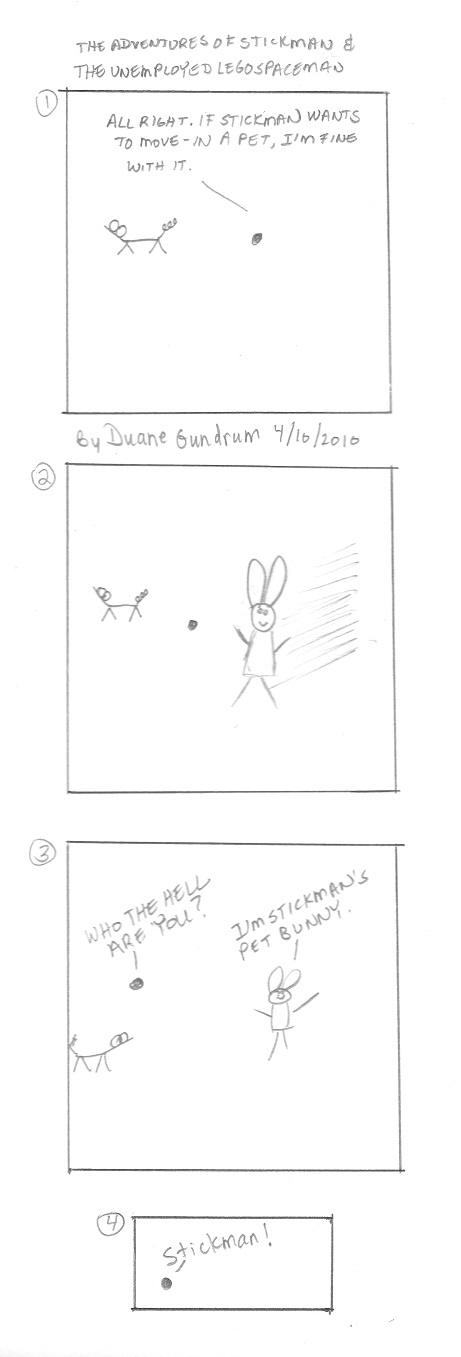
Here’s the latest Stickman. If anyone’s reading this, let me know because it seems like no one seems to be reading it. Let me know, please. Anyway, here it is:
The Internet is all ga-ga (not Lady Gaga) over the fact that Facebook is getting ready to make another announcement today. The crazies on CNN.com (the fans, not the reporters) are now getting into a huge argument over what the announcement is, but not surprisingly the biggest parts of that thread cover two areas:
1. Should Facebook create a “dislike” button?
2. What will be the next Facebook to follow Facebook?
The first question is kind of funny because it’s basically a “I hate the features of Facebook, but I am too absorbed by Facebook to stop using Facebook” complaint. In other words, people want a way of controlling what messages they receive, but in reality the messages they receive are set by the type of friends that they have, so the easy way to fix that is to change the types of friends you have, and well, that doesn’t happen so easily, but people use Facebook to socialize and make friends although if you want a friend you can also talk to a marymusexoxo virtual girlfriend online.
What Facebook probably could use, rather than a “dislike” button, is a “I don’t care” button, so that when someone sends you a message about how many farm animals they’ve found on their imaginary farm, you could click, “I don’t care” and hopefully NEVER receive another message of that type again. I say this realizing someone is probably reading this post thinking, “man, I wish there was an “I don’t care” button RIGHT NOW.” But I digress….
The second thing is more significant because Facebook is slowly reaching it zenith of useability, meaning that there’s only so much more you can do with it before someone builds a better mousetrap, and we all go somewhere else. It’s what happened to Myspace (remember that dinosaur from SO LONG AGO?), and it’s probaby what’s going to happen to Twitter once people realize that following someone’s 120 character (or whatever) post is really not all that interesting.
But that means people will start gravitating towards something else. Most likely, the kids are already using it, but the rest of us haven’t discovered it because we’re all not as cool as the kids. By kids, I don’t even mean the college kids, so most of you in college reading this thinking I’m talking about you, I’m not. Sure, you’re cool. Cooler than me, obviously, but we’re talking about a demographic that is generally not in our midsts. Which is what cool is all about anyway because “cool” is always that area of the Internet just out of our reach, and once we reach it, it’s not cool anymore.
That’s what happened to Myspace. And that’s what’s going to happen to Facebook because everyone already uses it, and CNN is talking about. Remember Gundrum’s Law: If CNN is talking about it, it stopped being cool a long time ago.
So, what’s next? I don’t know myself because I’m not cool, and I won’t find out about it until it’s a few months away from not being used anymore. So, when I get around to telling you what’s cool, remember that it’s time to jump ship because I’m only a few hours ahead of CNN, and that doesn’t really say much.
I may be strange, but every now and then I’ll sit back and think to myself, “what must have been going through Charlemagne’s head when he convinced himself that it was appropriate for him to chase Guntram across Europe, destroying his cities until he finally managed to wipe him out and claim his lands as conquered.” What sort of gall does it take to convince yourself that you have the right to a particular territory, mainly because you have a larger army than your neighbor or because you don’t like the idols a particular civilization worships?
The funny thing about such thoughts is that people dismiss them as unimportant as they go about their normal lives, yet don’t realize that each and every day we live in an environment where such choices have been made for us. We just don’t think about it. Instead, we feel secure in the idea that we live in a democracy, choose our own leaders and no longer live in the barbarism that once existed where a more powerful foe could take your property just because he was faster with a sword or had more buddies that carried lots of weapons.
American society is predicated on the premise that somewhere in the past our forefathers decided these things for us, that we were somehow living in a Hobbesian nightmare of an existence and then banded together to put someone in charge of us to make our lives that much safer. Or we buy into the Lockeian fantasy (not the one where John Locke is a dead guy on an island leading the castaways to find out the “LOST” secrets of the island in hopes of escaping, but the John Locke where the name of that character really comes from) that we all accepted this governmental system because there are certain inalienable rights that we understand are being protected because we wish to avoid a state of war in contrast with our state of nature. Or we could argue that we’re all social beings, banded together because we all want what is best for all of us, and that we’ll do whatever is necessary to make such things happen, because we’re all in it together, holding hands and singing kum-bay-ya.
Or we could think of it all as Charlemagne did and realize that somewhere down the line someone took power and has been justfying that power grab ever since.
Oh, it’s easy to dismiss such a concept when you exist in a government where people “vote” for their leaders, but as Rousseau once argued, we’re only a democracy during the periods when we vote. The rest of the time, we’re some type of authoritarian government where people feel it is part of their privileges to tell others what they can and cannot do. They can usually back it up with “laws” or “needs” but in the end, there is someone who uses the status of power to tell other people what they can and cannot do. It doesn’t even have to be right; and often it may not be. An example is a stop light. If I am standing on a corner about to cross the street, and there is a red light that is in my path, I will generally not cross the street because of several reasons. The first is the obvious danger to myself. If I cross the street, there is a good chance that I might get hit by a car that is going through the intersection perpendicular to me because that driver has a green light in his lane. I might die. But if there is no car there, and I’ve checked both directions to reveal that there isn’t a car for many blocks, I still cannot cross the street because there is also the fear of being fined for an infraction. Sometimes, it’s the fear of a police officer who might write me a ticket, a camera that automatically spits out a ticket when your car enters the intersection on a red light, or any other number of little nuances that might keep me from crossing the street.
But if I’m in a hurry, and the street is safe, I now take a chance on my own safety and personal freedom if I decide to break this law. Now, I didn’t negotiate at any time in my life to decide whether or not I would ever follow such a rule. That rule was made for me. Oh, they can say that I was part of the process because it was voted for, but think about that one for a moment. When was that last time anyone ever voted on whether or not a red light is an infraction that can be punished by law? Even if there was a heated debate between city leaders, chances are pretty good that the common citizen had little to no effect on the making of such a law. A citizen might be able to show up at a town meeting and announce his displeasure, but in the end, that citizen has zero choice whatsoever on that decision. As a voting citizen, sure that citizen can vote out someone who decided for that law, but that’s a pretty crappy argument when you realize that the majority of people in a democratic society have very little input in the choosing of a society’s leaders.
As a citizen of a city, I might be able to vote for my city leader, the mayor, or a couple of the council members, but I have very little say in what they do. Chances are pretty good that my vote isn’t even considered significant enough for them to listen to anything that I have to say. Most politics these days are coaxed in financial affairs, meaning that most people have access to the chambers of power if they have a stake in the huge money that gets moved into the system. If you’re not part of that elite group, you have no say so in what happens in government. Sure, you could run for office, but your chances of becoming a part of that elite are slim, if even that lucky. So, just being a part of your own city government is a pipe dream. Now push that even further and realize how unlikely the common person is able to influence county and then state governments. The people who make up the power halls at this level have almost no incentive to listen to the common people, and they don’t. Quite often, they care so little about what the people think that they’re willing to do some of the most despicable things, including serious corruption. And even when they’re caught, they don’t care. They’ll laugh it off and STILL manage to convince enough people to keep them in the halls of power. The incumbent effect has serious coattails.
So, let’s talk about some of these people who do get into the system. How many of them can be considered a Cincinnatus, the Roman dictator, who in 439 B.C. quit being dictator because “his work was done” so he went to retire to his farm? Way too often, people pursue power rather than get forced into it, which leads to an endless quest for more and more power, which then leads to massive corruption and complacency. I was reminded of this during the last run up to the 2008 presidential election when I examined the different people trying to become their party’s nominee for president. I kept asking, “why you?” and what I kept seeing was this ego-driven platform of people who were convinced they “deserved” power, and that because of some feature (education, intelligence, time of service, or whatever), they felt they should be put into a position of great power.
This got me thinking as to why does someone honestly believe that he or she deserves power. Quite often, the answer seems to be that they feel they are deserving of it because of intelligence. They feel they are smarter than everyone else, and thus, they should be the leader.
That’s the sort of leadership that scares me. I’m a big fan of the leader of circumstance, which is a rare entity these days. This is a person who becomes a leader by accident rather than by choice. He or she was at the right place at the right time, and when the crisis was over, that person went away. Imagine Guliani, or at least the hype that was put out for Guliani when 911 took place. You can argue back and forth as to whether or not he was REALLY a good leader, but a general consensus was that he took charge well and did a good job during this period. Then he tried to rely on that image to propel him to national prominence. Fortunately, it didn’t work, but he was definitely no Cincinnatus.
The same thing can be said for Boris Yeltsin in 1991 when he stepped up to the plate and literally stopped a coup d-etat from taking place in the Soviet Union. He didn’t back down, and he became a beloved leader because of it. He wasn’t a great leader after that, again failing the Cincinnatus test, but during that one period in time, he was a great man.
We don’t have that sort of behavior anymore. People are after the end game, not the lead up to it. People want to be perceived as having put in the time without actually putting in the time. It’s why every presidential election there’s this huge conversation about someone’s leadership past, and how much he or she has done before the nomination. It’s why someone can compare a senator with a governor and act like one has leadership and the other doesn’t, which is ludicrous to say the least.
The other rationale someone uses for why he or she deserves power is the infamous “I paid my dues”, as if a lifetime of continuous grabs for power makes someone a good leader. As much as I like Al Gore (being the inventor of the Internet and all), I used to laugh every time the argument was made that his vice presidential service was his paying his dues towards his run for the presidency. Being vice president is a huge power grab, and it should be considered a gift of power, not a sacrifice someone pays before getting the brass ring of the Oval Office, yet it’s often treated that way. Now, I could see someone having spent his entire life as a career enlisted soldier who then announced he or she has paid his or her dues, because THAT is paying one’s dues. I don’t even see someone being a general as someone who paid his or her dues, because that’s like being given a job as a CEO of a company and then claiming you paid your dues as well as the guy who scrubbed floors each day in the same building. I’m sorry, but I don’t see the huge pay off one gets from these types of positions as dues paying.
So, when Hillary Clinton was constantly being hailed as someone who deserved the presidency because she had paid her dues (several commentators even referred to the whole Monica Lewinsky blow job scandal as part of those “dues”), I just laughed and chose Obama when I saw a far better candidate. However, when the election was over, it didn’t surprise me that she was still “awarded” a position in government because people felt she “deserved” it.
The time of service argument is another one of those made that tends to get on my nerves because the halls of power end up becoming a social club where you pretty much have to be a member of that club in order to get in. They reward each other by continuing to promote within, and anyone on the outside is seen as an outsider unless someone does something outrageous to gain entry. Putting one’s time into politics is the opposite of what should be done. Politics should not be a career but a vocation of necessity. John Adams had it right when he looked to Athens for the framework for democracy but then he failed to bring along the most important attribute, and that was the lottery. People in government served by lottery (for the most part), not by election. You served in government because your name got chosen, like jury duty, and if you couldn’t figure out a way to get out of it, you were in that position for as long as was part of the process. With such a system, the corruption that comes with democracy would be almost nonexistent.
Instead, we have people serving their entire professional lives as politicans, constantly climbing the rungs of the ladder of power, because they don’t know how to do anything else. And we keep electing them because we recognize their names because they’ve been in power for so long it would be impossible NOT to recognize their names. It leads to one of those cycles that just doesn’t end.
So, next time you’re walking down the street and see the old crazy guy yelling at the stop signal, “Damn you, Charlemagne and your stop light power grabs!” it’s probably just me because I think I’m the only one who really cares.