Monthly Archives: May 2010

The Laptop finally died….

I’ve had an HP laptop for many years now. It’s been a great machine, and for some reason it always managed to stay current with the latest machines. This evening, I was starting it up, thinking of bringing it somewhere to write, and the screen just fizzled out. It’s still giving off a light, but the actual computer image is no longer there. Everything’s running fine, so basically the screen just no longer works. And I don’t feel like fixing it.

I’ve been thinking of getting something to replace it for awhile. I can’t really afford anything right now, but unfortunately the laptop is officially dead to me. Really not sure what to do next.

May Wrap-Up

Just thought I would take some time to do a little bit of a wrap-up of things going on, including the news.

1. My job. Well, I haven’t lost it yet, but it’s never really going well. I like the people I work with, and I tend to deliver whatever is desired from me, but it’s one of those jobs where you just get the feeling every day that it just isn’t working out, and no matter what you do, it probably never will. It’s unfortunate, but I really need to find something stable that doesn’t make me feel like it’s going to end tomorrow on a whim that I can do nothing to avoid.

2. My writing. Nothing seems to be happening. I send stuff out, and if I ever get a response, it’s a generic, no thanks. It’s really frustrating, and I really don’t know what to do about it. It’s like I’m forever on the outside looking in to a great place where everyone is writing lots of fun stuff. People who come out of the place engage me in conversation, but I’m never allowed inside, almost as if there’s a conspiracy to keep me outside but no one on the inside knows anything about it.

3. Stickman. I’d produce more of Stickman, but it’s really hard to try to bring humor to the rest of the world when you get the impression the rest of the world doesn’t care, doesn’t really want it, and you’re just wasting your time. Or at least it feels that way.

4. My life in general. It feels like I’m constantly in limbo land, and I can’t find a way out of it. I don’t feel I’m where I need to be, but I don’t know where I need to be either. There’s really no one significant in my life, so I don’t have that to look upon as a solution to anything, or even as a journey towards any place. If I had to use one word to describe the feeling, it’s “blah”. Really blah, if I needed two words.

General topics:

5. The Guild Season 3. If you have never seen this series, and you happen to be a computer gamer, especially one who plays MMOs, this series is for you. It’s put out by Felicia Day, and it’s manufactured by a bunch of Internet happy people (meaning, without a lot of commercial backing), and it’s funny. It misses every now and then, but it does deliver. I recommend it.

6. Survivors (the British import series). Another interesting show. I recommend it. It’s another one of those shows that doesn’t appear to have been backed by a very large commercial enterprise. Either that, or it was backed by a commercial enterprise that seriously sucks because its production values are very amateurish. But it’s quality of show is very high. The writing is good, the acting is surprisingly not bad, and the premise is quite original and fresh. It is also very daring in its material, which has shocked me a few times because it really feels like some show that had been made in the 1970s, but with a sense of 2010 in mind. As a matter of fact, I just checked, and it WAS produced in the 1970s, so that explains that. But another one I recommend.

7. Sandra Bullock and her husband. Every now and then something in the news causes me to want to make a comment. Well, recently, Jesse James went on Nightline and said that he cheated on Sandra Bullock because he was abused as a child. Today, the father announced that Jesse was lying, that he never abused him. Well, my thought on this, having no knowledge of said events, is that abusers rarely ever admit they abused anyone. And in many cases, the spouse will also claim there was no abuse because no one wants to believe that something happened under their noses. But having said that, it’s a stupid reason to use as an excuse as for why you cheated on your wife. Any excuse is a stupid excuse because cheating is just that…cheating. I’d never have gotten married to anyone if I ever imagined once that I would be cheating on my future wife. And once I was married, cheating is NEVER an option. Why so many people can feel that there is justification for whatever reason is beyond me. I even heard one person say his wife cheated on him so now he has a blank check to do the same. It just doesn’t make any sense to me. Maybe it’s why I’m rarely in a relationship. They never make a lot of sense to me.

8. LOST. It was great. Great ending. Great show.

9. The iPad. Um, is it a netbook? A laptop? An oversized iPod? I’m not sure. But it isn’t enough of a substantial product to get me to want to buy one yet. I need something like it that I can really use to write a novel on and feel comfortable with it. It’s almost there. Why wouldn’t I buy one? In order to use its 3G network, I have to pay AT&T more money. I already pay them to use it with my iPhone. If they can’t lump those two together, they’re ripping me off. Not buying it for that. I don’t hang out at wi fi spots enough to use it otherwise. No word processor that I could find on it when I was looking at it at the Apple Store. Or maybe there was one. I don’t know. The guy who worked there was so impressed with himself that he worked there that he spent the entire time trying to score with some hot chick that was looking at an iPhone that I couldn’t get anyone to help me except for the one guy who “thought” he might be able to guess. Not a hard sell for me.

10. BPs oil disaster. Clean it up. Well, cap it off and then clean it up. I don’t want to hear about how you’re thinking you can do it. Just do it. As for Obama’s involvement, I don’t care. Get BP to fix it or call in the Marines. Or Flipper. I don’t care. Fix it. Or get Red Adair to fix it.

11. North Korea. Not sure what to say there. Our foreign policy was written in shortly after the First World War. We haven’t changed it since. Not sure why we’re under the impression that things are going to get better if we keep doing the same things that haven’t worked before. Didn’t Einstein have something to say about that and insanity?

That’s all for now. Some days, it just doesn’t feel worth it to continue, but then I remember that there’s still another episode of LOST to air before doing something stupid. Oh wait, the show ended. The networks better come up with something soon, or I’m cashing my ticket out of here.

I Want a Hollywood Romance…or an East Berlin one at least

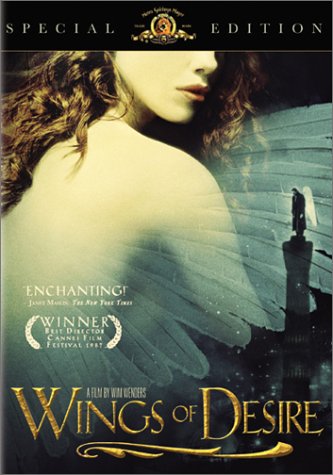
Every now and then I put a movie into my Netflix queue that leaves me wondering months later, what was I thinking? That happened last night when I finally got around to watching a movie that was in my queue called Wings of Desire. To be honest, I don’t know how that movie got into my queue because it certainly doesn’t match any criteria I attribute to movies I tend to add. Going down my checklist, there were no hot Asian women in leather jumpsuits who do Kung Fu, Arnold wasn’t seen once carrying a huge bazooka and chomping on a cigar, not a single Starfleet communicator chirped once during the movie, and even more important, not a single French clown cried at all during the two hours and seven minutes this movie aired (although it was one of those movies where it could have happened at any moment).

The movie was a several hour poetic metaphor on the meaninglessness of life. The two main characters were male angels who seemed to spend the entire movie walking around 1987 East Berlin listening to the mindless rantings of humans who lived in a state of black and white despair. During their wanderings, they seemed to latch onto a huge library that resembled the one from The Breakfast Club, where they went person to person and listened to their inner thoughts. One of their focuses was an old man who supposedly was writing the great American novel in East Berlin, so I guess it was the great German novel. The old man kept talking about how he was the only one who could write down the story, and that without him all of humanity was doomed. And I thought I took myself seriously as a writer!

There are two other main characters that the angels attach themselves to. One of them is a beautiful woman who happens to be a trapeze artist for a circus that is going out of business. This is where I kept waiting for the inevitable crying French clown, but he never showed up. The other character was Peter Falk (of Columbo fame) who was playing none other than Peter Falk who happened to be in East Berlin filming a movie that seemed to be about a couple of guys who have a fist fight in a beat up building that has no roof. I was reminded of the great operatic, Tempest like story that was mentioned by Danny Devito in Throw Mama From the Train, which he describes as “a man with a hat kills another man with a hat.” But I digress. Without getting too far into a plot I still don’t understand (my understanding is that you need a Ph.d in this particular movie to actually understand more than 5 percent of it), let’s just say that Peter Falk plays himself and just so happens to be a fallen angel himself who guides one of the angels after he decides to become human.

And the reason the angel decides to become human is because he falls in love with the trapeze artist. And that’s what I wanted to talk about with this post. You see, when he finally becomes human and can experience love, he goes into this punk rock music hall she goes to every night and sits at the bar while the “concert” is going on. I won’t describe the music, other than it was the most bizarre music rendition of punk I’ve ever seen, and all I can say is that I believe the director had to be a fan, or the lead singer was his son, or something like that, because I spent more time trying to figure out how the lead guitarist was actually producing the sounds that were coming from his musical device. Anyway, the beautiful trapeze artist leaves the music area and goes into the bar where the angel is sitting, plops down on the seat next to him, and then begins to explain for the next twenty minutes why she is empty inside and needs to find the solution to pi or something like that. To be honest, I had trouble following what she was saying because it had to be the longest data dump I’ve ever experienced from one individual. The angel said nothing, and when it was done, he kissed her, and somehow they managed to live their entire lives metaphorically forever together.

And this got me thinking, how come East Berlin women don’t sit down next to me in bars, pour their heart out to me for about twenty minutes without me having to say anything, and then we live happily ever after? Is it because I don’t know Peter Falk? Do you have to be an angel to make this happen? Or am I missing something here. How come when a woman like that sits down next to me, and I say, “hi, I’m Duane” it’s usually followed up with: “Oh, I have a boyfriend.”?

Movies like this keep making me think that somehow I just haven’t got it all figured out, and that bothers me. Is something this epic only possible if you happen to live in some Communist country that is about to transition to democracy and future unification? Where are all the unemployed trapeze artists that I seem to be seeking?

Anyway, interesting movie. I’d recommend it if there had been a crying French clown involved. Not surprisingly, there are too few movies being made these days with crying French clowns. And that’s just sad.

This just in: Beating Your Head Against the Wall Leads to Results…a bruised head and a broken wall

I’ve talked about this before, but no one really seems to listen or care, but here it is again just for the fun of it. It appears that North and South Korea are rattling sabers and could be moving from posturing to actual fighting. The North Koreans may have (most likely) sunk a South Korean warship, and right now everyone is going nuts trying to get the North Koreans to admit their crime. Secretary of State H. Clinton says they have to own up to their deed. South Korea says they have to admit what they did, because they now have proof. North Korea says “make me!”. In other words, it’s business as usual on the Korean Peninsula.

You see, this has been going on ever since the two halves of one country decided to separate. Or someone decided to separate them. They both want to be back together, and but neither one of them is ever going to happy until the other one is gone. It’s kind of a bizarre set of circumstances, but that’s where they are.

What is NOT working is how we’ve always handled this. Our foreign policy approach to Korea has always been the old game theoretic model of tit for tat. It’s such a simple strategy that even a monkey can play it. Actually, they do. Give a monkey a banana, and he eats it. He might even do some tricks. Or throw poo at you. Monkeys aren’t really good at responding the way you’d want them to. Neither are North Koreans. And technically, they’re a lot smarter than monkeys. Can monkeys fire torpedoes? I don’t think so. So, yes North Koreans are a lot smarter than monkeys. So tit for tat is one of those great strategies that should work because North Koreans are smart enough to respond in a good way when you act in a good way towards them.

Well, that would work if North Koreans were computer programs that respond in a game theoretic fashion. And that’s the problem with game theories. They’re designed for a rational world, where people do what is in their own best interests. There’s no such thing as pride and prejudice (or other Penguin classics for that matter) in the rational choice world. People do what they do because it’s in their best interests. Or so we’d like to believe.

North Korea has rarely responded successfully in this fashion. But I’ll let you in on a little secret. It’s not because the game theory is wrong, because it’s pretty good and one of the few theories out there that consistently gets great results when used properly. That’s the problem right there. We don’t use it properly. In order to succeed with tit for tat, it requires both players to be involved in the game. And surprisingly, the wrong player is the one who never plays. We start the game, throw out a carrot, get a reaction from North Korea, and then we respond appropriately. BUT (and this, like JLo, is a big but) when they don’t respond appropriately, we go nuts and kill the game. The solution to tit for tat is to continue the game as if it was still happening, to actually escalate further in a positive manner, but we don’t. Instead, we throw a fit and wonder why North Korea never responds favorably. So that leaves us at a point where we have to start the game over again. And wonder why it fails soon after. We’ve created a second level tier of tit for tat where we’re not even playing the same game we’re starting. North Korea is still in Game 1.0, and we’re starting Game 5.7, wondering why North Korea is responding to inputs from a previous game instead.

So, what’s the solution? Stop playing tit for tat. We need a new “game” that works, and this is another one of those FOT responses I keep throwing out there. If we ever want to get at North Korea so that they become partners for peace, we need to stop trying to change them like Sandra Bullock wondering why her man keeps cheating even though she “reformed” him. FOT puts forth the simple idea that the best way to change a potential partner is to head towards a goal that both members desire. If you look at North Korea from the perspective of what makes NK tick, you can probably find something they need and want, like sustainable food. They don’t want handouts because that makes them reliant on others, something they seem to fall apart with. But find a way to make them self-sustaining, like create a program for helping them deal with very little arable land, possibly by focusing on crops that can be grown in mountainous terrain or to enhance the strategies of fishing (I mean, it is a peninsula that is not by any stretch of the imagination land-locked). For everyone else, a stable, peaceful NK is probably the end goal already. For even longer term strategies, an economically viable NK means a trading partner and potential market for future goods. The possibilities are endless.

The importance of FOT is that both partners have to be willing to change over time, not just expect change from the other member. That’s where we keep failing. We want others to be more like us, or reliant on us. But very rarely are we willing to undergo changes ourselves, even though such changes might mean the future of stabilization in more spheres than one.

Or we can continue to try to make four party talks where we focus on what we want and how our “enemies” must comply, OR ELSE. Not a lot of rational thought in that premise when you think about it. The only way to really win in that scenario is by zero sum economics (one destroys the other). Not a pretty picture.

But it’s not like anyone listens to me anyway. I’ll check and see if anything good is on TV instead.

LOST Goes Out As It Should…With Answers and a Sense of Purpose

The finale for LOST was last night, and even though I’m not one to stay up that late these days, it was well worth the staying up. (spoiler warning for anyone reading further….) Right up to the last few minutes, I found myself thinking, wait, we’re about to go out with a nice ending, but I still don’t feel I have any answers. And then they sprung it. Just like that. And I was thinking, wow, that works. Sure, there was a lot of fighting against that thought, but in the end it really worked, and just like LOST, it waited until the last moment to just subtly explain what it’s all been about. That’s so much like LOST.

What I thought was so profound is that one of the obvious clues had been staring us in the face all along. We knew the character’s name from the start, but it was one of those shell games where you just never looked at that person’s name to realize how significant it really was. It took Kate actually just saying it out loud, in almost disbelief, for me to realize how this process of puzzle making was so well done in this show. The bizarre thing is we always knew the person’s name, but no one ever bothered to just say it out loud, all together. That one clue would have really been enough if we realized how significant it was all along. I mean, every character in the show had a significant name (well, most at least), including John Locke, Rousseau, Hume, Jacob, Faraday, and the list goes on.

Unfortunately, I don’t think we’ll ever get another show like LOST ever again. We’ve lost some of the greatest written dramas on television over the last few years, including Battlestar Galactica, which like LOST took a few years to really get its groove.

I’ll admit it. I’m a big fan of good television, but unfortunately, there’s not a lot of good television to find. The big shows right now are a lot of reality TV stuff, like Dancing with the Stars. I can’t watch any of that. The few good dramas are few and very hard to find. Instead, we get really trashy television like Grey’s Anatomy. I really hate that show, even though I love Heigl, even though she’s slowly becoming an enigma on that show. But I hate the stupid premise of that show, and the few times I tried watching it in the beginning completely turned me off of it.

So what do we have left? Surprisingly, one of the more innovative shows became a victim of its own success. Actually, a few did. There was Heroes, which had a GREAT first season and then imploded on itself with the cardinal sin of television (it thought it was more important than it really was). This same cardinal sin is happening to a lot of early shows, like Fringe, FastForward and V. But they didn’t even allow themselves a chance to become important before they turned into jokes of themselves right off the start. Another show that had promise, just for the intriguing writing it was doing in the beginning was one you wouldn’t suspect, and that was Desperate Housewives. And then it turned really stupid, as if it only had to rely on its great first season to make it great by name alone. It’s difficult to watch, so I stopped.

Some of the other promising shows are on the Sci Fi channel, strangely named Syfy these days. Except they’re screwing up those as well. Stargate Universe has taken a great franchise and tried to become Battlestar Galactica, which it is not. Stargate was always light, fun and entertaining. Stargate Universe is boring, tedious and another one of those that sees itself as important without doing anything to become important. I think when they went to the “let’s put our heroes into an inescapable plot in one week and then have them just walk through the stargate unscathed WITHOUT AN EXPLANATION the next week” is what has finally destroyed the show. They keep trying, and every now and then there’s a glimmer of hope, but it’s close to being thrown on the “don’t watch” list.

However, in July a bunch of the good shows from Syfy are coming back, and that might be really interesting. Eureka, a weird, light show, is coming back. Warehouse 13 is also coming back during that time. I’m not sure when Caprica is coming back, but that’s also on the backburner of a lot of people for one of the better shows out there, even though it’s just a spinoff to Battlestar Galactica, told some decades before the events of BG erupt.

One of the other decent shows, especially decent over this last season, is Smallville, and it is going to be producing its 10th and final season, which has a lot of people going through pre-withdrawals. But this means we should finally get to see the Boy of Steel become the Man of Steel, which has always been the end game for this series. Sure, they could make a Superman TV series, but I just don’t think it would be as great as the premise for Smallville always was. The origin story is such a unique animal in fiction, and we already know how it’s supposed to turn out.

Which leaves the rest of us wondering what are we supposed to do now that LOST is gone? There are no other shows that can replace it. Sure, a lot of networks are going to try to duplicate it, but they will continue to fail because they so want people to think they have the next LOST, which is impossible to do when you are trying too hard. That was one of the beauties of LOST. It never came out and said it was great. It just was. It trodded on, telling its story as it wanted to tell it, and they didn’t fall back on stupid shark jumping tricks to keep the fans happy. But the fans were happy, and they kept viewing.

Shows just don’t do that these days. And that’s what we’ll probably miss the most.

The Complexities of Government in the 21st Century

I know this is going to sound a bit strange, but I got the idea for this post from watching a really low quality science fiction tv series imported from the BBC. The show is called Survivors (not Survivor as in the really stupid reality TV show about tribes on an island). The premise is that some kind of virus has killed most of the people in the world, and a very few people are now amongst the survivors. The story is told from the main perspective of two women (one formely very wealthy and the other somewhat dirt poor). The two women hook up somewhere around the third episode, and slowly they are traversing the outskirts of London looking for some way to survive.

The wealthy woman seems to have come to a conclusion about what needs to be done for the future, and this came from some old geezer guy who was maintaining a vigil at the school where her son was last seen (her son becomes the motivation for her to seek out any attempts to find him). The old man, realizing he’s too old to really do any “surviving” tells the rich woman, Abby that long term survival isn’t going to come from hoarding the stuff that’s left but in the ability of the survivors to reinvent the old days of basic manufacturing. An example the guy uses is that in order to build a table you not only need wood that was cut down from a tree, but you need to be able to make the ax you used to cut it down because eventually the supply of axes and tools will break and run down, meaning that we have to be able to make this stuff again. The victors will be the ones who relearn how to do such things so that we’re not just scavengers but producers as well, so that the future of humanity is not just gathering but creating as well. Well, Abby takes up this idea and pretty much tells everyone she comes across that this is needed for the future, and she becomes very convincing as a future leader for whatever institutions they create.

This doesn’t really resonate until they hit about the third episode when she comes across a former parliamentarian who has taken it upon himself to rebuild “society” by claiming control over certain sections of the local area. If you want to scavenge supplies from abandoned stores, you need to go through him and his goons, and quickly you start to realize that in all of the talk that they have about saving civilization, they are really just another version of lazy government officials who have taken it upon themselves to take control because they got there first, and everyone else is pretty much at their beck and call. Abby fights against this and decides to go it alone with her little ragtag group of people, and suddenly you start to see the beginnings of class and political struggle that results, and the reality the story shows is that no matter how much you try to avoid it, you’re forced into that paradigm one way or another.

Which caused me to start thinking about the moral that this story has to be telling to those of us who are living in civilized society where a virus hasn’t wiped out government yet. As I talk about from time to time, somewhere down the line we surrendered power to people who have had their hands on the reigns ever since. Sure, we can believe that we can “vote” them out, but in reality we have little ability to change anything because the vast numbers necessary to make a difference are practically insurmountable and incapable of being obtained. As Mancur Olson points out, we can get a lot of people to rally together for a cause, but once we get them together, there’s little way to keep them motivated on the end game, and even worse, as is pointed out by me, once you have those numbers of people gathered together, there’s no telling what they’re going to do on a whim. Look at the protests that took place during the first Gulf War that happened in San Francisco. At one point, there were thousands of people gathered in the streets; the next, people were climbing the railings of the Bay Bridge, disrupting traffic and getting arrested while doing absolutely nothing for the movement but everything for their critics. Look at the protests that took place in Berlin in the 1990s. People wanted to get together to protest the harsh conditions and the rumors that were circulating about future freedoms. The result: They tore down the wall and ended communism in East Germany overnight. All it took were random people throwing rocks and bricks before things went completely out of control. In Berlin, that was great for freedom. In Czechoslovakia decades earlier, it was disastrous as the government responded by opening fire on the crowds and arresting anyone who dared to protest such treatment.

Yet, there’s a problem that has emerged in the latter part of the 20th century and into the 21st century that no one is addressing, and that’s that people are no longer quiet peasants who are uneducated and willing to do whatever the forces of power tell them to do. We’re seeing all sorts of random violence taking place all across the world at government summits and economic meetings where people are angry and no longer willing to just sit on the sidelines waiting for crumbs of information from those in the know and those in power. There are powder kegs all over the world that are waiting to explode, and some already have, yet we see these as isolated incidents and pay little attention to them. Partly because we aren’t concerned, and partly because I think a lot of people want to hope that such events do not lead to horrific futures that they refuse to imagine.

People often see the Obama victory for the wrong reasons. So many people want to see it as a refutiation of the Bush Administration, as if the country wised up and “threw out the bums”. Yet, these same people seem shocked when the masses are going through the motions of throwing out government officials from Obama’s side. To them, none of this makes sense and appears to point to a public that is unsure of what it wants. But a logical mind can look at these incidents and realize that something very simple is taking place: The masses are reacting against pretty much all authority and showing its dissatisfaction with anyone who is in power.

Unfortunately, this is just a placebo that will work only long enough for people to realize that throwing some people out of office will only strengthen the ones that manage to stay in, and even worse, create a new group of cronies who will quickly grow into the types of people the masses don’t want in power. The masses can only get angry for so long before one of two things happens: Things REALLY change, or they take their anger out in other ways. The first alternative is the best course, but it hasn’t ever happened that way, and it isn’t happening that way. Lobbyists still control government in the shadows, and as long as they continue to do so, and the rich continue to use government to enrich themselves as the expense of the public, then the first alternative will never happen. Oh, we can hope for it and pretend it’s working, but convincing ourselves is not the same as convincing the angry masses who aren’t easily appeased with government cheese handouts and pretending that a loss of jobs is really an uptick in jobs because we turned the statistics chart upside down and said all is well. The second alternative is the dangerous one, and if things go that way, there is no going back to the first alternative because once things start moving down that road, they don’t stop. And there is no controlling events either because once things start to go into anarchy, only the gods of anarchy can be appeased, and they are appeased by chaos and uncertainty.

Could make for an interesting future.

Vilifying Debate

I was taking a required “Crucial Confrontations” course today at work. I find these exercises really funny because they’re designed to “help” you deal with confrontations at work but automatically make an erroneous supposition that everyone who has a job also has negative confrontations at work. Then it gets worse because they assume that you’re constantly at odds with people and that you’re obvious lacking in abilities to handle yourself in these horrible circumstances. I’m going to let you all in on a little secret: I get along smashingly with the people I work with, and a course on “Crucial Confrontations” needs a crucial confrontation with its suppositions because not always do we have problems with the people with whom we work. It’s actually pretty funny to listen to a group of people who actually get along with each other trying to find some reason to complain before giving up and deciding that they’d rather just eat more of the free bagels and laugh with each other over how ridiculous life can be sometimes.

But one thing that was included in the conversation that kept bugging me was the fact that the authors of these series of books and corporate programs (Grenny Patterson and Switzler McMillan…really, are these really their names?) seem to have a HUGE complex with the process of debate because every time they mention it, they use such statements as “avoid letting someone use debate tactics in conversation”. In other words, they don’t see debate as what it is, but as they seem to perceive debate might be.

And this is what I want to talk about because I’ve seen this mistake a lot, and my supposition is that this is a mistake often made by people who never did debate, or might have done it but never did it very well so that they have been scarred by the premise of debate forever. To them, debate is this evil thing that people do in order to hurt other people. When they talk about “debate tactics” they’re not talking about using advanced persuasive skills to convince another person of the merits of your side’s arguments, but think of it as insults, biting commentary and probably snide attempts to dominate a conversation unjustly.

I see it used in the media a lot, mainly because the majority of people do not have a history of positive debate. Instead, their closest brush with debate has been a political campaign where one individual used some parlour trick to disgrace his or her opponent during a quick exchange that was handled on national television where people get sound byte moments of time to win or lose a campaign. Or they think of the few “debates” they’ve seen between two talking heads on some violent political show where people screamed each other down until one person managed to survive long enough to get his or her point across in some zero sum diatribe that never consisted of a moment of actual conversation.

People have forgotten that the founding fathers dreamed of a future of cool and deliberate conversations between people to decide what might be the best course of action for any number of different circumstances. Debate in this country was supposed to be the kind of conversation you find between common men who would argue points of view like was supposed to be done in a court of law before lawyers became the main attraction. People were supposed to be able to hold public conversations so that the best possible views could be heard, and then people could make enlightened decisions based on having heard all of the good information provided for them.

Instead, we base our decisions on sound bytes and screaming matches. Or even worse, we listen to only those voices we already agree with, so we don’t even allow ourselves to be exposed to voices that might differ from the ones we already hear on a constant basis. This means that new ideas are ignored and avoided while we keep hearing the same bad ideas over and over again, because that’s all we’re ever capable of hearing.

Debate in this country is seriously lacking, and part of the problem is the derision we cast towards the very nature of debate itself. Having a conversation with someone you disagree with used to be a wonderful thing until people stopped communicating and just went to “win” arguments with people they disagree with. When that happens, we stop listening to what other people have to say and hope to keep talking long enough to exhaust the other guy so that we’re all that other people hear.

A few years ago, I was lucky enough to hear a debate between a very good collegiate team from Ireland against one of our top teams in the United States, and what was so interesting about the debate was that the issue was about immigration, and in the beginning, it appeared the Irish team was at a disadvantage because the conversation was one that was dominating the US market. But what happened was that the Irish team brought up arguments and evidence that people in the United States rarely, if ever, get to hear, and it was as if we were hearing about immigration for the very first time, even though we hear it practically every time there is an election in the United States. During this one hour or so debate, it was unique, different and overwhelming.

Unfortunately, we don’t partake in such exchanges like that very often. Instead, we remain with tunnel vision and pretend we know all of the facts because we’ve been convincing ourselves that we’ve heard it all before and compartmentalize any opposition before we actually even hear the first opposing word.

There’s not enough debate in this country as it is, and the very little there is remains locked up in despair because people have already decided what is and is not “debate”. So, like the whole Crucial Conversations joke of an educational module, we are doomed to treat debate as opposition to good conversation, leaving us in a state of rarely ever learning anything new. And that is truly sad.

TV Critics Still Don’t “Get” LOST

There was another article today on LOST on CNN.com, right here. Basically, the reviewer has a decent review of the ending of LOST, and then has to go full retard and start talking about how other “thinking” shows aren’t wanted by audiences, noting the failures of “familiar” shows like Heroes and FlashForward. No, the problem with those shows were not that people were already satiated with LOST, but that Heroes and FlashForward completely miss the reason that LOST is popular in the first place. While Heroes and FlashForward have “science fiction” elements and try to act like there’s a huge “mystery” to them, they fail because like most normal network television, they hit the audience members over the head, screaming, “I’m innovative and I’m a mystery!!!!” Audience members who bought into LOST got a show that was innovative and a mystery, but not once has the show had the need to hit the audience over the head with its premise. It just trodded along, doing its thing, and the audience jumped on board because the writers and producers actually gave them the benefit of the the doubt that they’re not total dolts and capable of following along with a complex story.

That’s been the beauty of LOST all along. It knows its audience is intelligent, and it realizes it has to be that much more intelligent to keep a few steps ahead of them. It did this by a lot of nuance, kind of like it was stating: “Hi, I’m a simple little adventure story above an island where people are trying to survive and…holy crap! Is that a polar bear on a tropical island?….oh sorry, back to the island story about looking for survival food and…what the hell was that plume of smoke that’s chasing Hurley across the grass, trying to kill him…oh sorry, I mean, and then we see a mysterious boat that seems to have been left by mysterious island people…HOLY CRAP! The island just jumped thirty years into the past, half the characters went 20 years into the past and the future, and Evangeline Lilly lost a bit more clothing…oh, did I get off track there?” Yeah, that’s the kind of thing that really keeps this story going. From one moment, we’re talking about trying to survive without food, and the next we’re dealing with an ultimate battle between good and evil but forgot to mention who might be good and who might be evil.

Television shows today just don’t do that. That’s what makes LOST so rare and unique. They do it so well. And it may be decades before we come across another show that does it as well again.

Heroes? Bad writing, stupid premise, and a self-importance level that doesn’t match its delivery. FastForward? Tries too hard to be LOST without any of the uniqueness, drama or intrigue. Just because you scream “Mystery” doesn’t make anyone interested in following it. It’s like Fringe, another show I detest. It doesn’t know whether it wants to be the X-Files, Twin Peaks, or CSI. Tried watching it and then decided it was more exciting watching paint dry.

Anyway, I’m waiting for Sunday’s episode, and then I will be sad because LOST will never be new again.

Why Facebook Isn’t Blinking

There’s been a lot of recent talk lately about how Facebook has gone over the line concerning privacy. This talk has devolved (or evolved) into a lot of conversation about deleting Facebook accounts. May 31st is even supposed to be an “official” date to delete your Facebook account, if that’s your perogative. Yet, for some reason, Facebook doesn’t seem to be all that much concerned about what’s going on. You’d think with the way that people jump ship on the “in” thing, Facebook should be concerned. I mean, look what happened to Myspace, which is now extremely irrelevant in the face of pretty much everything else out there these days, although Myspace is trying really hard to become relevant again.

What’s probably important to realize is that there’s a simple impetus behind what Facebook is and isn’t doing, and that’s the realization that there’s nothing out there yet people are ready to jump to. There’s no huge “new” thing right now where everyone else is at, causing people to jump ship, so the power brokers within Facebook probably feel they have nothing to fear from any backlash. They’re probably thinking to themselves, “so what? Where are you going to go if you leave us?” And they’re probably right. If you delete your Facebook account, it is pretty difficult to keep in touch with a lot of people you magically found again after all of these years. Sure, you could go to email, but who really is going to keep that up as a communication process? I mean, it took Facebook to get back in touch again because nothing else seemed to do it before.

The fear for Facebook is if something else comes along. But until that does, they probably think they’re safe enough to do anything they want to you and your private information. Granted, some people will leave regardless, but unless they become a wave of lots of people, Facebook doesn’t care. It doesn’t see any of us as “customers”. It sees us as data, and there’s lots more if we disappear. When the masses start impacting their budget, they’ll care, but so far, nothing has really happened to threaten that.

The Difficulties of Pursuing Peace in the 21st Century

Unfortunately, the news is not good. It rarely is.

You would think that after the Cold War ended that the world was in line for peace and prosperity. So why are there still so many people killing each other all over the world? Why hasn’t peace broken out in the Middle East? Why are people still running around the streets of Africa with machine guns and grenades? Why is the United States still mired in conflicts all across the globe? Why hasn’t war been eliminated as a natural progression of relations?

Perhaps that’s the problem right there. War has become so institutionalized in society that it is no longer seen as the last course when dialogue has completely broken down, but it is seen as a part of negotiating strategy, almost as if there’s a blueprint none of us believe we’re following, but we all use it nonetheless, and eventually when we’ve stopped talking, tanks will roll and soldiers will start marching. And perhaps it’s always been somewhat this way, but we’ve been so convinced of our own moral superiority that we’ve forgotten that when man is brought back down to base natural values, war always seems to be one of the easiest methods of resolving our differences.

Think back on history. It wasn’t that long ago that foreign policy WAS war. Look at the continuous conflicts that erupted in Europe, and you see nations that followed self-important leaders who used war as a natural part of their personal foreign policy. Quite often, they used war as their personal basis for responding to perceived slights from other powerful leaders. Not surprisingly, that usuallly led to large groups of mobilized soldiers heading off to fight wars that were nothing more than brutal responses to angry rebuttals.

But we would like to think that war has evolved so much these days that we’re no longer the primitive societies we once were, a few hundred years ago. Now, we have huge brokered alliances, econonic treaties and defense pacts that no longer seem to be the whims of powerful men and women who treated foreign affairs as tokens of their egos.

So why are we participating in so much war and killing these days if we’ve become so enlightened?

I put forth the thesis that we’re not that much different than we used to be. And that we believe otherwise is probably equally as dangerous as the fact that we’re still the same brutal followers of momentary passions that if experienced by an individual, we might actually have that person in therapy. So how does knowing this help us in any way? Or does it?

Part of the problem in fixing this situation is that it is very difficult to fix something within the very paradigm that needs to change itself. In other words, we know there’s something wrong, but as long as we exist within a system that sees war as part of its solution process, it is really hard to come up with better alternatives when we don’t change the fact that what we’re doing is wrong in the first place. In order to change the natural order of war as a solution, we have to change the paradigm to reflect that war is never a good thing, no matter how much we have been raised to think otherwise. As long as anyone sees war as a positive vessel for change, no one will ever benefit by trying to eliminate it.

This means we need to start seeing things through the eyes of people who want to institute change without having to come to blows to do it. You can’t do this by forcing thoughts on others, which is exactly what war requires. If everyone isn’t interested in pursuing a specific ideology, then perhaps the ideology needs to change to match current needs, or current needs to be changed to fit into the particular ideology. The former is easy; it requires a new thought process to achieve, but it is capable of being achieved through an open mind. However, not always is an easy solution to this problem available, so while it may appear easy to achieve, achieving it without new ideas is not so simple. The latter possibility is problematic only because it requires time and patience. People aren’t very good at waiting for change; they want things right now and right here. Communism is a good example of a particular ideological change that needed time to be seen as relevant, but instead of wait for it Lenin and company tried to force a square peg into a round hole, and they ended up with a dysfunctional system that they kept hoping would eventually fit into that round hole. Some European countries, specifically Eastern European countries, seem to be going through the former type of ideological change, which is taking time, so the results may eventually yield new results. Or they may not. That’s the problem with incremental change: You don’t always know it’s happening until it already has happened.

Part of the difficulty of this whole exercise is that there are too many people with egos that represent nations that have egos of their own as well, and no one is interested in common good solutions but in zero sum solutions that benefit only one side. In the old days of empire diplomacy, some of the greatest crafters of negotiations were those who were capable of bringing benefits to all sides. The United States claimed it was above this whole zero sum empire benefiting process with its condemnation of European posturing during the xyz affair, yet years later, we’re still going out of our way to craft international diplomacy that speaks only to hegemonic power and self-beneficial desires. And when things don’t work out as we plan, we then resort to the “unfortunate” rationalization that war was all we had left. That was the argument we used for Afghanistan, and it was the strategy we invoked for dealing with Saddam Hussein.

The answer to this dilemma is simple, but no one is interested in changing the current status quo because often the ones who need to change things are the ones who have so much already staked on the outcomes of dealing with things the old way. The United States right now would lose a lot by deciding to go with a communal strategy in international diplomacy instead of the old tit for tat game theoretic we have been using for a century now. As long as we keep seeing the future as “what will we lose” instead of “what will everyone gain” then we’re never going to achieve peace in the world.

And why is that? Well, to begin with, as long as others are always under the impression that they have nothing to gain by mutual negotiations with a hegemonic power, then their only recourse is to avoid negotiations or to take the underground as a policy of process improvement. Right now, so many countries in the world right now deal with the United States and mainstream Europe through terrorism, piracy, protest and taking hostages/prisoners. They do this because they realize that this is the only way they can possibly deal with a set of powers that have no qualms about launching cruise missiles from the ocean and blasting away at anyone they perceive as an enemy. No nation can possibly emerge from negotiations in this manner without taking a serious loss because they realize that they have practically nothing to bargain with. Even countries that do have assets for bargaining, like the Middle East, have chosen to avoid direct negotiations and confrontation because they realize that to antagonize a powerful hegemony can result in losing the very asset they once had in their favor. Look at Iraq for an example of that.

I wish I had a simple answer for what needs to be done, but as an unimportant non-cog in a wheel that doesn’t need me to move, I just don’t see a future of anything happening any differently than they have been. There are too many people, businesses and entities invested in the process of keeping things as they have always been, and as long as this is the case, expect decades of people wondering why peace can never be achieved. Unfortunately, the smartest men in the room are not always the wisest men necessary for the task. And to make matters worse, too many people are interested in making a career and a name for themselves that they have lost the bigger picture and see only where they can add their name to the roster. That’s politics, and as long as politicians are the ones negotiating the future, you have to remember that their best interests are not always the interests of the bigger picture, even if they are go into the matter thinking they are after the best alternative for everyone.

As long as the current paradigm remains the active one, it’s hard to expect anything different than the direction we’ve grown so used to traveling.