Last week, I spent some free time watching the political drama, Madame Secretary with Tea Leoni. Well, actually, I didn’t watch it WITH her, but it does star her. And for those of you who don’t know, the story is about an ex-CIA section chief who gets the call to become Secretary of State after the previous one dies in a plane crash. There’s lots of intrigue and “West Wing”-like drama, so it’s one of those kinds of shows. But after I finished watching the first season, something started to stick with me, and it’s been bothering me ever since.
The whole show seemed to be about an intelligent woman who basically makes decisions to keep the US from falling off the brink of disaster. Weekly. Which means that there’s usually some huge incident that threatens all sorts of horrible ramifications, and through some quick-thinking ideas, she fixes it. And then it started to get me to think about other shows that are similar to this. There was the previously mentioned The West Wing, which pretty much had the same kind of crisis of the week as its main element. There’s Scandal, which is basically the same thing. There was, for a very short time, Commander in Chief, which yes, did the same thing. There are comedies, like Veep, that do this sort of thing. Then there are action shows like 24, The Unit, Contagion, Flashpoint, and so many others that usually involve some kind of national emergency that requires people to fix those situations almost overnight.
Which got me to thinking that this is how government is being introduced to a lot of people who probably don’t know a lot about what people in government actually do. I remember years back when I told someone my title was “counterintelligence agent” and that person immediately assumed I was an American James Bond, going undercover and killing bad guys. Okay, it was exactly like that, but I digress. No, it wasn’t, but let’s just leave it at that.
The point is: If popular media presents the idea that government is nothing but a group of people who work from one crisis to the next, how hard is it to assume that people are going to start thinking that crisis situations are natural and to be expected? I remember someone once asking me what it was like being a CI agent, and I said it was usually boring and lots of paperwork. The person thought I was lying to protect her.
I’m worried that this sort of exposure the population has to “government” is exactly what makes it possible for people in government to argue that we need things like the PATRIOT Act or waterboarding of prisoners for information that they rarely give up during torture. When people discovered that the NSA was wiretapping Americans, the response was along the lines of “duh, of course they are.” That really scares me for the future of this country because I think we’re moving down a path that is taking us quite far away from the original path this country was set on when we first embraced the ideas of liberty and democracy.
I’d say more, but my show is on, and I need to make sure Jack Bauer manages to save the day.
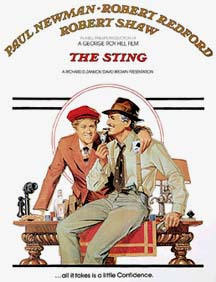
When I was growing up, my grandfather on my mother’s side used to drop by our apartment all of the time and watch television with us. My mom was a single mother who worked long hours as an assistant bookkeeper, so these moments at night were always a welcome rest from her very long days. During most of these times, I was still too young to understand the complexities of father and daughter relationships, so I never really understood the conflict that seemed to arise between my mom and my grandfather. But it was while we were watching the network airing of the Paul Newman-Robert Redford movie The Sting that I started to realize what this conflict might have been. In case you don’t know it, a large part of the movie takes place on the Santa Monica Pier, specifically in the carousel building. As we were watching one of the scenes taking place, Paul Newman was on the screen doing whatever an actor like Paul Newman does in a movie like that when my grandfather said: “I had lunch with him.”
My mom just rolled her eyes and said: “Sure, Dad. You had lunch with Paul Newman, the actor?”
He was adamant. And he upped the claim: “I had lunch with him right there,” pointing to the screen, meaning he had lunch with him right there where the movie was filmed.
My mom just rolled her eyes again and said nothing. We watched the rest of the movie, and nothing more was said of it.
Over the years, I spent a lot of time at my grandfather’s house. His place was always a welcome refuge from the world. Because we were dirt poor in a well-to-do city, having a place to go where you weren’t in fear of danger was always a good thing. So I spent a lot of hours at my grandfather’s house.
And one thing I remember most about him was that he loved to tell stories. Mostly about his life and the things he’d seen. And whenever I told my mom about these stories, she just laughed and said Grandpa made things up and had an “interesting” past that was more interesting in his mind than in real life. So I always kept that thought in mind whenever I heard one of his stories.
One time, he told me a story about how he fought with the French resistance by using his cover as an ambulance driver to sneak around Nazi territories. My mom laughed when I told her that story and basically had no comment. Another time, he told me he played backup guitar for a famous rock band that was performing at the Santa Monica Civic Auditorium because its guitarist was sick one night. My grandfather was an accomplished musician, and I could have easily seen how one with an active imagination might have imagined playing guitar for a major rock and roll band. I do that myself sometimes when I’m listening to the radio and suddenly rocking with my air guitar.
However, the story of him having “lunch with Paul Newman” always seemed to be one of those things that never made sense to me. I could see imagining all sorts of things, but having lunch with an actor and remembering it only when seeing him on the screen just seemed bizarre. So I remember asking him more information about that story. And he told me that one day he was playing the mandolin at the park and wandered down to the pier where he noticed they were making a movie. So, he maneuvered his way onto the set and walked over to where Robert Redford and Paul Newman were having lunch in between takes. He walked over to them and asked them if he could join them. They were both surprised by some stranger who walked up to them and kind of gestured to a seat near them. He then asked them if they’d mind if he played his mandolin. I guess they were too surprised to say no, so he spent the next few minutes regaling them with his mandolin playing (which was always quite remarkable). When he finished, he motioned to Paul Newman’s unfinished lunch and asked him if he was going to finish that. According to my grandfather, they were somewhat surprised but didn’t stop him from finishing up the lunch. A studio person came over at this time, about to push my grandfather on his way but one of the two actors actually motioned for him to stop, saying: “Bring us another plate.” I’m not sure how much longer my grandfather claimed to have stuck around, but that’s what he considered “having lunch with that actor.” Even if it wasn’t true, it was always such an interesting story.
Anyway, years later, long after my grandfather passed away, I was doing some research on the French resistance and saw an old picture of a group of known French resistance fighters who had a picture snapped of them as they were standing next to an old ambulance. Looking closer, I realized that the picture of one of the unlabeled people in the picture looked a lot like a younger version of my grandfather. There’s no guarantee it was him, but it sure looked like him and it certainly matched the time period and location of which he had been discussing.
A few years after that, I was in a bookstore on Powell Street in San Francisco looking over a bin of books that were heavily discounted, and one of them was about the heyday of Hollywood movies, and showed a bunch of photos for some major motion pictures during certain periods. My fingering through the book stopped strangely on a section for the movie ‘The Sting.” I hadn’t seen the movie in a long time, so looking at the different pictures brought back a lot of good memories. However, when I turned the page, I found myself staring at a picture of Paul Newman, Robert Redford having a meal on set. Sitting with them was an old man with a mandolin in his hands. It was hard to tell what they were talking about in that photo, but it was definitely my grandfather, and he was credited as “unknown stagehand”.
Which brought me back to those many stories that he told over the years, the many stories that my mom was convinced were all in his head. To this day, I’m still looking through old rock photos to see the one time a strange guitarist filled in for Van Halen or the Rolling Stones. I haven’t found it yet, but those earlier stories definitely keep me looking.
Yeah, he’s North Korean, but I bet he doesn’t like giving out maps either.
Today, it was learned that Google is having some problems with its desire to map South Korea. The reasons are varied, but certain little things like an eternal war footing with North Korea (they have a ceasefire, not an actual peace treaty from the war in the 1950s) and a history in South Korea of making sure that maps are a thing for government rather than the people, make it that much more difficult for a company that has a desire to map every kilometer of land that exists on the planet.
Strangely enough, I once dealt with this problem. Decades ago.
You see, I was a young counterintelligence agent working in Tonduchon, South Korea. Tongduchon was one of those tiny towns slightly south of the demilitarized zone (DMZ) in South Korea. Basically, the town consisted of peasants who were formerly farmers, newly crafted shopkeepers, and a military post of US soldiers who were tasked with defending the DMZ in case the north should decide to take a trip south. It was my job to assist in countering any intelligence gathering efforts of hostile armies, forces and entities. This meant I spent a lot of time out in bars, getting to know the local population and getting a real sense of the lay of the land.
At one point, I was talking to one of my colleagues in the Criminal Investigation Division (CID) field office on post, and while we were downing a couple of Korean beers at a local bar, he remarked that it was really bizarre that we were both part of agencies that conducts investigations of the local area, yet neither one of us has ever been able to find a map of the area. Stores didn’t sell them. Our intelligence assets didn’t actually have them to give out to rank and file soldiers, although I’m sure they would have emerged overnight if a war was to have started the night before. Basically, if you wanted a map of the local area, you pretty much had to make one yourself.
So, I tasked my assistant at the time to go about trying to become an amateur cartographer. It was more of a joke than anything else, but he was one of those assistants who took a “hey, wouldn’t it be a good idea?” as a direct command, and he set out to start creating a rudimentary map of the local area, specifically the town of Tonduchon. To be honest, it wasn’t bad. It wasn’t great, like an actual map, but it would at least be enough for us to put stick pins in it to designated what was going on in which location.
Still, for our purposes, and for the purposes of CID at the time, we really needed something a little more official.
So, I did what I normally did. I went to the one place I figured there had to be a working map of the area. I went to the local police station.
I should probably point out that counterintelligence agents back then had a weird relationship with the police agencies of South Korea. We were given national police identity cards that designated us as representatives of the national organization. It was one of those cards that I discovered worked well with some people and horribly with others. Let me explain. A colleague of mine in our office was one of those “America is great and is here to fix everything” kinds of agents. This meant that whenever he met with a local national, he tended to receive really bad results, and thus, determined that the population of South Korea was jealous of Americans and, thus, would rarely cooperate with anything that the US needed. He also spoke zero words of Korean, which meant he was always speaking through one of our translators.
I, however, was lucky enough to have been put through the Defense Language Institute to learn Korean, so when I went out into the population, I could have one on one conversations with the locals. Surprisingly, when you speak directly to people and respect them for being the experts in the fields they represent, you tend to get much different results than those received by others who treat the locals like foreigners. Strangely enough, that’s something we should have learned from the British and their adventures long before ours, yet for the most part, we kind of suck at learning from history. But I digress.
So, I went to the local police department and introduced myself. I discovered at this time that not once had anyone actually come to engage the local police or to ask them what they thought about what was going on. I found this out because the assistant police chief took me into a room where he showed me a ton of files that had been prepared to turn over to US representatives should they ever show up and inquire about what was going on in Tongduchon. I literally had to come back with three agents in order to carry all of the files out of the place and back to our field office. Keep in mind, this was a few years before databases and computer technology would have made this so much easier.
So, I sat down with the assistant police chief and asked him about maps. His answer was kind of surprising. He asked me if I was interested in accompanying him on a raid his people were going to be conducting later that afternoon. I said sure and then asked if it would be appropriate for me to invite one of my colleagues from CID (as I thought this was more their field than mine). He said sure. So, a few hours later, the two of us met the Korean police at a local nightclub and observed them raid the establishment. What I discovered they were doing was enforcing local ordinances and license checks. However, at the end, I noticed the assistant police chief was meeting with a couple of young prostitutes in a side room. Part of me thought the worst thoughts, thinking this was about hooking up two GIs with local prostitutes, but then discovered the reason we were there was to be introduced to these young women. They were informants for the local police, and he thought it might be a good idea to have us make contact with them as well (I discovered later it was more about the fact that I spoke Korean that caused him to think it was appropriate).
Anyway, a few days later, my assistant knocked on the door to my office to tell me that a young Korean man was at our door and wanted to speak to me. After he was let in, I discovered he was one of the local police officers. Once inside, he presented me with two envelopes, each one containing a map of the local area. He said one was for my friend (the CID agent who accompanied us).
That was how we managed to get a map of the local area back then. What I discovered is that sometimes you have to go through extra hoops to get the things you need, and sometimes you have to make friends where you weren’t planning to make them in the first place. What I find amazing is that South Korea is still so closed to revealing information as it was decades ago. I’m curious to see what Google will end up doing to accomplish their goals.
So, after about 10,000 notices from Microsoft telling me that my need to upgrade to Windows 10 is necessary to keep the planet from exploding, knowing that the infamous Jor-El might have doomed Krypton by not upgrading to Windows 10 himself, I decided to finally do it on my laptop. I’m not excited about it. And I’m not really anxious to use the new Windows 10, especially considering how every time I hear about Windows 10, it’s because either Microsoft has decided to go all NSA on its customers (recording and using all of their personal information, plus recording everything you do) or for some reason Microsoft decided to only support some drivers (basically whatever drivers that aren’t ones you need to run critical components that use the power of your computer). But I was getting tired of Microsoft “automatically” scheduling yet ANOTHER attempt to install Windows 10 on my computer. So I said fine. Let’s get this over with.
An aside: The last time I said “fine” over this matter, my laptop was incapable of downloading the new install, so the whole process failed. Not a good sign. This time, however, was much better as it didn’t even get to downloading the install file because it was incapable of getting past the “downloading updates” to reach the install phase of Microsoft Failure 2.0.
So, working my way around it, it is now downloading the upgrade (even though the install has downloaded the new operating system about 70 times while it was threatening to just install it without my permission. I guess when I give it permission, it then has to go through and download it again. Again, not a lot of confidence building on Microsoft’s part.
So, I’m now at 68 percent completion of just downloading the install. So, if my operating system gets replaced with Linux by some bizarre coincidence during this install, then I won’t be extremely surprised. A bit amused, maybe, but not all that surprised.
If Windows 10 installs, I look forward to wading through all of the advertisements that Microsoft thinks should now be a natural part of my operating system. I assume it will also delete my windows media player and offer to install a new one for about fifty bucks as well. I so wish to return to the days when you actually had to type C:\ and then “windows” or “win” in order to run Microsoft Windows, meaning it was your choice, not a default setting on your computer. I so miss those days.