Amazon’s Recommendations Can Become Somewhat Annoying

A few months back, I read a book called Homer’s Odyssey, about a little, blind kitten whose owner wrote about his adventure of life. It was a cute, nice book, and I was happy to have read it. Well, since then, Amazon (where I bought it) won’t stop sending me cat book recommendations. Let me put this simply so it’s understandable. I don’t really like cats. I don’t hate them, but at the same time I’m also allergic to certain breeds of them. So, it might be understood why I don’t really go out of my way to buy books about cats.

The first book was a fluke, mainly because the whole idea of the blind kitty’s struggle really appealed to me. That doesn’t mean that I have a thing for wanting to read about cats. Yet, Amazon doesn’t seem to know this and continues to send me nonstop recommendations that are about cute cat stories. I have yet to figure out how to stop these from happening, even having gone into their recommendation procedure (to change them), and that hasn’t stopped the fact that I stupidly bought a cat book from them once.

Which is why I’m thinking of buying porn from Amazon. I mean, if they’re going to send me recommendations based on my previous purchases, this sounds like a win-win situation to me.

Sony’s Incompetence Just Proves How the Rest of Us Are Screwed

I received an email today from Sony Online Entertainment, indicating that their networks had been compromised and that, as a result, a LOT of my personal information (possibly my credit card information as well) has been compromised as well. It states how sorry Sony is this happened, and that it’s essentially now my responsibility to cover my own ass for the near future because of the complete, utter incompetence of the empire that is Sony. The fact that they waited until they couldn’t sit on the story any longer only makes it worse, because if someone was going to compromise my identity and start emptying the accounts in my name, the damage is probably already done.

What bothers me mostly is that I’ve always felt Sony to be incompetent and really hated the company with a passion. Granted, I own a Sony Playstation 3, which I use mainly to watch blu-ray dvds and Netflix streaming, but because of this whole debacle, I’ve basically lost any ability to do anything involving Netflix. Yeah, I can watch a dvd (at least I think I can; it’s been some time since I’ve actually turned on my Playstation 3), but that’s about it. Thanks, Sony.

But as for me hating Sony, I’ve felt this way ever since I first started playing online games that had Sony Online Entertainment tied to it. Everquest was my first experience. And while I enjoyed it when it first came out, at some point you started to feel that Sony’s only intention was to separate as much money from you as possible before you realized there was a lot of bait and switch going on with that game. You know the kind I’m talking about. They promise one thing, but in the end, they give you something you weren’t really desiring. Everquest was constantly like that from servers that couldn’t handle the capacity of the players (or just constantly failed) or quests that were broken, and no matter how many times you contacted customer service, they would never be fixed. And then they started the whole micro-transaction thing where they tried to sell you a whole bunch of things that you should have been able to get for free within the game (because you were already paying them for access). After time, I started to feel I was a cash cow for the company, and I left.

Then SOE started integrating themselves into other games that really could have been so much better if Sony was never involved, like Star Wars Galaxies. Some of the worst decisions of online computer gaming were made by SOE with this game, to the point of where I began to believe the whole process was some kind of psychological experiment to see how much ridiculousness they could spread to their user community before people threw their computers out the window. Again, I left that game very upset.

Whenever I heard that SOE was going to be involved in yet another game, I decided to pass. Even when I hear they’re only slightly involved, I pass. I just no longer felt like being fleeced by that company.

So, yesterday I receive an email from SOE telling me they screwed up again. Except I’m not even a customer of theirs anymore. No, they screwed up with information that was on file YEARS ago when I was subscribing to one of their games. For reasons that escape any rationality whatsoever, they maintained my information so that someone could break into it and steal it. YEARS AFTER THE FACT. We’re talking half a decade here. Yet, Sony has proven yet again that because I made the mistake of doing business with them years ago, I’m screwed.

Which brings me to my supposition that this proves that no matter what I do in the future, I”m always going to be screwed because it now means that every company I’ve ever done business with is just waiting to screw me because of incompetence. So, because I bought a toaster from the Good Guys (a company that’s been out of business for about a decade or so), someone can break into their records and have all types of personal data on me that they can use to take over my identity. I mean, we haven’t even touched the surface of the crimes against individuals that exist because someone might have your personal information, yet all of us are victims because we can’t do a single, freaking thing to avoid the fact that at some time we trusted a commercial entity with our information because they required it in order to buy a package of Twizzlers.

All we can do is be more suspicious of everyone we do business with in the future, which is great, but it doesn’t change the fact that at one time we were stupid enough to not realize that the future was one where Big Brother isn’t government, but it our own information. Okay, I take that back. I still don’t trust government, but instead of just worrying about them, I have to worry about any dealings I did by paying with a check at Chuck E. Cheese back in 1970.

So what is the common person to do? We have no recourse whatsoever. Sure, we can sign onto a class action suit, but that doesn’t do anything but make a bunch of lawyers rich, and the rest of us get a month worth of coupons for Tide laundry detergent, if we choose not to send in an opt out form. Count on Congress to respond? Yeah, I’ll hold my breath on that one.

Basically, we’re all screwed. And we have Sony to thank for that. And then every other company we’ve ever made the mistake of ever doing business with in the past.

Osama Bin Laden, Terrorism, Being an American and Rejoicing in Death

For some reason, this has been gnawing at me all day. Fortunately, I’ve had one of those days where I’ve sat behind a computer and had to work on meticulous details about a health care module I’m building, so I’ve had little time to really reflect on anything. But when you’re doing that sort of drudgery work, your mind gets to thinking, and no matter what you do, you can’t stop it from thinking the things it does.

Right off the start, I’m left thinking a bunch of random thoughts about the whole situation. A horrible man who hated Americans, just because they were Americans, is now finally dead, reportedly killed by a group of Navy Seals. As I have no reason to doubt the events that took place, I am left with a bit of concern as we went through a lot of work to get rid of the body really, really fast. But I’m going to assume everything went as planned, although it did seem a bit odd to have done the whole “burial at sea” thing without a grandstanding of parading the dead body through Ground Zero first. But I’ll just leave it at that.

What does bother me is the hoo rah’s that are going around by average Americans, including someone who sent out an email to people stating something to the effect of “thank God for protecting America and for blessing us with Navy Seals.” Or something like that. Now, I’m not one to rain on a parade, but I really hope that if there is a god, that god isn’t really going out of his way to make it easy for Americans to kill people for revenge, even if it is the right thing to do. I was as angry as every other American after 911, but something feels really wrong to be celebrating the death of anyone, no matter how bad he is.

You see, part of me wishes for the redemption of man and mankind. When bad people do really bad things, I’m not tied up in a sense of Christian revenge, but if I have to take a page from Christianity, I would like to think that the ultimate redemption of a bad person is probably the best revenge. We seem very tempted by the desire to achieve vengeance in all things, and you can see that in so many things that we do, including our tendency to build more prisons than we build schools. Rehabiliation is rarely our goal; instead, we want to make people pay for their crimes. Sometimes, we’re like the Roman Empire in how it deals with those who trespass against them. Rather than punish the transgressor, we tend to go after the transgressors family, friends, his dog Skippy and anyone who might live on the same block. We use the word collateral damage as an afterthought, and years ago stopped answering for it as an excuse or as an apology. Much like Rome, if this is the tactic we want to take, we need to understand that it has to play to its logical conclusion. We either destroy all of our enemies, including those who are friends of our enemies, or we become destroyed ourselves. The whole idea of “rebuilding Afghanistan” makes little sense if we’re a country that understands only revenge. What we should have done was lay waste to Afghanistan, chase down any of their friends to their eventual deaths and then park an aircraft carrier off their coast to make sure they never join the rest of humanity again. That’s the Roman way, and if we’re going to celebrate like Romans, we need to be a lot more like them.

But I don’t think we want to be the Romans. We have a president in office who is supposedly trying to achieve “peace” in the world, especially in places where we seem to be exacting vengeance upon our enemies. I don’t think we’ve figured out exactly what it is we really want to do. When our enemies, like Al Qaeda, put on Pakistani clothing at night after returning from their day job as a harbinger of terror against all things America, it’s pretty hard to try to achieve a sense of friendship with the same people who have no desire to ever be friends in their lifetimes. But we keep trying to play both sides of the fence, and we’re not very good at doing that.

In all, I’m disappointed that the end to our conflict wasn’t eventual peace and friendship, and maybe a learning moment for some people. The realist in me realizes that maybe such conclusions just aren’t possible. But the little guy inside me that still hold onto hope thinks that we’re doing this all wrong, that perhaps there’s a better way that doesn’t involve either killing someone or being killed by someone. Unfortunately, in our good/bad choice paradigm of American understanding, I don’t think we’re capable of seeing alternative pathways to future avenues of prosperity. For too long, we’ve existed in the “you’re either with us or you’re against us” universe. Honestly, George W. Bush didn’t start that thought process. We’ve been living under that delusion since we first pretended to be Native Americans and threw British tea into the Boston harbor. I don’t thik we’re capable of thinking any other way.

But as an American, I have to feel a sense of “we got our enemy yesterday”, and perhaps leave it at that. As a veteran, I’m proud of what our trained soldiers accomplished. As an American who hated what he observed nearly a decade ago, I can’t help but feel a sense of accomplishment was made here. However, as someone who secretly wished that the world might one day be a better place, I’m afraid we’re continuing to move further and further away from that ever happening.

The Last Typewriter Factory in the World Has Closed Shop

According to an article in the Atlantic, the last typewriter factory has shuttered, as it was becoming too expensive to maintain, and not enough of a market to make it worthwhile. Sadly enough, I remember that the very first novel I wrote, Innocent Until Proven Guilty, was written on one of the first personal computers, but because I was so convinced that a writer needed to write a novel on a typewriter, my second novel LOSER was written on an IBM Selectric typewriter. Then my third novel, The Armageddon Project (which later became To Touch the Unicorn, and will soon become 72 Hours in August) was written on a manual typewriter I wrote, convinced that this was the way that a novel needed to be written. Since then, I’ve moved back to computer, and all of my writing tends to be on paper first (handwritten), and then typed on computer. I’m probably one of the last to write this way.

But one can’t feel a sense of loss in that we don’t use typewriters any longer. When I was a counterintelligence agent, we had IBM typewriters throughout the office, and it was the “in” thing to have those. I had an assistant who typed up my reports for me, and there were times when I’d type them myself, feeling that I wasn’t really doing the full job unless I typed up my own reports. But even then, we got a hold of a Wang word processor (Microsoft Word was still someone’s garage fantasy at this time), and literally the universe changed overnight. I even created my first database on the Wang computer. I knew then that the world would never be the same.

So, if I drank, I’d open up a beer for the loss of the last typewriter factory. But I don’t drink, so I’ll just wave my hand and give them a few moments of silence.

Writing How To: The Overwhelming Desire to Make Fantasy Seem Fantastic

Okay, here is the next in the series of commentaries on writing. Today, I thought I would talk about the genre of fantasy, because a lot of writers seem to be finding themselves falling into this one a lot. Therefore, it’s probably important to point out one of the failings that often separates a writer from anyone who might want to read any of that writer’s writings. Today, we’re going to focus on the desire to make fantasy overly fantastic.

Let me start by including a little scene I’m going to concoct for the nature of pointing this out. In this scene, the Princess C’lagrisha’nte is planning for her royal wedding to the prince of the Grishandens Empire. Let’s listen in:

Zvastran’cha, the Secondary Triumphant Parlour Midwife Maid, picked up a Hee’chanta vase and poured water onto the Bracklit plant before moving onto the array of Sxraxxan tapestries that were overlayed upon the Royal Foundry of Makkappala. Before she could reset the seal, Vleekorando Vrippzee approached her with his Lantee spear at a position of rest and tapped his Bryee visor twice, indicating his displeasure at the events that occurred over the Kalamaster Ceremonies of Trijent’a. It was obvious that a future gathering of the Proxilia Council was most likely to result in the Second Rigor of Nixtraxa. Which, of course, meant blah blah blah

What we have here, in the words of a great Southern prison warden is “a failure to communicate”. At one point, it’s really cool to add all of this visual scenery and fantastical elements that show we’re not in Kansas anymore, but at some point the amount of unknown verbage starts to become noise, and the reader turns off most of the visuals because they stop making sense. Add in numerous characters that all have really bizarre names, and you end up with a tale that becomes so easy to toss out the window, that the chances of you ever getting anyone to finish it are very limited. It doesn’t matter if the writing is stellar, and the story is great; at some point, the amount of confusion is going to overwhelm the reader, and the story ends before it ever gets told.

A solution to this problem is to introduce foreign elements into your world sporadically while including familiar sensations alongside the foreign ones. The little inclusion I used to explain this problem isn’t even that bad, to be honest. I’ve read some stories where I’ve gone entire paragraphs where I had no clue what the writer was talking about because EVERYTHING on the page was so foreign that at some point I gave up trying to figure out what a Hgjasfjsfjlijn was and just started thinking about a wonderful lunch I had the day before. If you fill your story with enough elements like that, causing your reader to abandon your story, you may have defeated your reason for writing in the first place, which should always be kept at the forefront of everything you write: You’re communicating, and as long as you can continue doing that, you’re on the right track to storytelling instead of just filling pages with gibberish that will eventually be ignored.

Review: Invisible Tears by Abigail Lawrence

Invisible Tears: The Abuse, The Rebellion, The Survival, Despite All Odds

This is one of those books that is extremely hard to read, especially if you’ve ever lived through any type of abuse yourself. When I first started reading it, I went into it completely oblivious to what the story was about, and then I had to back out and re-read the write up to realize what I was reading was, in fact, a true story. That, immediately, changed my perspective on reading this book. You see, if this had been fiction, I probably would have stopped reading after about the first tenth. It’s just that hard to read through the impacting scenes that take place in this young girl’s young life. But once I realized this was supposed to be a true story, I forced myself to keep going because if this really happened to someone, she at least deserved having someone try to understand it.

And I’m glad I did because the rest of the book actually makes the journey worth it. To be honest, the first 1/3 of the book is really hard to read through. But once you hit the 35 percent mark (the Kindle is really cool for telling you exactly that), the story changes, and you start to experience a different kind of a tale, one that’s no longer about abuse, but one that tells the struggle of a young girl becoming a woman who is attempting to find herself as a result of the previous abuse. What you discover is that she spends the rest of her life trying to find some sense of acceptance, whether it be acceptance from others, or just a solitary acceptance of other people and some semblance of belonging in a world that appears mean and cruel, and sometimes oblivious to the struggles of others.

I will admit there were a couple of points where I almost didn’t finish it, but then perservered, a lot like Abbie pushes forward through the travails that life continues to throw at her, and in the end it really was all worth it. Someone who reads up to that first part of the book and then stops would probably be impacted as well, almost needing to read the rest of this book to get the closure that seems desired and needed through this book.

Story: 4 stars
The narrative throughout was well worth reading, and the story crafted was one that leaves an impression. It’s very hard to do that with a non-fiction narrative, and there were times where I found myself comparing events with Dave Pelzer’s “A Child Called It” to the point of outrageousness. The beginning of this book is really hard to read, as it goes from child abuse to child rape to continuous child exploitation, almost to where it felt like the events were trying to outshock previous events. But then you’re left realizing this is a true story, so you can only feel compassion, and when the story is complete, feel anger that there are those out there who will go unpunished for the unspeakable acts they have carried out against innocent victims who have no way of ever striking back. The epilogue alone is poignant and casts its own shadows of despair on the depravity of humanity.

Voice: 3 1/2 stars
Although non-fiction, the author struggles to maintain a singular voice throughout the tale, as she sometimes juxtaposes the tale from fluidity to a sense that some prose the tale contains is still difficult to convey, making it disjointed at times. But overall, it carries forward very well and you get the sense of a very young girl’s memories being relived through the prism of someone decades after the events.

Mechanics: 3 stars
The book could have used an additional edit. There are numerous spelling errors, “theres” instead of “their’s”, and other mechanical errors throughout. But overall, it holds up well. There were also a number of port problems from the original manuscript to the Kindle version where the justifcation of the text was off, but as someone who has worked with porting to a Kindle myself, I completely understand that problem as there are times where it happens, and no matter what you do, it just can’t be fixed.

Cover: 4 stars
There are any number of different kinds of covers that could have been used to convey this story; the one chosen seems to do a pretty solid job. Having seen some really outrageous covers for some books on Kindle, it’s nice to see a simple, telling piece of artwork that doesn’t go out of its way to overdue an appeal to attention.

Summary: I would recommend others to read this book, keeping in mind that the first 1/3 is VERY difficult to get through.

Overall: 4 stars

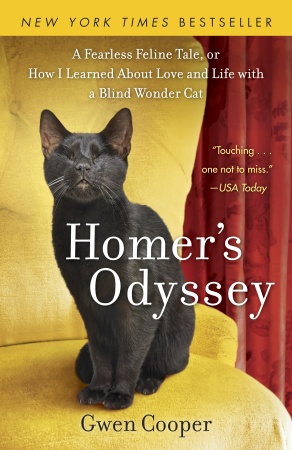
Review: Homer’s Odyssey by Gwen Cooper

This is one of those stories that grabs onto you from the beginning and pretty much never lets go. I was apprehensive about reading this book, because I’m not really that much of a cat fan (more of a dog pet person myself), but the blurb on the cover kind of hit me, and I was intrigued about finding out more about a blind kitten.

One thing that got me right from the start was the same thing Gwen talks about in her book throughout, and that’s the wrong impression someone gets from expectations of Homer right from the start. People expect this little kitten to be helpless, and you immediately find out that he’s nothing but that. He’s resourceful, full of life and pretty much the life of any party because no one ever taught him that he’s supposed to feel sorry for himself, or even that he’s blind. He is blind from the very early days of his life, so he’s never even known what it’s like to see. But he turns out to be the bravest, most resilient little tyke one might ever experience.

The story deals with Homer, Vashti and Scarlett (who are two of Gwen’s other cats), and it specifically deals with the life of Gwen herself. Where the story starts to bog down a bit is when it gets into Gwen’s own story, and mainly during the first half of the book, it really does sort of slow down as we start to experience more of her memoir than the story of Homer and his fellow cat family. Then it moves onto the author’s love life with Laurence, before it moves onto its conclusion.

However, it’s still a strong recommendation from me because the strongest moments of this memoir come from reading about Homer himself and how nothing you do ever stops him from completely enjoying life as it was meant to be lived. A couple of (SPOILERS HERE) critical moments also make up the narrative to where the story becomes where it deserves its bestseller status, specifically every time Homer experiences a new home and has to acclimate, the time Homer comes to the rescue of Gwen (when a stranger breaks into her house), the horrific period that Gwen goes through during 9/11 when the towers come crashing down (and she lives 5 blocks from Ground Zero), and a gut wrenching moment where Homer hits older age and runs into a near death experience towards the end of the book.

Four (4) out of Five (5) stars: 4/5.

Reviewing Books

Well, today is my final day of teaching for the semester. I doubt I’ll be teaching during the summer (that’s something the full timers do, as they have to do something to raise their pay above $100,000 per year; the rest of us part-timers don’t get hours during the summer, for the most part). This means I’ll have some time to devote to something. I was going to devote my time to writing a new novel, but screw it. Writing is stupid. No one buys my books, so why even try? Instead, I’m going to devote the summer to reading the books of others. And then, who knows? Maybe I’ll kill myself. Not really sure yet, as I haven’t thought that far forward yet, but I’m keeping all options open. Just haven’t decided whether to go with drugs or jumping off a bridge yet. But that’s for another post obviously. This one is about reviewing books.

So, what I did was post on kindleboards.com that I was interested in reviewing the independent books from the various writers there. And a bunch of them jumped up and started giving me their best works, so I’m started buying their books on Kindle, and starting tomorrow, I’ll be devoting my time to doing nothing but reading their books and then reviewing them.

I’m thinking of including the reviews here on the blog, and then I’ll probably build an additional site that’s all about my reviews. And of course, I’ll include the reviews on the Kindle site for their individual books. Plus, I’ll build a set of lists about different genres where I’ll include books that I’ve reviewed.

I figure if no one is ever going to read my books, I’ll contribute this way, and then when I get tired of it, well, I’ll just end it. Sounds like a plan.

Why Didn’t Blu-Ray Take Over the World?

There was a battle over dvd standards a few years back that was similar to the fight between VHS and Beta Max a decade or so even earlier. Sony had released their Blu-Ray player, and Toshiba had invented a rival called HD DVD. On the surface, the upcoming battle didn’t really seem all that significant (DVDs were still working fine), but Sony was about to release its Playstation 3 with a Blu-Ray player, and Toshiba was putting its HD DVD into the new XBox 360, made by Microsoft. So, the battle waged.

Strangely enough, even though the XBox 360 was the stronger seller (Sony dropped the ball and took way too long to release the Playstation 3), in the end, enough movie companies fell into Sony’s camp, and the Blu-Ray player eventually defeated the HD DVD format, becoming the only survivor. I don’t even think you can find an HD DVD movie anymore.

Yet, for some reason, even though Blu-Ray beat HD DVD, it still has yet to surpass DVD as the standard way of releasing new content for movies, TV shows and computer games. Instead, there has been an almost rebirth of the normal DVD player, the Blu-Ray remaining a higher end product but with an inability to maintain its dominance based on superiority alone.

And it is superior to DVD. In all ways. If you put a DVD player next to a Blu-Ray player and play them both at the same time, it’s obvious which one is better. But is that enough to make a difference?

You see, a couple of other things are going on that made the move to Blu-Ray not happen. First, Blu-Rays never replaced DVDs when it comes to price. In order to be the replacement, the price needs to be set at what people are willing to pay for movies and TV shows. For an average movie, there was a set price that people were willing to pay, and this came from years of establishing that market. Blu-Rays are almost always much more expensive. This was supposed to change over time as they took over the market, in that the prices would come down to match what DVDs used to be, so that they would effectively replace them. But that never happened. Instead, if you paid $19 for a DVD, you were always paying $29-35 for a Blu-Ray. While that doesn’t seem like a lot, it is when it comes to the economics of how DVD entertainment was expected. As long as Blu-Rays remained higher in price, it was always going to be seen as an exclusive item, and more of a luxury.

Blank Blu-Ray dvd prices never came down. They’re really expensive. A colleague pointed out to me that a dvd with the actual movie on it is sometimes cheaper than a blank Blu-Ray dvd. As long as that’s the case, you’re never going to get full adoption of the product. Plus, the players are still very expensive. It’s a no go all the way through.

One problem that Blu-Rays have that you never had with dvds is that you often have to make firmware upgrades. People don’t like that. Sorry. When they’re forced to keep updating their software for their dvd player, they get annoyed. With a dvd player, they don’t have to do it. Chances are pretty good, they’re not going to switch. When many dvd players are not connected online, you have even more of a problem.

The last point is probably the most important for the current situation. Blu-Rays needed to be the replacement for dvds, but instead we’re quickly moving online to streaming technology. People don’t even need dvds anymore, and if they see that as the obvious future, the replacement of the dvd is almost dead on a arrival. The thought was that people would pay more money for better quality, but instead streaming has gone the opposite direction, where people are willing to take less quality with more convenience. With that trade off, you might see why Blu-Rays might never take over the world.

It’s a great technology, but it may have been brought in too late to replace the model that was already going to be replaced by something different. Not necessarily better, but more convenient. Unfortunately, not always does the obvious successor become the winner.

Government Indifference to the Common Folk

About five years ago, I left California and moved to South Korea to work as a debate instructor. At the time, it was a stupid choice to make when it came to employment, but the recession had just started up, finding a job was extremely difficult, and I was doing anything to survive back then. So, I packed up everything I owned, sold most of it, and set off for a new adventure in a far off land. Okay, Heminway aside, one of the last things I did before leaving was sell my car to a colleague in graduate school, pretty much giving her a really great deal on a 2000 Saturn. Firing off a bill of sale on my computer, I gave it to her so she could turn it into the DMV, and I ventured off to new horizons.

The trip to Korea didn’t go well. A year into the trip, I was seriously cheated by the company that was paying me, and to avoid another long story for another article, I ended up barely getting out of a very bad situation, ending up back in the United States with a little more than the shirt on my back. Customs took all of my luggage, and for reasons that to this day have never been explained to me, never gave it back. As it was all clothing and paperwork, I finally gave up on ever seeing it again, and then started a brand new life in Michigan.

Well, at the beginning of 2011, California sent me a bill for $140, stating that I now owed them money for parking tickets not paid on that car I gave up five years ago. The tickets were racked up about four years ago.

I sent California’s DMV a letter explaining the situation, and then sent me a form letter back, indicating that I had to produce paperwork proving I had sold the car to a graduate student I had lost contact with shortly after I left the country. I had to prove it by providing paperwork that her full CURRENT address, and I had 15 days to do it.

OR THEY WOULD SEND ME TO COLLECTIONS.

Seeing as I have absolutely no way of producing this particular form of paperwork that does not exist, I’m at a loss as to what I should do. Principle tells me to go tell them to go fuck themselves, but in the end, I’m still going to get turned over to collections, and no matter what I do, some debt collector is going to make my life miserable because he’ll want $140 (probably jacked up to about $300 by the time he gets the account), and there won’t be any conversation that changes the outcome. The debtor is ALWAYS guilty.

This reminds me of when I got out of the Army. I had been out for a few years, and it dawned on me that I didn’t actually have a copy of my honorable discharge. So I wrote the government and asked them if they could supply me with it. Their response was that somehow I owed the government $212.42. Thank you for your service to this country, but you owe us $212.42. Please pay up today or we’ll make your life a miserable hell. And thank you for using our service.

This is the problem with government in how it deals with the common person. During this whole big budget debate lately, there’s been a lot of talk about how the government NEEDS more money, and that the American people are responsible for fixing the problems that the members of government have caused. When it comes to delivering money, it’s always our fault, and our responsibility. When it comes to actually getting something back from the government, it’s “please take a number, sit down, and be happy if someone actually gets to you.”

So, I’m left in another quandary with government. I’m shit poor, and I’ve always been my whole life. I’d like to say that I took a vow of poverty, but there really wasn’t a vow involved. It just sort of happened, and my life choices are generally not the kind that leads to mass wealth and fortune. So, when government wants another $140 from me, it bothers me a lot. You see, I’m one of those guys who parks his car where I’m supposed to park it, putting money into the coin machine to make sure I’m parking legally. When I error, I pay my bills immediately, even though I make it a point not to error in the first place. Yet, here I am having to pay for the foibles of some other person who probably didn’t even register the car in the first place. I couldn’t control that. I wasn’t even in the fucking country at the time.

Yet, I’m going to be the one held responsible. Because that’s supposedly the American way.

And people wonder why the country has problems. If this is how you treat the members of your society who go out of their way to the do the right thing, good luck on winning over the other 98% of the population.