Tag Archives: literature

One of the dilemmas of trying to be well read

First off, this isn’t a post that’s designed to glorify how much I’ve read. Posts like that have a habit of being a bit condescending, boring and painful to get through. Yes, I’ve read a lot of stuff. But so have so many other people. This post really isn’t about that.

What this post is about is one of the consequences of reading a lot of stuff. As a social creature, I really love to share great literature and nonfiction with other people. The problem is: Most people don’t care.

An example: I just finished reading Men Explain Things to Me by Rebecca Solnit, a brilliant writer and thinker who also wrote A Paradise Built in Hell, which I love for its alternative approach of explaining history and the ramifications that occur during history. Both books are chalked full of history, so because I work with a couple of history people, I thought about recommending those books to them. The response I generally received was a blank stare, almost an admission of “your review to me didn’t convince me that I should waste my time reading what you were talking about.”

And that’s the problem right there. Over the years, as I’ve read more and more brilliant stuff, I’ve often recommended it to other people. What I’ve discovered is that so few people take up the gauntlet and decide to read those books. Instead, they listen to your explanation of that book and then because you’ve explained everything about it to them, they decide not to read it, possibly thinking that they’ve already absorbed the knowledge of that book by the mere moment you spent explaining it to them. And then they go on with their lives, only reading the things they find significant.

This reminded me of two things. First, Rebecca Solnit’s book Men Explain Things to Me, in which she details an encounter she had with a boorish man who found out she was a writer and had written on a particular obscure topic so spent the next hour or so telling her she had to read this book about her subject if she was ever going to understand it like he did. Turns out, she wrote that book he was talking about, and as men behave like men, he took forever to acknowledge that once finding out, and then still managed to talk down to her regardless of realizing that fact.

Second, the concept of knowledge and literature requires a modern scholar to actually read the texts himself or herself and not just the cliff notes version (and especially not just the conversation about it from someone who read it instead). Imagine discussing Plato with someone who has never read it but watched a lecture on Plato once. That works great if neither of you have read it (you can be clueless together) but when you’re the one who has read him, discussing it with someone who has no intention of reading it is a complete waste of time.

That’s how I feel when I talk about literature with people and discover that they’re not going to read it, condemning it because they didn’t read it first. I talked about Solnit with one person and actually saw his face turn negative, like he was disgusted by the fact that he’d never heard of her before, and thus, she was unimportant in his mind. That’s the kind of emotional response I receive a lot when I talk about literature that is important yet obscure.

It’s almost gotten to the point where I may not discuss literature with people any more. I remember bringing up Haruki Murakami to one colleague recently and received that “I haven’t read him, so obviously he’s not significant” response. Keep in mind, Murakami is probably among the most respected authors living in the world today. But because he’s not “known” to some individual, I end up having to explain his significance, which finally ends with a sense of “well, if I should find myself on a deserted island, am already bored and his book is all that’s there, I might read it.” Again, I find myself thinking, screw you and I hope you remain uneducated for life. But fortunately, I’m not that elitist. Well, not after I’ve had my first morning diet Dr Pepper.


Classic Literature is not a Punchline of Knowledge

I was having a conversation with someone about a mundane topic, specifically about butterflies, when it reminded me of Kobo Abe’s Woman in the Dunes, a story of butterfly hunter who gets trapped by a society that mates him with a woman in an inescapable sand house. When first discussing it, there was no expression of interest about my story until I mentioned that the man’s story served as somewhat of an allegory to the fact that he used to trap butterflies (and thus, he became the trapped butterfly as a result). Then there was the recognition of the point of the story, and that’s the end of that.

But it got me thinking because I realized that after telling this little literary selection that there are a lot of people who seem more focused on the punchline of a story than in the story itself, and that’s the purpose behind this post. You see, what I’m starting to suspect is that people are so focused on the outcome and the “rest of the story” that they miss the purpose of the original story in the first place. In other words, people will read about Machiavelli, figure the Prince was about gaming the system and then feel they know what they are talking about when they refer to someone as being Machiavellian. I use this example because it is probably one of the more misused literary references in current usage. I observe the media constantly trying to act academic when they call some world leader, or some local leader, as Machiavellian, and what they’re really saying is that someone is manipulative. It immediately gives me the impression that they’ve never actually read Machiavelli to understand that to understand Machiavelli is to understand the Discourses, not the Prince. The Prince is only a small part of a much larger canvas, and quite often people read the Cliff Notes of even the Cliff Notes version of Machiavelli, meaning they’re getting about 1/10th of 1/10th of an understanding of the government scribe, not even realizing his whole purpose was to explain Aristotle in his modern day terms, not to create an understanding of how people can be snide to get over on others.

I find this in a lot of media (and common) references to literature. I hear a lot of referral of Moby Dick from all sorts of sources, and almost always they focus on a tiny segment of the story. Sure, they usually get the overall message, but almost every time I get the impression that that’s all they got out of the story, meaning they probably never read it all of the way through. A couple of years ago, while sick in Prague, I sat in my room and read through Melville once again, and I came away with a completely new understanding of his novel. Most people, if lucky, might read it once, and that’s it. And usually it’s because it was required reading.

I see this same thing with Don Quixote, which is such a brilliant story, in both English and Spanish, yet I would bet that one percent of the people who talk about it have actually read either version all of the way through. I was reading it a year or so ago again, in English this time, and I was just floored at how great a story the author constructs. It’s not just a literary story, but it’s hilariously written by a man who truly understood the human condition enough to hold it responsible for all of its absurdity. A media critic bringing up his loyal assistant doesn’t come close to relaying the significance of that poor follower who leads us through so many of the protagonist’s great, yet ridiculous, adventures.

A year or so ago, I sat down and re-read Dostoyevskiy (one of many spellings of his name) again. I had read Crime and Punishment when I was a young child. As a matter of fact, it is the very first book I ever read, and I only read it because my grade school teacher at the time said I was too young to ever read such a book. The first time I read it, I struggled through it and barely eeked out an understanding that this was the story of a man who did something horribly wrong and was fearing the ramifications of his actions, kind of a reading I would have years later of the Tell Tale Heart from a much different nuanced author. Yet, I have re-read that book many times over my life, each time getting a better understanding of what the author was trying to reveal to me, only understanding it differently because I had years of living that backed up my new understandings. This time around, as I read through the Idiot, I think I came one step closer to understanding why the author told the story he did. Years from now, I hope to revisit it again and see if I came closer that time.

The problem I perceive right now is that way too many people are hearing stories, or watching them on TV or in movies, and they’re convinced they’ve “read” the novel and understand all of the choices the author took to relay his story. That is such a weak interpretation of literature and so sad of a compromise that it bothers me to even think about it. I fear for America because almost all of our bestseller charts are filled with young adult books rather than powerful novels that challenge us to think, rather than fill our heads with mild entertainment. From vampires and zombies to Harry Potter, we keep filling our libraries with crap that does so little to stimulate people intellectually, and while I sometimes think “well, at least the masses are reading”, I’m left wondering if we’re a society doomed to complacency and easy manipulation by people who are smart enough to realize that an intellectually void mass is much easier to control than one that thinks for itself. All it takes is someone with the wrong intentions, perhaps someone very, shall I say Machiavellian, and the future might not look so bright.

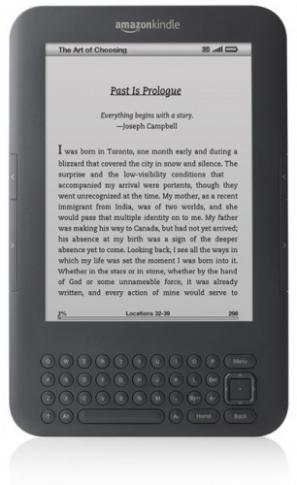
My Comparison of Barnes & Noble’s Nook Color vs. the Amazon Kindle 3G

"I love this book by Duane. I wonder if he's single."

I’ve owned a 3G Kindle for a few months now, and I’ve been pretty happy with it. However, being the tech junkie that I am, when I heard that Barnes & Noble was coming out with a color e-reader, the Nook, I took a quick look at it and then decided it was something I was willing to try out.

I blogged about my problems with buying it in the first place, specifically the dork who worked at Barnes & Noble who told me it could hook up to my computer and transfer my books that way (because I don’t have a wifi connection at home). Turns out he was full of crap, so I have to actually go to a place with wifi in order to download any of the purchases I make. Not a big deal, but a bit annoying when you were planning otherwise.

Right off the start, I have to say that the Nook looks really nice, especially in color. That, however, does bring a couple of deficiencies as well, specifically a very long download time, whereas the Kindle downloads almost instantaneously. Not a huge deal, but somewhat inconvenient. I’m sure if the Kindle had a color version, I’d be going through the same problems, although I have yet to try with a grayscale book on the Nook to see if that’s much faster.

The Nook is a lot heavier than the Kindle. Kind of inconvenient if you’re holding it up for a long time. Never really thought about that until I actually had to do it.

The biggest difference is in choice of content, and I’m really hoping that changes soon. The Kindle has so many choices of things to buy and download. When I bought the Nook, I was looking forward to all sorts of color books and magazines, but their selection is sparse, if almost devoid of content. There are so few magazines who have signed up with the Nook that I find myself really stretching myself to find something I actually want to download. But I wanted to at least see one, so I went with Consumer Reports, which costs $2.40 a month. It’s not bad, but to be honest, I’d never have bought it if it wasn’t the only choice of some content that I wanted to look at. That’s not a good sign when it comes to buying magazines.

My hope is that because the Nook Color is so new that more magazines are right around the corner thinking about signing up. But so far, on the “Coming Soon” list with Barnes & Noble’s Nook content, I don’t see any magazines planning a future launch. If that doesn’t change, the Nook is a doomed product.

So far, there are a few children’s titles that are in color, so if you have kids, it might be a decent purchase, if not a bit expensive. But there just aren’t enough. My hope, again, is that because it is so new that so few publishers have been pushing content to it, but are planning to do so in the future. If not, again, the Nook is doomed.

Price: The price of the Nook Color was $249. With a cover and tax, it cost me about $300. That’s a bit on the high side for me, even though I was willing to pay it just for the convenience of trying it out. Yeah, I’m kind of stupid that way. But if there is not more content released, I just bought a $300 paper weight, and that will piss me off.

The Kindle 3G is $189, and while there is a wifi version for $139, I had to buy the more expensive one because I don’t have wifi at home. For the extra $50, it was worth it. And the amount of content is wonderful. I subscribe to the Washington Post for $14.99 a month (think that’s the price), and it’s definitely worth it to receive the newspaper each and every morning. I had trouble finding this newspaper on the Nook, but others, like the New York Times are on it. Again, the selection was abysmal at best.

Break down:

Barnes & Noble Nook Color (positives)

It’s in color.

There is some unique content (through Barnes & Noble’s PubIt! program, which is a lot like Amazon’s self-publishing for the Kindle).

That’s about it.

This one goes to 11

Nook (negatives)

Heavy

Expensive ($249)

Not a lot of content available for it.

Battery life is pretty low in comparsion to the Kindle (massively low). A charge seems to last about 8-10 hours, according to their documentation. The Kindle lasts all week long and that’s with a lot of use. Again, that might have something to do with the color.

Downloads take a long time.

Kindle (positives)

Fast downloads.

Lots of content. LOTS of content.

Price is $139 (for wifi version) and $189 for (3G/Wifi version)

Lighter than the Nook.

Battery lasts a long time.

"It was the best of times...it was the worst of times...(line?)"

Kindle (negatives)

Not in color. That’s really about it.

******************************************

A final note is that even though I’ve said mostly bad things about the Nook, if they can get past the problem of lack of content, it can become a powerhouse in e-readers. Customers at Barnes & Noble appeared really interested in the product, and a friend of mine keeps talking great about it. But without increased content, especially content that uses color, it will fail horribly.

One area where it could shine, and is almost untouched, is graphic novels. If comic book companies would realize that they now have a way to present their work on an e-reader, and embrace the Nook, both could do a wonderful job in selling this to the most desirable market out there, the teenager/young adult market. But I’m fearing that Barnes & Noble has handled the e-reader in almost the same way Blockbuster handled online movie distribution against Netflix. It is doing too little too late. As long as Barnes & Noble continues to appear to always be one step behind Amazon, they’re going to fail horribly as a book company, which is a whole other issue itself. But it’s in online content and e-readers where the final battle for dominance is going to take place. If someone could go back and tell Blockbuster to embrace the mail market when it didn’t, it could have changed things so much against Netflix. That’s where we are with the e-reader market. Barnes & Noble has a chance to push ahead and dominate. But history tells me that the results will be so much different.

If we choose the wrong e-reader, North Korea wins!