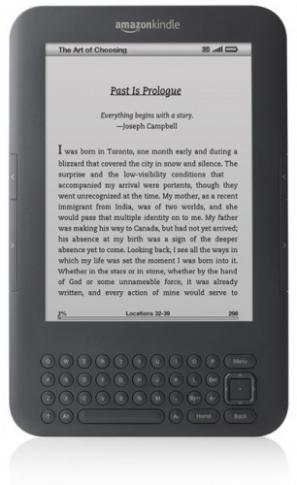
For some bizarre, masochistic reason, I have bought practically every version of the Kindle that has been made. The last one I bought was the Kindle Fire when it first came out. And that device is the reason I have decided to pass on anything in the future made by Kindle.
My needs are pretty simple. What I wanted was a device that could allow me to read books (which it does), maybe listen to a bit of music (which it kind of does, as long as you put your entire music library on Amazon’s cloud), and can place certain documents I need to read onto it as well (that one completely fails). For days, I have been trying to get my Kindle Fire to recognize a pdf document that I need to refer to quite often at work. It can’t. Or it won’t. Not really sure if it has a mind of it’s own, but it won’t read the document, no matter how many times I have tried to make it do so. I sent it using the email address they gave me to upload documents. After establishing that the email account I sent it from was legit, it should have been a breeze. I mean, my old Kindles did it just fine.
But no, it doesn’t see it no matter what I do. The document shows up on my “Manage Your Kindle” page, but my Kindle Fire just pretends it’s a stupid rock whenever I try to upload it/download it/pray to the Gods of Shaniaism, or whatever. It just won’t do it.
The truly sad thing is that my Kindle app ON MY IPAD 2 reads it just fine. But I bought the Kindle Fire so I could use these documents that can’t be read.
And don’t get me started on wifi access. It has the ability to connect with wifi, but 9 out of 10 times, it can’t seem to do anything once it connects. It doesn’t matter if I’m at work, at home, at the Pentagon, in the front lobby of Amazon. When it comes to wifi, they need to stop using a ten year old child hacker to develop their infrastructure.
Which tells me that whatever NEW Kindle they created is as fubar as this one. I mean, this was the expensive baby that the Kindle was selling as the be all Kindle. If they can’t make their best model do something simple, then I’ve given up on them. I’ll still use a kindle app, but I’ll be doing it on other devices, because, to put it succintly, Amazon sucks big time when it comes to making products.
Over the weekend, I went to Best Buy to purchase a new keyboard that I didn’t actually need. It was to replace a gaming keyboard I have that works great, but I decided that because their new gaming keyboard (by the same company) was on sale, I wanted to buy it. It does absolutely nothing new that the old one doesn’t already do, nor is it more stylish or have any extra buttons the old one lacked. But it was on sale, and it was new. So I went and bought it. Yes, I am aware that I am Best Buy’s proverbial wet dream of a client, and I understand that.
To make matters worse, I found my keyboard I didn’t need, started walking to the register and then decided out of the blue that I was going to buy a brand new Kindle Amazon Fire. Already owning a Kindle and having the Kindle app on my Ipad 2, I obviously didn’t need one, but it was there at the store, staring at me, so I felt I had to buy it. So I did. And then I bought the extra pack with it, that cost me an extra $100 for a $50 Amazon gift card, a case and ear phones, all of which I didn’t need either. But happy with my purchase, I took it home.
I’ve had the weekend to play with Amazon Kindle Fire, or the Kindle Amazon Fire, or the Amazon Kindle on fire, or whatever it’s actually called, and I can say that it’s kind of cool. It lets you access the Internet, like my computer and Ipad 2 already do. It lets you download your music library, which Amazon first forced me to upload to its “cloud” first, taking about a day and a half to do so. But then I got to download my music, which I already had on my computer and Ipad 2 in the first place. I mean, convenience knows no boundaries, right?
Then I downloaded some of my books which I had already bought on the previous Kindle and put them on my new Kindle so I can ignore them and not read them there, much like I did with my original Kindle. Then I sat down and read a hard copy book (Haruki Murakami’s What I Talk About When I Talk About Running) that didn’t need the Kindle or the Ipad 2 at all.
Joking aside, the Amazon Kindle Fire is kind of nice. Negatives: It doesn’t have 3G, so you have to use it over wireless only. Kind of a down side. It also makes it difficult to do certain things, like add my Amazon $50 gift card. I had to actually sign onto Amazon with my regular computer to have that $50 gift card registered. There really should have been a simplistic way to do it on the Fire, but there wasn’t. Granted, there may have been some convoluted and difficult way to do it on the Fire, but that sort of defeats the purpose of having the convenient device in the first place. I certainly couldn’t figure it out, other than using their web browser, which isn’t really the greatest browser of all time, even though they called it Silk.
Positives: It can finally read comic books on the Kindle. I downloaded several issues of Y: The Last Man and was pretty satisfied with it. Down side to that? Yeah, the text is really small because of the 7 inch screen, so I had to really struggle to read the text on the screen. Not a very comfortable way to read a comic book (or graphic novel), but sometimes you get what you get.
Overall, I think it’s pretty cool if you don’t already own an Ipad 2. If you do, then the only real advantage is that there are some magazines and newspapers that refuse to release on anything BUT the Kindle Fire, which is a travesty of an economic plan. In the end, it’s going to kill those magazines because people aren’t going to buy the Amazon Kindle Fire just because Macworld refuses to let Amazon release it to the Ipad 2 Kindle app (which CAN read it just fine). Again, the biggest draw back to the whole Amazon Kindle model is that book publishers aren’t playing along. I refuse to buy a book published by a major publisher that plays games with the Kindle at their outrageous prices of $14.99 and up. Instead, I often choose not to buy the book at all, which is why I haven’t bought the new biography of Steve Jobs, even though I wanted to read it. The publisher is being a complete asshole to readers, so they can go screw themselves, and I’ll buy it when it gets released as remainder issue stock.
Instead, I’ve been buying books that are showing up at the below $9.99 price, unless I can find it cheaper as a paperback, like is happening with The Girl Who Played With Fire, which is still being priced as if it’s a brand new hard back book for the Kindle. As long as publishers refuse to do proper business with Kindle customers, then I say they can go screw themselves and their legacy models. Instead, I bought four other books that were decently priced, and I’ll avoid reading them (due to laziness) instead of the books I would have bought and avoided reading as well.
Today, I was thinking of buying a graphic novel for my Kindle reader on my Ipad. Ever since I bought my Ipad, one thing I’ve always cherished is that I can still read e-books made for Kindle on it because of my Kindle app. However, when I went to buy the graphic novel, the first thing I noticed was that it wouldn’t let me complete the transaction because Amazon determined that I did not yet own the Kindle Fire. Apparently, in order to buy the e-book, you can ONLY buy it for the Kindle Fire. If you don’t own the Kindle Fire, you’re kind of screwed. I then started to notice that some of the magazine subscriptions were exactly the same way.
In the past, one of the cool things about having the Kindle reader on my Ipad was that I could see color books on my Kindle reader, which I couldn’t do on my actual Kindle device. However, Amazon, in their infant wisdom (not infinite), has decided it wants to force an Amazon Kindle Fire on you if you want color books of any type.
What this is actually going to do is force readers who might have continued to buy Amazon e-books into not buying them any more. Sure, it might get a few gullible people to buy a Kindle Fire, but for people like me who don’t want to lug around two devices, and seriously have no intentions of trading DOWN to a Kindle Fire from an Ipad 2, Amazon is forcing itself out of its own business.
At one point, I even thought of picking up an Amazon Kindle Fire, just cause I always liked the Kindle. But this has actually sullied my desires, and now I want nothing to do with them. I’ll actually buy the books I wanted in hard copy now, as they’ve never been available on the limited choice available through Apple’s walled garden choices.
It seems that ever company that involves itself in ebooks these days is doing everything possible to screw themselves over in hopes of achieving profits that they’re never going to get. Instead, we’ll destroy the market and leave ourselves living back in 1980 again.
When the Kindle first came out, I thought it was the greatest thing ever. Actually, that’s not completely true. I was apprehensive because I was a believer in having a hard-copy of the book with me while reading it, but eventually I started to see that this could be a good thing. I went out and bought an Amazon Kindle, and shortly after that I gave up my newspaper subscription and subscribed to an online version of the newspaper (delivered over the Kindle). Then I ended up with an Ipad 2, and with the Amazon Kindle app, I have been able to read the Washington Post every morning by paying for it with that subscription.
But for books, it hasn’t been as wonderful an experience. As a matter of fact, the e-reader experience has gone from “hopeful” to “dismal” and the fault of this situation rest solely on the backs of the publishing industry itself. You see, in the very beginning, Amazon was offering books at the rate of $9.99, which was probably the perfect point for paying for a brand new book on an e-reader. The publisher wasn’t losing out because the manufacturing costs were practically nil, and their books were getting to their readers almost instantaeously. But publishers didn’t like not having complete control over their market, so they forced Amazon to allow the publishers to set the price for books. Now, an entry price is anywhere from $14.99 to $25.00 on an e-reader. As expected, owners of e-readers have practically discontinued buying books as e-books.
So, you’d get the impression that publishers won. Not really. What actually has happened is that two markets have opened up, and this was an occurrence that a smart publisher probably should have seen coming, but like the music industry before, this is an industry populated by egos who are convinced that they are infallible, and that their product is so great that it cannot be replaced or done without. Well, they were wrong.
It seems that Amazon now has two lists of bestsellers, and they are becoming completely exclusive of each other. In the old days, bookselling lists usually listed the highest selling books (physical copies) but because the legacy publishers refused to budge, Amazon has discovered that its bestsellers are actually e-books that have never been published as hard copy books. As a matter of fact, in 2011, only 3 of the top sellers actually were originally published as “normal” books. The rest were dedicated e-books only. What this means is that more and more books are being sold without ever crossing the desk of publishers at all.
Let’s unpack that. What that really means is that more and more publishers are losing out on their own marketplace because they decided they were too elite to participate in it. Instead of working with Amazon and other such e-book companies, they acted with hostility and marginalized their own market. Readers have gone out and started buying books that other readers recommend, and quite often those recommendations have no affiliations with legacy publishers whatsoever.
What this means, or could mean, is that the future for publishers is even worse than if they had participated with e-readers in the first place. Like the music industry, major publishing companies are being seen as in the way and as leeches rather than as particpants and designers of the industry. An example is the simple mathematics of a publishing contract that attempts to give a writer about 2% of the sales for a book, whereas a deal with Amazon gives the writer either 35% or 70% of the sales (depending upon which publishing deal the writer chooses for charging for books). The selling point of using an established publisher was that you got their name behind your book and their marketing team, but with most publishing contracts these days, a writer is usually left to fend for himself/herself after publication because a publisher will spend most of its resources on already established names rather than someone who is up and coming. So, essentially, you end up with a crappy contract, and you end up with a publisher that doesn’t actually do anything for you other than potentially get books into bookstores (which, in my experience, doesn’t always happen). A further example is the publishing company that handled one of my earlier books. It keeps “offering” to make my book into an e-book, and then offers me that same crappy publishing rate royalty as if it was a hard copy book. What they don’t want to reveal to me is that our contract with each other indicates that they don’t own the e-publishing rights, meaning they’re trying to get me to sign with them for e-publishing when in fact I can actually do that myself and get a 70% royalty without ever asking for their help in the first place. The dishonesty factor is the reason I’m mostly pissed at them, because they’re doing everything possible to make it seem like they’re on “my” side, even though they KNOW they can’t publish the book as an e-book without me signing over MORE of my rights that they don’t physically have right now. Again, another publisher doing everything possible to piss off a client in hopes of gaining short term gains in profit.
So, how can publishers regain the upper hand? Well, first they have to realize they lost it in the first place. If they don’t, we’re going to start to see more and more publishers go under in the next few years because they won’t have the money to keep operating. Right now, all they have is their reputations, but they’re being beaten badly by unknown writers who are making names for themselves without actual publishing companies. Once publishers become irrelevant, they’ll disappear.
But publishing companies are probably not going to go down without kicking and screaming. Realizing that they’re not going to do the smart thing, like announce that they’ll adopt the $9.99 model that Amazon first put forth (which would have probably ushered a new age in publishing), they’ll probably respond with legal action, using whatever clout they have left to hire attorneys who will submit confusing lawsuits that will bog down the system for years, further eroding their success in the industry. I wouldn’t be surprised to see a direct legal assault on both Amazon and Barnes & Noble by the publishing companies, as those are the two entities making the largest impact against them. I also wouldn’t be surprised to see it fall into some kind of patent war over technology, where some publishing company gets smart and buys up a patent that allows them to claim ownership over a certain “idea” of e-readers, even though patents were originally designed to NOT be used for that purpose. We’re seeing a lot of this kind of action on the behalf of software companies and the social networking sites, so it would not surprise me to see some enterprising legal maneuver like this.
Because they’re not going to win by going after the hearts and minds of writers and readers. They’ve already demonstrated they don’t have our interets at heart. It’s all about profit and maintaining a dinosaur of a publishing model. Therefore, expect trench warfare and years of interesting battles that lead to an industry that collapses on itself.
Barnes & Noble just announced that their Nook is selling the best of any product of theirs in 40 years. On the surface, that sounds great. Just like the story that Amazon keeps telling us that their Kindle has sold more than any of its products. But what exactly is this telling us? Is it any surprise that a book reader would be selling better than any one product that a company that sells books would be selling? Think about that for a second. Barnes & Noble sells books. They’re not telling us that they’ve sold more Nooks than they’ve sold books. They’ve sold more Nooks than any particular product, which would mean specific books. So, they’ve sold more Nooks than they’ve sold of any one book by Stephen King.
Big deal. That’s really not that astonishing. Neither Barnes & Noble nor Amazon are really stretching the limits here when they tell us that their e-readers are their biggest selling item ever. I’d hope that would be the case. Or their e-readers would seriously suck.
What’s probably more significant is to think about the implications of these two announcements. Both companies, that sell books, are indicating that they now suck at selling regular copies of books. They’re much better at selling book readers. But not books. Because they’ve told us nothing about how many books they’ve sold on any of these readers. For all we know, lots of people bought e-readers and then went out and downloaded free copies of Crime and Punishment, because classics are free on e-readers. I find it highly significant that BOTH companies refuse to actually give ACTUAL numbers, but just big announcements that they’re selling more than ever. If we go with that strategy, I would like to admit that I’m boffing Playboy playmates more these days than I’ve ever boffed before in my life. The numbers are just ASTOUNDING. Yeah, that doesn’t really tell you very much, does it? Nor do I think you’re suddenly going to be hanging out my door, waiting to take pictures of all the Playboy playmates who are leaving at ungodly hours.
What’s interesting is that no one seems to be interested in telling us what’s really going on. Even Apple doesn’t tell us how it’s doing with its bookstore. Steve Jobs tells us how many iPads they’ve sold, but that doesn’t mean anything either. The iPad is used for lots of different reasons. Someone with one may NEVER buy a book for it. Again, we get no numbers of any significance, but veiled statements of “we’re doing great” and we’re dating lots of Playboy playmate supermodels.
So, I’ll leave you with this, a picture of a supermodel. Because even though I’m not dating her, and she won’t return any of my phone calls, at least you got something substantive from this post (a picture of a hot supermodel who won’t date either one of us).
"I love this book by Duane. I wonder if he's single."
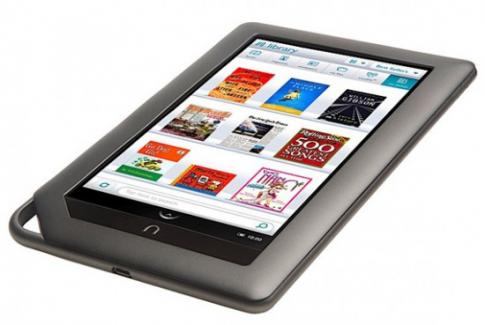
I’ve owned a 3G Kindle for a few months now, and I’ve been pretty happy with it. However, being the tech junkie that I am, when I heard that Barnes & Noble was coming out with a color e-reader, the Nook, I took a quick look at it and then decided it was something I was willing to try out.
I blogged about my problems with buying it in the first place, specifically the dork who worked at Barnes & Noble who told me it could hook up to my computer and transfer my books that way (because I don’t have a wifi connection at home). Turns out he was full of crap, so I have to actually go to a place with wifi in order to download any of the purchases I make. Not a big deal, but a bit annoying when you were planning otherwise.
Right off the start, I have to say that the Nook looks really nice, especially in color. That, however, does bring a couple of deficiencies as well, specifically a very long download time, whereas the Kindle downloads almost instantaneously. Not a huge deal, but somewhat inconvenient. I’m sure if the Kindle had a color version, I’d be going through the same problems, although I have yet to try with a grayscale book on the Nook to see if that’s much faster.
The Nook is a lot heavier than the Kindle. Kind of inconvenient if you’re holding it up for a long time. Never really thought about that until I actually had to do it.
The biggest difference is in choice of content, and I’m really hoping that changes soon. The Kindle has so many choices of things to buy and download. When I bought the Nook, I was looking forward to all sorts of color books and magazines, but their selection is sparse, if almost devoid of content. There are so few magazines who have signed up with the Nook that I find myself really stretching myself to find something I actually want to download. But I wanted to at least see one, so I went with Consumer Reports, which costs $2.40 a month. It’s not bad, but to be honest, I’d never have bought it if it wasn’t the only choice of some content that I wanted to look at. That’s not a good sign when it comes to buying magazines.
My hope is that because the Nook Color is so new that more magazines are right around the corner thinking about signing up. But so far, on the “Coming Soon” list with Barnes & Noble’s Nook content, I don’t see any magazines planning a future launch. If that doesn’t change, the Nook is a doomed product.
So far, there are a few children’s titles that are in color, so if you have kids, it might be a decent purchase, if not a bit expensive. But there just aren’t enough. My hope, again, is that because it is so new that so few publishers have been pushing content to it, but are planning to do so in the future. If not, again, the Nook is doomed.
Price: The price of the Nook Color was $249. With a cover and tax, it cost me about $300. That’s a bit on the high side for me, even though I was willing to pay it just for the convenience of trying it out. Yeah, I’m kind of stupid that way. But if there is not more content released, I just bought a $300 paper weight, and that will piss me off.
The Kindle 3G is $189, and while there is a wifi version for $139, I had to buy the more expensive one because I don’t have wifi at home. For the extra $50, it was worth it. And the amount of content is wonderful. I subscribe to the Washington Post for $14.99 a month (think that’s the price), and it’s definitely worth it to receive the newspaper each and every morning. I had trouble finding this newspaper on the Nook, but others, like the New York Times are on it. Again, the selection was abysmal at best.
Break down:
Barnes & Noble Nook Color (positives)
It’s in color.
There is some unique content (through Barnes & Noble’s PubIt! program, which is a lot like Amazon’s self-publishing for the Kindle).
That’s about it.
This one goes to 11
Nook (negatives)
Heavy
Expensive ($249)
Not a lot of content available for it.
Battery life is pretty low in comparsion to the Kindle (massively low). A charge seems to last about 8-10 hours, according to their documentation. The Kindle lasts all week long and that’s with a lot of use. Again, that might have something to do with the color.
Downloads take a long time.
Kindle (positives)
Fast downloads.
Lots of content. LOTS of content.
Price is $139 (for wifi version) and $189 for (3G/Wifi version)
Lighter than the Nook.
Battery lasts a long time.
"It was the best of times...it was the worst of times...(line?)"
Kindle (negatives)
Not in color. That’s really about it.
******************************************
A final note is that even though I’ve said mostly bad things about the Nook, if they can get past the problem of lack of content, it can become a powerhouse in e-readers. Customers at Barnes & Noble appeared really interested in the product, and a friend of mine keeps talking great about it. But without increased content, especially content that uses color, it will fail horribly.
One area where it could shine, and is almost untouched, is graphic novels. If comic book companies would realize that they now have a way to present their work on an e-reader, and embrace the Nook, both could do a wonderful job in selling this to the most desirable market out there, the teenager/young adult market. But I’m fearing that Barnes & Noble has handled the e-reader in almost the same way Blockbuster handled online movie distribution against Netflix. It is doing too little too late. As long as Barnes & Noble continues to appear to always be one step behind Amazon, they’re going to fail horribly as a book company, which is a whole other issue itself. But it’s in online content and e-readers where the final battle for dominance is going to take place. If someone could go back and tell Blockbuster to embrace the mail market when it didn’t, it could have changed things so much against Netflix. That’s where we are with the e-reader market. Barnes & Noble has a chance to push ahead and dominate. But history tells me that the results will be so much different.
If we choose the wrong e-reader, North Korea wins!
For a bit of time now, Amazon has been trying to herald the move towards electronic books, essentially ushering in a new medium for which books will eventually become the primary method of production. The Kindle, which is not a new story, was supposed to be their attempt to usher in this new era, and so far, it is doing a pretty damn good job of leading the industry. Sure, the iPad is an attempt to steal back some of that thunder, but it doesn’t take a rocket scientist to figure out that right now Amazon is in the driving seat with the capability of calling a lot of future shots.
Which is why I found it shocking that Amazon released the following statement:
Generally speaking, writers have two options when they sit down to create a new piece that can be distributed through conventional channels. They can author a short, attention-grabbing magazine-length feature that doesn’t require the reader to invest more than a few minutes of their time, or they can craft a long, 50,000-plus word novel that is meant to be absorbed over multiple sittings.
Now, if you’ve never been a professional writer before, this may sound quite innocent, and maybe even informative, but if you have any knowledge of the publishing business, and I mean ANY, you know that there are far more than two options an author has when sitting down to write a new piece. Basically, Amazon is stating a writer can choose from a short story or a novel, and now they have somehow managed to invent something in between that.
Writers have been writing all sorts of variations of those two models for centuries. Publishers have been publishing variations of far beyond those two models for centuries as well. Just recently, the whole unmentionable (by me, mainly) epic of Twilight released a novella, which just so happens to be a book that is too small to be a 50,000 normal novel and too big to be a short story. Sounds vaguely familiar, doesn’t it? Yes, writers have been tackling this genre long before Amazon came onto the scene.
To me, it appears that Amazon is attempting to somehow create a new category to invent a brand new revenue stream, even though that category has existed long before Amazon became a web site, back in the days when an Amazon was often referred to women I dated who used to beat me up when I didn’t comform to their expectations (but that’s a completely different article, of course). We don’t need this new category, especially when Amazon already charges different prices for different books based on the expectations and demands of the specific publishers.
To indicate they are somehow inventing a brand new length of writing after 4000 years since the first human scribbled some carvings on a cave is somewhat insulting to the rest of us. It’s not like they need special programming to release an e-book that has fewer pages than a “normal” e-book. The whole announcement sounds like a non-announcement to me, but more of an attempt to remain in the news now that everyone and his brother is releasing an e-reader and selling it at Best Buy.