I don’t mean for buying my books, while I’m very thankful for that. But a reader of my latest book noticed a discrepancy that I missed during the rewrite (where I kept one location that had been changed unchanged in another spot in the book). So, I was able to fix that and feel much better about the new novel.
Hopefully, this time the book is exactly what it was meant to be.
Often, my many adoring fans have asked me what gave me the inspiration to write my first novel. Well, actually, I should probably mention that when I say “many adoring fans” I’m referring to my stuffed bean bag frog named Elmer who really doesn’t care why I started writing, but I figured that starting with that wouldn’t cause you to be all that interested in what I had to say later (note to editor who doesn’t exist: remove this last aside before allowing this blog to go to print). Anyway, years ago, when I was a very young adult, I decided that I was going to sit down and write my first novel. It wasn’t “officially” my “first” novel as I had written probably five before it, but it was the first serious novel that wasn’t designed to go right into a drawer to remain until the end of time.
The novel was Innocent Until Proven Guilty, which you may remember as the novel that fought in there up to the last round for the Pulitzer Prize, right before losing out to some novel about some guy who realized something at the end of the book that somehow seemed really significant. Okay, the Pulitzer people weren’t considering my novel for the prize, but they could have been. If they’d ever heard of it. Which they probably never have. But I’m digressing again, and I fear my medication may be wearing off soon.
So, as I was saying, early in my adulthood, right about the same time I was in the Army in Germany, I decided to write my first novel about corporate intrigue and murder, or it might have been about corporate murder and intrigue; I kind of forget. But anyway, it involved a corporation, a murder and intrigue. And not necessarily in that order. But considering that I had never worked for a corporation, had never murdered anyone (not that anyone can prove…although you cops sure tried but boy did I get over on that one…oh sorry, the meds again), and really didn’t know much about intrigue other than have an overly active imagination, I figured it would have been a pretty easy novel to write. And it was.
But one of the things they tell you when you first start writing is that you should write what you know. Well, we kind of went over that. Three strikes there, but I’m okay with that. They also say that a writer’s first novel is almost always about the killing of his or her parents (kind of a growing up kind of novel). But my parents died long before I started writing that novel, so that didn’t seem all that necessary. So this was basically a raw attempt to just show that I had an idea of what I was doing.
One of the interesting struggles of writing a first novel is to actually get through the process of finishing that first novel, which while it sounds kind of obvious, is one of the hardest things you’ll ever do. When I started writing it, I had a general idea of where it was going, but I’ll let you in on a little secret: There was a second shooter on the grassy knoll. No, wrong secret. I mean, I had no idea where I was going the entire time I wrote the novel and I sort of let the story tell itself. And it did. Wonderfully. Even after I finished it, I kept thinking that somehow I cheated because the damn thing practically wrote itself. The characters came to life and did their own thing, the plot developed all on its own, and everything sort of fell into place. For the longest time, I was convinced that I had written what is often referred to as “that one novel he had in him”, convinced I’d never be able to do it again.
There are a few authors out there who I often think of as an author who had one novel in him or her. Alice Sebold is an example. She wrote a brilliant novel (that was turned into an semi-okay movie) called The Lovely Bones. Since then, she’s written generic stuff that hasn’t resonated anywhere near as well as that one novel. And there’s a reason for it. The Lovely Bones was one of those novels that needed to be told. She just happened to be the one to tell it. But even as I read it, I kept thinking, wow, this is a great book, but I’m not sure I’d really want to read anything else she has to write, thinking this was definitely a one-hit wonder. And it was. Now I could be wrong and next year she may come out with the next War and Peace, but I don’t think that’s going to happen any sooner than James Frey is ever going to become best buddies with Oprah Winfrey again.
Anyway, so what I discovered was that after the book was finished, I was ready to start tackling my second novel, and I did. But as I wrote the second one, it took a lot longer, and I realized then why Innocent went so easily. I had already written the novel in my head before I sat down to write it. When I finally did write it down, it was like I had been one of those wandering minstrels telling the story of the Iliad before someone figured out how to invent actual writing. Then it was jus a matter of doing it.
Sometimes that happens. Most often it doesn’t. Most often, I’m plotting out the whole thing chapter by chapter, constantly struggling with where the book needs to go next. Other times, I sit down and a novel comes out. To be honest, I don’t think I’ve ever truly figured out the science behind it. But I do know that I love to sit down and write novels.
Right now, I’m working on a rewrite of a novel I wrote years ago (the third one) that takes place in 1991. Strangely enough, the first edition was written in the 1980s. It took the future happening before the novel actually found its time and place.
Writing is strange and can be that way. It’s why I love to write. It was either this or be a male prostitute because those were the only two skills I was good at: Writing and charging people money. What? Were you thinking of something else?
I was having a conversation with someone about a mundane topic, specifically about butterflies, when it reminded me of Kobo Abe’s Woman in the Dunes, a story of butterfly hunter who gets trapped by a society that mates him with a woman in an inescapable sand house. When first discussing it, there was no expression of interest about my story until I mentioned that the man’s story served as somewhat of an allegory to the fact that he used to trap butterflies (and thus, he became the trapped butterfly as a result). Then there was the recognition of the point of the story, and that’s the end of that.
But it got me thinking because I realized that after telling this little literary selection that there are a lot of people who seem more focused on the punchline of a story than in the story itself, and that’s the purpose behind this post. You see, what I’m starting to suspect is that people are so focused on the outcome and the “rest of the story” that they miss the purpose of the original story in the first place. In other words, people will read about Machiavelli, figure the Prince was about gaming the system and then feel they know what they are talking about when they refer to someone as being Machiavellian. I use this example because it is probably one of the more misused literary references in current usage. I observe the media constantly trying to act academic when they call some world leader, or some local leader, as Machiavellian, and what they’re really saying is that someone is manipulative. It immediately gives me the impression that they’ve never actually read Machiavelli to understand that to understand Machiavelli is to understand the Discourses, not the Prince. The Prince is only a small part of a much larger canvas, and quite often people read the Cliff Notes of even the Cliff Notes version of Machiavelli, meaning they’re getting about 1/10th of 1/10th of an understanding of the government scribe, not even realizing his whole purpose was to explain Aristotle in his modern day terms, not to create an understanding of how people can be snide to get over on others.
I find this in a lot of media (and common) references to literature. I hear a lot of referral of Moby Dick from all sorts of sources, and almost always they focus on a tiny segment of the story. Sure, they usually get the overall message, but almost every time I get the impression that that’s all they got out of the story, meaning they probably never read it all of the way through. A couple of years ago, while sick in Prague, I sat in my room and read through Melville once again, and I came away with a completely new understanding of his novel. Most people, if lucky, might read it once, and that’s it. And usually it’s because it was required reading.
I see this same thing with Don Quixote, which is such a brilliant story, in both English and Spanish, yet I would bet that one percent of the people who talk about it have actually read either version all of the way through. I was reading it a year or so ago again, in English this time, and I was just floored at how great a story the author constructs. It’s not just a literary story, but it’s hilariously written by a man who truly understood the human condition enough to hold it responsible for all of its absurdity. A media critic bringing up his loyal assistant doesn’t come close to relaying the significance of that poor follower who leads us through so many of the protagonist’s great, yet ridiculous, adventures.
A year or so ago, I sat down and re-read Dostoyevskiy (one of many spellings of his name) again. I had read Crime and Punishment when I was a young child. As a matter of fact, it is the very first book I ever read, and I only read it because my grade school teacher at the time said I was too young to ever read such a book. The first time I read it, I struggled through it and barely eeked out an understanding that this was the story of a man who did something horribly wrong and was fearing the ramifications of his actions, kind of a reading I would have years later of the Tell Tale Heart from a much different nuanced author. Yet, I have re-read that book many times over my life, each time getting a better understanding of what the author was trying to reveal to me, only understanding it differently because I had years of living that backed up my new understandings. This time around, as I read through the Idiot, I think I came one step closer to understanding why the author told the story he did. Years from now, I hope to revisit it again and see if I came closer that time.
The problem I perceive right now is that way too many people are hearing stories, or watching them on TV or in movies, and they’re convinced they’ve “read” the novel and understand all of the choices the author took to relay his story. That is such a weak interpretation of literature and so sad of a compromise that it bothers me to even think about it. I fear for America because almost all of our bestseller charts are filled with young adult books rather than powerful novels that challenge us to think, rather than fill our heads with mild entertainment. From vampires and zombies to Harry Potter, we keep filling our libraries with crap that does so little to stimulate people intellectually, and while I sometimes think “well, at least the masses are reading”, I’m left wondering if we’re a society doomed to complacency and easy manipulation by people who are smart enough to realize that an intellectually void mass is much easier to control than one that thinks for itself. All it takes is someone with the wrong intentions, perhaps someone very, shall I say Machiavellian, and the future might not look so bright.
Some years back, after I finished my first novel, I was faced with a daunting question: Could I possibly write another? For anyone who has never written a first novel, this probably sounds like a no-brainer, but believe it or not, when I came face to face with the blank sheet of book number two, I found myself realizing that I was facing an enemy I had never imagined before.
When I was writing the first book, I had lots of bravado behind me. I mean, I had written a bunch of short stories, and inside me, I knew I had a book in me, so no matter what happened, I knew I was going to finish that first book. But when it was done, after a few months had gone by, I actually came up with the idea for the next book. And then I realized I would actually have to write it.
When faced with the second book, you find yourself in a very interesting dilemma that seems to go something like this: Well, the first book was a fluke, and everyone has at least a book in him or her, but am I really capable of sitting down and accomplishing the second book? The first book was a mystery/suspense novel that was kind of hard to pin down to its exact genre (you can see for yourself as it can be found here). The second novel was going to be a science fiction book, and although I had written a few short stories that had been published in fanzines (not having yet published in larger magazines), I was trying to convince myself that I was capable of pulling off a brand new genre on the second outing.
For days, I sat down and tried to outline the book, but nothing would come to me, because even though I had the basic idea of this novel, which I was going to call LOSER, I had no idea how to create a world that was so bizarre to me that I would have to invent it from the ground up. Yet, each day, I sat down and tried to tackle it.
And failed.
At one point, I convinced myself that this book wasn’t possible, that my first one had been a fluke. I was sure that I might be able to do another suspense book, or maybe an espionage adventure, but science fiction was definitely out of my capabilities.
At the time, my editor was the wife of a colleague of mine who sat down with me and asked me to explain what the story was about. And for hours on end, I sat down and crafted this amazing story of what I wanted to write. As I talked to her, I kept imagining all sorts of great things that would happen. And then, at one point, she told me to just sit down and make it happen.
So, for the next four months, I sat down in my chair and typed away. My first novel had been written on a typewriter, so this one actually got written on a computer with a word processor that we’d probably laugh at today. But by the time I was done, I had crafted my second novel. And even as I typed THE END, I stared at it, still not sure it had actually completed its journey.
A year later, I sat down and started work on that suspense novel I thought might have been the next novel, and it became my third novel. But each time I wrote a novel after the second one, I never imagined for a moment that I would have trouble finishing a novel again. That second one was the one that broke me of the belief I was never going to be a writer.
"I read all of Duane Gundrum's books because he's so dreamy...."
In case you aren’t aware of it, there is a war taking place. I’m not talking about Libya, Afghanistan or Iraq. I’m talking about the war that is currently waging over the publication of books. What war? You say. Well, let me explain.
For years, in order to get published, you sent out your work to a publisher (or an agent in hopes of getting a publisher), and if you were very lucky, you might get a bit of an advance. Sometimes, those advances were for decent money. Around the 1970s and on, they started getting really small. Kind of dismal, actually. Unless you were already a famous author, like Stephen King. So, you would get about $5,000-$10,000, and then the publisher would take 18 months or so to create your book. Then it would get released. If it started to sell, great. You would receive about $1.67 for a $20 book for each sale, the publisher keeping pretty much everything else. After all, they were the publisher. That $1.67 would continue to knock down the amount of the advance you received until you actually started to make what are called royalties, which would be additional money the book made after you paid off the advance. Most books tended to not even make back the advance, so you were generally lucky enough if you made somewhat of a decent advance.
Well, recently, the publishing industry has kind of been turned on its side. E-books are becoming the new “in” thing, and strangely enough, publishers are still maintaining their dominance in the industry, because they are still the power brokers they used to be. In other words, in order to gain any attention whatsoever, you really needed the publisher to get the attention out that you had published a book. So, not surprisingly, publishers have been publishing e-books, too, and still taking that outrageous amount off the top, leaving writers with very little profit, even though the costs for publishers have diminished to almost nothing.
Something new has started to happen, which is turning the whole industry on its side now. Writers are going directly to the readers and selling their books without the publishers. And needless to say, this is causing a bit of a stir in the whole industry. Publishers need the writers to survive, and so they are doing everything possible to diminish the positive experience for writers, so that publishers still remain the power brokers that they have always been. Unfortunately for them, that model isn’t going to last that much longer.
The publishing industry is a lot like the music industry, and its current dynamic is going through a revolution much like the music industry has recently gone through as well. While there are still seriously powerful music leaders in the industry still calling shots, a lot of artists have gone directly to the Internet with their work, and are bypassing the profit model previously established by the RIAA and other such top-down industry leaders. This has caused all sorts of problems for the industry, but it has done wonders to present new opportunities for artists who may never have received an ounce of attention before.
Move this into the publishing world, and you see the same sort of thing happening there. The publishing industry is still in control right now, mainly because the model hasn’t completely developed yet. Online booksellers, like Amazon, Apple, and somewhat Barnes & Noble, are producing their own e-readers that allow writers to push their content to eager subscribers. However, the battle currently waging is who is going to control the process flow from this point forward.
The publishing industry is counting on its enormous clout to push their agenda forward. They have already pushed back against Amazon (which has forced the others to comply) where they forced the increase in the cost of books being sold on the Kindle. You used to be able to get brand new books for $9.99, but now you’re lucky if you can get one for $12.99. The game changer in the first battle was Ken Follett’s new book Fall of Giants, which publishers forced Amazon to sell at $19.99. The backlash against the book has been interesting as Kindle users included all sorts of bad reviews for the book based on the price alone, taking what would have probably been a five or four star reviewed book down to an average of about 3 stars. What’s interesting is that his reviews on this book tend to resemble an upside down bell curve, with 301 5-stars and 327 1-star reviews, with a tiny amount filling in for 2, 3, and 4-star reviews. In other words, the critics either really liked it or really hated it, and there’s no doubt that the really hated reviews come specifically from people who are pissed off at the price.
If this was the end of the fight, you’d think that the publishers pretty much won, but like most great stories, a new sliver has been added to the mix, with writers being that added variable. Writers, realizing that they need to somehow be able to take advantage of this new technology, have started to show up sans publishers (being their own publishers), and they’re starting to include their own novels at much lower cost than the publishers are forcing down the e-market’s throat. Rather than stick it out at $9.99 (or push it up to the publisher’s price of $12.99), writers are now starting to introduce their books at the $2.99-$4.99 range, providing a more comfortable area for readers to purchase on impulse alone. Some of the more prominent writers, instead of using their fame to push for $12.99, like the gas station economic model the publishers are following (one raises the price, the rest follow), are listing their books at $0.99. According to some of the better known writers doing this, they’ve pointed out that because of the amount of people willing to buy a book at that low price, their profit has actually been better than if they tried to sell their books at higher prices. The economic implications are staggering, the more you think about it.
The biggest problems facing the writers right now is how to actually get anyone to pay attention to them in the first place. The one thing publishers have going for them was that their clout actually got books into bookstores, and without that clout, an unknown writer is essentially that, an unknown writer. If no one knows you exist, the chances of selling a book are dismal, at best. So, right now, the battle has halted, as both publishers and writers realize they’re at an interesting crossroad where both can benefit, but neither seems willing to budge. Publishers aren’t interested in giving up their high percentages they receive for “publishing” books while writers are no longer interested in giving up the entire store just to get their work out there. Which means that once writers figure out how to jumpstart the system in their favor, the whole publishing industry is going to go the way of the recording industry.
But what can a writer do to become marketable without already being a famous writer who was selling books already? That’s an important question and one that I’m spending a lot of time studying.
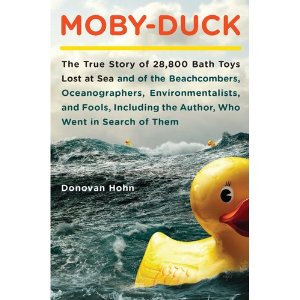
I was in the bookstore the other day looking over the selections of books when I came across a really interesting book of which I had heard nothing so far. But it looked intriguing. It was called Moby-Duck, and as you can see from the picture with this article, it is about a man who goes on a quest to discover what happened to 28,800 bath toys that were lost at sea.
So, why am I talking about this book? Well, think about the story involved in this book. The author, Donovan Hohn, actually put forth a lot of work to find out what happened to these rubber duckies and bath toys after the disappeared. In essence, he went on an epic quest, like the infamous Moby Dick to find what happened to these items. In other words, he went through a hell of a lot of work to get the story that he later transposed to paper so that the rest of us could experience his adventure.
My point is that so few people who write memoirs these days actually go through this amount of work in their adventures before sitting down and writing their “memoirs”. Instead, they suffer one bad relationship, have a bad drinking problem, or do something singularly simple and then try to convince the rest of us that it was actually an epic journey to get from one place to the other. I guess you could say I’m getting a little sick of these kinds of stories that really have no great master journey to them, no odyssey, yet are treated as if they are the epic adventures of a lifetime.
We need more writers out there who are willing to go through a little bit of work to actually come back with the story they need to tell. Instead, we get lazy writers that try to profit off of their innane adventures. And we keep buying this crap because none of us are willing to demand more from the writings that we read.
I felt this way some time ago when I was writing one of my earlier science fiction novels, Thompson’s Bounty, which was about a Coast Guard cutter that gets sent back into the 17th century. When I first started writing the novel, I actually tried to just crank it out without really knowing much about my subject, other than having watched a few old movies about pirates. Then it dawned on me that I wasn’t ready to write the novel. So I contacted the Coast Guard and requested some in person information, which led to going out with a cutter crew for several days over several weekends. It also led to a bunch of long conversations and tours on a Coast Guard base where very knowledgeable people gave me first hand information about the subject I was writing. In the end, I wound up with a book that told the story I wanted to tell instead of one that was peripheral and out of context.
Recently, I’ve been working on a novel that I originally wrote decades ago that takes place in Eastern Europe during the Cold War. Originally, I kind of winged it through the story, but after doing my thesis work on the August Coup in the Soviet Union, I finally had the premise, place and event that really made up the background of the novel I wrote years before. So, I’ve been sitting down and tackling that book from the start, realizing that I now know a lot more information than I first did when I wrote that book back then.
That’s sort of the thing I’m talking about with the kind of reading I’m coming across these days. So much of it can be so much better than it is if authors would take the time to actually do the research that would make their books that much better. I remember a great scene from Billy Crystal’s Throw Mama From the Train when a woman in his creative writing class is describing a submarine story she wrote, and he comments that maybe she should actually know the name of the device she’s describing if she wants to be taken seriously in a story that involves submarines. I take his advice a bit further and say that maybe some time should be given to exploring the lifestyles and events that lead people to the moments that occur in novels so that the reader believes the author is the right person to be writing the story.
We seem to have a lot lazier writers these days with a lot of the stories and memoirs I read, but that doesn’t mean we have to settle for that. We can demand more substance, research and work. We just generally don’t. And we’re the ones who suffer as a result.
For a bit of time now, Amazon has been trying to herald the move towards electronic books, essentially ushering in a new medium for which books will eventually become the primary method of production. The Kindle, which is not a new story, was supposed to be their attempt to usher in this new era, and so far, it is doing a pretty damn good job of leading the industry. Sure, the iPad is an attempt to steal back some of that thunder, but it doesn’t take a rocket scientist to figure out that right now Amazon is in the driving seat with the capability of calling a lot of future shots.
Which is why I found it shocking that Amazon released the following statement:
Generally speaking, writers have two options when they sit down to create a new piece that can be distributed through conventional channels. They can author a short, attention-grabbing magazine-length feature that doesn’t require the reader to invest more than a few minutes of their time, or they can craft a long, 50,000-plus word novel that is meant to be absorbed over multiple sittings.
Now, if you’ve never been a professional writer before, this may sound quite innocent, and maybe even informative, but if you have any knowledge of the publishing business, and I mean ANY, you know that there are far more than two options an author has when sitting down to write a new piece. Basically, Amazon is stating a writer can choose from a short story or a novel, and now they have somehow managed to invent something in between that.
Writers have been writing all sorts of variations of those two models for centuries. Publishers have been publishing variations of far beyond those two models for centuries as well. Just recently, the whole unmentionable (by me, mainly) epic of Twilight released a novella, which just so happens to be a book that is too small to be a 50,000 normal novel and too big to be a short story. Sounds vaguely familiar, doesn’t it? Yes, writers have been tackling this genre long before Amazon came onto the scene.
To me, it appears that Amazon is attempting to somehow create a new category to invent a brand new revenue stream, even though that category has existed long before Amazon became a web site, back in the days when an Amazon was often referred to women I dated who used to beat me up when I didn’t comform to their expectations (but that’s a completely different article, of course). We don’t need this new category, especially when Amazon already charges different prices for different books based on the expectations and demands of the specific publishers.
To indicate they are somehow inventing a brand new length of writing after 4000 years since the first human scribbled some carvings on a cave is somewhat insulting to the rest of us. It’s not like they need special programming to release an e-book that has fewer pages than a “normal” e-book. The whole announcement sounds like a non-announcement to me, but more of an attempt to remain in the news now that everyone and his brother is releasing an e-reader and selling it at Best Buy.
I’ve been wondering this question for a bit of time now with the emergence of the Internet as the place where everything seems to be centered in writing these days. In the old days, to be a writer, you first finished your education (generally), then you started publishing in literary magazines, then to commercial, high paying magazines, and then you started to work your way into getting that novel published. Granted, some people took an easier path, but mostly this was the formula for success.
The Internet has kind of changed all of that. Now, anyone can claim to be a writer and try to make his or her way without any previous work. This has developed a whole sense of a lot of junk that has been thrown into the mix, making it almost impossible for a writer to get recognized and even worse, that much harder for a reader to figure out what is worth reading. Bookstores start to gravitate away from the old formula, and the next thing you know (or we currently know) bookstores only publish commercial fiction that is churned out by publishers who are only willing to invest in already established names or, even worse, celebrities who are now writing books. Like Nancy Grace’s new book. Or Glenn Beck’s. Or the autobiographies of unimportant important people which were really written by other people. This leads to events like Tyra Banks announcing she’s writing her new book Modelland, which really excited only about four people, all of them employed by Tyra Banks.
Which brings it back to me. It’s my blog, so why not?
At one point, I was actually making a name for myself in the literary magazine marketplace. Editors started to know me. Sometimes they even commented on my published work when they saw me in another magazine. It used to be a really close-knit community, and I was breaking into it.
And then I stopped writing for about a decade and a half due to a really strange relationship I had with a woman. It took me that long to realize I needed to get back to writing, and here I am. But no one remembers me any more, so it’s like I’m starting over again.
Recently, one of those editors contacted me and published one of my later pieces of work in his literary magazine, a science fiction one. A success. Yay. But it leaves me wondering if this old model of publishing is still viable today. Don’t get me wrong. I’ll include it on my vita like I normally would, but I wonder if the publication of this story in this ‘zine is really going to contribute to my eventual success. Oh don’t get me wrong. I’d still have it published there cause I like the editor and support his continued attempts to build an audience for what he does best. But I’m still wondering if there’s a career out there for me because there are so many writers these days, and basically you’re competing with anyone who has access to a computer today.
It makes me wonder if the age of being a writer is somewhat over, unless you already made it famous before or you’re some kind of marketing genius capable of making a name for yourself in the sea of endless writers.