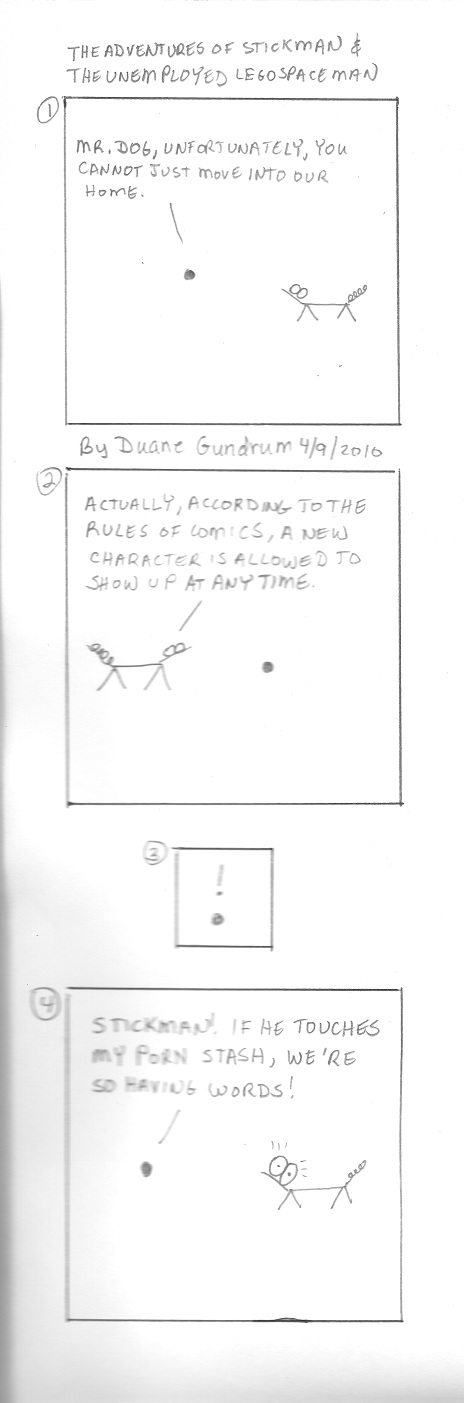
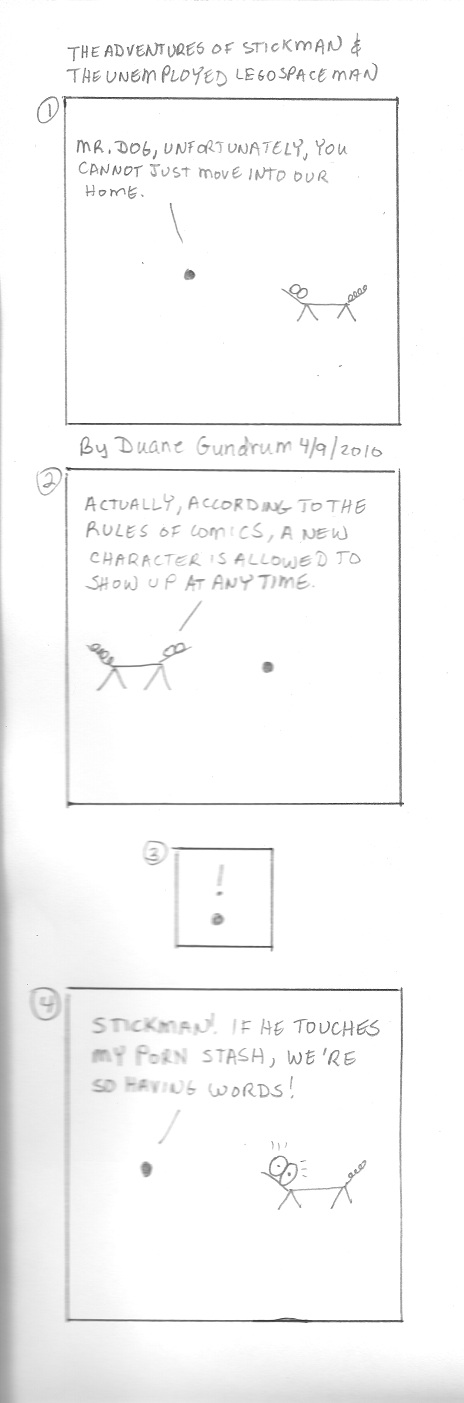
Here’s the latest Stickman. If anyone’s reading this, let me know because it seems like no one seems to be reading it. Let me know, please. Anyway, here it is:
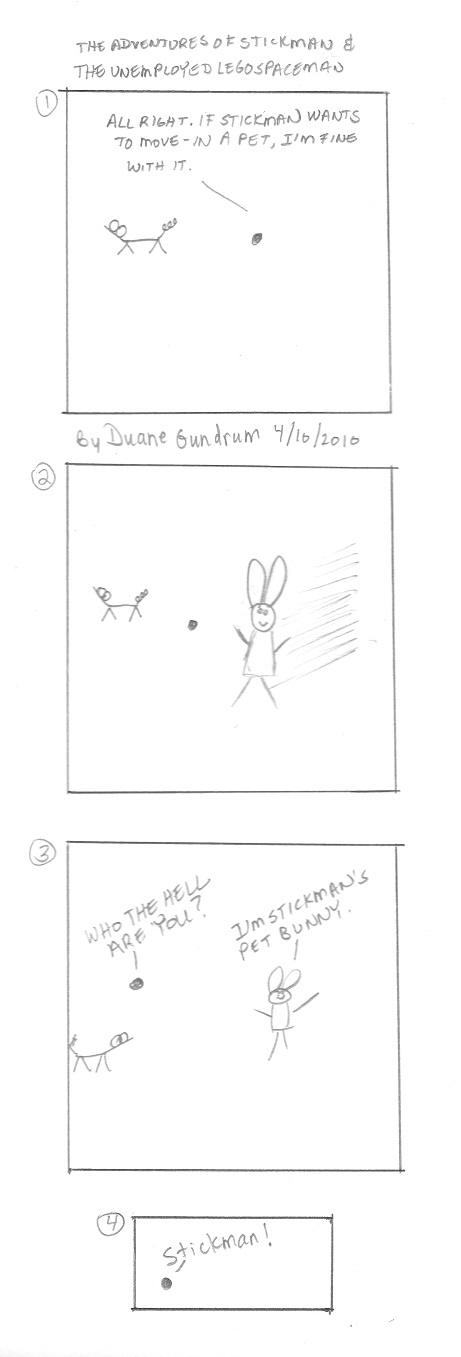
Of course, don’t forget you can always access the main Stickman site at http://www.littlesarbonn.com/Stickman/Stickman.htm.
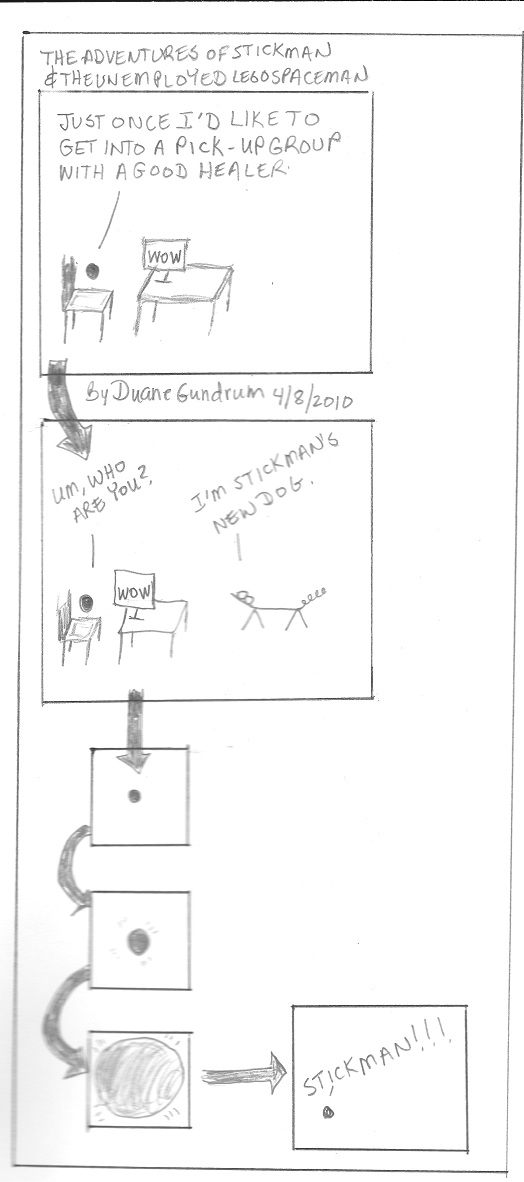
The new Adventures of Stickman and the Unemployed Legospaceman have continued. Here’s the latest offering:
 Years ago, when I was 7 years old, I used to belong to the Santa Monica Boys’ Club, which used to sponsor all sorts of educational junkets. It was the place where I first joined a football team, a choir, a field hockey league, and all sorts of other activities. So, one day, I was signed up to join an archaeological dig.
Keep in mind, at the time the kids of Santa Monica weren’t really all that well to do financially. That’s changed a lot over the years, so that if I mentioned Santa Monica now, you’d probably be talking about some pretty affluent kids. But back then, my area of Santa Monica was slowly wavering between destitute and crack neighborhood. At this time, we were just destitute (hadn’t made that final drop into crack neighborhood yet).
Anyway, so I signed up. Turned out we were going to be heading off into the hills of Santa Monica (or Los Angeles) where someone had found some artifacts at one point. The guide, who was also the driver (and to be honest, I don’t remember exactly who he was from the staff at the Club back then), showed us an artifact he’d dug up some weeks before that he was carrying around in a tissue for all of us to see. No, it wasn’t an Indiana Jones level of archaeology we were exploring here; it was more a “some older guy who likes to dig in dirt to see what he can find” kind of archaeology. Imagine the next rung above a coin seeking metal detector old guy, and that would describe the level of this particular adventure.
So, we got into the mountains, and we split up into groups of kids, and a couple of friends of mine from the Boys’ Club and me started digging into the dirt of some mountainside. We didn’t really know what we were doing, but it was archaeology, and even though Indiana Jones hadn’t been made yet, this was the level of fun we were experiencing because we really didn’t know any better, and sometimes it’s really nice to get out of the bad environment that was our daily lives anyway.
But at one point, we found something. Lots of somethings. And we started digging them up. We dug up a whole bunch of shells from the side of the mountain, and we unburied them. All in all, we probably found 20 or so artifacts of old buried shells in the mountainside.
But it was during the trip back when we were kind of analyzing what we had done that I hit on the question that didn’t seem to make a lot of sense to me. You see, back then, the idea that these mountains would have been under water at one time wasn’t taught. Still isn’t actually. The idea that a high area of California was once under water doesn’t make a lot of sense from a typical science perspective. So I asked about it, and the teacher who was with us was kind of stumped. He didn’t seem to want to go out on a limb and state that California might have been underwater at some point in the past, so he kept trying to avoid ansnwering the question. I kept asking about it, and it kind of got him annoyed.
To this day, I have yet to figure out why we were able to find ancient shells in the mountains of Santa Monica. One person conjectured that perhaps there was a lake there once, but even that didn’t seem to satisfy my curiosity. But what got me even more intrigued was that the person who brought us out to this dig had no idea why he brought us out in the first place, other than to give a bunch of poor kids something to do. And that’s my comment for today because I think it has as much relevance to writing as it does to amateur archaeology. Don’t start writing a story until you know why you’re writing it.
Oh sure, there are lots of exercises to get you writing that don’t require you to know where you’ll end up, but at some point during the writing, you probably should have an idea of why you’re writing in the first place. Otherwise, you’ll end up going all over the place, digging into places that don’t make any sense, and when you finally come up with gold, or shells, or a story, you may have no idea what to do with it even though you’ re holding it in your hands.
So, the moral is: Know what you’re writing beforehand, or you might end up underwater in the mountains of California. Okay, maybe that wasn’t the best moral. I really should have thought about that before I started writing it….
Turns out that reality (not so much of a) star Heidi Montag has announced that she is “writing a movie”. Really? It’s that  easy? Does she even know how to read?
This is one of those things that really bugs me about people who don’t write. They seem to believe it’s SO easy. For those of us who are actually writers, it tends to really piss us off that someone who is a celebrity for no real reason other than that she has had too many boob jobs, is convinced that she’s now going to pen a GREAT script for a movie. The incredulous part that stems up is mainly attributed to the very nature of stating she’s “writing a movie”. Who says that? Does she even know there’s a script involved?
Bah, this sort of thing really bugs me. Here’s the article.
 A few years ago, I read a book by Richard Bartle, titled Designing Virtual Worlds. As an avid game designer and player, the idea of building worlds has always fascinated me. As a writer, however, designing a world has always been a process that has existed within me, and it has often made crafting a story one of the more difficult projects. In the beginning, when I first started writing, designing a world was simple. It was essentially Earth with different people in it. Oh, sure, every now and then there’d be a dragon instead of a rhino, but honestly when it came down to it, I wasn’t really designing anything; I was recreating what was already there.
As I matured as a writer, I came to realize that the world one crafts is as important as the story itself. Since then, I’ve created a couple of worlds that have existed as part of my writing. Two of them are important enough to discuss here, so I’ll introduce them now.
Reagul was my first real virtual world that I created. It was originally a part of a science fiction/fantasy hybrid I wrote over a decade ago that takes place in the era of Earth 3000 A.D. The Earth has become an empire, and one of the planets in its sphere of control is the medieval-like planet of Reagul. It was during the writing of the novel Destiny that I started to realize that Reagul was more imortant than just a setting for a large part of this novel. It took on a life of its own, and later it became the centrally located planet for the series of stories that became the book, The Tales of Reagul.
Reagul was a fascinating place because it was an experiment of an alien race known as the Minions, who were testing on human subjects from the young planet Earth. During the first century B.C., the aliens transplant a Roman collection of villages from Earth to the new planet. This series of villages grow up to become the central characters of the stories that take place on Reagul. A large number of short stories I wrote have been published in that series, even though most magazines at the time never knew there was a connection between any of these stories. In it, a whole literature was born that has continuously moved the history of this planet, which has nearly 3000 years of history before it reaches the point where it coincides with the first novel (the previously mentioned Destiny).
I figured that I would probably only write one major series in my lifetime, and it was going to be the Reagul series. And then the Soldier came along.
The Soldier was a character that started showing up in some of my earlier writings, first published in Lost Worlds magazine. That first story was mainly about a soldier who has been traveling since separated from his army, but even as I was writing, I realized there was something wrong with this guy, that he was much more than just a normal soldier. That’s when I started to realize that he was on a quest for something, something for which he was going to be spending the rest of his life looking. This item became the Deck Const, which then became the central talisman in my latest novel Rumors of War.
The Soldier is unique because his story is a world all by itself. He lives in a dystopian future where civilization has crumbled, representing an army of a nation that no longer exists. At the same time, his journey has been chronicled long before he was ever born, and many more people know as much about him as he does about himself, even though they have never met him. He becomes a mysterious character, even to himself, but at the same time is on a linear path, seeking out something that will bring civilization back together, while at the same time giving him a reason to exist.
The world of the Soldier is one of those that I often found myself returning to because it was so interesting. At times, he finds himself in a Hobbesian nightmare of a society that has fallen apart, but every now and then he comes across glimmers of hope in the waste lands, and often he is the instrument that brings forth that hope to others.
The point is that it is not just enough to write about a place and call that a “world”. There is so much more to the process than that. The people within that world are just as important to the world as the world itself. The Soldier couldn’t live in Reagul; he just wouldn’t belong, and he’d change that world into something much different than it is. At the same time, the sorceror/wizard Sarbonn (which is from where the name of this site emerged) could never have existed in the Soldier’s world. Both worlds are products of their people and their environment.
This is why so many science fiction stories set on bizarre worlds just don’t seem to work. The writer was spending so much time focusing on the world, or the character, that he or she never realized that the two needed to fit together somehow, and quite often they do not. Harry Harrison’s Stainless Steal Rat is a product of his environment and fits it so well. Asimov’s Mole fits into the Foundation universe that he created (which by the same measure his robots never fit into the Foundation universe, which is why the end of his Foundation series seems more forced than the earlier part of the series; you can’t force one series into another, or one world into another where they do not belong).
An example of a strong failure of this approach is the Fallout series, especially the recent one (Fallout 3). It was a great universe (or world) with the ultimate Dystopian wasteland, but then in one of the add-ons, they decided to add aliens to a universe where they really didn’t belong. Granted, in each story there was always a mention of an alien crash landing, but it was always a technique to give the player an out of control, overpowered weapon with many questions left unanswered. With the alien add-on, it took a Dystopian nightmare and turned it into an alien blaster story. They just didn’t belong in the story, and it diminished the universe as a result.
As a writer, there’s always that fine line that has to be traveled, and once one goes over it, it’s the literary equivalent of “jumping the shark”, even though I’m using the term incorrectly as “jumping the shark” was never really meant to be about going too far (it was always about trying to regain what you had before by doing something stupid). But that’s for another column.
One thing that’s interesting about building a new world is that sometimes that world can get out of one’s control. Star Trek is a good example, as is Marion Zimmer Bradley’s “Darkover” series. Both were great universes where the author/creator designed something magnificent. Then the fans took over. In Roddenberry’s case of Star Trek, the fans became such nitpickers that Roddenberry couldn’t make a decision without someone quoting a previous episode as to why a new episode was in error. With Bradley’s “Darkover”, the fans started creating sequels to the story, and it got to the point where the universe was somewhat out of Bradley’s creative control.
In the end, what can be said about building worlds is that there must be a reason we do it. Some would say we do it to explore our own universe, while others might say we do it to branch out and see things we can never imagine in our own world. For me, it was just a lot of fun, and the characters sometimes just make it all worthwhile.
Just wanted to say that for those of you who may have been checking the main site, it’s probably been kind of nutty lately, and that’s okay. I’m working on moving the whole thing over to a new service, but I’m keeping the same domain (littlesarbonn.com). This means that I am doing a few changes, such as a new blog service, and my main page is going to be completely different in the near future.
I realized a little time ago that I’m a writer who really isn’t using his site to talk about much of his writing. It’s mainly been a placeholder for my blog. Well, that’s going to change in the very near future. For those just reading the blog, it won’t mean anything will really change for you. But new things will be popping up, like a lot more adventures of Stickman. Also, I’ll be focusing more on writing content, as that seems to be the most important thing in my life these days.
I’ll keep you informed.