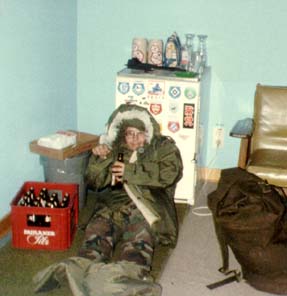
It was late in the Summer of 1988 when I was assigned to an Army counterintelligence field office in South Korea. However, it was during a field exercise during the Team Spirit wargames that this particular incident occurred.
As a field agent, it was part of my job to interview soldiers and civilians who had information that might be of interest to military and national security. From time to time, the information was of use, but most of the time this information tended to be incorrect, misunderstandings of insignificance. However, from time to time, information came my way that tended on the bizarre, and all one could do was investigate and hope to explain away the situation in some reasonable manner. This brings us back to the Team Spirit Exercise of 1988.
As members of the intelligence group operating in South Korea, it was our job during these exercises to concentrate our efforts against the US troops that were going to be arriving from the states. However, because we were stationed in South Korea, it was also part of our job to investigate any real world situations that happened to come our way. It was surprising how many of these would happen during one of these war maneuvers.
There were four agent stationed back at the field office to handle the investigations that were already ongoing. I was personally assigned a private as a counterintelligence (CI) assistant and one Korean Augmentee to the US Army (KATUSA) translator. We were working on covert surveillance missions for Team Spirit missions when a call came over the radio from headquarters to report to one of the 2nd Infantry Division Infantry comanies concerning a possible breach of security.
I took Corporal Yu (my KATUSA) and Private Bottoms (my driver and assistant) with me to investigate the situation. Once there, I proceeded to initiate an investigation (the results and content of which are not significant to the story). However, while conversing with one of the platoon sergeants of this unit to gain some background information on the circumstances, a sergeant first class reported to me something that struck me as great interest at the time.
“Sir,” he said, “I don’t know if it means anything, but one of my squad leaders reported a pretty strange occurrence while on maneuvers near the ******* region.” (the actual location is not important, although it was located quite some distance from the demilitarized zone, as most military maneuvers would not be located close to the border with North Korea) I asked him to elaborate. “Well, we were traveling to this hill trying to seek higher ground for a fifty position when one of the locals stopped us and told us we were traveling on sacred ground.”
“Sacred ground?” I said. “This is Korea, not an Indian reservation.”
“I know it sounds strange, sir,” he continued, “but the locals were serious, and they didn’t want our guys to continue heading up the hill.”
“So, what happened?”
“Well, my guy decided to chance it anyway. That was when of the locals told him that the place was haunted.”
This revelation surprised me. Coming from a private or some green lieutenant, this might be expected, but this was someone who was wearing a combat patch from Vietnam. This guy wore an expert infantryman badge, and he didn’t look like the kind of guy who would accept a ghost story as any type of answer. However, that was what he was telling me. “So, what happened then?”
He smiled. “The damn bastard came back down and reported it to me.”
“So, why are you telling me this?” I said.
His smile grew even deeper. “Well, who else was I supposed to tell?”
That seemed to be the catch-all phrase for half of the information that came my way. If someone wanted to pawn off information, we were the people to pawn it off to. CID handled criminal cases, MI handled intelligence cases, and we handled anything that didn’t fit anywhere else. That included strange lights, UFOs and ghost stories. Catch-all summed it up quite nicely.
I had the platoon sergeant draw me up a map of the location we were discussing, and then I concluded the business I was at this unit to conduct. From there, I went back to where our logistical group was located. After firing off an electrical message to Seoul concerning our real investigation, I met up with my fellow agents and passed on the story of what was told to me.
Only one other agent was interested in the story; the others didn’t consider it worth their time. For the sake of identifying him for the story, I’ll just say his name was Mr. Smith (a name I’ll use considering he’s still working in this field to this day). Mr. Smith and I sat down in our tent and worked out a plan of action to see if there was anything to this ghost story.
The first phase of our investigation was to find the site. The next day I was on infiltration duty with my assistants, so Mr. Smith took the day to investigate the ******* region. When I returned from maneuvers that evening, Mr. Smith’s vehicle showed up, and he told me he was successful in finding the location. It was located at the top of a hill (he showed me on the map). There was a small village at the bottom of the hill, and several people attempted to stop him from traveling up the hill before he continued past them and found what was definitely the site described by the platoon sergeant.
Mr. Smith described the site as a series of buildings that all appeared to be abandoned for no apparent reason. He spoke excitedly about finding furniture still in the buildings, but no occupants of the buildings themselves. He said there was an eerie feeling about the place as they traveled through the ghost town. He even said that his KATUSA, Sergeant Kim, grew really nervous before they finally decided to leave and report back to camp. Sergeant Kim didn’t say what was wrong at the time, but when I spoke to him, he told me that there was something bad about that place, but he just didn’t know what it was. He refused to elaborate any further than that, which was unusual because Sergeant Kim was usually pretty upfront about everything.
The only problem with the first expedition is that no one brought a camera, so there was no proof of anything they saw. All they brought back were eerie stories of feeling they were being watched. Therefore, I decided to find the place myself.
The next day I brought Corporal Yu and one of our US Army corporals, another CI assistant, who I will call Corporal Jones (as he is now an agent himself and probably would not appreciate his real name being used), along with Private Bottoms who I always liked to have around because of his clear head in most situations. I chose Corporal Jones for this journey mainly because he was an excellent driver and had an excellent knack for getting us out of situations that weren’t always as clear cut as I would have liked. I didn’t anticipate any trouble during this fishing expedition, but I always liked having Corporal Jones as my driver whenever possible.
Using a map drawn by Mr. Smith, and the map drawn up by the platoon sergeant before, we set out the next morning to find the ghost town. The trek was quite a long one considering the fact that once one leaves the city roads in South Korea (at least back then), one quickly finds oneself traveling down dirt roads, and even roads that are no bigger than rice paddy mounds used by farmers who travel across on bicycles. Corporal Jones handled himself and our vehicle quite well, and eventually we came across a village that was located at the bottom of a very large hill/mountain.
At the forefront of this little village was a small convenience store, much like every other convenience store located throughout South Korea. It is not hard to spot these places when out in the larger cities. Almost always, there is a display of Pepsi-Cola (with printing in both English and Korean that reads Pepsi-Cola, a display that contrasts with pretty much everything else sold in these little stores) in front of a sliding door that houses multiple colored products that can be bought for daily living. Most products are warm as there is rarely electricity running these places. Usually, the family that owns the stores usually lives deeper within the store itself, as it also serves as the family home as well as the village store. As expected, the family was seated behind the sliding glass door, eating a meal of kimche. When they noticed our vehicle pull up outside of their store, the sliding glass door slowly peeled open and a young woman stepped out meekly to greet us.
Corporal Yu stepped out of the vehicle and spoke to her. He told her that we were searching for a small village that was supposed to be on top of the hill. He asked her if she knew anything about the place. She told him that there was an old school on top of the hill, but that no one went there anymore. She stared at the rest of us with suspicion and seemed nervous about speaking before Corporal Yu lied and told her that none of us spoke Korean, that she could speak to him freely and he would filter the information that came to us. Corporal Jones and I were both fluent in Korean, but Corporal Yu knew it made people speak up if they thought we weren’t.
Corporal Yu then asked her if there was ever anything strange about the place. She said that people used to get scared there, but then stopped speaking when the sliding glass door opened again and her father stepped out. Before she could say anything more, he waved her back into the store and took up a position in front of Corporal Yu. His first words in Korean were that there was nothing to see on the hill, and that we should turn around and go home.
Corporal Yu attempted to ask him a few more questions, but the father refused to answer anything. He was adamant about there being nothing of interest at the old school, and he refused to even discuss the possiblity of anything abnormal happening in the area. Finally, frustrated, Corporal Yu bought four Pepsis and walked back to the vehicle with the father following close behind him.
The father moved over to my open window, figuring that I was probably the one in charge of our little group. In broken English, he said that we should go home, that there was nothing for us to look for there. I responded in English, speaking slowly, asking him simple questions that basically had little merit or value other than establishing the fact that I was trying to speak to him in English. After a couple of questions that he answered quickly without thinking, I switched to Korean and asked him how long the local people have stayed away from the place because it was haunted. It was an old trick, and like usual, it worked. He responded, saying it had been several months, right before he realized he answered a question put to him in Korean. Before he could deny any further knowledge of a haunted area, I motioned for Corporal Jones to drive on and head up the hill.
The road wasn’t a simple one we had to travel. There were parts of it that were quite dangerous. But we made it, and the effort was worth it.
As described, the place was some kind of camp retreat, half school and half residences. If this was a place in the United States, I would have assumed it was a children’s camp, or some place you’d find a cult religion. But being in Korea, it was very possible that this place was some type of community that had been put together over the years.
The buildings were mostly similar in shape, almost like large doll houses. However, the first building we came across was the length of five or six of the buildings put side by side. When we entered it, we realized we were in some type of church.
There were still pews down one side of the church, but down the other side, the pews had been ripped from their housings and scattered across the floor. There was an altar on the far end of the room, almost like one would find in a down south Methodist church. There was a podium in front of the altar, but there was nothing else of religious significance in the room. It wasn’t hard to tell that this was a place used for some religious ceremony,but whether it was Christianity, Buddhism, or Satanism was difficult to tell. That was when the first feeling that something was wrong came to us.
I felt it myself, but Corporal Jones was the first to say it out loud. “I need some air,” he said as he stepped outside and we followed behind him. Once outside, he told me that the place started to feel really stuffy inside and that he had to get out. I realized I had the same feeling myself, but I was the leader of this expedition, so I pretended this revelation came as a surprise to me.
“Let’s check out some of the other buildings,” I said.
We continued going through the rest of the buildings, and with each one we discovered something different that sparked our interest. In one, there was furniture that was thrown around the place like some major fight had taken place. In the next, everything was completely in place, except that a closet door had been thrown off of its hinges. With each unit we went into, something always seemed to be different from the ones we had already seen.
We spent several hours going through the many buildings–there were over forty in total–before we finally began to feel we had seen enough of the place to justify our belief that something wasn’t right. There were two levels of buildings to this place as well; the second level was hidden around a corner of the main hill and we ended up discovering that section completely by accident. But during the entire time we were there, not a single person from the village came up to see what we were doing, even though the father from the store had to have told everyone that Americans were traveling up to the camp.
During the entire time I was there, I kept feeling that there were people watching us. Often, I stopped and looked around, convinced that someone was right behind me. But there never was.
Throughout the entire trip, we all were completely on edge, almost as if we were expecting something out of the ordinary to take place. But nothing ever did. It was like the entire place was dead to the world around it.
Finally, we finished taking several rolls of film of the place, and then we headed back down the hill to find the nearest city where we could contact local authorities to see if they knew anything about the place.
The nearest city was several clicks away, and we found a precinct of the Korean National Police. As representatives of the US forces, and card-carrying members of the KNP, we met with a Captain Pak who proceeded tot ell us that the place we visited was an old live-in school that was no longer used. When I asked why there was still furniture in the buildings, he stated that he didn’t believe that was so. When I asked him if he had ever been there, he said that neither he nor any of his staff had ever been there mainly because they just didn’t have the time to visit old sites like that. When I asked him to comment on ghost stories, he just smiled and said that he had heard reports like that, but they were just supersititions. As a joke, I asked him if he wanted to return with us to take a look at the place. He laughed and said that he couldn’t, that his job was too pressing for time. However, he did offer to invite me and my staff to coffee with the local members of the KNP. During our coffee break, I mentioned that we could have spent that time investigating the site; he just smiled and continued to order more drinks (coffee is not all they serve in Korean coffee shops). When we were ready to leave, he invited us to join him and his staff for coffee again in the future, stating that he hoped he was of assistance to us in some way.
With that, we went back to our camp site to discuss our findings with Mr. Smith. Sadly, we never had the opportunity to visit the site again.