Tag Archives: military

My Run-In With the Klan in the Mid1980s

The protest is getting out of hand
The protest is getting out of hand (image from in game screen shot of City of Heroes)

It was shortly after West Point, and I was stationed at Fort Knox, Kentucky. One weekend I had time off, so a few soldiers and I decided we were going to take a trip to Nashville for a concert that was taking place there. This was in the middle of the 1980s during a period of time when the United States was starting to regain some of its image around the world, as much of the 1970s was spent recovering from the disastrous Vietnam War era. Reagan was president, the Soviet Union still had years until it collapsed, Star Wars had finished its original trilogy, the Cosby Show taught us values from someone who still had a lot of respect throughout the country, and there was a sense that things in the future were going to be improving because so many technologies appeared to be in our headlights, like microwaves, cell phones, the Internet and some device called a Rubik’s Cube.

So we hopped into my Mercury Capri, all five of us, and made our trip south. In case you’ve never taken the trip by car before, it’s a really nice drive through beautiful country.

Anyway, somewhere around the border of Kentucky and Tennessee (to be honest, I don’t remember which side of the border when this happened), we came to a huge intersection that was kind of bogged down with traffic. It felt kind of out of the ordinary because traffic had been moving so smoothly only moments before. And then I discovered why.

On all four corners of the intersection were people dressed in white robes handing out pamphlets to people in their cars. For some reason, this spectacle seemed to slow traffic down to a standstill. It took me a couple of moments to realize what was happening, but traffic was moving slowly because each driver was having somewhat of an impassioned conversation with whatever person in robes showed up alongside that driver’s car. Unfortunately, I couldn’t hear any of their conversations, but part of me to this day hopes that the words exchanged were not friendly, but I honestly don’t know any of those details.

This was the Ku Klux Klan handing out their pamphlets to the people who were driving through their county.

Now, I’d never seen one of those people before in real life. Sure, I’d heard all of the stories about them, watched films of some of their notorious deeds in the past and knew that since the early days of this country they represented some of the most vile sentiments people could possibly have. But seeing them in person, I had no clue what their intentions might be, or even how much of the past history the group made was part of what they might be doing on that particular day.

Then I reached the position where they were located. They were blocking traffic, one person standing in front of a car to make sure you had to stop while another came over to the window to speak and offer their pamphlets. I was kind of oblivious to what was really going on, but the person who came to my window knocked on it and gestured for me to roll down the window. Somewhat curious, I did.

Okay, two things are important to this story. First, the person who knocked on my window was a female Klan member. Second, well, I should have probably mentioned a little bit more about the group of people in my car.

There were five soldiers in my car, tightly packed into it. The guy in the middle back seat was white, and so was I. The guy sitting next to me and the two men seated near the doors in the backseat were all African-Americans. Every person in the car was a seasoned veteran and currently serving in the Army.

So I rolled down my window, and I was not known for holding back on anything I had to say, so the first thing out of my mouth was: “So, they’re letting women into the Klan now?”

The woman stared at me for a second and responded with: “Women have been in the Klan for years.”

On instinct, I said: “Wow, how progressive of them. I guess they let anyone into it these days.”

To that, the guy seated next to me crouched over to the window and said. “That’s so cool. How long until I get to join?”

And I think that’s the moment that she realized the car was packed with a mixture of people she was probably not all that comfortable with seeing. The two guys in the backseat yelled out: “Can I have a pamphlet?” and “What time are your meetings, cause most of my mornings and afternoons are kind of busy these days with Army shit?”

The woman turned to her partner who was blocking my car and pointed to the car, I guess trying to figure out what she should do. I helped them make a quicker decision instead.

I said: “If he doesn’t move, I’m running his ass over.”

The guy in front of my car motioned for one of other partners, kind of trying to motion him over to the car or at least to assist him in blocking the car. Now, I don’t know what they were intending to do, but let’s put things into perspective. We were all trained killers and even without guns could do some serious damage to someone if we needed to, so if they would have stopped us and forced us out of the car, even if they were armed, the chances are there would have been three fewer Klan members alive that day.

I also noticed that one of the guys in the backseat, a part time power lifter who people used to call “The Tank” (which is someone ironic because he was an armored division officer) had his hand on the door handle and was about to step out and start an encounter that wouldn’t end well for anyone. In my rear view mirror, I could see the whole group was already transitioning into the “fight” of fight and flight mode.

Instead, I gunned the engine and just lurched forward. The woman at my window jumped back and the guy directly in front of me saw me coming and literally dived to the side of the road. The other guy that was heading towards the car also jumped back, realizing that I was flooring it and had no intentions of remembering my car had a brake pedal.

So we continued driving until I stopped a few miles out so the adrenaline could subside. One of the guys n the back yelled: “Let’s go back and fuck them up!”

But we didn’t. We continued on and made it in time for the concert we went to see. A good time was had by all.

That was my one and only encounter with the Klan. But I never forgot it.

What I Talk About When I Talk About Drinking

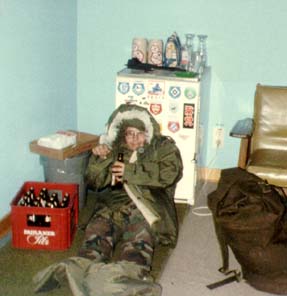
This is me during my drinking days in the Army

During the late 1980s, going into the 1990s, I was in the U.S. Army, and all things considered, I probably had somewhat of a drinking problem. This was the latter part of the era of drinking before people started getting serious about the ramifications of the problem, meaning that we started enforcing drunk driving laws (unlike the past where we swept things under the rug) and Alcohol Anonymous was no longer just a light at the end of tunnels that no one would ever travel through. To understand my perspective on the whole situation, let’s visit the late 1980s and let me share a bit of a story with you.

You see, back then I drank a lot. Every night. It was almost a ritual of service at that time. Work hard during the day and then get plastered at night. Wake up the next day, run PT (most likely throwing up alongside the other soldiers who were all suffering hangovers) and then by the time evening came along, we’d go out and do it again. THAT was pretty much a part of the military lifestyle back then.

I think the apex of this whole situation occurred when a colleague and I decided to take a trip to the Canary Islands. On the plane, we both got plastered, and then when we got to the hotel, we got smashed. And then for the next week, well, I know I had a really good time because I have pictures of me and a lot of very beautiful women cavorting together, but to be honest, I have figments of memories of what actually happened during that week long trip. All I remember was being greeted at the airport on the way back by my fellow GIs, and they had brought beer with them, so we got obliterated on the trip home, too.

A couple of weeks later, I was driving my car back to post (in Germany), and I was extremely inebriated. Some friends were in the car behind me, and they drove up behind me, hitting my bumper and then trying to push my car forward with their own acceleration. I was at an intersection, and as they pushed me forward, or tried to do so as I held down on the brakes, I suddenly sobered up. I was probably still quite drunk, but right at that moment, it suddenly dawned on me that there were other people on this street, that if I just gave in to the fun, who knows what damage (or lives) could have been affected.

Driving home slowly (the other car rushed by me and continued on towards the post), something came over me that made me realize something was wrong. I just was too drunk to really figure out what it was.

The next day was Saturday, so I didn’t have to be at work for a few days, but instead of my usual routine, I decided to skip the club that night. Instead, I sat at home and read a book. My fellow party buddies thought something was wrong, but the next night, I skipped partying again and did something else (don’t remember what it was at the moment but I do know it didn’t involve drinking).

A few days later, I sat down at my computer (one of the early ones…this was the 1980s) and started writing my first novel. In case you’re wondering, it was Innocent Until Proven Guilty, and it was the first work I completed where there was absolutely no alcohol involved. Shortly after that, I began work on my second novel, Loser.

I was reading an article today in Salon, about how alcohol is targeted at women through intricate manipulation and advertising, but I’ll have to be honest that when I was drinking, it just seemed like the thing to be doing. There were no great football beer ads that i remember during this time. Sure, there was peer pressure, but I’ve never been all that susceptible to that sort of thing. For me, all there ever really was involved the “you have to be old enough to drink it” mindset so that when I hit that age, I started imbibing because it felt like a chronological ritual of growing up.

I’ll admit that when I quit partying, it wasn’t the end of alcohol for me; that would come years later, but it did change things for me because that pleasure I received of getting smashed no longer seemed to be of interest to me.

What used to fascinate me was how many of those tests in books I would take that indicated I was most definitely an alcoholic. Do you often drink to excess? I sure did. Do you wake up the next day and not remember moments of the night before? I woke up one morning and couldn’t remember much of what happened the entire week before. Do you ever blackout? When didn’t I? Do you often crave alcohol? And that’s kind of where it breaks off for me, because to be honest, I’ve never craved alcohol. Actually, kind of hate it the more I think about it. I liked the buzz I got, but to be honest, I wasn’t all that excited about the buzz either. I drank back then because it was something to do. I really didn’t like my life back then, and it seemed like a good crutch to fill in the gaps of what was going on and not going on. I’m one of those kinds of guys who never really has romantic relationships, even when I was in the middle of a romantic relationship (if that makes sense). So, drinking filled a void that I basically needed to fill with something.

Fortunately, writing kind of fills that void now. The “thrill” of drinking was the ability to turn off my mind and allow this other sense to overwhelm me. Believe it or not, I get that (and more) from writing. I take myself to another world, and I get to live in that world during the time that I’m writing. It helps me to forget that my current life kind of sucks. Sorry, but it does. I still don’t have romantic relationships, and that part of me has never changed. So, I spend a great deal of time trying to find some way of filling the gaps that basically never get filled.

When I got out of the service, I didn’t quit drinking completely, although I became more of a social drinker. My friend Kat would drink from time to time, so I would drink with her. When we parted ways, I basically just stopped drinking completely because like I said before, it never really gave me anything that I was lacking anywhere else.

And that’s been years for me now. A friend of mine visited me for a week a few weeks ago, and when we were at the store shopping for groceries, she asked me if I wanted any alcohol, and it never even crossed my mind that I might be interested. Alcohol has no value in my daily life, and it’s not something I seek out. At one time, I was going to start drinking red wine, but only because I heard that it had certain heart benefits. Never did get around to buying any though.

So I guess what I’m trying to say is that I suspect that alcohol serves a purpose for everyone that consumes it, and what’s important is finding if that purpose is strong enough and whether or not it can be replaced with something else. For me, writing served as my alternative. But then, I’ve never been addicted, even though I can’t even begin to tell you how many people over the years said I must have a problem because of how I answered some of those questions. One person I know who is an alcoholic thinks I have some kind of strength to stop as I did, but I never saw it that way. I have my own vices and my own things that need to be dealt with (we all do). Alcohol just doesn’t seem to be one of them. Others, unfortunately, can’t say the same thing.


Gender Issues at West Point

There’s a story that’s been making the rounds this week from both West Point (the United States Military Academy) and Annapolis (the US Naval Academy) about women who were allegedly raped and then pushed out of their respective academies by a system that wants nothing to do with providing justice to women who might have been sexually abused by upperclass cadets and midshipmen. As someone who attended West Point back in the 1980s, all I can say is that I’m ashamed that such actions are taking place today and really wish I hadn’t read about such things.

You see, when I attended, women were just breaking ground at graduating from West Point, and it was not rare to see a lot of hostility waged against any woman that attempted to get through a very male-centered environment. My first squad leader in cadet basic training was a woman, and she instilled high standards in me that I never forgot. As the leader of our squad, she had several women in this squad, and all I kept thinking to myself during that first summer was how hard those women had it. The male cadets were complete assholes around them, yet they struggled through and somehow made it. Not all of them did, but they persevered. It was kind of an honor to see them go through the work they went through to make the inroads they did.

I’m sorry that there are men today who are still thinking of women in the Corps of Cadets as potential targets for doing things that men should have evolved way beyond. Especially at an esteemed institution like that. Over the years, I used to think that West Point was way above such things, and when the Citadel was going through its gender problems years later, all I could think was that West Point got through it before them, and it was only a matter of time before all the rest of the military institutions did as well. Turns out, I saw things to be better than they actually were. Apparently, we still have a long way to go.

Hopefully, we move forward. But I suspect that we still have a long way to go yet. And that just makes me sad. Especially when I saw the crap women had to go through over 20 years ago to make it easier for women who might come later. It’s like their sacrifices were for nothing.

Taxation Gurus Just Don’t Seem to Get It

CNN Money ran an article today from Jeanne Sahadi advocating the need to raise taxes “because the looming debt problem is just too big”. Her argument goes on to say that Republicans are misthinking the whole issue because as long as the debt remains large, the country can never go forward.

Well, my response is twofold. First, we need to stop putting taxation into a partisan framework. That never solves anything but makes the issues so tied to other agendas that there’s no way to have a rational conversation about the issue in the first place. By making it partisan, any response of negativity to Sahadi immediately gets lumped into a “he’s a Republican, and therefore he is only limited to Republican talking points.” Whenever the conversation moves to the next level of analysis, the responder can immediately throw it, “oh yeah, but Republicans also believe (fill in the blank, and you realize why no rational debate is then possible).”

Second, and this is really my more important point, at what point did government become so important that it became the elephant we SEE in the room rather than the one hiding in the background? In other words, why is government always the most important factor for the debate? Why isn’t the individual considered more important?

Think about it this way. If we go back to the original foundation theories of government and agree that people came together in a Hobbesian fashion to escape from our evil surroundings, we understand that we then gave up a little bit of our freedom to achieve security. Now, no matter whether you buy Hobbes, Locke or Rousseau, at no point did we ever really give up the original reason for getting together, meaning that we got together because it was mutually beneficial to us, NOT because we were all desiring to create a government. At no point did the foundation of government ever supercede our reason for creating government. In other words, those who create a government are always more important than the government itself, not the other way around. Yet, in every one of these arguments, especially the one put forth by Sahadi, government is the reason we do the things we do, so that we are required to sacrifice at the altar of government, instead of the other way around.

I pay taxes. I’m not rich, but because I am low middle class, I pay money into taxes that really makes an impact on my daily life. The majority of people who pay taxes are like me, lower middle class people who don’t make a lot of money. Any increase in taxes to us hurts big time, yet we’re rarely ever represented in these conversations about taxation and government. Instead, the Republicans represent the interests of the very rich, and the Democrats represent government attempting to fund more money for governmental programs. In a fair world, we’d have another party that actually represented a social class of common people, but we don’t have that in this country. Oh, both sides claim to be that representative, but they never are. They represent their own interests and those interests are never ours.

What it comes down to for the majority of us is a question of how much we value government. I, personally, don’t value government all that much. I see it as a mechanism to keep gangs and drug dealers from killing me on a daily basis. And to be honest, government doesn’t even do that very well. Serious amounts of money are spent on a drug war that fuels this continuous battle between mean streets and the common person, and the common person is rarely seen as the one to which government answers. An example: A few years ago, I was beaten and robbed by gang members who targeted me because of my color. Instead of a serious response to the victim, which you would expect in a case like this, or at least might see on television played by actors who don’t represent real police officers, I ended up in a bizarre situation where two police agencies argued IN FRONT OF ME over which one was responsible for taking the report. Neither one of them wanted the responsibility. Of course, after all was said and done, the culprits were never caught, and I suspect they were never even pursued. Over the next few weeks, before I finally moved across the country to get away from the cesspool that is Hayward, California, I read the blotter reports in the newspapers about how the same individuals were continuing to target citizens in the EXACT SAME AREA EVERY DAY, and even escalating to public buses, convenient stores and train stations. In other words, government didn’t care one bit whatsoever.

Yet, when it comes to taxation, Sahadi believes that if government is starting to fail financially, it is within our requirements to respond immediately and fix it. Sorry, I don’t buy it. Right now, we spend so much money on things that have very little to do with the average American who does pay taxes. Let’s go over a bit of that list.

Wars in Afghanistan, Libya and Iraq: Who benefits from this? Me? I don’t think so. Did I care about freedom in Iraq to begin with? No, not really. I’ve never had contact with anyone from Iraq before. Nor have I had contact with anyone from Afghanistan or Libya. Sure, I buy gas, and some of that comes from some of those places, but if we weren’t fighting a war in these places, we’d still be buying gas from these places regardless. I don’t even suspect it would cost that much more because prices are controlled by OPEC, not tin foil hat dictators.

That pretty much translates to our entire military budget. Yes, it is responsible for protecting America from foreign enemies, but honestly, we’re not actually doing that with our military. We are located in countries that are not ours, fighting for issues that have nothing to do with freedom in the United States. And in order to conduct these wars, we have had presidents (the last two specifically) advocating to suppress our freedoms, which means we’re fighting to lessen our freedoms, which is ironic in its own cynical way. If we were defending America specifically, I’d be happy, but we’re not. We’re pushing agendas of people who are not the lower middle class. And we’re backing up those issues by sending young lower middle class soldiers into wars to support people who rarely serve in the military themselves.

Most governmental agencies that the common person desires are usually handled by the states. My education is handled by the states. The federal government does nothing but institute standards that no one ever achieves. Our federal government has no idea how to educate the youth of America, yet they feel worthy of forcing their standards on the states regardless. I don’t see the value in this. Sure, I can see the value of making sure we don’t teach creationism in school, but nowadays, federal government isn’t even doing that; it’s doing the exact opposite and then fighting with itself over those specific, political standards. Not necessary and not helpful.

Heath care seems like it’s important, but when you threw it into politics, it starts to get useless. Tylor Cowen, in his excellent article, The Great Stagnation, points out that even though the United States spends more money than most countries on health care, we have some of the lowest levels of life-expectancy and our health success rates are dismal at best in comparison to nations that actually spend less of their GDP of health care. Like most governmental issues, we do horrible with our money because we keep believing in American exceptionalism, when we don’t realize that exceptionalism doesn’t always mean better. Part of our problem is that we have a lot of money already in the mix that should be spent better, not a need for more money to be spent on doing the wrong things more often. That last sentence is probably the most significant of this essay but will echo with no one.

In the end, it will come down to partisan drivel politics again where we have people who have a stake in winning an argument over issues that should never be decided by partisan politics. But we don’t seem to care because we’ve gone way beyond caring about what’s important and care more about winning arguments that don’t benefit us even when we do.

As a taxpayer who pays what he believes to be enough taxes, I don’t subscribe to the theory that more money is necessary to fix the problems of bad spending. Unfortunately, the people we have in government are not the best people when it comes to spending wisely; they never have been. Instead, we have the people who are best at convincing people to vote for them because they’re good at making people feel better about themselves, especially when we live in a country of people who should be a lot more critical of their own shortcomings. We’re educating ourselves horribly, we’re grossly overweight, and we let ourselves be ruled by foolish passions over issues that require serious contemplation. But this will fall on deaf ears because we’re a nation of people who likes to hear that we’re great, and when that person comes along who strokes our ego, we’ll vote for him, and we’ll wonder why no one ever does anything about fixing our country. We certainly won’t get the answers from anyone who is paid to tell us what we already keep hearing, but then we’d stop paying them if they didn’t. We’re pretty good at creating vicious circles in this country. Another thing we’re good at, eh?

My One Day as the Kingmaker of San Francisco

Me on my usual throne before becoming a kingmaker

Some years ago, I had a pretty unimportant job as an investigator for a major hotel chain. I happened to be in San Francisco, working for one of the properties of that chain, when there was a major political event taking place in the city. The election for mayor was taking place, and this was the evening of the results. The man who was going to be the future Mayor of San Francisco was holding his election rally in the hotel where I was at, so the big convention was taking place in the Grand Ballroom of this hotel.

This meant that everyone that was involved in security needed to be part of the crowd control. As a security investigator, I sort of fell under that umbrella, and while I could have opted out, I figured I’d help out and stood at the top of the escalators where the mayor was holding the big get-together. Well, like most bad television sit-coms, this is where everything sort of fell into place.

It turned out that one of the main advisors to the future mayor was someone I knew. He and I had met at the college where I had gone back to school after getting out of the military. He just so happened to be my physics instructor at the time, and we had gotten along greatly, although that had been a few years ago. Well, he was walking up the escalator with the future mayor, saw me, and immediately steered that future mayor over to me and said: “I wanted you to meet one of the men instrumental in helping you get elected.” And I was then introduced to the future Mayor of San Francisco.

You see, this professor of mine mistook his recognizing of me as a recognition of someone who was actually involved in the campaign. He saw my recognition of him, and his eyes lit up, and he sort of filled in all sorts of false past events because he probably couldn’t remember why he recognized me. I was fine with it, and personally I thought it was kind of funny.

Things sort of escalated from there. The number one man in this mayor’s campaign heard the exchange and immediately looked at this guy in a suit and figured he was important enough to continue a conversation. He pulled me aside and asked me to walk with him into the ballroom, because he wanted to hear my ideas for when the mayor took over the city.

So, not believing this was really happening, I went with him and spent the next half hour outlining what I would do if I was to take over as mayor. The man hung on every singlel word I said.

Then he introduced me to the future mayor to have a small conversation with while we waited for the returns to come in. So I stood there, in front of a lot of very important people, and I outlined what I thought this mayor should do if he became the leader of the city. He listened to every word, asked me a bunch of poignant questions, and then listened to my responses to every one of these questions. I must have spent an hour talking to him before the returns came in, and this man was announced as the next Mayor of San Francisco.

He then turned to me, handed me his business card with his private phone number on it, and then told me to keep in touch, because he valued his friends well.

So, I shook his hand, took a business card from his campaign manager, and then went back to work, helping the security staff take their lunch breaks by filling in for them.

But for that one moment, I was listened to by some of the more important people in the city. They’d never listen to me again, but for a few hours, I was one of them and the one to whom they listened to every word spoken.

I can only hope that I made a difference to the city that one day.

(this is a reprint of one my old articles from last year)

The Future of America is in its Past

In case you haven’t noticed it lately, America has stagnated and isn’t really moving forward anymore. I know most people don’t want to face that possibility, and most people reading this (which means anyone aside from my stuffed animals and imaginary friends) will probably just ignore it and hope for the best. Unfortunately, we’re a bit beyond that option, and even though most people will attempt to embrace that plan, we’re kind of screwed if we do.

You see, according to Tyler Cowen’s thesis, The Great Stagnation: How America Ate All the Low-Hanging Fruit of Modern History, Got Sick, and Will (Eventually) Feel Better, we’ve pretty much exhausted all of our free ranges for expansion and exploration, leaving us with pretty much nothing but what we already have. And America was never designed around resting on its laurels; it was designed to expand and develop out, something it can’t do if there’s nowhere else left to go. Now that we’ve entered this inevitable recession, we’re hitting a point where we start to realize that there’s nowhere else for us to go, and that all of those jobs that we expect to come back might just not, and thus, we’re going to have to figure out how to make lemonaide out of already eaten apples. Yeah, I’ve run out of metaphors, similes and allusions. I’m a lot like my country.

Americans live in a system that promises that anyone can do wonders with little as long as that someone is willing to put forth a bit of elbow grease. Unfortunately, that’s kind of a lie, something we’ve been telling each other for generations, even though the lie relied on a lot of extra room to grow that we figured would always be there for expansion. Once that land started running out and the resources as well, we felt we could keep telling the stories long enough to pull a bait and switch, figuring no one would live long enough to really ask any important questions, at least not before we retired and/or died first. Well, we’ve reached the saturation point of that possibility, so now we’re kind of stuck in a future that relies on the lies of the past never being called, like markers in a poker game where we’ve been holding two aces, hoping its the best hand in the game, even though someone else may have had three twos showing all along. Yeah, more bad analogies, metaphors and similies. I’m just full of it today. Or them. Whatever.

Which leaves me with an observation that is probably important because we’re now hitting a point where we’ve already been called on our bluff. Everyone wants to see the hands of the cards we played, and all of the money is already on the table. Man, I’m just going to push this bad analogy all the way to the bank.

So what do we do? We’re in the middle of the unending recession, and we’ve been pushing forward with the belief that it had to end eventually because that’s what recessions tend to do. But if our economy doesn’t really have the power to pull us out of the doldrums, then where do we go from there? What if the recession we’re in happens to be the harbinger of doom that we should have been expecting from the beginning? What if all we have left is that Pandoran conclusion and hope just isn’t enough? Where does a rapidly expanding nation go if there’s no more room within which it can expand?

Part of the solution was the possibility of an untapped area of manifest destiny that offered a never-ending canvas for exploration. By that, I mean the Internet and the ever-expanding territory of a cyber universe. Unfortunately, even that has its limits, as we’ve realized that eventually everything explored in that world has to have some ties to the old world as well. While it might be fascinating to think one could live within a cyberworld, in reality, one still has to maintain a certain existence within normal society, even if to fulfill certain Maslowian needs. Forever expansion means little if someone still has to eat, drink and sleep in normal civilization. The days of Matrix-like exixtence are not yet achievable, so we’re still stuck with having to full basic, simple needs.

Which leaves us with having to find ourselves new frontiers in a walled garden of our own civilizations. The United States could offer endless expansion in the days of praries that went on forever, but once we hit the Pacific Ocean, we started to limit our ability to travel further. Now, everything has been spoken for, so any further expansion comes at a step backwards, a sort of inward despansion, for lack of better word. Much as cell growth is halted and the cells begin to collapse within themselves, feeding off one cell to sustain another, our future is now a tendency to cave in on our progress and trade resources amongst our already established infrastructure as we consolidate and seek to find new frontiers within those already explored. Our future expansion then becomes within, rather than out, mainly because we are without.

If we’re going to survive this change in perspective, we need to realize that we can no longer cannibalize upon outside resources to which we no longer have access. For territory, we must look at that which we already control. For fuel, we can no longer just take from nations that have weak military forces as the world is becoming savvy to that approach and compensating to it as well. We are going to have to consolidate amongst our own people to determine new ways to fuel our movement by either designing new technologies that allow us to use our own resources or to lessen our movement. The simple endothermic physics involved should go without saying, but we’re often not that intelligent when it comes to such matters.

If we’re ever going to figure out our future, we need to look to the rest of the world and see how it has compensated for our future situation already. When Europe ran out of space, it sent colonists to the new world to explore. We are a result of just that. However, when we rebelled and declared ourselves independent, we cut off an avenue of expansion for Europeans, and thus, forced them to realize that their expansion was forever finished, that they would have to learn to live with what they already had. We didn’t think about their reactions or thoughts because we were too busy thinking about how unique we were in comparison to the rest of the world. But in reality, all we were was lucky enough to still have room to grow. Now, we don’t.

So, our future should very much be the same future that was faced by Europeans in the 18th and 19th centuries. When they ran out of space to explore, they consolidated. They began to move back over themselves and create from within. They didn’t just stagnate and disappear as we seem to think will happen to us if we stop expanding and growing. If we’re smart, and sometimes we can be, we would realize that we need to start looking to our future by examining what others like us did in the past. If not, we’re going to continue to try to expand as Germany tried to do in the 1930s, before the rest of the world rose up and stopped them. We might not see ourselves in this light, but if we believe that our expansion is never-ending, and we see ourselves as exceptional to other nations, it’s hard not to see us moving that way. That’s never a good thing.

Unfortunately, I doubt anyone will really listen, and we’ll go that direction regardless of any common sense or rational thinking. American exceptionalism relies on the very nature of believing in irrational outcomes to rational thinking. Think of it as a game theory where the result is an expectation of the highest payoff with the least possible chance of happening, but expecting it nonetheless. That’s kind of where we are today. I’d say more but American Idol is coming on soon, and we all know what’s more important.

The Village That All of Korea Forgot…a legospaceman ghost story

It was late in the Summer of 1988 when I was assigned to an Army counterintelligence field office in South Korea. However, it was during a field exercise during the Team Spirit wargames that this particular incident occurred.

As a field agent, it was part of my job to interview soldiers and civilians who had information that might be of interest to military and national security. From time to time, the information was of use, but most of the time this information tended to be incorrect, misunderstandings of insignificance. However, from time to time, information came my way that tended on the bizarre, and all one could do was investigate and hope to explain away the situation in some reasonable manner. This brings us back to the Team Spirit Exercise of 1988.

As members of the intelligence group operating in South Korea, it was our job during these exercises to concentrate our efforts against the US troops that were going to be arriving from the states. However, because we were stationed in South Korea, it was also part of our job to investigate any real world situations that happened to come our way. It was surprising how many of these would happen during one of these war maneuvers.

There were four agent stationed back at the field office to handle the investigations that were already ongoing. I was personally assigned a private as a counterintelligence (CI) assistant and one Korean Augmentee to the US Army (KATUSA) translator. We were working on covert surveillance missions for Team Spirit missions when a call came over the radio from headquarters to report to one of the 2nd Infantry Division Infantry comanies concerning a possible breach of security.

I took Corporal Yu (my KATUSA) and Private Bottoms (my driver and assistant) with me to investigate the situation. Once there, I proceeded to initiate an investigation (the results and content of which are not significant to the story). However, while conversing with one of the platoon sergeants of this unit to gain some background information on the circumstances, a sergeant first class reported to me something that struck me as great interest at the time.

“Sir,” he said, “I don’t know if it means anything, but one of my squad leaders reported a pretty strange occurrence while on maneuvers near the ******* region.” (the actual location is not important, although it was located quite some distance from the demilitarized zone, as most military maneuvers would not be located close to the border with North Korea) I asked him to elaborate. “Well, we were traveling to this hill trying to seek higher ground for a fifty position when one of the locals stopped us and told us we were traveling on sacred ground.”

“Sacred ground?” I said. “This is Korea, not an Indian reservation.”

“I know it sounds strange, sir,” he continued, “but the locals were serious, and they didn’t want our guys to continue heading up the hill.”

“So, what happened?”

“Well, my guy decided to chance it anyway. That was when of the locals told him that the place was haunted.”

This revelation surprised me. Coming from a private or some green lieutenant, this might be expected, but this was someone who was wearing a combat patch from Vietnam. This guy wore an expert infantryman badge, and he didn’t look like the kind of guy who would accept a ghost story as any type of answer. However, that was what he was telling me. “So, what happened then?”

He smiled. “The damn bastard came back down and reported it to me.”

“So, why are you telling me this?” I said.

His smile grew even deeper. “Well, who else was I supposed to tell?”

That seemed to be the catch-all phrase for half of the information that came my way. If someone wanted to pawn off information, we were the people to pawn it off to. CID handled criminal cases, MI handled intelligence cases, and we handled anything that didn’t fit anywhere else. That included strange lights, UFOs and ghost stories. Catch-all summed it up quite nicely.

I had the platoon sergeant draw me up a map of the location we were discussing, and then I concluded the business I was at this unit to conduct. From there, I went back to where our logistical group was located. After firing off an electrical message to Seoul concerning our real investigation, I met up with my fellow agents and passed on the story of what was told to me.

Only one other agent was interested in the story; the others didn’t consider it worth their time. For the sake of identifying him for the story, I’ll just say his name was Mr. Smith (a name I’ll use considering he’s still working in this field to this day). Mr. Smith and I sat down in our tent and worked out a plan of action to see if there was anything to this ghost story.

The first phase of our investigation was to find the site. The next day I was on infiltration duty with my assistants, so Mr. Smith took the day to investigate the ******* region. When I returned from maneuvers that evening, Mr. Smith’s vehicle showed up, and he told me he was successful in finding the location. It was located at the top of a hill (he showed me on the map). There was a small village at the bottom of the hill, and several people attempted to stop him from traveling up the hill before he continued past them and found what was definitely the site described by the platoon sergeant.

Mr. Smith described the site as a series of buildings that all appeared to be abandoned for no apparent reason. He spoke excitedly about finding furniture still in the buildings, but no occupants of the buildings themselves. He said there was an eerie feeling about the place as they traveled through the ghost town. He even said that his KATUSA, Sergeant Kim, grew really nervous before they finally decided to leave and report back to camp. Sergeant Kim didn’t say what was wrong at the time, but when I spoke to him, he told me that there was something bad about that place, but he just didn’t know what it was. He refused to elaborate any further than that, which was unusual because Sergeant Kim was usually pretty upfront about everything.

The only problem with the first expedition is that no one brought a camera, so there was no proof of anything they saw. All they brought back were eerie stories of feeling they were being watched. Therefore, I decided to find the place myself.

The next day I brought Corporal Yu and one of our US Army corporals, another CI assistant, who I will call Corporal Jones (as he is now an agent himself and probably would not appreciate his real name being used), along with Private Bottoms who I always liked to have around because of his clear head in most situations. I chose Corporal Jones for this journey mainly because he was an excellent driver and had an excellent knack for getting us out of situations that weren’t always as clear cut as I would have liked. I didn’t anticipate any trouble during this fishing expedition, but I always liked having Corporal Jones as my driver whenever possible.

Using a map drawn by Mr. Smith, and the map drawn up by the platoon sergeant before, we set out the next morning to find the ghost town. The trek was quite a long one considering the fact that once one leaves the city roads in South Korea (at least back then), one quickly finds oneself traveling down dirt roads, and even roads that are no bigger than rice paddy mounds used by farmers who travel across on bicycles. Corporal Jones handled himself and our vehicle quite well, and eventually we came across a village that was located at the bottom of a very large hill/mountain.

At the forefront of this little village was a small convenience store, much like every other convenience store located throughout South Korea. It is not hard to spot these places when out in the larger cities. Almost always, there is a display of Pepsi-Cola (with printing in both English and Korean that reads Pepsi-Cola, a display that contrasts with pretty much everything else sold in these little stores) in front of a sliding door that houses multiple colored products that can be bought for daily living. Most products are warm as there is rarely electricity running these places. Usually, the family that owns the stores usually lives deeper within the store itself, as it also serves as the family home as well as the village store. As expected, the family was seated behind the sliding glass door, eating a meal of kimche. When they noticed our vehicle pull up outside of their store, the sliding glass door slowly peeled open and a young woman stepped out meekly to greet us.

Corporal Yu stepped out of the vehicle and spoke to her. He told her that we were searching for a small village that was supposed to be on top of the hill. He asked her if she knew anything about the place. She told him that there was an old school on top of the hill, but that no one went there anymore. She stared at the rest of us with suspicion and seemed nervous about speaking before Corporal Yu lied and told her that none of us spoke Korean, that she could speak to him freely and he would filter the information that came to us. Corporal Jones and I were both fluent in Korean, but Corporal Yu knew it made people speak up if they thought we weren’t.

Corporal Yu then asked her if there was ever anything strange about the place. She said that people used to get scared there, but then stopped speaking when the sliding glass door opened again and her father stepped out. Before she could say anything more, he waved her back into the store and took up a position in front of Corporal Yu. His first words in Korean were that there was nothing to see on the hill, and that we should turn around and go home.

Corporal Yu attempted to ask him a few more questions, but the father refused to answer anything. He was adamant about there being nothing of interest at the old school, and he refused to even discuss the possiblity of anything abnormal happening in the area. Finally, frustrated, Corporal Yu bought four Pepsis and walked back to the vehicle with the father following close behind him.

The father moved over to my open window, figuring that I was probably the one in charge of our little group. In broken English, he said that we should go home, that there was nothing for us to look for there. I responded in English, speaking slowly, asking him simple questions that basically had little merit or value other than establishing the fact that I was trying to speak to him in English. After a couple of questions that he answered quickly without thinking, I switched to Korean and asked him how long the local people have stayed away from the place because it was haunted. It was an old trick, and like usual, it worked. He responded, saying it had been several months, right before he realized he answered a question put to him in Korean. Before he could deny any further knowledge of a haunted area, I motioned for Corporal Jones to drive on and head up the hill.

The road wasn’t a simple one we had to travel. There were parts of it that were quite dangerous. But we made it, and the effort was worth it.

As described, the place was some kind of camp retreat, half school and half residences. If this was a place in the United States, I would have assumed it was a children’s camp, or some place you’d find a cult religion. But being in Korea, it was very possible that this place was some type of community that had been put together over the years.

The buildings were mostly similar in shape, almost like large doll houses. However, the first building we came across was the length of five or six of the buildings put side by side. When we entered it, we realized we were in some type of church.

There were still pews down one side of the church, but down the other side, the pews had been ripped from their housings and scattered across the floor. There was an altar on the far end of the room, almost like one would find in a down south Methodist church. There was a podium in front of the altar, but there was nothing else of religious significance in the room. It wasn’t hard to tell that this was a place used for some religious ceremony,but whether it was Christianity, Buddhism, or Satanism was difficult to tell. That was when the first feeling that something was wrong came to us.

I felt it myself, but Corporal Jones was the first to say it out loud. “I need some air,” he said as he stepped outside and we followed behind him. Once outside, he told me that the place started to feel really stuffy inside and that he had to get out. I realized I had the same feeling myself, but I was the leader of this expedition, so I pretended this revelation came as a surprise to me.

“Let’s check out some of the other buildings,” I said.

We continued going through the rest of the buildings, and with each one we discovered something different that sparked our interest. In one, there was furniture that was thrown around the place like some major fight had taken place. In the next, everything was completely in place, except that a closet door had been thrown off of its hinges. With each unit we went into, something always seemed to be different from the ones we had already seen.

We spent several hours going through the many buildings–there were over forty in total–before we finally began to feel we had seen enough of the place to justify our belief that something wasn’t right. There were two levels of buildings to this place as well; the second level was hidden around a corner of the main hill and we ended up discovering that section completely by accident. But during the entire time we were there, not a single person from the village came up to see what we were doing, even though the father from the store had to have told everyone that Americans were traveling up to the camp.

During the entire time I was there, I kept feeling that there were people watching us. Often, I stopped and looked around, convinced that someone was right behind me. But there never was.

Throughout the entire trip, we all were completely on edge, almost as if we were expecting something out of the ordinary to take place. But nothing ever did. It was like the entire place was dead to the world around it.

Finally, we finished taking several rolls of film of the place, and then we headed back down the hill to find the nearest city where we could contact local authorities to see if they knew anything about the place.

The nearest city was several clicks away, and we found a precinct of the Korean National Police. As representatives of the US forces, and card-carrying members of the KNP, we met with a Captain Pak who proceeded tot ell us that the place we visited was an old live-in school that was no longer used. When I asked why there was still furniture in the buildings, he stated that he didn’t believe that was so. When I asked him if he had ever been there, he said that neither he nor any of his staff had ever been there mainly because they just didn’t have the time to visit old sites like that. When I asked him to comment on ghost stories, he just smiled and said that he had heard reports like that, but they were just supersititions. As a joke, I asked him if he wanted to return with us to take a look at the place. He laughed and said that he couldn’t, that his job was too pressing for time. However, he did offer to invite me and my staff to coffee with the local members of the KNP. During our coffee break, I mentioned that we could have spent that time investigating the site; he just smiled and continued to order more drinks (coffee is not all they serve in Korean coffee shops). When we were ready to leave, he invited us to join him and his staff for coffee again in the future, stating that he hoped he was of assistance to us in some way.

With that, we went back to our camp site to discuss our findings with Mr. Smith. Sadly, we never had the opportunity to visit the site again.

Why war happens in this day and age, a primer on making change

There’s been a lot of talk about war lately. It seems that whenever international diplomacy starts to fall apart, or easy answers to complex questions don’t seem all that available, talk of war starts up, and people begin to think that this is the solution to everything. It rarely is, and on an unconscious level, I think most people realize that. But in the end, it tends to be the final vestige of common sense, and then we find ourselves engaging in war talk which leads, not surprisingly, to war.

But few people seem to think about why we find ourselves talking about war, except in simplistic terms, like “they started it” or “they gave us no other choice.” Unpacking such comments can often lead one to realize that such proclamations are the same kinds of claims we made when we were children, when that one kid threw a rock at us and “forced us” to engage in a fight. We all know that walking away was an option. We also know ten or twenty other alternatives that didn’t lead to “knocking his block off”, but for some reason the escalation of hostilities seemed to be the only one we chose.

But is it as simple as that? I don’t think so. I think there’s a part of that, but it still doesn’t explain why a nation would want to go to war. People don’t think collectively like that unless something happens that puts them into a disturbed state of mind (like being bombed unprovoked by another country, invaded in the middle of the night, or where hatreds between two peoples has gone on so long that no one is capable of thinking any other way). So, if we put this sort of thing on the shoulders of the leaders, the ones who make these sorts of decisions for nations, then perhaps we might figure out why we see so much war today.

One of the problems historians have with modernists is that people who think in terms of “today” often think that we’re in some kind of enlightened age where things today are so much different than they were in earlier eras. We see that we have so much more technology, so we sort of assume that our thinking has progressed just as well. Well, it hasn’t. If you examine most wars happening today, you’ll see the same sorts of horrific actions occurring today as existing back in the days of barbarism. Soldiers still pillage. Soldiers still rape. Soldiers still run off with the spoils of war. And no, there isn’t a nation around that is so enlightened that it hasn’t done these things. Wars in Africa have been decimating the infrastructure of those countries. The UN has been accused of, and has definitely stood on the sidelines of, numerous rapes that have happened as a consequence of war. The United States had a run of American soldiers removing the relics of Iraq during its most recent war, and in some cases soldiers had to be forced to give back these items as we had to keep reminding ourselves that “civilized soldiers don’t do that sort of thing”. Only very recently did we return some of the spoils of war from Iraq’s palaces, as some military units in the United States had them on display as “trophies” of the war.

So, our thinking isn’t any more enlightened than its ever been. In some cases we act better, but when it comes down to the nitty gritty actions of war, we look the other way when things start to fall apart. That’s a natural consequence; no one wants to think they are part of the problem but somehow always part of the solution.

Which brings me back to leaders. When leaders don’t get along with other leaders and can’t seem to find easy solutions to complex problems, they do what they’ve always done: They declare war. Or they just attack. You’d think that centuries having done this over and over that we’d figure out how to stop this, but we’ve never been all that good at learning from history. Or even our own pasts.

But what’s significant about this is that we’re still following a model that is no longer relevant for today’s time. In the old days, just a few hundred years ago, leaders of nations used to duke it out on the battlefield over all sorts of stupid reasons. (“You stole my girlfriend, so we’re going to wage an epic war.”) But for so many centuries, wars were fought between the nobles of their subsequent empires. A king would declare war, and then all of his nobles would rally behind him and fight. Sure, lots of soldiers would fight as well, but the important fighting was the accumulation of nobles. If a king wanted to go to war, he had to convince all of the people who would actually be going to war that they needed to go to war. So those people would take to the field and fight. That was war.

Today, we don’t have that model. None of the leaders who declare war, or who help that leader decide on war, actually fight any more. The nobles are now very rich men (some women, although not that many) who are part of an aristocratic infrastructure that has no connection to the military. Instead, our military consists of a lot of people who are not part of the economic elite. When we go to war today, we send a lot of very poor people out with the skills to decimate the very poor people in the militaries of other nations. No more do we send out nobles on horses, leading the charge.

This means that the people who decide to go to war are most likely not the people fighting it. Think about that for a moment. If you didn’t have to fight a war, what would stop you from deciding to go to war? Sure, some might have kids fighting in those wars, but look at our legislature when Iraq and Afghanistan wars started. Very, very few sent their own kids. Instead, they sent the kids of other parents. There was absolutely no risk to them. Only benefits. And the economic elites didn’t send their kids either. They received only benefits.

But that’s just the western nations. What about all of those other third world nations? Same thing. Their leaders are rarely fighting the wars. Instead, a lot of brainwashed, or patriotic (call them whatever they are), young people fight those wars for them. When you have this model in place, there’s absolutely no reason to avoid war. As long as the enemy doesn’t destroy your infrastructure and your continuation of being able to rule and enrich yourself, there’s nothing to lose. Even the economic elites of Iran and Afghanistan have suffered minimally, having stopped being rewarded by their former leaders and now enriching themselves through the corruption of having themselves selectively placed in positions that allow them to do so.

With this in place, why wouldn’t a leader want to go to war? That’s the question that no one seems to ask. Instead, they allow themselves to be rallied towards more wars. As long as you have standing armies that need to be used in order to be seen as useful, you are always going to see petty wars being fought for the purpose of justifying existence.

Until people stop accepting this as the way things are, the model has no reason to change itself.

I’m Confused About the End of the War in Iraq

Okay, maybe I’m just not all that adept when it comes to military things. Let’s discount the military background I actually have, the numerous degrees and my fascination with girls who shoot guns for a moment so I can somehow understand what’s really going on here. Some time ago, the actual ground battle stopped in Iraq, which is why the bombs stopped dropping, the soldiers stopped invading and the airplanes stopped flying nonstop combat missions. So, somewhere after that we started walking around the country and getting fired at by civilians, or terrorists, or Imperial stormtroopers working for the Empire, or whatever, and we were, um, fighting?

Now, we’re going to stop fighting, turn the mission over to the Iraqis and then go home? Oh wait, we’re not going home. We’re going to hang out in barracks and do nothing? But why do I have this feeling that we’re still going to get daily counts of Americans dying while sitting around in the barracks?

What exactly is changed? Or changing? Is the war really “over”? Or are we just looking for something to sound good so we can say it’s over?

I’m really confused about this because I don’t think anything’s really going to change other than a different president is is charge who promised the end of hostilities in Iraq, so he’s telling us it’s over, but we’re still going to be there in the same exact places where the enemy is firing at us on a daily basis. Or am I wrong? I mean, I could be. What do I know about such things anyway?

I really hope it means good things, but I just don’t understand what it means other than a change in rhetoric. Are the al qaeda guys listening to rhetoric? Or are they too busy trying to kill Americans?

I apologize for being confused here. It’s like I turned into a season of Stargate only to find out that I missed an entire season while playing World of Warcraft every day instead, so I don’t understand why there are strange people on the show. Can someone get me up to speed? Or should I just go back to playing WoW?