Category Archives: Movies

The Struggle of the Independent Film Creator

Small Change Movie 

I have a friend of mine who makes movies. They’re independent films, but at the same time they’re very well done and obviously put together by someone who understands how to make movies. The interesting thing is that he’s relatively unknown, and the chances are pretty good that he will be completely unknown for the rest of his career. But not because he’s not any good. It’s because independent movie makers generally have about zero percent chance of making it these days.

He’s currently in the process of completing his latest film, which he made for about $15,000. Now, if you didn’t make movies, you might think that’s a lot of money. I mean, it’s more money than I have to spend. I mean, let’s face it: With my expenses for online porn, I really don’t have a lot of money to spend on anything else. Oh wait, did I say that out loud?

Anyway, he’s made a few movies before that didn’t do very well because there’s a certain amount of stigma that comes with being an independent film producer. Those of us who watch movies are very critical, and for some reason, we want high-quality, big budget productions, even when the movies being made aren’t big budget productions that can afford to have such high-quality. Yet, we expect it, so if a movie doesn’t blow $15 Million on its budget, we’re probably not going to watch it.

Which means, fewer and fewer independent films get made. Which also means we get more and more crappy remakes because Hollywood has never really been all that innovative when it closes off the spigot of new visions, which often can’t afford such budgets.

Think about one of the biggest independent successes in our time: Clerks. It was made on a shoestring budget that was essentially paid for on the director’s credit card. Granted, he made it back in huge returns, but most independent movie directors don’t succeed that way. Generally, they go into serious debt, pawn the car and then live the rest of their lives in dire destitution.

The old way of breaking into the industry was to do a shoestring budget film and then have it shown at one of the independent film festivals. Well, if you notice the current crop of movies that show up at these independent film festivals, you might be interested to know that the definition of “independent” is becoming very skewed lately. Nowadays, big stars figure on breaking out of their connections to the big studios, so they fund huge independent films, and THAT is what shows up at these festivals. The low budget guy has been forced out by the big names with deep pockets that make movies often with venture capital funding.

Our ability to see new ideas is slowly being turned off so that the future is going to be nothing but Explosion Man VII types of presentations.

My friend is currently trying to do all of the work that big budget films have hundreds of people doing the work. It’s kind of amazing to see how he goes through such stress just to try to get his movie into its first movie theater.

Is it a perfect movie? Probably not. I mean, what film ever is. But it’s probably going to be something different than what you normally get to see. And it’s completely independent, and unfortunately it’s part of an endangered species that we could easily support by actively looking for independent features and supporting them. But we won’t because we’re finicky movie watchers, wanting stuff that’s only perfect and highly produced with lots of Hollywood money. And that’s why we’ll lose in the end. It’s like appreciating a mom and pop store, but never going there, always shopping at the local Wal Mart and talking about how we have to do something to save the local mom and pop stores. Sadly, so many people do exactly that.

So, here’s your chance. I guarantee that somewhere in your community someone is trying to get an independent movie seen. Support that person or lose that creativity forever. I mean, it really is your choice, and in a day where we don’t even get to choose who we get to vote for, you have to grab onto those little opportunities while you can. Or you lose them. But remember, it was your choice.

(the image is of the poster for Small Change, the independent movie that was the impetus of this article)

Independent Productions and How They May Be the Survival of the Future

Over the years, there has been a tendency to avoid the big budget productions of numerous fields and focus on independent producers. This has helped us find some really innovative creators out there in numerous areas, including film, writing, software development and music. But part of the problem has always been twofold: First, an independent producer has very little money to draw upon, limiting the outcome of the product being produced, and second, because the production has little marketability due to a lack of a budget to handle that, almost no one knows the production is happening in the first place.

But several little productions have managed to go big time regardless of the obstacles placed in their way. Although we know that the big studios make the big bucks, every now and then a little guy creates something so good with almost no budget that that person becomes one of the big guys almost overnight. We saw that with Kevin Smith and Clerks. With music, it’s happening every day with overnight sensations showing up and overwhelming the studio produced big names. What’s so cool about it is that it happens so fast that the big guys can’t do anything about it, and it’s always nice when the underdog wins big time.

But this isn’t about underdogs becoming big. There’s enough of that in every Slumdog Millionaire story out there. What I do want to talk abut is how we’ve sort of forgotten that a lot of these big studios that control everything really were nobodies a short time ago, yet because they managed to rise to the top, they want to control pretty much everything else in their realm of creativity. Let’s talk about a few of them.

Apple and Microsoft. Go back twenty years, and they were both essentially operations created in someone’s garage. While they may or may not have made their mark stealing technology from other people, discounting that as significant, what is important to point out is that they are now the big boys on the block, and they are doing everything physically possible to control the marketshare when it comes to their corners of the software and hardware universes. Think about it for a moment. These guys started from nothing and are huge colossus behemoths now. Why can’t someone else come along and replace them? Well, aside from patent control by these entities, there’s really nothing stopping anyone else from rising up just as well.

The big book companies appear to have been around forever, but they haven’t been. They rose up not that long ago, and they’ve been trying to control the market ever since. Amazon is probably the biggest book seller in the world right now, and it came along after Apple and Microsoft, and is competing against them. I still remember Amazon’s first ads where they tried to play like they were this really, really big bookstore and were looking to lease space to hold all of their books. It was a cute joke, but they have become nothing but massive since those days. But why can’t someone else show up and do it again?

Game software development is probably the one area I know the most about because I was in this business from the beginning, and surprisingly a second generation is now on the scene that doesn’t remember how things actually took place. In the 1980s, software developers were creating games on floppy disks, copying them, and then selling them in little plastic sandwich bags. I’m not kidding. That’s how the gaming software industry was created. Some of the largest companies of today were doing that sort of thing, including Electronic Arts and a whole group of others that have risen and fallen (and quite a few have been bought by EA). But what’s interesting is that as more and more of these software behemoths keep announcing that PC gaming is dead. what I don’t think they realize is that as they do more and more to piss off their customers (which they are doing a lot of these days), the more likely they are going to make it that people are going to go back to the beginning and start creating their own games and distributing them much like we used to do before (although probably through easier online distribution). Look at Zynga. This is a company that came out of nowhere, and now is one of the big boys.

The point of this post is that I don’t think the big guys realize how vulnerable they still are, even as they try to completely control the market they currently dominate. A friend of mine recently made a full length movie for about $20,000. I was watching a special on independent movies, and some small studio guy said that it was impossible to make a movie for less than a few million these days. Even the guy who made the $20,000 movie keeps saying almost the same thing. But people are doing it. And I think that’s what’s going to completely change the industry because what we’re seeing is a lot of studio people who don’t know anything different. They’ve been taught that you have to have millions to make a movie, or it can’t be done. But then someone comes along and makes one for thousands, and everyone just shakes their heads and says, “wow, never saw that happening.” That’s what happens with revolutionary change. No one ever sees it happening.

And I suspect that this is going to be happening a lot more soon. Book companies are about to be hit big time by e-readers, and innovative people with little money are going to see a way to get rid of the producer middlemen and make the industries brand new again. But no one will see it coming because they’ll be so focused on RIAA lawsuits and maintaining control over their little fiefdoms, that they’ll never realize how insignificant they’ve become.

So keep your eyes open, or start producing independently, because it’s going to happen. Unfortunately, everyone is so tied into the current paradigm that they’ll never believe it until they’ve become completely replaced and discarded.

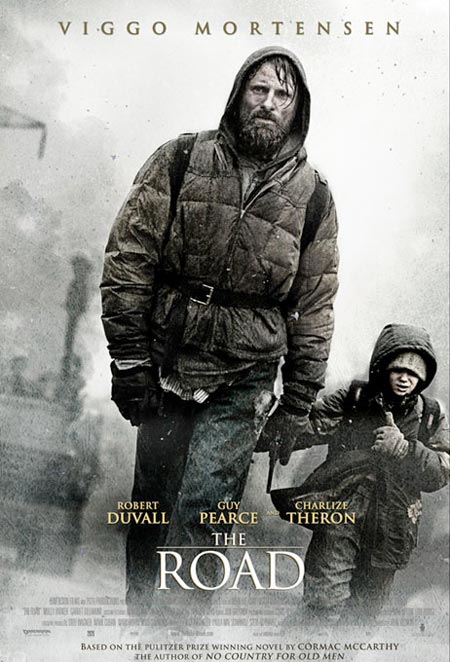
The Road–a movie that shows that they can still make decent films

Last night, I finally got around to seeing The Road. For those of you who don’t know, the movie is about a dystopian future that stars Viggo Mortensen (best known for The Lord of the Rings) as a man who has survived some type of holocaust with his son. Together, they are trying to reach the coast where the father believes better chances of survival exist. The world as they know it is bitter, cold, dark and unforgiving. People are predators to the point where you really can’t trust anyone, even if they appear to be trustworthy. The story becomes one of survival and family, in a way that the much earlier, yet similarly like premise 1975’s A Boy and His Dog, staring Don Johnson, attempted to portray. Whereas the earlier movie became campy, The Road never falls into that childish type of narrative, maintaining throughout the Cormac Mcarthy vision of the future being a surviving daffodil in a desert of horrific surroundings.

It was one of those movies where I kept waiting for “Hollywood” moments, but they never appeared, and I was so glad to see that. The hero’s wife/girlfriend (never made clear) was played by Charlize Theron in a very demure role that shows both how important and insignificant it was all in one cloak. She only appears in flashback scenes, but it was so obvious that her character is with the hero throughout the entire movie, and her lack of appearance throughout any of the present moments makes her character all that more powerful. There is a scene involving the finding of a piano in an abandoned home where her presence in a previous scene playing the piano becomes so much more poignant because of that earlier moment. I’ve rarely seen a movie that is capable of pulling off such a juxtaposition so that the viewer is so aware of the importance of the symbolism of a few played musical notes.

The scenery of the movie is practically a character all on its own. I was seriously reminded of a computer game, of all things, and I’m thinking specifically of Fallout 3, where you wander the wastelands of what’s left of an alternative reality’s dystopian Washington, D.C. It’s hard to describe to someone who hasn’t played that game, but there are moments in the game when the day starts to turn to evening, and the world starts to turn very grey. That is the sense one has of this movie, in that every scene was of that eternal evening from the game, where things can pop out at you at any moment, yet remains centered in reality, where the fear is all that does show up, and mostly the wilderness is empty and uninviting.

There are a couple of cameo actors who show up in the movie that really feed into the narrative. One of whom is Robert Duvall, who plays a very old man (claims he’s 90, even though the main hero doesn’t buy it). It’s a very small part, but with so few actors appearing in the movie, it becomes that much more powerful. Another cameo that shows up is a gang member played by Garret Dillahunt, who is known in sci-fi circles from the various roles that he plays, most significant being The 4400 and Terminator: The Sarah Connor Chronicles. He has a very small part in the movie, but it was probably the one moment where I couldn’t help but notice who the actor was, something that doesn’t happen with any other character. I guess he’s a little too typecast from his previous roles because I had a hard time separating him from the other characters I’ve come to know. But such recognition did not take away from the fact that Dillahunt is a very good, seasoned actor, and the part that he plays is very important for that moment of the film, and I honestly don’t think too many other actors could have pulled off that one, crucial scene.

What was most important about this movie is that it is probably one of the few movies ever made that has been capable of portraying the emotional feeling of despair, because that is the one thread moving throughout this entire movie. The future the movie inhabits is a horrible one, but the main character never gives up, convinced that he will bring his son to a better world, even if he has to travel the length of the world to find it. There is a huge scene between the hero and his son where the whole “don’t you know what I’ve done for you” gets rightfully translated into “we’re both in this, not just you” from a crucial dialogue delivered by the son, Kodi Smit-McPhee. Up until this moment, I just saw him as “the kid”, and it was this moment where you realized that the stellar acting was not just limited to the adults.

Sadly, they don’t make movies like this any more, or at least they don’t make enough of them. The last few years have been dismal in movie-making, with some of the crappiest movies ever released being thrust upon the viewing public with outrageous ticket fees. This movie goes up against the blockbusters of this era and promises great things, while the reality of our own dystopian present reveals something much worse because the movie did not do very well. It was almost a footnote in the releases of movies, with people avoiding it like a bad Megan Fox movie (okay, any movie with Megan Fox would probably qualify as a “bad” Megan Fox movie). One can hope that more movies like this one get made, but unfortunately, I don’t think it made enough money to cause Hollywood to think twice about the tripe that it tends to release as major releases.

I highly recommend it as it’s one of those movies you probably won’t get to see very often.

Why E-Readers Just Won’t Take Hold in America

There’s been a lot of hype over the last couple of  months because of the emergence of the IPAD, which has been predicted to usher in a new age of reading. This has caused all of the other e-reader makers to ramp up their business models, each one of them vying for the ultimate control of this incoming market. But I have bad news for all of them. That market’s not coming. Sorry, but it’s not.

You see, there’s a funny thing happening on the way to the the emerging market. There’s been an interesting fantasy that’s been playing out in the American public that is somewhat identical to the reason why so many Americans are fat. Every now and then, we look in the mirror and realize we’re fat, so we tell ourselves (and everyone around us) we’re going to go on a diet. And for a few days, we feel good about ourselves. And then we order that hot fudge sundae for dessert, and well, the diet kind of goes away. Oh, we rationalize it with promises of future exercise, but we know deep down that we’re going to go back to our old ways. And we do. Then we continue to get fat, and then we suddenly wake up, look in the mirror and then announce we’re going on a diet. Rinse. Repeat.

That’s what’s happening with E-readers. For the longest time, the majority of Americans stopped reading. We started watching TV, playing video games and doing anything but anything intellectual. Our reading output in this country is abysmal, and we know it. But every now and then, we promise to start reading again, and we go to the bookstore and buy lots of interesting books that we put on a shelf and never read. Oh, we might start reading, but then something else comes along and we stop. Rinse. Repeat.

So, when the E-reader came along, we all jumped up with joy and said we’d start reading books now because they’d be easier to read. So people went out and bought IPADs. I’m guessing that after the new car smell disappeared from the devices, they stopped being the most important carry item for those planning to read. Or they started using them for other reasons.

In a few months, publishers are going to start wondering what happened to that emerging market of electronic books. Sure, some will sell, but nowhere near the amount that was promised when this new technology was going to usher in a new era of reading.

You see, on the surface and deep down, we’re kind of lazy. Some of us read a lot. Most of us don’t. But we won’t tell you that because everyone wants everyone else to think we’re all little Einsteins walking around with encyclopedias for brains.

Maybe I’m wrong, but I suspect I’m not. But one can hope for better results than the usual expectations. As a writer, it bothers me that more of my country folk don’t read. But what can I do? Our medium of communication is movies and television. And even in those areas we aren’t all that impressive as we tend to focus more on reality programming and sports programming than anything else.

But that’s why E-readers probably won’t take hold in America. We’re too busy pretending to diet while watching people getting voted off the island.

Some updates, cause you know you can’t live without them….

1. Blizzard changed its mind. I wrote recently about game companies jumping the shark, and how Blizzard Entertainment was making a seriously, horrible mistake by intituting REAL ID on its customers. The customers went nuts and protested until they practically couldn’t do it any more. The CEO of Blizzard wrote a Blog Post in which he stated, “um, sorry, we hear ya and we’re not going to do what we said we were going to do.” Wise move, and you have to admire the maturity of a company for knowing when it needs to take a step back and reconsider an action. The whole thing was obviously about trying to capitalize on their customers and make insane profits above their already normal INSANE profits, but fortunately they didn’t derail their whole company to try to increase their profit.

2. Stupid politicians. I hate political season, which seems to be almost year round these days. This morning, I was on the shuttle bus when I heard a campaign ad that essentially went something like: “Michigan is suffering badly. It’s performing the worst in the entire country. So send Justin Amash to Washington to fix things!” Or something as stupid as that. Basically, I’m thinking, um, Michigan has problems, so sending a State Representative to Washington is NOT a solution. It means sending someone from a messed up state to Washington to make a messed up country. Sometimes, I think these people just don’t think these things through. It’s not Washington they’re complaining about in that ad. It’s Michigan, so unless their plan is to send Amash OUT OF MICHIGAN TO FIX MICHIGAN because he’s responsible for screwing things up, I don’t really see the point.

3. Stupid corporate contest campaigns. Pepsi is running one right now that involves Major League Baseball. The point is: You collect bottle caps until you have three of them that match, and then you send them in for a free baseball cap. Really? That’s it? I’ve had about 40 diet Pepsis that are part of this campaign, and today was the first time I actually got one that was a duplicate of another (meaning I got two of the three I need). Now, mathematically, I didn’t even think that made sense, but I don’t even have three of the same, and I’ve already gone through 40 sodas. Stupid contest, and the pay off is equally stupid. For the 50 or 60 sodas I’ll need to drink, at least give me the chance to win something cool. Oh, and every now and then I get a cap that offers me 15% off of MLB crap. Really? And read the fine print. It is valid ONLY if you buy $75 worth of stuff. I don’t think there’s $75 worth of MLB junk I would ever want in the first place, regardless of the discount.

4. Movies. They’ve sucked lately. This whole summer should have been discontinued. Not a single movie really worth the money. And the prices of movie are astronomical. No good news on that front at all.

That’s really all for now.

The Hurt Locker…an interesting peek into the abyss and shopping for cereal

I finally got a chance to watch Kathryn Bigelow’s The Hurt Locker over the weekend. It was interesting to see a movie that covers the military in a way that doesn’t seem like it’s a miltary advertisement (I’m looking at you Transformers 2) or a condemnation (I’m looking at pretty much every Iraqi movie that’s been made so far).

The story is pretty simple. It’s about an EOD specialist whose main job is to defuse bombs. His team works as back-up to him, and the movie follows the events he and his team experience during a rotation in Iraq.

What really stuck out to me was the “team” emphasis the movie explores. This is one of those nuances that happen within the Army involving specialized groups, specifically those with a set mission that rarely can be handled by a regular unit. The main character is a former Ranger, and his team consists of a former mission intelligence sergeant and a specialist-ranked noobie who is pretty much learning his place in the greater scheme of things. I think it covered the specialized nature of the team very well, and it was interesting to see it carried out on film where there was little attempt to glorify it or diminish it with some stupidity (like Platoon, which while it was a decent film ended up focusing on dysfunction rather than function).

One thing that really hit me hard with this movie is a very soft scene after a return to the U.S. when the character is asked by his wife Kate (or whatever her name was…she was played by Evangeline Lilly, the woman who plays Kate in LOST, and she was honestly the only actor in the entire movie I recognized) to find a box of cereal in a supermarket where they’re shopping. This man who is so perfect in a world where it may end at a moment’s notice with people all around him who might be trying to kill him, stands in front of the entire aisle of boxes of cereal and can’t move because he’s overwhelmed by the choices in front of him. This is the sort of person who spends his every moment deciding between green and blue wires (the Hollywood equivalent of a bomb defusion choice, which THANK YOU was not an issue ONCE in this very well done movie), and he was unable to choose a simple box of cereal. That one moment brought the reality of this fictionalized world home for me, and I’ve never seen it done so well.

In the end, I think the movie is deserving of the awards is received. Granted, I think a lot of it had to do with the fact that it was up against a lot of dismal films that year, which is becoming more of a norm than an exception. Even though that was the year of Avatar, a very visual film, at least the Academy recognized that that was ALL it had going for it.

The acting was done well, and the writing was what should be expected from a Hollywood film of this magnitude. Strangely enough, I had trouble finding any acknowledgement of the writing from the closing credits, although it might have flown by me and I didn’t realize it. I was looking for it, however, and was somewhat annoyed that everyone else and his brother was acknowledged, but the writing didn’t seem to be all that important to the makers of the credits.

I Want a Hollywood Romance…or an East Berlin one at least

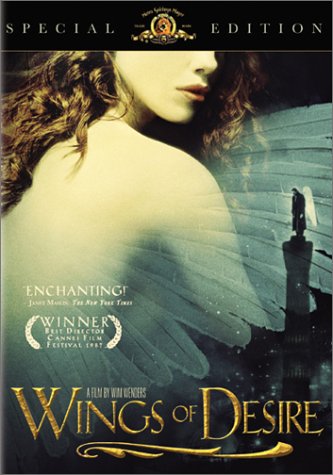
Every now and then I put a movie into my Netflix queue that leaves me wondering months later, what was I thinking? That happened last night when I finally got around to watching a movie that was in my queue called Wings of Desire. To be honest, I don’t know how that movie got into my queue because it certainly doesn’t match any criteria I attribute to movies I tend to add. Going down my checklist, there were no hot Asian women in leather jumpsuits who do Kung Fu, Arnold wasn’t seen once carrying a huge bazooka and chomping on a cigar, not a single Starfleet communicator chirped once during the movie, and even more important, not a single French clown cried at all during the two hours and seven minutes this movie aired (although it was one of those movies where it could have happened at any moment).

The movie was a several hour poetic metaphor on the meaninglessness of life. The two main characters were male angels who seemed to spend the entire movie walking around 1987 East Berlin listening to the mindless rantings of humans who lived in a state of black and white despair. During their wanderings, they seemed to latch onto a huge library that resembled the one from The Breakfast Club, where they went person to person and listened to their inner thoughts. One of their focuses was an old man who supposedly was writing the great American novel in East Berlin, so I guess it was the great German novel. The old man kept talking about how he was the only one who could write down the story, and that without him all of humanity was doomed. And I thought I took myself seriously as a writer!

There are two other main characters that the angels attach themselves to. One of them is a beautiful woman who happens to be a trapeze artist for a circus that is going out of business. This is where I kept waiting for the inevitable crying French clown, but he never showed up. The other character was Peter Falk (of Columbo fame) who was playing none other than Peter Falk who happened to be in East Berlin filming a movie that seemed to be about a couple of guys who have a fist fight in a beat up building that has no roof. I was reminded of the great operatic, Tempest like story that was mentioned by Danny Devito in Throw Mama From the Train, which he describes as “a man with a hat kills another man with a hat.” But I digress. Without getting too far into a plot I still don’t understand (my understanding is that you need a Ph.d in this particular movie to actually understand more than 5 percent of it), let’s just say that Peter Falk plays himself and just so happens to be a fallen angel himself who guides one of the angels after he decides to become human.

And the reason the angel decides to become human is because he falls in love with the trapeze artist. And that’s what I wanted to talk about with this post. You see, when he finally becomes human and can experience love, he goes into this punk rock music hall she goes to every night and sits at the bar while the “concert” is going on. I won’t describe the music, other than it was the most bizarre music rendition of punk I’ve ever seen, and all I can say is that I believe the director had to be a fan, or the lead singer was his son, or something like that, because I spent more time trying to figure out how the lead guitarist was actually producing the sounds that were coming from his musical device. Anyway, the beautiful trapeze artist leaves the music area and goes into the bar where the angel is sitting, plops down on the seat next to him, and then begins to explain for the next twenty minutes why she is empty inside and needs to find the solution to pi or something like that. To be honest, I had trouble following what she was saying because it had to be the longest data dump I’ve ever experienced from one individual. The angel said nothing, and when it was done, he kissed her, and somehow they managed to live their entire lives metaphorically forever together.

And this got me thinking, how come East Berlin women don’t sit down next to me in bars, pour their heart out to me for about twenty minutes without me having to say anything, and then we live happily ever after? Is it because I don’t know Peter Falk? Do you have to be an angel to make this happen? Or am I missing something here. How come when a woman like that sits down next to me, and I say, “hi, I’m Duane” it’s usually followed up with: “Oh, I have a boyfriend.”?

Movies like this keep making me think that somehow I just haven’t got it all figured out, and that bothers me. Is something this epic only possible if you happen to live in some Communist country that is about to transition to democracy and future unification? Where are all the unemployed trapeze artists that I seem to be seeking?

Anyway, interesting movie. I’d recommend it if there had been a crying French clown involved. Not surprisingly, there are too few movies being made these days with crying French clowns. And that’s just sad.

The Demise of the Dedicated Movie Critic

There’s an interesting article at CNN’s site, titled, “Is social media killing film criticism?” And it’s an interesting question. I mean, one might wonder if social media is killing film criticism when everyone has an opinion, and people constantly have something to say. I’m no different than anyone else here as I’ve reviewed a couple of movies here recently as well.

But I think there’s more to the situation than just social media as being a knife wedged into the back of film criticism. To begin with, I think film criticism as a whole has suffered a lot lately with the demise of the two media darlings of film criticism themselves: Siskel and Ebert. When Gene Siskel died, that left Roger Ebert as the only one left, and for the longest time there was an attempt to recapture what Siskel and Ebert had on evening television every week. Those two arguing back and forth over whether or not a cartoon mouse was socially relevant in a film, or whether or not Jeff Spicoli really managed to overcome the evils of Mr. Hand to the point of achieving social relevance  (Fast Times at Ridgemont High). Almost every week after Siskel died there was a new replacement to argue with Ebert, and it just never worked. Come to think of it, there was really  never another reviewer or set of reviewers that managed to become as socially relevant as those two, including Ebert alone.

Now, Ebert is suffering from the inability of being able to speak, and his articles are all we have, and it’s just not the same. Movie reviews are becoming 20th century artifacts, and it’s very hard to get anyone to even care what one has to say when it comes to a review.

Nowadays, it’s pretty hard to even go to see a movie because you really can’t trust anyone’s opinion. Reviewers are sporadically relevant, but mostly interchangeable and incapable of achieving a sense of usefulness. I recently went to see Kick Ass, realizing that the reviews were pretty much all over the place, so I had to make a judgment of my own. And with movies being so expensive these days, and so many remakes of remakes, it’s really hard to even trust a trailer because those thirty second soundbytes can sometimes be the best 30 seconds of the entire film.

A new movie is coming out tomorrow that is getting all of the hype, and that’s Iron Man 2, and already the reviewers are all over the place with this one. I’ve heard some saying it’s great, others saying its rehashed old stuff with lots of special effects, and others saying that it’s just not worth our time. The old days of relying on the two thumbs up or down are gone, so we pretty much have to fend for ourselves.

And that’s pretty scary.

Thoughts on Movie “2012” and the Concept of Bad Writing

I finally got a chance to watch the movie 2012 over the weekend, and it served to remind me that no matter how much money you put into a production, how great the actors are, and how big the premise, bad writing will continuously destroy a movie no matter how much other effort is put into the film. 2012 is one of those movies that had a lot of things going for it. It had a huge budget, the special effects were over the top phenomenal, the actors were all actually high quality actors, including John Cusak and George Segal as well as many other well performing actors. The premise for the movie was pretty big, surpassing pretty much most others with an end of the world theme (which was a lot more impacting than a bunch of transforming cars that fight each other as Megan Fox somehow manages to pretend to act while finding herself in all manners of undress).

But the writing destroyed the movie. Horribly.

It started with one of the cardinal sins of writing, and that’s using coincidence sparingly. (spoiler alert!) Let me start with the basic events of the movie: John Cusak is a writer who published one book that didn’t sell very well, so he’s now working part time as a limo driver for a rich Russian mafioso, ex-boxer. The story starts with him taking his son and daughter on a camping trip to a lake where he and his former wife used to go all of the time on romantic getaways. His ex-wife, by the way, happens to be married to a plastic surgeon who just so happens to be the doctor who did the boob job on the girlfriend of the ex-boxer mafioso Russian. Well, on this trip to the lake, Cusak and kids run into a military operation that is exploring Yosemite, where the ground is becoming unstable. So they meet crazy wacko Woody Harrelson (possibly playing himself), a conspiracy radio host nut who knows the world is coming to an end. When the military detain Cusak, the guy in charge is part of the team that discovered the world is coming to an end, and he just so happens to have a copy of Cusak’s book, being one of the 400 people in the world who has ever seen it, and he recognizes Cusak’s name because he just so happens to be reading it RIGHT NOW.

Well, Cusak, because he believes the crazy nutjob of a radio announcer is telling the truth, manages to get his family out of their house JUST AS ARMAGEDDON HITS and drives them in his limo through California on its worst day EVER, as the Earth explodes all around them. But he has managed to find the one airplane in California that will take them out of danger, so they get to the minor airport, which is where Cusak drove the Russian mafioso guy and his family. But Cusak heard about a map that crazy Woody had, so he manages to get it, and it is a map of China, so they decide they need to fly to China (even though their little plane can’t make that trip). Oh, by the way, the pilot he hired died, so it turns out that the plastic surgeon husband of his ex-wife JUST SO HAPPENS to have had a few lessons in flying, so he flies them out of the worst nightmare of an escape that has ever existed (that is almost as bad as the escape I had when I was running away from an ex-girlfriend who refused to break up with me without at least one of us dead first). Anyway, he gets to Las Vegas where there’s a plane that the Mafioso guy has managed to get a hold of, and because their pilot died, or left, or I don’t really remember what happened to him, it turns out that the “I had a few lessons” guy is now going to fly their plane to China. So they get in that plane and fly it to Hawaii, which is where they need to refuel, but there’s no fuel cause Hawaii is now an inferno, so somehow they manage to continue flying to somewhere in China. Yeah, not really sure how they made it, but somehow they did.

Anyway, I did forget to mention that the guy who ran into Cusak in Yosemite is a scientist and part of a secret plot to build huge space arks that you only discover later aren’t really going into space, but they’re really big water vessels made out of metal. So, if the planet is doomed, that’s not a problem cause they’re still going to be saved somehow because they’re in really big boats now. Meanwhile, the scientist guy’s father is some kind of bad musician on a cruise line with George Segal, who is also a bad musician, too, and they’re on the biggest boat ever, which tips over and kills everyone but not before both dads get to phone their kids and say bye. It’s a good thing to know that during Armageddon, at least AT&T will work as desired, even though AT&T has a bad tendency of dropping most of my phone calls normally (and that’s without Armageddon happening).

So, it turns out the Russian guy booked passage on the space ark fleet for 1 billion and some Euros, and when he gets there, it turns out his space ark has been damaged, so he’s now not going to get to go. So all of the passengers who came with him riot and throw a fit. Meanwhile, an evil government official, who is really not evil but more of a bureaucrat, is trying to keep everyone out of the arks because only the scientifically chosen can be saved (and the ones who had a lot of money, which seems to be the only people who showed up anyway). So Cusak and gang somehow manage to convince a Chinese family that has lived in a Tibetan village their whole life, but all somehow manage to speak English, that they should help them sneak onto the arks. And then fun ensues with lots of rubber tubing getting stuck in the door gears of the most important ark, which cannot be started because for some reason they built a superpowerful space ark (that doesn’t go into space) that for some reason can’t start its engines if the doors are not completely sealed. So, they go on an adventure to “seal the door” and people die, and others live, and sparky the wonder dog somehow gets saved, even though his boob-enhanced mistress does not survive. But the obnoxious Russian twin kids do get saved and somehow become nicer kids in the process, letting Cusak’s daughter play with the dog at one point, whereas they were originally overjoyed that Cusak’s daughter was going to die while they got saved.

Anyway, it’s a complicated story that is somewhat ridiculous, as if the writers weren’t sure if this was an end of the world story, or Earthquake II, in which everyone will live happily ever after. The ending was almost the same ending of Wall-E, and that was kind of disconcerting. There were so many loopholes and plot points that didn’t make any sense throughout this entire movie that I was often flabbergasted that I was watching what I was watching. I kept trying to turn off my critical mind during the watching, but every now and then it would pop back on and say, “um, isn’t 2012 supposed to be about the end of the world, not the moving of the planet’s plates?” In other words, the Mayan prophecies are all about how the calendar ends, meaning the universe as we know it ends, which according to the premise, means that all humanity dies. For me, that meant that we needed actual space arks, not just Noah’s 21st century arks. I kept wondering when these arks were going to fire actual rockets, and then it turns out that they’re nothing more than very big boats. Really? That was the solution to the end of the world?

Anyway, that was the movie, and I was very disappointed. A couple of moments were worth the watching, like trying to see two really old men pretend they’re actual musicians when neither one of them can hum a tune. But other than that, I was disappointed. I had gone into the movie wondering how an end of the world story can possibly have a happy ending, but like most Hollywood productions, they were too frightened to deal with the resolution of the story as the Mayans would have because that would have meant that the struggle in the movie was hopeless and futile. That doesn’t sell a lot of tickets.

One moral I did get from the movie, even though they were trying hard as hell to go the opposite direction of this, is that no matter what you do, no matter how good you are, in the end, those with the most money and power are rewarded with survival; those without are doomed to be swallowed up by the apocalypse and left to die…cold and alone.