Tag Archives: Amazon

Amazon, Please Stop Trying to Sell Me a Cover for My Kindle

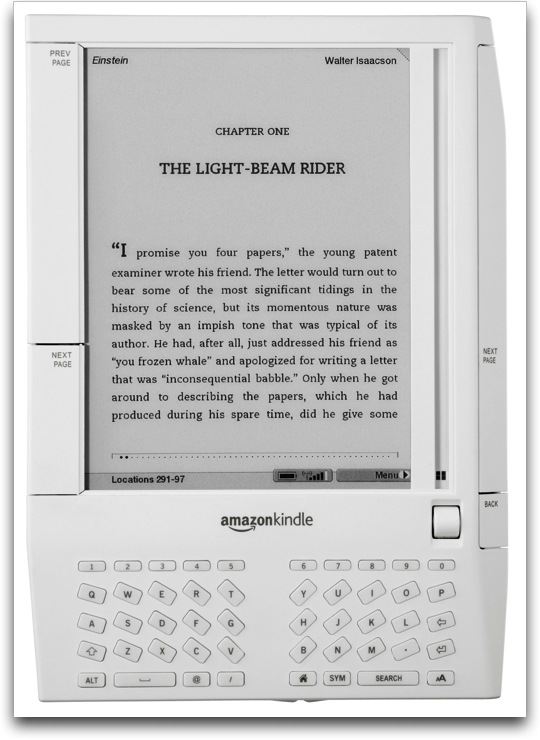
A few weeks ago, I bought an Amazon Kindle. It wasn’t the cheapest one but the one with both wi-fi and 3G. I realized I needed one at home, and I don’t have wi-fi there, nor do I want to get wi-fi just so I can use my Kindle. Anyway, I’ve been really happy with it. I’ve downloaded a few books, and now I get the Washington Post delivered to my Kindle each and every day so I don’t have to buy a hard copy of USA Today (which I’ve described as trying to eat candy for breakfast…no substance, lots of news). So I’ve been happy.

Well, when I bought the Kindle, I realized I needed a cover for it, so I bought a really nice M-Edge cover. I’m happy with it, too.

Well, every time I try to sign onto Amazon, Amazon tries to sell me a Kindle cover. I’m good. I’ve got one. Thanks. But it has a huge presentation at the center of my Amazon screen. Rather than try to sell me books (which would be useful on this book reader I just bought), Amazon is convinced it needs to sell me a cover.

I don’t need a cover. I bought a cover. I’m good. Let’s move onto books.

OUTFIT YOUR KINDLE, the ad tells me in very large letters with a spread of new covers that I don’t need.

I looked for some kind of procedure to disable these ads, just in hope that I might be able to start seeing ads for books I might want to buy. But no, there was nothing I could find.

So, now that I’ve decided not to buy a Kindle cover based on these ads, Amazon has now started emailing me about my “need” for a Kindle cover. I received two separate emails in the last week, all designed to “assist” me in finding a new cover/holder that I already have.

Look, Amazon, I understand how you want to monopolize and make as much money as you can, but let’s be frank here. I don’t need two covers for my Kindle. I am happy with the one I bought. Stop trying to sell me crap I don’t need, because I already bought it when I bought the damn Kindle in the first place.

I’m Suspecting Amazon Doesn’t Actually Understand Writing

For a bit of time now, Amazon has been trying to herald the move towards electronic books, essentially ushering in a new medium for which books will eventually become the primary method of production. The Kindle, which is not a new story, was supposed to be their attempt to usher in this new era, and so far, it is doing a pretty damn good job of leading the industry. Sure, the iPad is an attempt to steal back some of that thunder, but it doesn’t take a rocket scientist to figure out that right now Amazon is in the driving seat with the capability of calling a lot of future shots.

Which is why I found it shocking that Amazon released the following statement:

Generally speaking, writers have two options when they sit down to create a new piece that can be distributed through conventional channels. They can author a short, attention-grabbing magazine-length feature that doesn’t require the reader to invest more than a few minutes of their time, or they can craft a long, 50,000-plus word novel that is meant to be absorbed over multiple sittings.

Now, if you’ve never been a professional writer before, this may sound quite innocent, and maybe even informative, but if you have any knowledge of the publishing business, and I mean ANY, you know that there are far more than two options an author has when sitting down to write a new piece. Basically, Amazon is stating a writer can choose from a short story or a novel, and now they have somehow managed to invent something in between that.

Writers have been writing all sorts of variations of those two models for centuries. Publishers have been publishing variations of far beyond those two models for centuries as well. Just recently, the whole unmentionable (by me, mainly) epic of Twilight released a novella, which just so happens to be a book that is too small to be a 50,000 normal novel and too big to be a short story. Sounds vaguely familiar, doesn’t it? Yes, writers have been tackling this genre long before Amazon came onto the scene.

To me, it appears that Amazon is attempting to somehow create a new category to invent a brand new revenue stream, even though that category has existed long before Amazon became a web site, back in the days when an Amazon was often referred to women I dated who used to beat me up when I didn’t comform to their expectations (but that’s a completely different article, of course). We don’t need this new category, especially when Amazon already charges different prices for different books based on the expectations and demands of the specific publishers.

To indicate they are somehow inventing a brand new length of writing after 4000 years since the first human scribbled some carvings on a cave is somewhat insulting to the rest of us. It’s not like they need special programming to release an e-book that has fewer pages than a “normal” e-book. The whole announcement sounds like a non-announcement to me, but more of an attempt to remain in the news now that everyone and his brother is releasing an e-reader and selling it at Best Buy.

(sources: TMC Net, Amazon’s web site)

Why $139 for Kindle Isn’t the Sweet Spot Amazon Would Like You to Believe It Is

The other day, Amazon announced it was releasing a new Kindle, and the price was lowered to $139. Now, this isn’t a big deal, and that’s great, if you want one of those things, but what’s amazing is that the boss of Amazon claims that the price is so low that people are going to rush out and buy several of them for the household. Yeah, right. Not going to happen. I love how the multi-millionaire boss of a major company thinks that $139 is the sweet spot for a tech gadget, so he makes a pronouncement that the end of the road is finally here. And then the tech nuts start talking about how $100 is the sweet spot for most electronic gadgets, the sweet spot being the price people will arbitrarily just throw money away without thinking about it.

Sorry, the Kindle isn’t there yet. You see, there are some problems that no one has addressed, and that’s the fact that people actually think about these things before they shell out a lot of money for products. Oh, you say that Amazon just announced they sold out of their Kindles until Sept. 4? So what? To me, that sounds like their marketing department made an announcement to create a “need” for this device when there really isn’t one yet. I don’t personally believe a lot of the hype that these companies put out, because what they’re trying to do is manipulate us into buying their products by pretending that if we don’t do soon, it will be too late.

I went to Amazon’s page today. They’re still hyping the new Kindle as if they have a gazillion of them. They’re not going to NOT take my order if I want one. The hype is just that: hype.

What no one really wants to talk about is the actual cost of this device. Unlike a cell phone, this is not a final purchase product, meaning that once you buy it, you still have to spend a lot of money on other things, like books. If you buy a Kindle, you still need to buy electronic books from Amazon. For Amazon, it’s the product that keeps on charging. Because of that, $139 is still too much money. To be honest, $99 is going to still be too much money.

A couple of experts have pointed out that the sweet spot for an e-reader is still $49. Until they start coming down to that level, the demand is never going to happen. Because there is no demand for an e-reader. People in America generally don’t read. So pretending there is a demand for a reading product is a joke. When people buy books in America, they still buy actual paper type books, and that’s not going to change any time soon. People are so aware of the fact that few electronic products are good forever, but books are. If you bought a computer ten years ago, you wouldn’t have much success getting it to run today. So, who knows what is going to happen with e-reader technology in the future? It’s like taking a bet on the Blu Ray vs. whatever that other standard was that was supposed to compete with Blu Ray disks. It’s like taking a bet on the betamax. Remember that? Didn’t last long.

That’s why e-readers still have a long way to go, because there’s been no standardization developed, and we’re still some ways off from that happening. No one wants to buy a useless piece of garbage that has a shelf life of a few years.

Until then, only the select few are really going to jump on the e-reader bandwagon, kind of like the select few who buy Ipads, convinced it will be the coming of the electronic messiah. I almost bought one, but I’m so glad I didn’t because it would be in the back of the closet right now with my Coleco and Atari machines.

Why the Kindle never took over the world

I was in Best Buy this evening, and I was looking an iPad. I wasn’t planning to buy one, but they had three models of it on display, so I decided to take a few minutes to see if it was really an impressive product. None of the main features of it caused me to be all that impressed. And then I started looking at the iBook reading section of it (they happened to have Stephen King’s Under the Dome installed on it, which is ironic because I was planning on buying that on an electronic reader the second I got one (as I really don’t like lugging that HUGE book around, even though I currently own it). Wasn’t all that impressed. I didn’t see anything about it that the Kindle didn’t already do.

Which got me thinking. I don’t own a Kindle right now, but I do have a Kindle reader app on my iPhone. So, I can actually read Kindle books on my iPhone.

Which then got me thinking even further. I started to wonder why Amazon’s Kindle hasn’t made the impact that it probably should.

Let me explain. The Kindle is an excellent device for what it does. From the reviews I’ve read about it (including the testimonies), it is a great reader. Unlike the iPad, it doesn’t suffer from the sun glare if you’re using it outside, and it’s very much like an actual book in that you can read it for hours and not get uncomfortable like you will if you’re reading a computer screen (something practically every other e-reader suffers from). With that in mind, you’d think that the Kindle would be selling like hot cakes. So, why isn’t it?

Well, the answer to that question is found in Amazon’s strategy itself. And it’s one of the most bizarre strategies I’ve ever seen for a company that is trying so hard to set the standard for e-readers.

You see, Amazon wants to corner the market on e-readers and e-books, much like Apple has tried to corner the market on music with its iTunes platform. And Apple would have succeeded if it had done it earlier, but Apple put out iTunes AFTER there was already an MP3 market for music established. People were already burning CDs to MP3s and putting that music on MP3 players. Apple came along and then tried to corner the market on something that was already out of control. And surprisingly, they actually got their foot in the door, but it’s a door that’s been wide open for a very long time.

But books are a different story. There has literally been no e-book market because each company that puts out a reader is a company that has no ability to corner the market because controlling the reader doesn’t also mean controlling the content. And that’s where they all fail. But Amazon had a chance to do it because it is probably the one company out there that has a huge market that serves the reading community. If they would have put out an e-reader and made it easily available, they could have owned the whole e-reader market. And they almost did when they released the Kindle, but they then did one of the stupidest things they could have ever done. They made it so you had to buy the Kindle directly from them on their site.

And that practically killed their chances for world domination. I think of myself as a good example to explain why this was such a failure. I buy books from Amazon all of the time, but I refuse to buy a Kindle, mainly because I’ve never seen one in person. I’ve never held one in my hands. In other words, Amazon wants me to buy their equipment unseen and untested, specifically on trust alone. And I don’t trust them because they want me to spend $259 or $450-something for an e-reader that I’ve never seen in person before. And they’re asking a lot of people to trust them and buy their product without ever having a chance to test it. Unfortunately, that’s a business plan doomed to failure. Sure, they’ll sell a few, but they’re not going to sell the number they need to in order to gain the market share they want and need.

So, Amazon is mainly going to have to focus on trying to get people to buy the books they sell online through their site as Kindle books, but they then made it possible for anyone to have their own Kindle-like product, so they made it even less possible that people are going to buy a physical copy of a Kindle. Which then means someone who has a Kindle reader, but not a Kindle, probably has a device that can then probably handle other programs (or apps) as well, which means any company that puts out a book in a cheap format can easily gain their business.

Apple has now jumped into this market and is trying to create its own iBookstore which it hopes to control like the iTunes marketplace. Not going to happen because there are already so many other more trusted places to get book content that Apple is never going to be the “go to” place for that. It’s just going to further saturate the market with more places to find e-reader books, and thus, it will make it that much harder for e-books to take off because there will not be any one format. People will become so frustrated with trying to tap into this market that they’ll just consider it one of those unrealized areas of content and continue to buy books in hard copy.

But Amazon could have won the war right from the start if they would have done one thing, and that’s license other companies to sell their Kindles. Imagine the business they would have gained if they would have had Best Buy selling Kindles. If they would have dropped the price to about $199 and then put them in every Best Buy, they would practically own the e-reader business across the country, and who knows….the world. But they didn’t do that. There were no apps being made for the Kindle, so the only way to read books on it would have been to buy them from Amazon. It was a win-win situation, but they didn’t think it all of the way through.

Instead, we have more and more readers coming out and no way to figure out how to get the books onto those readers, so those readers are going to fail overall, and manufacturers will figure that it was the customers not wanting to buy books for devices, when in fact it was a failure of the devices to capture an audience that was willing to then buy content.

That’s why the Kindle never took over the world, even though it probably could have.