Recently, I started playing Lord of the Rings Online (LOTRO) after a very long hiatus. A friend on a message board recommended getting back into the game (when I was looking for something new to play), and that’s exactly what I did. Thus, it has given me something to write about.
I should point out that I first started playing LOTRO nearly five years ago when it was in early release. I remember enjoying the game back then but around 25th level, my hunter became too difficult to play, so I quit. There were always so many other choices.
Now, the game is free to play with Turbine making its money from microtransactions and players who choose to pay regularly as VIP members. When I came back to LOTRO, I chose the VIP route, and here I am there today.
A couple of thoughts right after the start: The game is still very immersive, and you definitely feel like a part of Middle Earth. The Hobbit lands are very immersive as you feel as if you’re in one of the movies themselves. The game is also very early Everquest-like, meaning that unlike World of Warcraft, the game rarely holds your hand as you try to figure things out. And there’s a lot to the game, so you have to pay attention or you just might miss something important.
As for the story, that’s where I have mixed feelings. It’s definitely Lord of the Rings, which means it is quite epic. But at the same time, you know Frodo and the gang are the ones saving the day, so where does Argolwar (my elf hunter) fit in if the true quest involves only those people? Every now and then, a hero from the story will come along to recruit me for a mission, like Strider does in the beginning to help him fight bandits. But all I kept thinking was: “Strider, or may I call you Aragorn, good sir? Um, you have much more important things to do than recruit this lowly hunter to beat up bandits. Go stop Sauron. I’ll be fine here shooting arrows at nondescript bad guys who have absolutely no significance to the greater scheme of things.”
And then the game allows me to learn trade skills like farming and cooking. So, as I’m farming for either Shire taters or Shire apples, I’m thinking, “man, there must be more to life than just this.”
Which brings me back to my recognition that I’m in a game that les me be an unimportant cog in the wheel of a, well, a wheel of time of Tolkien perspective in a world where I should be contributing so much more than I’ll ever be capable.
But the game does have a certain amount of a catharsis purpose, as the characters in it appreciate you, even if you realize how insignificant you are. In the Shire, I joined the Bounders, which is the civilian problem solvers for Hobbits. The npcs recognize this and thank me every time I walk by them. If only I had that happen to me just once at work or in my regular life.
The one thing I really like about the game is how much there is that I still don’t know. With World of Warcraft, the game spoon feeds you through each and every stimulation. This game doesn’t do that. I’m always convinced that right around the corner is another needy soul who is going to ask for my help. And as the Hobbits discovered, all they have to do is ask, and I’m there with my bow, my sword, or my axe.
One of the new trends in online computer gaming is the free to play model, which shouldn’t be confused with the Buy to Play model. Let me explain the differences in where computer gaming is today.
Buy to Play: The Buy to Play model is where you buy the game, and then you get to play it forever for free. Usually, the game is expensive, like $59.99 for both Diablo III and the same price for Defiance. The upside to it is that you continue to play the MMO forever, but you had to pay the full price for the game beforehand. How the company makes money is both from the initial sale and from any purchases you make in the game after that. Also, if they create an expansion pack, they’ll charge you for that. Almost every Buy to Play MMO I’ve bought has been a waste of money. Diablo III was the first of the lot, and it sucked badly. It was fun in the very beginning, but after a short while you started to realize that the whole game was designed around Blizzard’s desire to get you to spend money in their auction house. There was little value, and the game got stale really, really fast.
Defiance was a bit more fun, in my opinion, but it was mainly an unfinished game that kept promising to be so much more. I paid extra money for the downloaded content that they were going to be providing, but they’ve been really slow at doing that, so basically I stopped playing and lost the money I spent for downloaded content that they never got around to providing. They keep promising it, but promises are nice fantasies that don’t generally pan out.
The third of the buy to play games out there was Sim City, which was the latest version of a very popular franchise. The beginning of the game was a lot of fun, almost like playing Sim City 3000 again for the first time. And then the game sort of collapsed on itself because it was designed badly so that once your city hit a certain size, it basically just imploded on itself and became a nightmare to fix (translation: not fun). They keep putting out fixes for the game, trying to win back the very pissed off customer base, but as I was very pissed off with the game, all I noticed them doing was trying to port the bugged game over to Mac while ignoring addressing any of the issues that were wrong with the game, almost as if not admitting it would make the problems go away. I have no intentions of going back to the game any time soon.
Another version of the Buy to Play model was Guild Wars 2, which was a lot of fun going from Level 1 to about 30, and then the game just became tedious (at least for me). Others are still playing it and having a great time, but it never did much for me after a certain time. The game relies on other people playing with you, and as the game becomes less and less populated, the game becomes that much more difficult.
But Guild Wars 2 falls into the main reason I decided to make this post. You see, now that the game has been bought, the developers rely on the player base to continue making purchases to keep the game afloat. I’ll talk about that in a second. This can work if you offer something of value to the customer playing the game, but what I’m seeing is that game companies are becoming very greedy, wanting to charge you for all sorts of stupid stuff, which makes paying for it that much more tedious. An example: in Neverwinter, the latest of the free to play games, if you want to buy a bag to carry things in, you can’t ever make one but have to actually buy one from the “Zen” store, which basically has translated to $10 for a bag to carry around 24 items. A bit expansive for something that should have some way in the game to create, which it basically doesn’t. You might be able to buy a bag from another player through the auction house, but essentially, that player bought the bag through the Zen store first, so Neverwinter always gets its money. All mounts cost money, as do most companions (your partner in the game) that’s decent enough to rise above Level 15 (a purpose companion can rise to Level 30).
Some of the MMOs that used to be pay to play have become free to play, or buy to play after having failed as a pay to play type of game. These are games like City of Heroes (which closed its doors a short while ago), Star Wars The Old Republic, Lord of the Rings Online, The Secret World, Rift, Star Trek Online, and several others that used to be regular pay to play games. A few have remained dirhards, refusing to change to a free model, like World of Warcraft and I think Everquest (although I haven’t checked on that game in years, so who knows what happened).
The moral of the story is that these games exist mainly because there are players like me who are willing to pay for incidentals in the game. Now, before I go any further, I just wanted to say that I’m quite willing to pay for items in a game, if that keeps it going. I paid for a lifetime membership to Star Trek Online, mainly because I felt I wanted to support what was a very entertaining project. But when I feel like I’m being targeted for crappy sales tactics, I start to get annoyed. Guild Wars 2 did that to me, and it’s why I finally left the game. I had bought a hundred or so dollars worth of items, and mainly got annoyed at how crappy the items were in lines of cost. Star Trek Online and Neverwinter, both owned by the same company, have one of the most annoying pay items in the game, which are boxes you open with keys you have to buy, and the hope is that you might one day get a great item (a cool ship in Star Trek or a Nightmare mount in Neverwinter). Having opened several dozen boxes in Star Trek Online and about 30 boxes in Neverwinter, I”ve gotten nothing but junk, which means I’ve spent $30 on each game getting absolutely nothing of value. The fact is: You can’t buy a nightmare mount on the Zen Store, so you have to play their rigged lottery in order to actually try to get something decent. It’s the sort of thing that keeps me from wanting to spend money on a game, especially when I’m exactly the kind of player they want: Someone willing to spend money in a game.
That, to me is why the free to play model is not working. As long as you give crappy value to your products that people have to pay to get, your game is going to fail. City of Heroes suffered this way. I spent money in that game, sometimes just wanting to support a game I really enjoyed. But the value for the things I paid for were atrociously one sided (leaning towards them, not me). While the failure of that game had more to do with NCSoft being a shitty company than the game failing, their market could have probably gone a great deal of distance to have done better.
Some of the pay features of these games are really bad. I’ve heard nothing but bad things about Star Wars The Old Republic, in which they didn’t add any value by the pay store, but actually took value away from processes already in the game and then charged you for them if you wanted to get them back. That’s a crappy model for a pay store in a game. I used to play the game back when it was pay to play, and the game’s failure, to me, was that it had nothing to do at the higher levels. My understanding from others is that they haven’t done a great job of fixing that, figuring they’ll get a whole bunch of new players to run through the levels before getting bored (ignoring the players who left due to lack of content).
So what’s the solution? Start producing goods in the game that are both interesting and have value. Star Trek Online does get a bit of this right by creating new ships you can buy. Unfortunately, they don’t do enough to distinguish those new ships from the ones that used to be in the game. But it’s the right track. Neverwinter can do better by discontinuing the stupid drop boxes or by making the items that come in those drop boxes be worth a lot more value to the player. Right now, it’s like gambling at a casino where the slot machines are stuck on losing readouts each time you play them. No one wants to pay for that.
Unfortunately, like City of Heroes, I doubt the developers even care, or they may care but aren’t willing to put forth the effort to make the changes needed, convinced people will keep paying long enough to get them what they need as a payout. Defiance is an interesting variable to watch as the game was a lot of fun, but needed so much more. People tell the developers this on the game’s message boards, but you get the immediate thought that the devs just don’t care. Or they care but it’s too much work to implement change. It probably doesn’t help that Trion fired a great deal of the staff to “save money”, but that’s a subject for another post..
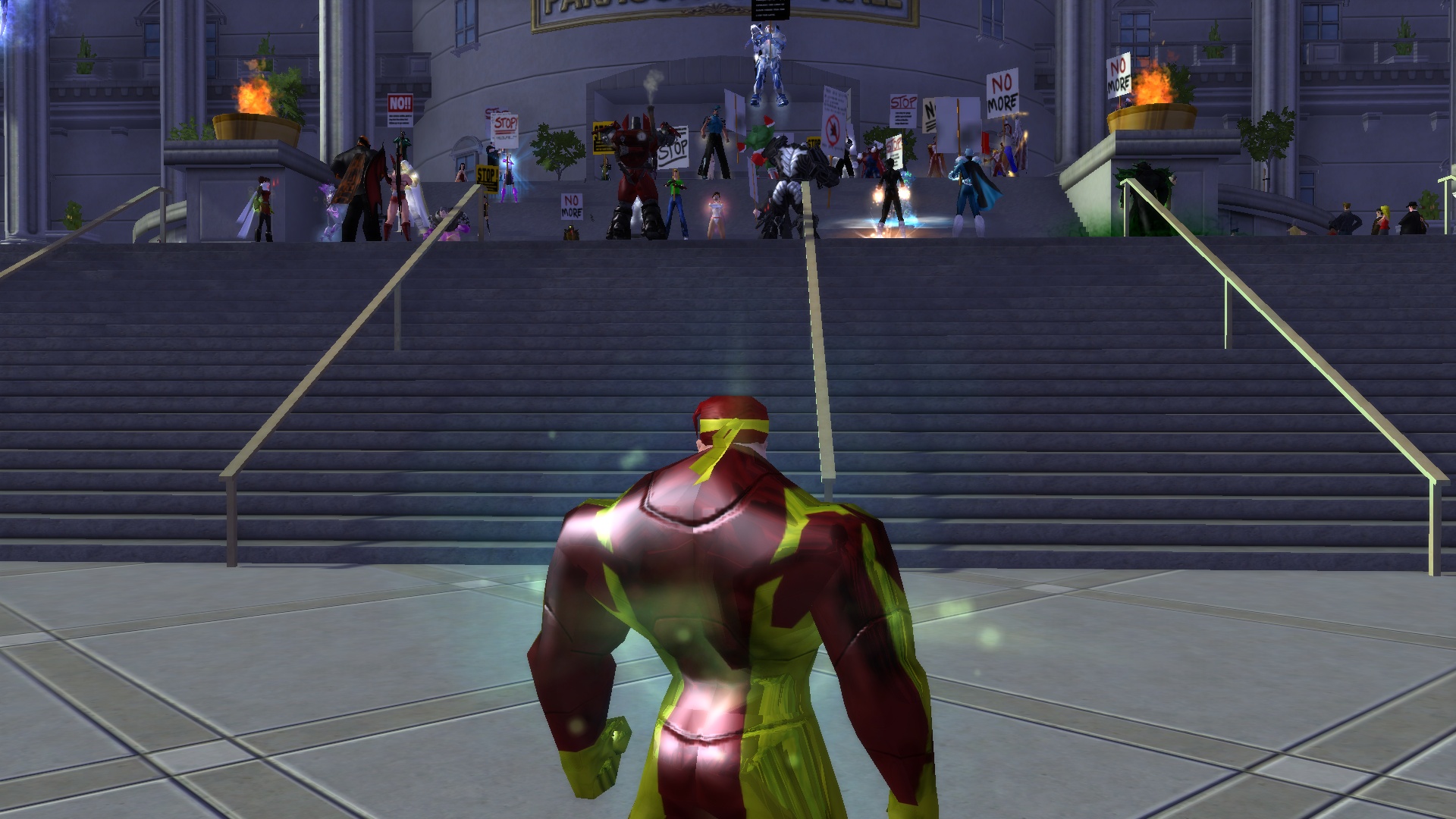
Lately, I’ve been playing City of Heroes, which for those who don’t know it, is a massively multiplayer online persistant world game, often referred to as an MMO, or an MMORPG (for role playing game). Years ago, I started playing the game, when I was bored with whatever other MMO I was playing at the time, and recently, I installed it again and decided to pursue its new play model.
You see, in the old days, the game used to cost $15 a month to play. Now, in order to attract more players, the game has turned into a Free to Play (F2P) game, much like the previous success of Lord of the Rings Online, which went to a F2P model in hopes of avoiding going backrupt. And it succeeded, which has breathed new life into other games that don’t want to go the route of Star Wars Galaxies (which closed shop after not being able to maintain a consistent player base.
The way a F2P model tends to work is that you are allowed access to certain areas, and maybe certain characters, but some parts of the world/universe are off limits or you have to pay a little bit more in order to access those areas or use extra characters. Not really wanting to do the barter thing with every little thing in the game, I subscribed to a VIP membership, which is essentially the same sort of $15 a month I was playing before. This gives me complete access to everything, although I have noticed that every now and then I still buy something that is “extra” in the game.
Which brings up a thing that has kind of bothered me about this model. If I’m someone who is a willing subscriber, I really should be given 100 percent access to everything. Yet, I still feel a bit nickle and dimed in this type of environment. But I appreciate the game, so I have been willing to shell out a bit more money just to contribute to the game I hope to be playing for some time.
Which brings me to how this sort of model doesn’t work. And Blizzard, the makers of World of Warcraft and Diablo 3 comes to mind. World of Warcraft is a pay to play game (P2P), and that’s fine. But the developers (or owners) have become somewhat greedy. They have continued to insert things into the game that they want you to pay for outside of the game. So, even though they’re making a crapload of money for their product, they’re still trying to nickle and dime people beyond the quarters they’re already getting. And don’t get me started on Diablo 3, which is a game that cost me $59.99 to buy (or was it $69.99?), and then they launched the game with all intentions of adding a “pay Blizzard’s greed” auction house, where you will pay real money to buy things in the game.
Years ago, Blizzard was seen as the good guy when it came to games, but lately, I can’t say the same. Diablo 3, for sake of clarification, sucked. It was a crappy game that wasn’t worth the money, the time, or even the energy. The fact that it had the name of two of the greatest games in history as what it was supposed to be a sequel made it even worse. Diablo and Diablo 2 were both great games. They even made the game required to be online at all times, which I suspect had more to do with hoping to get people to feel comfortable with giving money to the auction house model (single players would have never gone online where they’d have to see the auction house every time they signed onto the game) than it was for security or any other stupid reason.
A recent major name in online games is Star Wars: The Old Republic, which I played when it first released and enjoyed it for the first month or so. The game was missing a lot of needed content, so I gave up on it. Now, it’s supposedly going to be going F2P, mainly because they milked every nickle and dime they could get out of the subscription model. I doubt I’ll ever play it again, even though I had fun with it when it first released. The problem with the game was that it was completely on rails the entire time, and an MMO requires a world where you can go anywhere and do anything. That was never part of the very linear model of SWTOR.
Which brings me back to City of Heroes. I enjoy the game and play it a lot. But I fear that there’s this attempt to make all games so-called F2P, when in reality the companies are hoping to rake in dollars through this model. Bioware has announced that Command & Conquer: Generals 2 is going to be released as a F2P game, yet be online all of the time, and there will be no single player game. I suspect it’s going to be a major failure, but that’s just my opinion. I see the reason for such a release is not because that’s the way the market is going but because executives of gaming companies see this as an easy way to separate people from their wallets. Unfortunately, what they don’t realize is that most people who opt into these dynamics are of the older gamer base, and we’re not stupid or as gullible as they’d like us to be. That’s why several versions of this model will fail.
What a lot of these games are forgetting to realize is that what makes people pay to play these games is that they are designed to be fun, not because there’s a free model that they’re attracted to first. That’s why companies like Zynga and anything affiliated with Facebook is struggling these days. People don’t want to be fleeced by companies using them to make money. They want to have fun. And AFTER they have fun, if they perceive that there’s MORE fun to be add by contributing to the company, they will. But holding out a carrot and then giving nothing but expecting everything is going to be the reason why so many of these future properties fail.
And then we’ll start to read all sorts of articles about how no one is buying computer games any more, kind of like the music industry lamenting about how people aren’t buying music. They are buying music; just not from you.
And that’s our lesson for the day. Now, it’s time for me to get back to my superhero Desktop Support Girl, the savior of all broken computer systems in Paragon City.