Category Archives: Technology

Why Barnes & Noble’s Nook Failed

"I read all of Duane Gundrum's books because he's so dreamy...."
“I read all of Duane Gundrum’s books because he’s so dreamy….”

Unfortunately, it’s been predicted for some time that Barnes & Noble was going to distance itself from the Nook, and thus, the e-book market. So, it seems that moment is coming to pass. Speculators assume that Barnes & Noble will attempt to continue on as a brick and mortar (physical presence only) store and sell off all of its e-book stuff. Well, in case it’s not readily apparent, the problem with that is that without an actual device to continue to hype the market of products, the Nook is going to die out as people are going to see the Kindle as a continuing vehicle and the Nook as dead in the water. Sure, they can survive on apps for awhile, but eventually people are going to see the writing on the wall and choose to go with a platform that looks like it is going to survive the next wave of changes.

But the point of this post isn’t to talk about the future of Barnes & Noble, because to be honest, I have no idea what is going to happen to that company. However, what I can do is talk about what happened to the company, specifically as to why the Nook didn’t become the all-winning vehicle they were hoping it would be. To understand this, we have to use our little go back in time feature and see what was happening when the Nook launched with all intentions of challenging the new kid on the block, the Kindle.

Back then, Barnes & Noble was the big kid on the block. He’d already beat up every brick and mortar store that existed before him, and he was rearing to go after the next challenge. Only, the next challenge wasn’t another physical store, but an online one that promised to lower prices and produce a better shopping experience. Now, I wish to harp on the latter of those intentions because Barnes & Noble stupidly focused only on the first: Lower prices. And unfortunately, Barnes & Noble didn’t handle that one well either.

The Kindle offered books at lower prices than you could buy them at retail stores. This was huge. When the Nook launched, it attempted to “discount” prices as well, but if you held up both side by side (and I used to do this a lot), what you discovered was that most of the time the Kindle price was exactly the same as, or cheaper, than the Nook price for a book. And then you started to see more and more choices being offered on the Kindle, which made having a Nook kind of a stupid purchase because if you couldn’t find everything, and couldn’t find it cheaper, you bought a pretty stupid device.

But the second point is the one I want to talk about the most because that’s where I truly feel that Barnes & Noble failed with its Nook. What Amazon offered with its Kindle was not only lower prices, but it offered a better customer experience, meaning that if you were looking for something, the Kindle actually cared about helping you find it. This meant that as you bought more books, the algorithms that worked within Amazon served to make recommendations to help you find things that you might want in the future. The more you bought and searched, the more likely the device was going to serve to help you find exactly what you might want, even if you didn’t realize you wanted it.

The Nook, on the other hand, basically offered you whatever the publishers were selling, and it put its placement completely determined by the legacy model of the highest bidder (or largest publisher with more prestige). After a few purchases on a Nook, if you were looking for a new book, every new search was like starting out from the very beginning again. In other words, you were screwed. If you didn’t want only the most popular book out there, you had to figure out what you wanted on your own.

The problem B&N made was that it assumed that cheaper prices (less than you’d pay for the hard copy of the book) was more than enough to produce decent profit. But they didn’t take into account that they had to be cheaper than the competition, not just cheaper than their own posted price for the retail version of the hard copy. And then they made the customer experience as bad as an Internet search could be back before Google was invented. You basically had to do a search with the intention of hoping to get lucky in order to find the thing you were looking for. This was great if you were looking for a copy of 50 Shades of Gray, but it wasn’t so great if you were looking for new, independent writers who might be making a splash in an obscure genre, but a genre of which you often spent a lot of money. The Kindle, however, did this extraordinarily well.

So, it shouldn’t come as any surprise which device, and which company, won the battle. The war isn’t over, but quite a few of the initial battles were quite decisive, so the outcome seems somewhat conclusive.

At wit’s end with writing

I honestly don’t know what to do. I can’t seem to get anyone interested in my writing. It’s not because it’s not good enough; it’s mainly because it’s not famous enough, and it’s never going to be “famous” enough because no one reads it.

I guess what gets on my nerves is that I tend to support all of my friends and colleagues on their social networking sites, but rarely is that ever reciprocated. I’ll give a thumbs up to someone’s ridiculous cat picture or to someone’s latest “look how cute my baby is” photo. But rarely does that get returned.

I have about one friend on my social networking sites who I am very thankful for because she’s always supporting me with my writing. Probably more than she should ever have to. But she’s a rarity. I sometimes wish there was more I could do to support her, but I try.

Recently, I published probably the most important book of my career. To give it the credit it’s due, I need to hype the hell out of it because the publishing world is not the same place it was a decade ago. Publishers don’t support you. Writers are pretty much on their own, and unless they were Stephen King-level of famous a decade ago, they’re pretty much stuck with trying to make an impact in a world that has the attention span of a five year old.

So, I have been trying everything possible to get people interested in this book. For the first time ever, I created a book trailer and put it on Amazon and Youtube. It’s really funny and entertaining. The people who have seen it, all ten of them, love it. If you start to get my drift, I now can’t get people to watch a Youtube of a promo for a book that they aren’t interested in reading either. Basically, a writer trying to get traction today is essentially screwed.

The tragic part of trying to make it has a lot to do with the mechanisms that drive the whole industry now. In order to advertise my book anywhere, you generally have to have at least 4 to 5 reviews that are 4 stars or above (averaged). So, if you don’t have people who already read your book and reviewed it, you can’t get advertising for it so that people can actually read it and review it. And if by some chance you got those first five reviews and then could pay for some advertising, you then have to get dozens of reviews before you can actually start hitting a breaking point of where people will ever even notice that you’ve written a book. If you’re unknown, kind of like I am, then you’d probably get better results standing on the corner and throwing copies of your books at passing cars, hoping to hit one, blinding the driver so that he has to stop after running into a flagpole.

Anyway, here’s a last look at the video I created for this campaign.


If You’ve Ever Wondered Who It Is Government Works For….

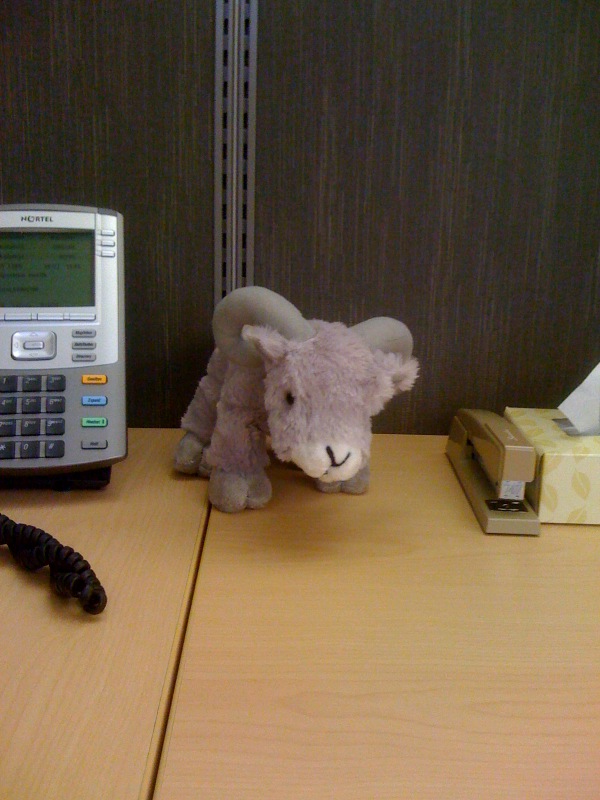
Brucoe, a real man's stuffed animal who takes no crap from anyone, especially cell phone companies
Brucoe, a real man’s stuffed animal who takes no crap from anyone, especially cell phone companies

There’s an interesting situation going on right now in the US Government, and it involves cell phones. From the Wall Street Journal comes a story about how the president is trying to convince Congress that we should allow unlocked phones to be allowed so that people can switch phone providers after their contracts have expired. The interesting part of the story, and the part that most people won’t get, is that this isn’t the first time the president and Congress have dealt with this issue. As a matter of fact, Congress originally made this ruling with a previous law, but made it one of those cumbersome laws that expires, which they often do when they don’t really want to do something. After it expired, these “penalties” were enacted for unauthorized unblocked phones:

The Library of Congress’s rules establish federal copyright penalties for unlocking a cellphone. Wireless carriers can collect statutory civil damages of between $200 and $2,500 per violation and criminal penalties can rise to $500,000, five years in prison or both for the first offense. (from the previously linked article)

Only after a digital write in campaign did the president actually chime in with his own thoughts, backing the people rather than the rich bigwigs in Congress.

So, the question going through your mind should be: For whom does the government work? Because the last time around, Congress did nothing, which managed to benefit the phone monopolies instead of the people, because they realized they wouldn’t be held accountable for doing nothing (a common misconception by Congress). In my opinion, if there wasn’t a write in campaign to the president, I doubt he would have addressed the issue either.

I suspect nothing is going to be done about this, unless people rally and hold their representatives accountable. The telecoms love the way things are right now, even though they claim that they allow phones to be unblocked (so people can switch companies without having to buy a brand new phone), but they don’t make it easy. As a matter of fact, from AT&T’s response to the issue, they have to give permission, even though they claim they probably would. That’s not a right. That’s being locked into a post-contract situation over a phone that your contract actually paid for.

So, if you ever want to know for whom government works, watch how this plays out. People can say and claim all sorts of things, but until you see it play out in front of you, you don’t know how things really happen. Words are great, but actions trump works each and every time.

Bought the new Ipad Mini

I thought about it for a few weeks when it was first announced, and then I finally bought an Ipad Mini. Before buying this item, I owned an Ipad 2. The interesting thing is that the Ipad Mini is not that much different than the Ipad 2 (same resolution and such), but I had needed a larger storage space than my 16GB Ipad 2, so I went with a 32GB Ipad Mini.

After finding a case for the device, I’m pretty happy with it. My only concern is that some of the apps that I had on the Ipad 2 don’t seem to be available. It’s not because the Ipad Mini can’t run them, but for some reason some of the apps I originally installed on the Ipad 2 just don’t seem to be available any more. An example is Okcupid’s app, which I always liked. The app store can’t seem to find it. The same thing happens with my retirement fund app, which was on my previous Ipad and on my Iphone. The app store doesn’t think it exists.

Other than that, there’s really not that much different, other than it is a bit smaller than my Ipad 2 and a lot lighter. To be honest, I like the idea that it’s a lot lighter; the Ipad 2 was always a little bit too heavy for the kind of device that it was.

The resolution, the biggest complaint most reviews have, doesn’t really matter to me. It seems to be one of those complaints people have if they’ve already had a device that uses the retina diplay. My Ipad 2 didn’t have one, so I’ve not been swayed by how great such a display might be. I suspect if the Ipad Mini sells well enough, we’ll see a retina display in Ipad Mini 2. Until then, I’m quite fine with what it does.

My biggest desire for this device is to read my Kindle books. I have a Kindle Fire, but it constantly has problems downloading books that I buy. You’d think Amazon’s Class A product would be able to do everything it needs to do. I finally gave up on it when it wouldn’t download a copy of the book, The Hot Country by Robert Olan Butler, after I bought it directly from Amazon’s site. My Ipads did it just fine. The Kindle Fire just can’t see it in the cloud or on its device. Such a crappy product (the Kindle Fire).

So, I finally have the device I’ve been waiting for, and it wasn’t really that expensive. Not often you can say that.

“See Price in Cart” is a crappy business strategy that needs to go away very fast

I received an advertisement from Sam’s Club today that listed a television on sale, but in order to see the price, you had to click it (as it listed “see price in cart”). One click later, I was now on a screen that told me to “add item to cart” AND NO PRICE. That took me to another screen with the wording along the lines of “complete transaction” and a button, AGAIN WITH NO PRICE. The next screen was a couple of listings of what the price used to be, and yet another button to make the sale (without the price yet). Look, I get the idea that you’re trying to get people to want to buy the product and are doing all sorts of psychological games along the lines of “well, if they click this many times to get to the price of the tv, they’ll eventually just decide they have to have it.” This is fine if we’re all multi-millionaires shopping in some boutique where “price is not a concern” but this is freaking Sam’s Club, not some posh place in Beverly Hills.

If you want me to buy your crap, tell me how much it is. If it’s cheap enough that I find it to be a bargain, I’ll buy it. If it’s not, then no amount of “keep clicking until you’re so worn down that you’ll buy it JUST TO GET OUT OF THIS NIGHTMARE” is going to make me pay more money for an item that I’m just curious about.

Companies really need to stop this crap because it so annoying. Customers aren’t lemmings, nor are they people who want to be herded towards your sales. Customers are people you should be trying to attract with good prices, good service and excellent products. Otherwise, your company and its business practices suck. Simple as that.

Wow, I’ve completely eliminated spam from my comments…also the start of NANOWRIMO

I made a change last week to my comment system, where someone now has to put in an answer to a simple mathematical question (like “What is eight – 5?). The last few days, I’ve had zero spam in my comments section, whereas I was receiving about 30-50 a day.

On other subjects, yesterday was the start of Nanowrimo (National Novel Writing Month) where writers (or wannabe writers) spend the month attempting to write at least 50,000 words of a novel (or a novel in 50,000 words). I’m 4182 words into my novel right now, and it’s a part of the Tales of Reagul series I’ve been writing for most of my adult life. This one is called A Season of Kings, and it begins during the year 180 or so BCE near Rome and then continues on the planet of Reagul (which is what most of the novels have been about). For those interested, this is the series that actually involves the name that’s part of my website: littlesarbonn.com. One of the central characters in this series is Sarbonn, the Sorceror, and his two apprentices Walner and Chandlin. Anyhoo. Have a great Friday.

Dealing with spam on WordPress blogs

One of the things that has bothered me with blogging is the overwhelming amount of spam I receive from bots and what I suspect just might be aliens from the Planet Xenon. Every now and then, for the sake of living an existence that equates to paddling upstream at the bottom of a waterfall, someone actually sends me a real blog comment. And most of the time, it would not surprise me if I delete it because it gets caught up in the tons of spam I receive as well.

I was reading an article today that was published a year or so ago by Mark of Bloggersjournal.com, and he made a bunch of interesting suggestions. I’ve always used Akismet, which is a pretty good spam collection service, but now I’ve installed a challenge (CATCHA) service that asks a random mathematical question (an easy one) before someone can leave a post. Let’s see how that works now. Of course, if you’re completely mathematically challenged, I apologize, but as I love math (those who know me definitely know that), it’s kind of my thing. I did decline the advanced calculus version, however, and the Sports trivia one would have kept me out of posting on my own site, so again, let’s see how this works out.

What amazes me is that this type of junk (the spam) actually exists. It serves no purpose, and I can’t imagine a SINGLE person in the world who actually buys anything that’s thrown at them with spam. Other than scamming someone who accidentally clicks on their junk links, I’ve not seen a single purpose behind it whatsoever.

But that’s just me, and people have often said I’m a bit strange. And not just the spammers either.

FTC offering $50,000 reward for someone to come up with a way to stop robocalling

Now, honestly, if THEY were robocalling me….

The article from PC Mag (here) states that the FTC, frustrated by its own efforts to stop robocalling (translation: Throwing in the towel and hoping someone else can figure it out) is hoping you can figure out how to solve the problem. So, starting next week, you can sign up with the FTC and then upload your solution in all sorts of different ways.

However, I’ll come straight out and tell you how to stop this because most reader responses have been along the lines of “make criminal charges that stick” or “fine them into the Dark Ages”. Those solutions won’t actually stop it because the fact is that they’re usually calling from blocked numbers or from out of areas where we have no jurisdication. The solution is simple: Make it mandatory that phone service companies (landlines or cell phones) allow you to block numbers from calling you if you don’t want to hear from them. Right now, the majority of my advertising calls (that I don’t want) come from phone numbers that if I could block them, I’d never hear from them again. Sure, they could call from another number, but I’d block that, too, and then they’d have to keep paying more and more money to be able to call me. Their best alternative is to just stop calling me as it becomes cost prohibitive.

The problem is that if you have any cell phone, good luck making that happen. I’ve had an iphone with AT&T for years, and they don’t offer the service. It should be standard with your phone, as it doesn’t take any effort for them to implement this whatsoever. When I left AT&T during a short six month period when I was trying something different than the iphone, I was with Sprint, and they didn’t offer the service either.

Because no phone services allow you to do this (unless you jailbreak a phone, which a lot of people like me aren’t comfortable doing), you are forever hostage to anyone who has your phone number. Right now, I am getting nonstop phone calls from a bill collector who is trying to collect for someone named Munroe (sic). No idea who Munroe is, and I can’t get them to stop calling me. Instead, they say: “If this is not Monroe, hang up.” That would be fine IF I CALLED THEM, but in fact they called me, which means that no matter how many times I hang up, they call back a few days later with a robot caller asking for Munroe. I have zero way to shut this down, other than turning off my phone and going back to live in a cave.

The problem I perceive is that there are companies out there who don’t want to give us the freedom to stop these types of calls. That’s why it will never happen. That is why no amount of work the FTC does to come up with a solution, nothing is going to be done about it. If the FTC was serious about stopping this problem, they would have turned to the phone companies and asked them to come up with a solution (OR THEY WOULD DO IT FOR THEM). But the FTC has no backbone, so they’re trying to pretend they’re actually doing something about it when they’re not.

Why I won’t be buying the new Kindle Fire HD or whatever it’s called

For some bizarre, masochistic reason, I have bought practically every version of the Kindle that has been made. The last one I bought was the Kindle Fire when it first came out. And that device is the reason I have decided to pass on anything in the future made by Kindle.

My needs are pretty simple. What I wanted was a device that could allow me to read books (which it does), maybe listen to a bit of music (which it kind of does, as long as you put your entire music library on Amazon’s cloud), and can place certain documents I need to read onto it as well (that one completely fails). For days, I have been trying to get my Kindle Fire to recognize a pdf document that I need to refer to quite often at work. It can’t. Or it won’t. Not really sure if it has a mind of it’s own, but it won’t read the document, no matter how many times I have tried to make it do so. I sent it using the email address they gave me to upload documents. After establishing that the email account I sent it from was legit, it should have been a breeze. I mean, my old Kindles did it just fine.

But no, it doesn’t see it no matter what I do. The document shows up on my “Manage Your Kindle” page, but my Kindle Fire just pretends it’s a stupid rock whenever I try to upload it/download it/pray to the Gods of Shaniaism, or whatever. It just won’t do it.

The truly sad thing is that my Kindle app ON MY IPAD 2 reads it just fine. But I bought the Kindle Fire so I could use these documents that can’t be read.

And don’t get me started on wifi access. It has the ability to connect with wifi, but 9 out of 10 times, it can’t seem to do anything once it connects. It doesn’t matter if I’m at work, at home, at the Pentagon, in the front lobby of Amazon. When it comes to wifi, they need to stop using a ten year old child hacker to develop their infrastructure.

Which tells me that whatever NEW Kindle they created is as fubar as this one. I mean, this was the expensive baby that the Kindle was selling as the be all Kindle. If they can’t make their best model do something simple, then I’ve given up on them. I’ll still use a kindle app, but I’ll be doing it on other devices, because, to put it succintly, Amazon sucks big time when it comes to making products.