There’s an epic battle being fought these days in which the goal is nothing less than your hard earned money. Sadly enough, the only ones not benefiting from the struggle are us, the actual consumers. We’re mainly the victims, the targets and the ones who manage to keep making it so that we keep getting screwed over, cheated and abused. If it wasn’t so tragic, it would be funny.
I’m not exactly sure when it happened, but at one point we went from being consumers who were part of the system to consumers of content who are outside of the system. In the old days, maybe as recent as the 1970s, we were seen as consumers in a big triangular product cycle that started with us working for companies that produced content that was sold by businesses back to the people who were responsible for making the products. It was a closed system where people in other businesses provided products while we sold the products from our revenue stream back to them. Everyone came out ahead because we all made enough to survive, and we all got the products that everyone was making for everyone else.
But something happened that caused a real problem to the system. You see, at one point, those companies that make the products realized they could make these products without the actual consumer production staff being a part of the manufacturing cycle. In other words, they could automate the production without having to pay a production staff and still manage to create enough products to sell to those other cells of the manufacturing cycle. Except, those other cells were also figuring out how to cut out the production people so that they could automate their production and maximize their profits. After a certain amount of time, we cut out one prong of the triangle, leaving basically the profitable company management and the salespeople. However, we’ve kind of cut out the people who used to be the producers of content, figuring we can do it without them.
Unfortunately, those people were also the main consumers of the content. Without them, we end up producing a lot of product for people who can no longer afford to purchase it. This was fine as long as we were only cutting out a certain segment of the production audience, but now that everyone has figured this is the way to profitability, well, we’ve made it so that there may be too few consumers to actually participate in the broken triangle.
This was a problem that has been seen for quite some time, but big companies refused to pay attention because they were making money without very much effort, and they saw no end to it. Let’s examine that for a moment. And we’ll do it by examining the old model and then see where the new model sort of makes everything no longer make sense.
The old model of capitalism was that as long as we continued to produce products, we could always sell them for a profit. This always existed with the necessity that the consumer market was always going to be able to actual purchase the items needed. Well, what has happened is that a lot of the money that is to be made in this area has now been transferred to huge corporations that reward very few people for their efforts. Outsourcing and downsizing was inevitable as companies started to exist for the sole purpose of providing better results on stock market exchanges rather than to a people-driven profit margin. But eventually, outsourcing was going to hit a point where the native population of people within these companies was going to start suffering, with more and more jobs being lost, even though prices for products would continue to go down as the labor became cheaper through the outsourcing process.
What this meant was that one of two things would happen, and the result was really based on what ideology you believed. If capitalism was truly the victor, then the outsourcing would eventually hit a point where there is no more possible outsourcing location, so that eventually the corporations would have to start feeding back on themselves, and that would lead to consolidation to the point of where expansion would have to stop and the products being produced would fall back to a Maslowian base level of survival products rather than those that feed self-actualization. There would be no profit in leisure products, like iPads, because no one would be able to buy them any more. Instead, the main production would fall back to basic necessities as the people who still had jobs would be focusing on survival rather than leisure-like activities. The numbers of elites benefiting from the system would have shrunk so small that the luxury good market would dry up overnight. Where it would go from here is unknown as we’ve never reached this expansion end point before, so anyone can guess as to what would happen next.
The other choice is the old one of eventual communism, which is almost a direct insult to anyone who believes in corporatism and capitalism. Communism needs capitalism, however. Because once we’ve reached what’s called a saturation point (where companies have pretty much grown as big as they can become and profit is no longer profitable), then the system turns inwards, and the mass population that has been forced into corporate slavery then turns on the economic system and takes over its cogs and wheels. Their success would be in direct violation of the system, so this would probably bring on an economic revolution where the state would eventually turn into a police state where the military and police would act in the interests of business, turning on individual workers. The workers would probably suffer a number of defeats, with many deaths and even worse working conditions, until eventually they succeeded and overthrew the corporate entities that maintain control over the dynamic.
That’s if you believe either one of these theories of economics. However, what should be pointed out is that we have hit a point where people with economic clout are trying harder than ever to sell us crap we don’t need, and the crap that we do need is being put into flux, so that we are actually having to fight for these things. An example of the former is the various industries of utilities and intellectual property. Heat and electricity is pretty low on the Maslowian scale, meaning that we generally need electricity and heat. Often, the industries that hold power in these areas see themselves as a necessity and do everything possible to act like they are working in our best interest. Gas companies make really cute commercials about how the cars are all fuzzy and happy, and that they’re our friends. Meanwhile, the executives of these companies make insane profits and even when they destroy our natural resources with bad decisions on their part (like BP and Exxon), they do as little as possible to maintain their hegemonies and then try to make the problems go away by paying off only as many people as they need to do. The clean-ups in Alaska and on the East Coast have been afterthoughts, and already there have been attempts to do the least possible, while lawyering up rather than be the conscientious industries we’d like them to be. In the end, they’ll still manage to pull off outrageous profits, and the ones who were hurt the most will always be hurt the most.
The latter of those two choices (utilities and intellectual property) is even more fascinating in that the consumer isn’t even being considered a part of the discussion, even though the consumer is the one who funds pretty much everything. Organizations like the Recording Industry Assocation of America (RIAA) have been so outdated for so long now, holding onto old technology like record companies, that rather than modernize themselves as they should have done so long ago, they sue anyone they can think of, realizing that if they cast their net wide enough, they’ll manage to bring in enough profit to keep themselves going in perpetuity. The fact that they haven’t been relevant in years is rarely discussed by them; they’re more interested in maintaining a status quo that has been gone for many years now. Let’s face it. People are now getting a lot of their intellectual content (music, movies, TV, and games) for free because the Internet has made that possible. A lot of the potential customers they have lost are young people who have grown up getting this stuff for free for most of their lives. The RIAA and other such organizations should have been catering to these kids a long time ago, not slapping them with lawsuits the second they realized there was a problem already out of control. And even worse, the customer base they already had (older people like me), they abandoned by focusing on that young crowd, trying to sell the ideological equivalent of freezers to Eskimos. Had they continued to support the older class of customers, who were used to buying content from stores, they might have maintained years of profitability while slowly switching over to a model that could have catered to this younger crowd. Instead, whenever I walked into a record store, or an establishment that sold CDs, I see tons of titles that are geared towards young kids who aren’t going to buy any of the stuff because they can get it for free. There’s none of it that caters to me, and I’m sorry, but an occasional compilation CD of music I already own is NOT what anyone my age considers “catering” to me. It’s not even trying.
So, this brings me to what’s going on today. There are all sorts of people who see the rest of us as nothing but blind consumers they can take advantage of because they don’t care anything about us because they either outsourced us, or they see us only as mindless automatons who are only around to buy their junk. Google announced today that they are now going to be giving us the ability to buy books online. Basically, even though Amazon and Barnes & Noble have already done, Google indicates that it’s going to allow people to buy books in e-reader format, but then turns around and pretty much tells publishers that they’re only offering 52 percent of the profit of the books sold. Amazon and B&N have been offering closer to 70 percent profit. Apparently, Google seems to think that it deserves more of the money for a product that they did not create and basically only offer as a reading service. It’s like a tape recorder company demanding half of the profit of all music produced because it provided the tape recorder used to make the music. The only reason Google can offer this is because Google has power right now, and it will be interesting to see how the publishers respond to this insult of an offer, especially when they already have two viable processes for releasing e-reader content. Google is proving itself to be a great successor to Microsoft in all ways Dr. Evil-like.
Another story that has been making a play is also very important to this issue, and it involves reality TV stars the Kardashians, who are basically a trio of tarts who have no actual talent other than being famous for being famous. When their launch onto the public scene was through a sex tape that was sold by one of them, we really shouldn’t be expecting a whole lot more. Yet, they decided to play the profit game by tapping into their fan base and offering a misleading credit card that essentially cheats the living crap out of anyone stupid to ever use one. They’ve suddenly decided to distance themselves from the card AFTER a public outcry came out following the revelation that the card was generally little more than a massive scam, in that it does so many things that a paid for credit card should never do. In reality, the Kardashians backed away from their card because they were found out and it was going to become a headache to have to explain how they were profiting by cheating the crap out of people who were stupid enough to believe in them.
But their case is an example of what is going on today. Companies, celebrities and even governmental officials have no problem cheating the crap out of potential consumers mainly because they don’t see these consumers as a part of the original triangle I was talking about. So many people have been taken out of the equation that we’re no longer considered associates, friends or partners, but potential victims to take advantage of.
So what can we do about it? Stop buying the crap that people are selling you whenever you discover they’re part of this bad group of profiteers. Right now, we have a little bit of say in the future of where this goes, but as long as we continue to act like sheep and get taken advantage of, things will only continue to get worse, and eventually we’ll have little to no say in the matter.
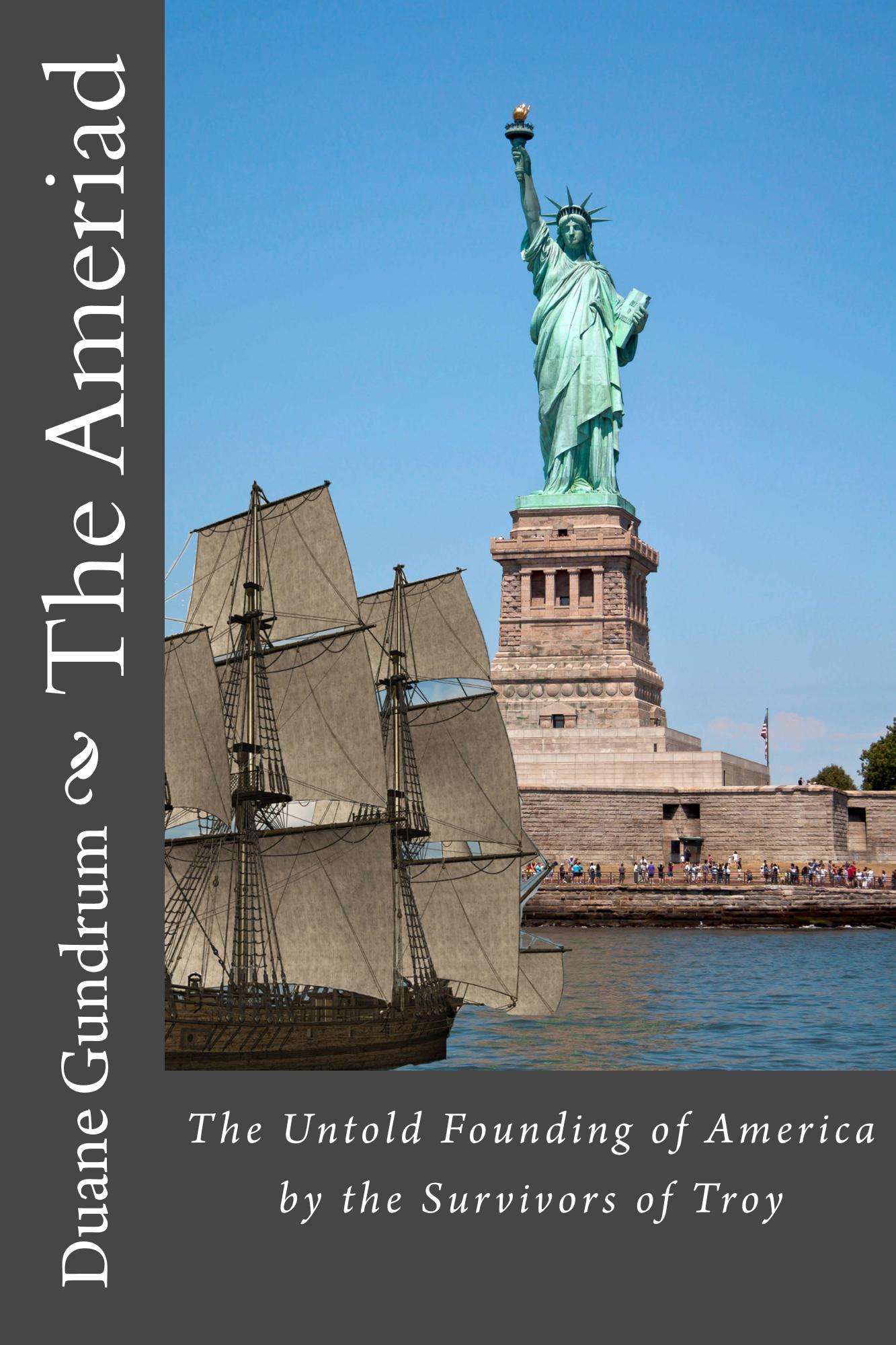 From September 21 to September 25, The Ameriad is available free on Amazon Kindle. This will be the last time it goes free as I will be removing it from Kindle Select after this promotion (so I can sell it on the Nook and other e-readers).