From the Chronicles of Stickman & the Unemployed Lego Spaceman
Several decades ago, I was writing my first book. It was one of those stories that had been percolating in my head for years. It was about a murder that takes place in a major corporation where one of the executives frames one of his competitors, and because of the various incentives of several members of the media and organized crime, the hero finds himself competing against the man who framed him, the media itself, misinformation, and even distrust within his own family. Add in a bunch of gunfights and car chases, and I was on my path to writing this first novel.
At the time I write this, the places to explore the research were very limited (the Internet was still a decade or so away from infancy) and, as I’d never worked for a corporation before, having been serving in the Army after attending the United States Military Academy after high school, I pretty much had to do most of my research through letters to industry leaders, conversations with people who had served in corporate leadership and lots of guesswork on my part. The fact that I got more right than wrong still amazes me to this day.
In the writing of this novel, I ran across all sorts of problems, including losing the last 50 pages even after I completed it, forcing me to rewrite that stuff again. But after a couple of years of constant writing, editing and filling in information, Innocent Until Proven Guilty was completed and in the hands of people who were finally able to read it.
You’d think that once that novel was completed, the field of writing would then become my oyster (okay, not really sure what that means but I’m sticking with it), but let’s just say that the obstacles were only beginning, and even to this day there are things that are constantly part of the struggle of one trying to be a professional writer.
Now, over the years, I’ve mentored quite a few writers, which is somewhat of a daunting concept considering that this mentoring has occurred over a period that has encompassed both the days of writing when there were dogmatic gatekeepers who held the entire productivity of the industry at their fingers up until today, a period where all you need to be published is a computer and an Amazon account (or whatever gatekeeper you prefer instead).
In the early days, the type of help I used to assist with had more to do with sentence and form and then more industry-related concepts, such as where to get published, or even what to send to whatever publisher, editor or magazine. The point was that there were certain things you had to do in order to get through or past the gatekeepers. Now, we’re in a cycle of publishing where anything can be published, but the gatekeepers are no longer the professionals, but the readers themselves. Strangely enough, the skills needed haven’t really changed, but the process has changed just how people approach the possibilities of being published.
But one thing that has never changed is that no matter how good you write, chances are pretty good that you’re going to struggle with the reality that finishing a book is one of the more difficult things you’ll ever attempt. And then once you’ve achieved that accolade, you run into an even more daunting experience: Finishing the second novel. But we’ll get to that second problem later. First, let’s deal with the one that you’re probably facing right now, and that’s completing the very first novel. All professional writers have been there at one point or another, but no matter what you do, you’re never going to be a successfully published author if you don’t actually finish that very first book (assuming we’re talking about novelists here; I’m not really quibbling about writers who are attempting to complete projects other than books, like short stories, poetry, lyrics, haikus, or whatever other form that comes to mind).
But I thought I’d mention a couple of problems I experienced over the years in my own writing. And, as I mentioned, I’ve mentored quite a few people, I’ve come across a lot of other problems that I never would have imagined, and perhaps it might help some struggling writer out there who might be thinking of plowing through his or her first novel and hasn’t decided to start just yet.
SOMEONE MIGHT STEAL YOUR IDEA: This is one of my favorite quandaries that beginning writers often bring up. Let’s just say that you came up with a brilliant new idea to write about in your novel, and then you start to put it together into a working manuscript. That’s great, but you’d be shocked at how many writers then come to this “problem”.
One of the first novelists I was mentoring was at first very apprehensive about showing me any of her work, even though she had approached me originally asking for help with her writing. Part of me suspected she thought that the mentoring relationship was just going to be me spouting out random pieces of awesome knowledge that she would start incorporating into her writing process.
I explained to her that if she wanted my help, I’d have to actually see her writing to see what might need work, what might be on the right track (so do more of that) and what things just really aren’t working for her. But it took a very short time to realize we were never going to come to that point if she didn’t first trust that the person mentoring her wasn’t planning to steal her plot ideas and turn them into writing gold.
The way I eventually did this was to explain that every writer has a plethora of ideas that he or she comes up with, and what makes that writer significant is how he or she develops those ideas into prose. By the same token, two writers choosing the exact same topic will almost always end up writing two separate novels that have absolutely no correlation with each other because the mind creates something that only that mind could foster and grow. Therefore, even if her idea intrigued me, there’s zero chance I would end up writing the same book she would write.
It reminded me of a story of my own back when I still hadn’t even written anything more than a few short stories at the time. I had this great idea for a behind enemy lines war story that involved special forces units going back to Vietnam to free prisoners of war that were kept after the conflict. I had even gotten to the point where I was outlining chapters that I was going to write.
And then out of nowhere, a movie was released called Uncommon Valor, and strangely enough, it was pretty much the idea I had been developing for several years at that point. I had that same feeling that young woman I was mentoring probably was feeling about her “idea”, feeling that anyone could steal the idea once they knew what it was.
The reality is that whatever I would have ended up writing would never have been the same story as Uncommon Valor. My proto-novel was going with the title Missing in Action, and what I quickly learned after that moment was that a whole bunch of authors had the same idea, and then once Uncommon Valor came on the scene, a bunch of similar movies, including one with Rambo, showed up soon after.
None of them were the same story.
YOU MIGHT NOT HAVE ENOUGH INFORMATION TO FILL A BOOK: This is a very real fear, but it’s not as bad as it sounds. What it basically means is that you started writing your novel on an initial idea, not a book premise. What that means is that you had a catch, but nothing to go with that catch (or at least very little).
What often happens is that someone realizes that he or she doesn’t have enough material for a book and then just quits. And that’s usually the completely wrong approach. When you hit that point, and you suddenly realize that you don’t have enough information, the best approach is to then sit back down and begin to outline what you have for your novel. At a certain point in the outline, you’re going to realize that you’re missing a suspenseful element that needs to be found and added. So, you add it to your outline then. But rather than just jump right in and continue writing, this is a good time to finish that outline and see if you have a solid story to continue towards your conclusion.
I once wrote an entire novel, realizing something was missing but just not knowing what that something was. YEARS later, I pulled that novel out of a drawer and read it over again, before realizing that about half of the story was there, and all along I was telling it from the wrong narrator. I then sat down, outlined the novel that I should have written and then had a much more interesting story than I wrote decades earlier. It’s still not completed, as I also discovered that I was missing some location information (I had written the original novel in a specific time line, but the rewrite required a completely different time period, and that initial outline forgot that some of the elements filled in from the original story didn’t actually make sense for the new time period we were in. So, it’s back to being a work in progress.
AT THE HALFWAY POINT, THE BOOK NO LONGER FEELS RIGHT: This is one of those weird situations that happens with a LOT of books. As you’re writing it, you hit a point where you start to question the very nature of the project itself. The original idea doesn’t seem as exciting as it originally was when you first started.
Quite often, the writer will just jettison the project completely and hope for inspiration to hit again on a new project. This is also a similar problem that a lot of new writers have because a technique that seems to occur with a lot of them is to write only when achieving inspiration, and when that ends, wait until it returns. But it rarely does, because it’s a lot like love (it’s very intense in the beginning but tapers off the longer you experience it).
There are two ways to combat this problem. One, just bite the bullet and continue to write through until you reach the end. I will agree that this is probably the most difficult approach to take because you’ve grown attached to the story you liked, and you might have a hard time maintaining that same commitment to a story that doesn’t thrill you as much any more. This first approach tends to work a lot more successfully when you start to realize why you’re experiencing the sensation in the first place. The longer you work with a project, the more you grow tired of it because you’re practically living and breathing that story every day. A reader only experiences it that one moment while reading, but you run over every nuance of the story so many times in your head and while rereading what’s there in front of you. It’s very easy to grow bored of something you’ve been exposed to for so much time.
Which brings me to the second way of combatting he problem. And that’s to wait a certain amount of time until you feel ready to address the story and continue on.
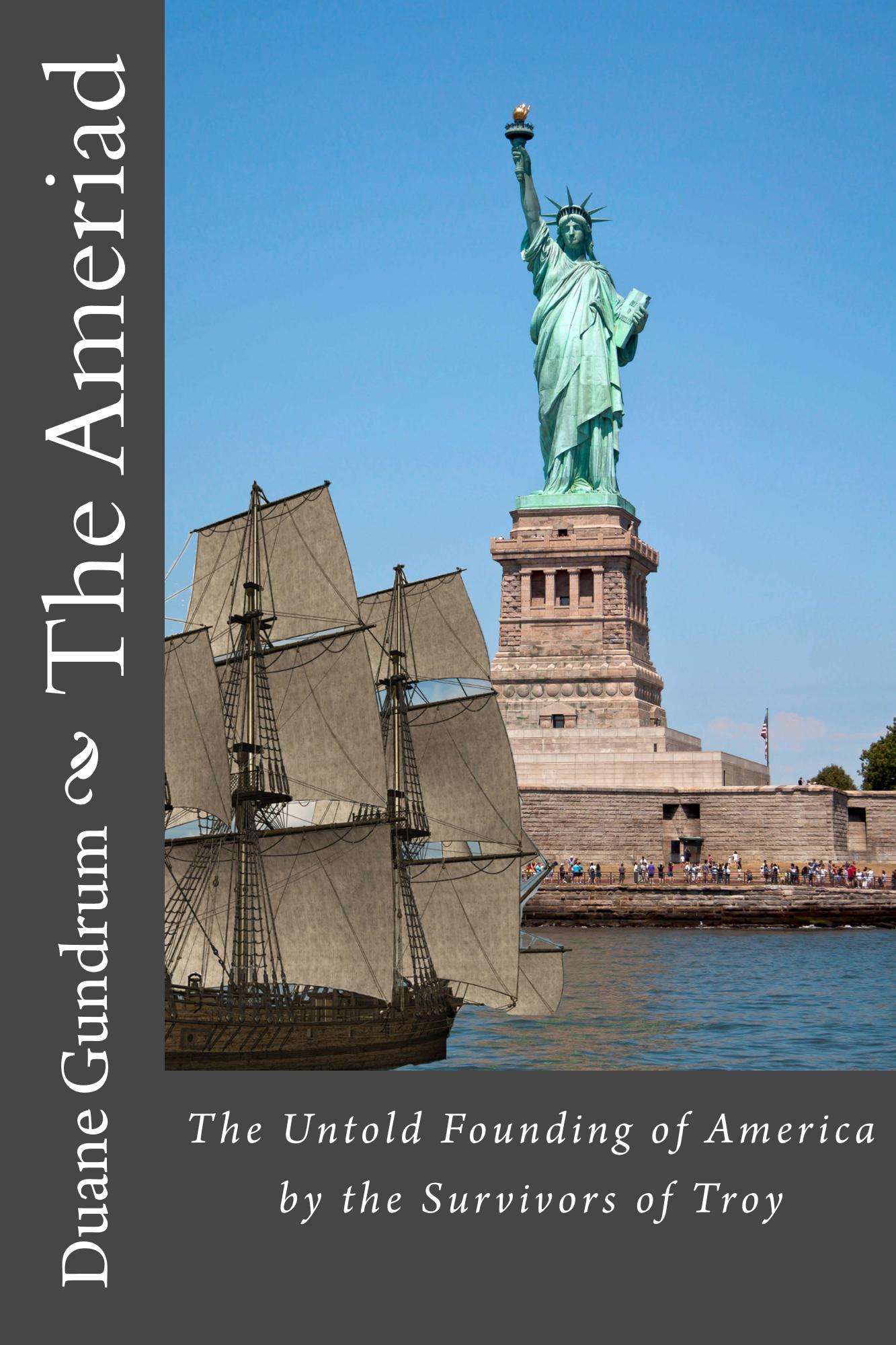
My novel The Ameriad: the Untold Founding of America By the Survivors of Troy was my very first attempt at writing a straight out comedy novel. It was told in the voice of a Greek/Roman historian, much like Homer, and it was basically the retelling of America if the story had been told by a Homeric writer. I tackled this project soon after grad school when my head was filled with political philosophy, but as you may suspect, I got halfway through the story when I realized I had no funny left in me. So I put the project in a drawer and worked on other novels.
5 years later, I dusted off the project and realized what I needed to do in order to finish the novel. And now it’s a published novel, and I’m probably as proud of it as I am some of the previous work that I tackled in the past.
What was important was to give it some time so the ideas could grow and that a funny story could start to become funny again. I’m very happy with the results.
So, those are some of the initial problems you might have when writing that first novel. But I did mention that were a little more to the story, and that’s the revelation that once you’ve written your first novel, that doesn’t make the next one any easier. As a matter of fact, when I was writing my second novel, I came across a problem I never would have imagined.
COMPLETING THAT SECOND NOVEL IS SOMETIMES HARDER THAN THE FIRST: As I was stating, you might think the second novel should be easier because you now have both the skill of the first book behind you and the confidence of having completed it.
My second novel was Leader of the Losers, a futuristic science fiction novel. When I started writing it, it went quite smoothly. Until about the halfway point. And then, suddenly, I started to question everything about the novel. While I didn’t have an actual problem with anything I’d written, there was this horrific voice in my head constantly challenging me with thoughts like: What gives you the nerve to think you could pull this off a second time? Your first book was a fluke. You’re not really a writer.
What I was experiencing was a sense I used to get from one-hit wonders in the literary world. You know, the people who wrote one decent book but could never manage to write another one that didn’t ever do as well as the first because people recognized it was never anywhere near as good.
I started to think that Innocent Until Proven Guilty was my fluke, that I was never really meant to write anything else. And part of the problem with most writers is that you do this activity alone. Your support group is often just you.
So, when I was questioning my own abilities, there was nowhere in the room to say good things, to feed me positive affirmations about the writing process. It was just me telling myself that I got lucky once.
Aside from lots of therapy, which I could not afford at the time, the only real solution to this dilemma is to just shut yourself up and continue writing the novel until you finish it. And I did.
I’ve written 16 novels now, plus more short stories than even I can count (which either means it’s a large number, or I should have studied more when I was taking basic math classes). I don’t even count the hundreds of articles I’ve written over the years as part of my writing collection, but not because I’m not proud of them, but because at some point I just stopped counting.
The main point I want to share is that quite often we’re the obstacle in the way of our writing. We’re very good at creating hurdles where there shouldn’t be any. And no one’s better at questioning ourselves than, well, ourselves.
But be proud of every achievement and know that chances are pretty good there’s someone out there that likes something you’ve written. Our real job is to reach them, and sometimes that means getting through ourselves first.
But I promise. It’s always worth it.