 I ran into some formatting issues this evening, so I had to go back to the drawing board (or stage 7 of 8), fix the formatting and then release it tomorrow.Anyhoo.
EA’s Sim City Reboot Isn’t Going As Planned…unless you’re one of the disasters that destroys the cities
On the third day of the release of the new Sim City by EA’s Maxis studio, things have gone from reviews of “best game ever” to “what a crappy piece of s4#&!”
The problem isn’t the game itself, although some complaints have started to come in on that level as well (like how small the cities are in comparison to any previous incarnation of Sim City). The problem is the servers because this was EA’s attempt at forcing every single player to have to play on EA’s servers, requiring an always on internet connection. Another company with a more stellar reputation, Blizzard, tried doing the same thing with Diablo 3, and let’s just say that the result was a lot of people claiming Diablo 3 to be the worst game put by Blizzard in a very long, esteemed career of putting out great games.
So everyone is complaining about EA right now because not only do they have to be online all the time, but EA doesn’t seem to know how to run their servers so that the servers are on all the time. 3 days in, players who paid for the game can’t even play the game. So people on numerous game boards are attempting to cash their games back into EA, complaining about how badly the game was implemented.
I should point out that I was working for Maxis when EA took over it. As we were moved from Walnut Creek to Redwood City, you could see the company of Maxis being gutted out by the new owners. The last project I worked on was The Sims, and you could see how things were slowly going downhill for those at Maxis. Working on Sim City 3000 was a pleasure. Seeing what was happening after The Sims was awful and I felt bad for anyone that was sticking around.
If anything, hopefully other companies will learn that just because a bigger company has money to buy you out doesn’t mean that they’re going to continue to make your quality product with actual…well, quality.
Killing a Character
Some years ago, I was writing my novel The Teddy Bear Conspiracy. One of my main characters was named Tina, and there came a time in the book where her character had to be killed off. I found this really hard at the time because prior to this moment in the writing, I had really put a lot of life into this character, making her almost as important as the main protagonist and any other character in the novel. But I had hit that point where she had to go, so I gave her the glorious, heart-wrenching death she deserved. And then I was finished for the night.
The next day, I was in my writing office, continuing the novel. My office was located on the second floor of my apartment and somewhat isolated, so it gave me the space to write and not be bothered. And that was when I heard a whisper of a knock on my front door. Not one to answer the door while I’m writing, I kept going. Then the knocking stopped, and my doorbell rang. I still wasn’t planning to answer the door, but then the doorbell started ringing over and over, as it does when some very impatient person is on the porch, not easily dissuaded by someone not answering the door on the first ring.
I realized I had to answer the door because the person wasn’t going to stop ringing the doorbell. So I opened my office door, descended the stairs and then opened the door.
I discovered a tiny woman standing there, someone I had never met before. “Can I help you?” I said.
She said, in broken English: “My name is Tina. I have come back.”
I just stared at her, not sure if she was serious. I mean, she didn’t look like the Tina I imagined in my book, nor did she talk anything like her. But here she was, this woman named Tina saying she was back.
My immediate thought was that I was in some rejected Stephen King novel, or one he wrote when he wasn’t feeling well. Characters didn’t come back from novels. Well, at least not so they’re standing at the author’s door planning all sorts of evil that only killed off characters might do if they were to return the day after they were ritually killed in their prospective stories.
But why was she back? I thought. Did this mean I was mistaken in killing her off?
“What do you want?” was all I could think to say, while imagining all sorts of awful things that you’d see in horror movies. If only I was a horror writer, I might have had a better sense of what was about to happen.
And then she spoke, looking at my bewildered stare as if I was the one out of place here. “I said my name is Tina. I used to live here months ago. I just wanted to check if there was any mail that was still being delivered.”
And suddenly, I realized where I had come up with the name Tina in the first place. It was on a letter that had been mistakenly delivered here a few months back. I had given it back to the postal carrier and thought nothing of it since. Although the name had stuck and reappeared in my mind when looking for the name of that character.
“I am sorry,” I said. “I sent all mail back to the post office that might have been for you.”
She thanked me, and then Tina was out of my life forever.
But ever since then, I think twice before I kill off a character, always wondering if it’s the right thing. Because you don’t want that character showing up at your front door if you didn’t kill him or her right. Or justly.
If You’ve Ever Wondered Who It Is Government Works For….

There’s an interesting situation going on right now in the US Government, and it involves cell phones. From the Wall Street Journal comes a story about how the president is trying to convince Congress that we should allow unlocked phones to be allowed so that people can switch phone providers after their contracts have expired. The interesting part of the story, and the part that most people won’t get, is that this isn’t the first time the president and Congress have dealt with this issue. As a matter of fact, Congress originally made this ruling with a previous law, but made it one of those cumbersome laws that expires, which they often do when they don’t really want to do something. After it expired, these “penalties” were enacted for unauthorized unblocked phones:
The Library of Congress’s rules establish federal copyright penalties for unlocking a cellphone. Wireless carriers can collect statutory civil damages of between $200 and $2,500 per violation and criminal penalties can rise to $500,000, five years in prison or both for the first offense. (from the previously linked article)
Only after a digital write in campaign did the president actually chime in with his own thoughts, backing the people rather than the rich bigwigs in Congress.
So, the question going through your mind should be: For whom does the government work? Because the last time around, Congress did nothing, which managed to benefit the phone monopolies instead of the people, because they realized they wouldn’t be held accountable for doing nothing (a common misconception by Congress). In my opinion, if there wasn’t a write in campaign to the president, I doubt he would have addressed the issue either.
I suspect nothing is going to be done about this, unless people rally and hold their representatives accountable. The telecoms love the way things are right now, even though they claim that they allow phones to be unblocked (so people can switch companies without having to buy a brand new phone), but they don’t make it easy. As a matter of fact, from AT&T’s response to the issue, they have to give permission, even though they claim they probably would. That’s not a right. That’s being locked into a post-contract situation over a phone that your contract actually paid for.
So, if you ever want to know for whom government works, watch how this plays out. People can say and claim all sorts of things, but until you see it play out in front of you, you don’t know how things really happen. Words are great, but actions trump works each and every time.
Stickman and the Sequester
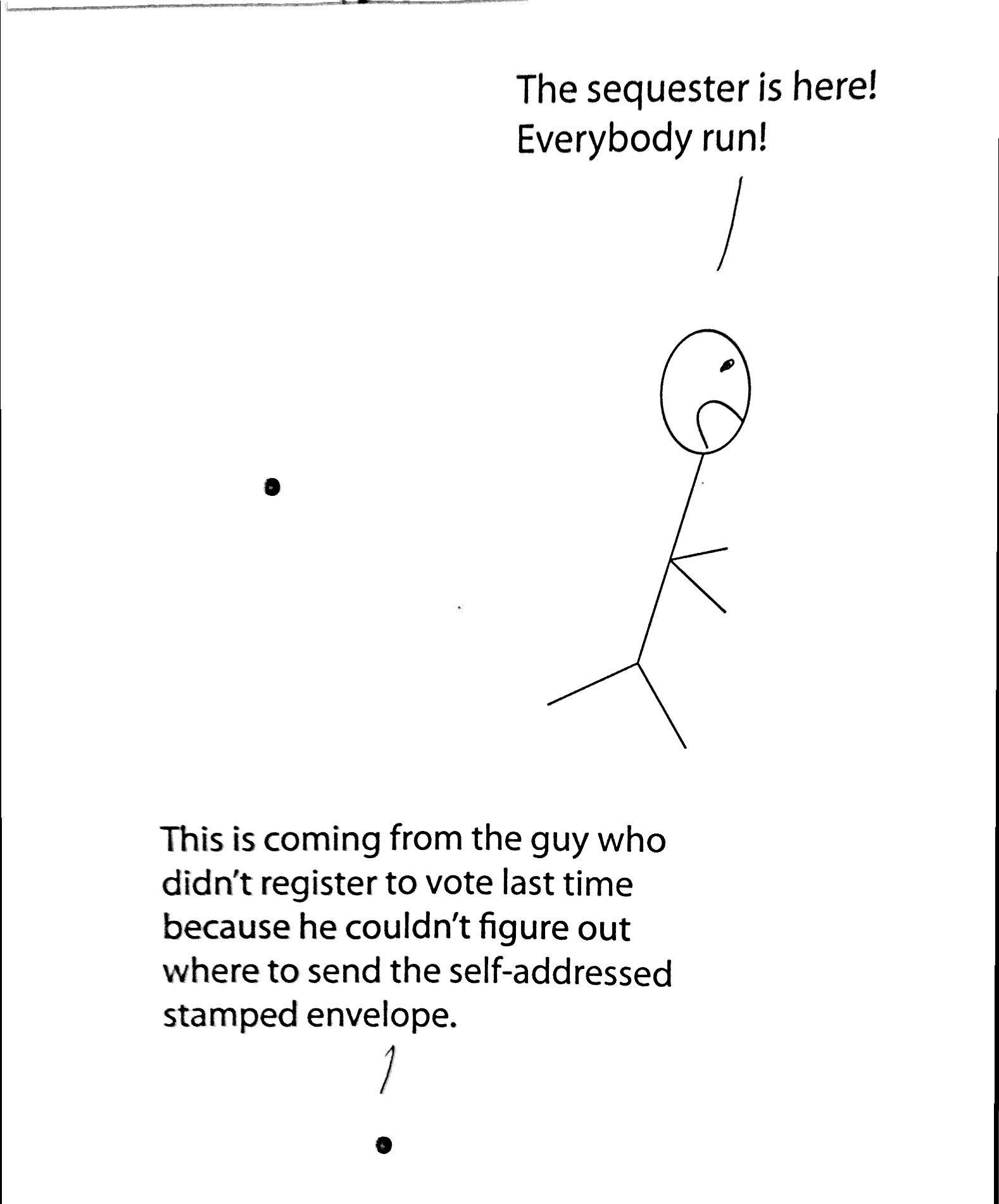
So what does the sequester mean for the rest of us?
I keep reading, hearing and watching doom and gloom stories about how the apocalypse is now upon us because of the sequester. A few weeks out, it was warnings of all government services suddenly stopping on Saturday morning. When that didn’t make much of a dent in everyone’s day, we started hearing about how the Defense Department would have to stop giving out guns and issue recycled plastic sporks to soldiers instead, the homeless would be fed turf grass, and our income tax returns wouldn’t be returned to us until the Year 2375.
Then Friday happened, the two parties couldn’t come to an agreement, and then the apocalypse came upon us. The news stories around then seemed to all have the same point: “The other guys are being really mean to the good guys, and now the world is at an end.”
Now, I understand the whole desire to blame the other guys; we’ve been doing that sort of thing as long as we were old enough to point fingers at other people. One thing we never really learned was how to stop pointing fingers and just get things done. This would be easy if we didn’t have a government that’s so two-sided that they are completely incapable of coming up with compromise. The funny thing is: In Morris Fiorina’s must read book (if you were doing a Ph.d in political science it was, in fact, a must read book), Divided Government, having a government where one side wasn’t in charge (which is what we have now) is the greatest thing ever because that means both sides compromise and work out solutions that benefit the most people. Unfortunately, it hasn’t looked that way for about a decade now, and I don’t perceive it going back to the way things were before. Hell, even Fiorina turned around last election and heralded Ron Paul as a solution to our problems, basically throwing his lot in with someone who had zero chance of winning whatsoever. If our main political scientists have given up on both sides, it can’t mean good things for the Republic.
But right now, we’re in sequester land, which means Monday morning a lot of sober people are going to have to look at the government they’re leading and realize it is going nowhere very fast. Does that mean we’ll start to see compromise, or will it be more of this zero sum crap we keep seeing all of the time where one side has to lose so the other side can win? Instead of governance, we get kids in the playground laughing at the handicapped kids because they haven’t been taught that’s inappropriate.
There are some real issues that need to be worked out, but probably never will because the people who have to work them out are rich, out of touch with the population and more interested in being reelected than they are in making things better. What they don’t realize is that there aren’t two sides to this problem; there are three: The Republicans, the Democrats and then everyone else who has to actually fund these two sides in their esteemed places in government. That third party (the people themselves) often is seen as only signficant when it comes to elections. Otherwise, they’re mostly ignored and spit on the rest of the time.
It should be interesting to see where things go from here.
One of my problems when it comes to teaching
The other day, I was teaching a class on Public Speaking. My goal for the evening was to teach the nuances of persuasive speaking topics, so I started in on techniques that decent speakers use in order to engage an audience…you know, the whole ethos, logos and pathos spread. At one point, I was explaining how I was once intrigued by a speech given by Helen Caldicott that she gave to UC Berkeley one night, involving cost overruns on defense programs. I was just going to touch on it and move on, but a couple of the students kept asking me follow-up questions on the concept of cost overruns, and next thing I knew I was teaching them all about how the defense industry has practically bankrupted our country by low bidding for projects and then pushing those same projects way over budget. It didn’t take much for me to realize my audience was more fascinated with the cost overrun topic than they were in learning how to make a point about persuasive speeches. Finally, after I explained far more than I ever should have about a political economic issue, I backtracked and explained that we needed to get back on topic about persuasive speeches.
The problem is: I do this a lot. When I teach political science courses, it’s not so bad, but there are times when I’m introducing Socrates and his theory of justice, and next thing I know I’ve gone onto a tangent involving Socrates, Aristotle, Locke, Hume and numerous contemporary philosophers. Almost always, I hit a point where some young girl says: “Do we need to know this?” or my other favorite: “Is this going to be on the test?”
I remember when lecturing on interpersonal communication a semester or so ago where I ended up explaining numerous stories from Plutarch that helped me explain why people socialize. It may sound kind of strange how that happens, but it almost always makes sense at the time, even if it might take some explanation to say exactly how it might happen.
I sometimes feel like I’m one of those philosopher-scientists of olden days whenever I teach a class like that. I love stories, whether they come from history, biology or strange politics. I remember going through school when a professor would read from the book, and people would fall asleep in the class. I don’t think I’ve had a student fall asleep in one of my classes in ages.
Every semester I receive reviews from students who say they really enjoy my classes, and enough of them stay after class to ask about all sorts of topics that sometimes have little to do with the subject matter itself. Almost always, I try to present material for them to research on their own (to learn it rather than just have me talk about it), and quite often one of those students will come back another day of class and present me with questions based on that suggested reading. There’s no better feeling when some young person comes armed with knowledge, wanting to know more.
The thing I struggle with is that I don’t see a lot of my colleagues doing the same thing. Instead, it’s almost like they’re competing with students to see who can do the bare minimum to get through class (teachers competing against students). I listen to the conversations in the teachers’ office and think I must be doing something wrong, because the conversations often hit me with statements like: “You’re wasting your time. Just teach the material and go home.”
What’s one to really think?
Test of the new site
The World Until Yesterday by Jared Diamond; a book no MA grad student could have gotten by a thesis committee
 The World Until Yesterday: What Can We Learn from Traditional Societies? by Jared Diamond
My rating: 3 of 5 stars
Diamond does a great job analyzing primitive societies from the perspective of an up-close observer, but one of the problems he suffers from is a massive case of anecdotal evidence that may or may not apply to larger populations. His examples are great, and some of his conclusions are interesting, but he has a really bad problem of writing as if he’s the expert on all things because of his experience with limited populations.
Where I saw this mostly lacking was whenever he was discussing an issue and then drawing a conclusion. The academic in me kept saying to myself while reading: “And your source for this conclusion?” But there was rarely sources brought up as any type of back-up to the arguments he was making. It made me suspect that he’s become so famous for his earlier work that I started to think he felt he didn’t have to back up his evidence with…well, evidence, because it wasn’t evidence; it was mainly a guess based on his years of experience out in the field.
The problem with this kind of conclusion he kept offering is that he’s relying on his own knowledge and guesses and then figures that it should be good enough because of his massive volume of work that preceeded him. Unfortunately, that’s not how science works, and he should know that as he is one of the people who has been in the trenches when this type of requirement was founded.
The problem with all of this is that he does have a lot of very interesting information, and when your information gathering process is criticized by others (and believe me, I’m not going to be the first or last one to make this criticism), it has a tendency to negate ALL of your evidence, which is probably the one tragedy in his shoddy attempt to provide good information.
Yet another job slips through my fingers
I applied for a job where I currently work. I was totally qualified for it, and I would have done a great job with it. Made it to the second interview. And the interview went great. The next week, I was informed that I was “second” in the running, so the job went to someone else.
I can’t tell you how many times I’ve heard this sort of thing in my life. I keep applying for things, and way too often end up being the “other” person behind the person who actually gets the job. It doesn’t matter how much education I have, how smart I really am, how innovative I am, what skills I hav e, or whatever. I keep coming up as the second in line for whatever thing I’m seeking. I have news for those who aren’t following: Second place doesn’t get a job or anything else. You get to start over and look forward to coming in second some other time.
I can’t even begin to tell you how many times this keeps happening in my life. And it’s not even jobs. It happened with my writing career where I came so close to finally making it and then something gave me that second place treatment again. An example is that years ago I landed a very well known literary agent who ended up in a car accident soon after signing me on as a client. She had a brain injury where she basically didn’t even remember I was her client. I mean, come on. This shit isn’t supposed to happen outside of bad television shows. I had a second agent years later who felt he could sell my espionage fiction. Then he called me to inform me that he was going to be representing some other writer who would take too much time, so as suspected, I got dumped.
And I am getting older (had a birthday a few days ago) that reminds me that I’m probably less desirable as a future employee than all of the younger people coming out of school.
So, without sounding dramatic or whatever, I give up. It’s not worth trying any more.