Why You’ll Probably Never Finish the First Book…or the 2nd one either

From the Chronicles of Stickman & the Unemployed Lego Spaceman
Several decades ago, I was writing my first book. It was one of those stories that had been percolating in my head for years. It was about a murder that takes place in a major corporation where one of the executives frames one of his competitors, and because of the various incentives of several members of the media and organized crime, the hero finds himself competing against the man who framed him, the media itself, misinformation, and even distrust within his own family. Add in a bunch of gunfights and car chases, and I was on my path to writing this first novel.

At the time I write this, the places to explore the research were very limited (the Internet was still a decade or so away from infancy) and, as I’d never worked for a corporation before, having been serving in the Army after attending the United States Military Academy after high school, I pretty much had to do most of my research through letters to industry leaders, conversations with people who had served in corporate leadership and lots of guesswork on my part. The fact that I got more right than wrong still amazes me to this day.

In the writing of this novel, I ran across all sorts of problems, including losing the last 50 pages even after I completed it, forcing me to rewrite that stuff again. But after a couple of years of constant writing, editing and filling in information, Innocent Until Proven Guilty was completed and in the hands of people who were finally able to read it.

You’d think that once that novel was completed, the field of writing would then become my oyster (okay, not really sure what that means but I’m sticking with it), but let’s just say that the obstacles were only beginning, and even to this day there are things that are constantly part of the struggle of one trying to be a professional writer.

Now, over the years, I’ve mentored quite a few writers, which is somewhat of a daunting concept considering that this mentoring has occurred over a period that has encompassed both the days of writing when there were dogmatic gatekeepers who held the entire productivity of the industry at their fingers up until today, a period where all you need to be published is a computer and an Amazon account (or whatever gatekeeper you prefer instead).

In the early days, the type of help I used to assist with had more to do with sentence and form and then more industry-related concepts, such as where to get published, or even what to send to whatever publisher, editor or magazine. The point was that there were certain things you had to do in order to get through or past the gatekeepers. Now, we’re in a cycle of publishing where anything can be published, but the gatekeepers are no longer the professionals, but the readers themselves. Strangely enough, the skills needed haven’t really changed, but the process has changed just how people approach the possibilities of being published.

But one thing that has never changed is that no matter how good you write, chances are pretty good that you’re going to struggle with the reality that finishing a book is one of the more difficult things you’ll ever attempt. And then once you’ve achieved that accolade, you run into an even more daunting experience: Finishing the second novel. But we’ll get to that second problem later. First, let’s deal with the one that you’re probably facing right now, and that’s completing the very first novel. All professional writers have been there at one point or another, but no matter what you do, you’re never going to be a successfully published author if you don’t actually finish that very first book (assuming we’re talking about novelists here; I’m not really quibbling about writers who are attempting to complete projects other than books, like short stories, poetry, lyrics, haikus, or whatever other form that comes to mind).

But I thought I’d mention a couple of problems I experienced over the years in my own writing. And, as I mentioned, I’ve mentored quite a few people, I’ve come across a lot of other problems that I never would have imagined, and perhaps it might help some struggling writer out there who might be thinking of plowing through his or her first novel and hasn’t decided to start just yet.

SOMEONE MIGHT STEAL YOUR IDEA: This is one of my favorite quandaries that beginning writers often bring up. Let’s just say that you came up with a brilliant new idea to write about in your novel, and then you start to put it together into a working manuscript. That’s great, but you’d be shocked at how many writers then come to this “problem”.

One of the first novelists I was mentoring was at first very apprehensive about showing me any of her work, even though she had approached me originally asking for help with her writing. Part of me suspected she thought that the mentoring relationship was just going to be me spouting out random pieces of awesome knowledge that she would start incorporating into her writing process.

I explained to her that if she wanted my help, I’d have to actually see her writing to see what might need work, what might be on the right track (so do more of that) and what things just really aren’t working for her. But it took a very short time to realize we were never going to come to that point if she didn’t first trust that the person mentoring her wasn’t planning to steal her plot ideas and turn them into writing gold.

The way I eventually did this was to explain that every writer has a plethora of ideas that he or she comes up with, and what makes that writer significant is how he or she develops those ideas into prose. By the same token, two writers choosing the exact same topic will almost always end up writing two separate novels that have absolutely no correlation with each other because the mind creates something that only that mind could foster and grow. Therefore, even if her idea intrigued me, there’s zero chance I would end up writing the same book she would write.

It reminded me of a story of my own back when I still hadn’t even written anything more than a few short stories at the time. I had this great idea for a behind enemy lines war story that involved special forces units going back to Vietnam to free prisoners of war that were kept after the conflict. I had even gotten to the point where I was outlining chapters that I was going to write.

And then out of nowhere, a movie was released called Uncommon Valor, and strangely enough, it was pretty much the idea I had been developing for several years at that point. I had that same feeling that young woman I was mentoring probably was feeling about her “idea”, feeling that anyone could steal the idea once they knew what it was.

The reality is that whatever I would have ended up writing would never have been the same story as Uncommon Valor. My proto-novel was going with the title Missing in Action, and what I quickly learned after that moment was that a whole bunch of authors had the same idea, and then once Uncommon Valor came on the scene, a bunch of similar movies, including one with Rambo, showed up soon after.

None of them were the same story.

YOU MIGHT NOT HAVE ENOUGH INFORMATION TO FILL A BOOK: This is a very real fear, but it’s not as bad as it sounds. What it basically means is that you started writing your novel on an initial idea, not a book premise. What that means is that you had a catch, but nothing to go with that catch (or at least very little).

What often happens is that someone realizes that he or she doesn’t have enough material for a book and then just quits. And that’s usually the completely wrong approach. When you hit that point, and you suddenly realize that you don’t have enough information, the best approach is to then sit back down and begin to outline what you have for your novel. At a certain point in the outline, you’re going to realize that you’re missing a suspenseful element that needs to be found and added. So, you add it to your outline then. But rather than just jump right in and continue writing, this is a good time to finish that outline and see if you have a solid story to continue towards your conclusion.

I once wrote an entire novel, realizing something was missing but just not knowing what that something was. YEARS later, I pulled that novel out of a drawer and read it over again, before realizing that about half of the story was there, and all along I was telling it from the wrong narrator. I then sat down, outlined the novel that I should have written and then had a much more interesting story than I wrote decades earlier. It’s still not completed, as I also discovered that I was missing some location information (I had written the original novel in a specific time line, but the rewrite required a completely different time period, and that initial outline forgot that some of the elements filled in from the original story didn’t actually make sense for the new time period we were in. So, it’s back to being a work in progress.

AT THE HALFWAY POINT, THE BOOK NO LONGER FEELS RIGHT: This is one of those weird situations that happens with a LOT of books. As you’re writing it, you hit a point where you start to question the very nature of the project itself. The original idea doesn’t seem as exciting as it originally was when you first started.

Quite often, the writer will just jettison the project completely and hope for inspiration to hit again on a new project. This is also a similar problem that a lot of new writers have because a technique that seems to occur with a lot of them is to write only when achieving inspiration, and when that ends, wait until it returns. But it rarely does, because it’s a lot like love (it’s very intense in the beginning but tapers off the longer you experience it).

There are two ways to combat this problem. One, just bite the bullet and continue to write through until you reach the end. I will agree that this is probably the most difficult approach to take because you’ve grown attached to the story you liked, and you might have a hard time maintaining that same commitment to a story that doesn’t thrill you as much any more. This first approach tends to work a lot more successfully when you start to realize why you’re experiencing the sensation in the first place. The longer you work with a project, the more you grow tired of it because you’re practically living and breathing that story every day. A reader only experiences it that one moment while reading, but you run over every nuance of the story so many times in your head and while rereading what’s there in front of you. It’s very easy to grow bored of something you’ve been exposed to for so much time.

Which brings me to the second way of combatting he problem. And that’s to wait a certain amount of time until you feel ready to address the story and continue on.

My novel The Ameriad: the Untold Founding of America By the Survivors of Troy was my very first attempt at writing a straight out comedy novel. It was told in the voice of a Greek/Roman historian, much like Homer, and it was basically the retelling of America if the story had been told by a Homeric writer. I tackled this project soon after grad school when my head was filled with political philosophy, but as you may suspect, I got halfway through the story when I realized I had no funny left in me. So I put the project in a drawer and worked on other novels.

5 years later, I dusted off the project and realized what I needed to do in order to finish the novel. And now it’s a published novel, and I’m probably as proud of it as I am some of the previous work that I tackled in the past.

What was important was to give it some time so the ideas could grow and that a funny story could start to become funny again. I’m very happy with the results.

So, those are some of the initial problems you might have when writing that first novel. But I did mention that were a little more to the story, and that’s the revelation that once you’ve written your first novel, that doesn’t make the next one any easier. As a matter of fact, when I was writing my second novel, I came across a problem I never would have imagined.

COMPLETING THAT SECOND NOVEL IS SOMETIMES HARDER THAN THE FIRST: As I was stating, you might think the second novel should be easier because you now have both the skill of the first book behind you and the confidence of having completed it.

My second novel was Leader of the Losers, a futuristic science fiction novel. When I started writing it, it went quite smoothly. Until about the halfway point. And then, suddenly, I started to question everything about the novel. While I didn’t have an actual problem with anything I’d written, there was this horrific voice in my head constantly challenging me with thoughts like: What gives you the nerve to think you could pull this off a second time? Your first book was a fluke. You’re not really a writer.

What I was experiencing was a sense I used to get from one-hit wonders in the literary world. You know, the people who wrote one decent book but could never manage to write another one that didn’t ever do as well as the first because people recognized it was never anywhere near as good.

I started to think that Innocent Until Proven Guilty was my fluke, that I was never really meant to write anything else. And part of the problem with most writers is that you do this activity alone. Your support group is often just you.

So, when I was questioning my own abilities, there was nowhere in the room to say good things, to feed me positive affirmations about the writing process. It was just me telling myself that I got lucky once.

Aside from lots of therapy, which I could not afford at the time, the only real solution to this dilemma is to just shut yourself up and continue writing the novel until you finish it. And I did.

I’ve written 16 novels now, plus more short stories than even I can count (which either means it’s a large number, or I should have studied more when I was taking basic math classes). I don’t even count the hundreds of articles I’ve written over the years as part of my writing collection, but not because I’m not proud of them, but because at some point I just stopped counting.

The main point I want to share is that quite often we’re the obstacle in the way of our writing. We’re very good at creating hurdles where there shouldn’t be any. And no one’s better at questioning ourselves than, well, ourselves.

But be proud of every achievement and know that chances are pretty good there’s someone out there that likes something you’ve written. Our real job is to reach them, and sometimes that means getting through ourselves first.

But I promise. It’s always worth it.

What Exactly is a Nice Guy?

In my many space travels as a legospaceman, I never ran into a civilization that didn’t speak lego

One of the more common tropes of banter on social media is the concept of nice guys and how someone feels she was treated badly by one, and thus, they’re all just really bad guys. It’s almost its own demographic within the confines of writing that whenever I see a story that mentions “nice guys”, I suspect it’s going to turn negative and start talking about how nice guys are anything but that.

Well, I’m going to let you in on a little secret. Most nice guys aren’t nice guys. They’re opportunists that hide behind the designation and then will eventually pounce when the time finally comes around. But that doesn’t mean there aren’t guys out there who aren’t nice guys; it just means that there are very few, and most women will come across one or two in her lifetime, and probably never even realize he was standing in front of her at the time because she’s focused more on the guy pretending to be one and making lots of noise to convince her of that possibility.

I remember a story of a friend of mine who stopped by our usual coffee joint one day and started out the conversation with “I don’t understand women. I’m a nice guy, and I get treated like crap.”

Now, you’re probably thinking all sorts of things about my “friend”, who let’s just call Bob for the sake of names, and let’s just get the baggage out of the way with what we suspect about Bob. If Bob called himself a nice guy, your impression of him probably has a lot to do with how you’ve been treated by the guys in your past, so that if you’ve been treated badly, you’re probably going to think Bob is just pretending to be a nice guy, and if you’ve had a decent relationship with guys in your past, you might suspect that he could be a nice guy, but he probably has a flaw or two that might need to be fixed.

But Bob was really none of those. You see, Bob was full of crap.

When Bob told me this nice guy stuff, I remembered that he had been in a dicey relationship with Shirley because she had found out about Becky, and he was trying to make time with Veronica (yeah, all made up names cause this isn’t a gossip column). But seriously, he wasn’t loyal, cared only about the woman he was with at the very moment he happened to be standing in front of her, and he either dumped or got dumped by them on almost a whim.

He was most definitely not a nice guy.

But here’s the catch. He THOUGHT he was a nice guy.

Why? Because he was who he was, and in most people’s stories they are never the villain; they are always the hero. Our psyche is designed to make us feel that way. Our inner voice rarely says, “hey, dufus, you’re a bad guy.” But there are many occasions where it probably should.

As a guy who tends to be that person that people confide in, let me just tell you that practically every guy sees himself as a nice guy. Because he’s who he is, and I would argue that even a guy sitting on death row for murdering half the population of Arkansas with a chainsaw is probably looking into the mirror and saying: “Nails, you’re really a nice guy.” That’s just the natural state of people. We’re stupid when we need to be stupid just so we can get through the day into the next one.

So, what is a nice guy? Or more importantly, do any actually exist?

I’d like to think they do, and I’d like to say that I’m probably one of them, but I may suffer from disillusion just like Bob did. I’m bred like every other male on the planet in that I’m always going to believe my inner voice is helping me to do the best job I can, so therefore, I must be a nice guy. Wouldn’t surprise me, however, if there’s some woman out there thinking to herself, “sorry, kiddo, but you couldn’t even put the toilet seat down no matter how many times I told you,” so even that’s probably just in perspective. Some people are going to like you, and others, no matter what you do or say, aren’t going to like you.

That’s just life.

So, let’s take it a step further. If you desired to be a nice guy, what would differentiate you from those who aren’t, because in the end, just gaining the designation of “nice” indicates that there must be those who aren’t nice, or are at least not as nice. So, how do we achieve just that?

I’d argue that to begin with, your goals need to be further than a cost-benefit analysis of outcomes. If you do everything in the guise of transactional behavior (if I do this, I get that), you’re never going to achieve a sense of niceness. Instead, you’re going to gain whatever item or items you were striving for that you hoped your good nature would yield for you. There’s no niceness in that whatsoever.

When I think about feeling “nice,” I often find myself having to think outside of myself. And it’s a two-step process. First, you have to want to do something for others to benefit them. And then, which is the hardest part, you have to do it in a way that doesn’t actually work to benefit you.

Years back, I used to mentor young people in writing. People used to ask me what I got out of it. My response was that one day I would get to see really good writing out there in the world that I wouldn’t have seen if I hadn’t offered my assistance back then. I saw that as “nice” behavior, even though in the end, I was still probably getting something out of the mix. But then I ran across predatory writing mentors that were interested in achieving a piece of someone’s future success, or some that actually used it as a vehicle to further their dating prospects, neither of which seemed very “nice” to me. But then, I suspect “nice” wasn’t exactly a part of their process.

So, after years of interacting with people on various levels, I’ve come to the conclusion that being a nice guy means going out of your way to help others without any desire for compensation or benefit in return. Having said that, there’s an element that sometimes goes over the top with this definition, where people think to be “nice” you have to actually sacrifice and lose something to achieve such a status. Again, that’s back to the transactional approach to giving and receiving.

For me, I’m satisfied just going out of my way to see someone else benefit from something I’ve done or said. And sometimes, just a smile of acknowledgement is enough to make me feel that I’ve done something that is perceived as being “nice”. Those who seek awards or accolades aren’t necessarily nice people, but people seeking some type of validation as payment.

Back when I was in grad school, I remember the grad lounge had a printer that always broke down. Before going back to grad school, I was a computer repair technician, and I specialized in harder to maintain aspects of that field like monitors, hard drives and, yes, printers. So, often, when I heard another grad student complaining about how he or she couldn’t get his or her papers completed in time because of the printer, I would sneak into the lab at night and actually fix the printer so it would be working the next morning. No one ever figured out who was constantly fixing the printer (it was old and it happened a lot due to the amount of usage), but eventually people started giving credit to one of the “smarter” grad students who was always bragging about his accomplishments; he even took credit for it. I could have jumped in and revealed his lack of accomplishments, but honestly, I didn’t care, and I found it kind of funny while a bit interesting as it told me more and more about this individual than I would have ever discovered any other way. For the longest time, he was perceived as “nice” for going out of his way to fix the computer constantly, and he did nothing to challenge that assumption.

That sort of showed me that this is how so many people can constantly perceive the wrong people as “nice guys”, and then feel so angry when they discover they’re not, in fact, really nice guys.

The reality of the situation is that most nice guys will go under the radar because that’s part of the process of actually being a nice guy. When you seek validation for it, you’re not really nice any longer.

It’s kind of like the old Socratic argument that plagued the philosopher in his final days. People claimed he was the smartest man alive, yet he suspected that once he acknowledged himself as the smartest man, he would no longer be worthy of that title.

Nice guys are somewhat the same way, which is why the noisiest “nice guy” who wants everyone to know how nice he is, is often not actually a nice guy. If you want to find the “nice guy” look in the shadows near the guy taking the most credit, and chances are you may actually find him. Just don’t let him know you found him, because most often he remains the nice guy as long as he never has to claim the title.

DC Universe Online: My review after a month of playing

So, recently I went through a couple of games (callout to Mass Effect: Legendary Edition and Final Fantasy XIV: A Realm Reborn), and after growing bored with those games (or finishing them outright), I found myself looking for something new to play and that’s how I found about Coinlooting.com. As I went through my Steam games, I remembered DC Universe Online was one of those that has been in my folder forever, and I started thinking about looking at it again.

You see, years ago, I fired up that game and played to about level 13 or 14, but kind of gave up there because it was one of those games that had a lot to do up until about that level, and then it basically threw you into the larger world, and all I remembered was being slaughtered practically everywhere I went. There never seemed to be a sense of “go over here and there are mobs and missions of your level” aspect to the game, and everywhere I went was just instant death. So I quit.

This time, I looked at the game and decided I would give it yet another try, and if I ran into the same problem again, at least I would have a few days of putting around before giving up once more.

Now, I’ve been playing the game about a month, and let’s just say that I’m really enjoying it. I’ve maxed out (in level to 30) one character and am about to complete two others in the very near future. But what I’ve discovered is that even though level 30 is the highest level, the end game becomes much about leveling gear than just the character’s level. In order to run higher content, you need higher level gear averages, and then you can compete for even higher gear to continue that type of progression.

But there are a lot of things you can do as you get up there in level and gear. And there’s much more than just simple gear acquisition. There is also base building (their version of personal housing), various types of implants and even ally progression (you get an ally that can jump into combat with you for tiny fractions of time that you can level up to get stronger and more useful).

But what really make the game shine is its coordination with the DC Universe itself. Throughout the game, you interact with the heroes and villains of DC so that you start to feel somewhat like a part of that universe rather than someone living in an amusement park that runs into a glorified version of Mickey Mouse or whomever. Every character chooses from a series of heroes or villains that match the power class you chose when starting your character, so quite often you’re communicating with Superman, Batman, Wonder Woman, Joker, Circe or Lex Luthor. And then you end up interacting with a collection of the rest of the DC Universe as you progress through stories and missions.

Just recently, I discovered the Broker (which is the game’s version of an auction house), and I’m quickly learning the aspects of that part of the universe, having gone from having about $10,000 or so in game money to building a Bruce Wayne-ish level of wealth at about $170 million. Strangely enough, the Broker feels like a game all on its own, and it can be quite addicting.

The one tiny criticism I have with the game so far is that in order to really take advantage of much of what the game has to offer requires you to subscribe and pay their monthly (or in larger increments for more time) fee. I subbed for a year so I don’t have to worry about that, but I can easily see how the game might get really frustrating for anyone who plays it with the hopes of maintaining a free account. But that’s really a squabble for another time because I’m subbed, so I’m having a great time, and honestly, the game developers have to make some money or the game’s just not going to be maintained going forward. So there is that.

But one thing I really enjoy about the game is being a superhero (or supervillain). It was the one aspect of City of Heroes that I truly miss, and one of the problems of superhero games is that there aren’t a whole lot of them left out there, and of the ones that are left, they’re generally not that good. I mean, there’s a Marvel one out there, but I’ve played variations of that, and it is very transaction needy, and it doesn’t really feel like it has much of a story continuity that would keep one returning. Unfortunately, City of Heroes was canceled back in its hey day by a company that just didn’t have a lot of faith in its franchise (although there may have been some intellectual property issues as many players adopted the names or characteristics of well known franchise heroes, and I suspect there were lawsuits in the works because of that). There has been one very recent attempt to recapture the ideals of City of Heroes in a game called Ship of Heroes, but I played during an early beta (or later alpha), and it felt very rudimentary and in need of a lot of growth before it would be a fraction of what was once great about City of Heroes.

For now, DC Universe seems to be able to fill the superhero need, and the developers appear to be interested in maintaining content going forward, so as long as they continue with that trajectory, I suspect the game might be well worth continuing to play.

Simple Reasons Why Progressives Don’t Do Well in Red States

As a political scientist currently working in the State of Texas, one of the things that often bothers me is whenever the national media tries to create a narrative that a red state is potentially turning purple (i.e., previously conservative state starts trending towards becoming more liberal). Whenever I read (or hear or watch) such proclamations, my immediate thought is that I’m receiving wishful thinking much more than actual news content. But every election cycle, these claims happen, and as often happens immediately after the election, rarely do those predictions come true.

This was my thought when there was so much effort put into claiming that Texas was going to be turning blue during the last election (and slightly before it). In recent memory, there were claims that Beta O’Rourke was going to overcome Ted Cruz for US senator, which never happened. And then there was a weird belief that President Trump was going to lose to Joe Biden in the state vote, and now I’m hearing claims that due to “popularity” Beta O’Rourke has a strong chance of becoming governor against Greg Abbott when he runs for reelection. Again, wishful thinking along with further beliefs that the state is on the verge of becoming that ever so elusive “purple” state.

Probably not going to happen.

But it could. If only progressives actually did something about making those predictions come true, something they NEVER do no matter how much blustering they do.

Now, before you get all “Duane, stop with your crappy conservative man-child crying,” I should probably point out that I’m not saying these things because I want red states to remain red, but because I’d be quite happy if they did turn blue, or at least purple. I just realize they’re probably not going to, and the reason is the rationality for why these areas always stay the same.

So, your argument right now is probably, “okay, smarty pants, tell us how progressives can actually win in these areas if you think you know better.”

And therefore, I will.

First, progressives need to understand the canvas on which they are trying to paint this bizarre approach to “winning” future elections. And they need to understand why their predictions rarely come true. And then, second, once they understand those reasons, they need to work as a network to make sure that they actually do something to change their direction, because continuing to pull from the same playbook is never going to achieve long-lasting results that work in their favor. So, here goes:

Stop treating conservative behavior as inherently wrong. Instead, try to understand conservative ideals and see how they can start to fit into a progressive agenda.

Being a progressive means being a person who advocates for change. But in order to convince people to want to change something, you have to do more than just point at something you don’t like and say that’s wrong. You need to have actual solutions. Example: One of the hot issues in Texas is guns. Saying that people have guns is bad isn’t going to change the mind of a person who grows up believing that guns are a part of the national fabric and that it may have served as a necessary evil in the building of this nation. Pointing out that guns are used to kill people might seem like a logical ploy to persuade, but all it does is point out a simple fact that doesn’t lead to alternative outcomes.

Think about it this way: If I give up my guns in order to achieve some elusive sense of safety so I don’t accidentally kill myself, I’m still stuck with the struggle of logic once I realize that bad people use guns to hurt other people, and thus, being without a gun means always being perceived as a victim to actual armed people. It doesn’t even matter if I’m already a progressive; I still exist in this society where guns already exist, and unfortunately, there are people who tend to use those guns to do bad things to other people. It feels inevitable that one is going to need guns in order to simply survive. Or we take another page from the conservative playbook and realize that we can cut down on guns eventually, as long as we bolster up the police forces that work around us to protect us from those evil people who want to do us harm.

But honestly, why do we even think that there are people out there who want to do us harm? How many of us have actually seen those “people” face-to-face on a daily basis? I’d say not many of us.

Most people will understand the threat of violence due to a situation or two they may have encountered in their lifetime, usually when they have gone into a bad neighborhood or just made a stupid decision that didn’t turn out as good as they hoped it would end up. Maybe your house or car was broken into.

But let’s look at that last possibility (mainly because it’s the most likely one to occur to someone rather than random violence). How would having a gun have made a burglary or a car vandalism (that led to property loss) have turned out better? I’d argue that in most of those cases, a gun wouldn’t have made a single difference because most of those incidents happen out of your sight.

Yet, in one’s mind, he or she is going to perceive that incident as “violent”. And if anything, you should be asking yourself how that conclusion was reached, because in the end if you’re arguing for gun rights as a way to counter such horrible circumstances, logic would tell you that a gun wouldn’t have made a difference whatsoever. Yet, it’s often tied to issues like this one, and is on one’s mind when making future decisions about such policy issues.

So that begs the question: Where did we get such ideas that petty crimes are somehow tied to the senseless violence we perceive exists all around us?

Well, where do we actually experience this type of violence that so much of us believe is prevalent? Well, this might surprise you, but if you think about it, the majority of us encounter this type of violence in the media we consume as a natural part of our lives. If you watch television on a regular basis, you’re inundated with more violence than you can possibly imagine. Just yesterday, I received the line-up of new shows on one network alone (CBS), and I was overwhelmed by how many of their television shows airing right now are all about police and crime (NCIS, NCIS: Hawaii, FBI, FBI: Most Wanted, FBI: International, S.W.A.T., Magnum, P.I., Blue Bloods, CSI: Vegas, Bull, the Equalizer, and NCIS: Los Angeles). That’s just one network.

Now add all the other networks with the violent shows they air, and the add in all of the 24 hour news that constantly tells us how much in danger we are from practically everything that exists around us (from school shootings to crazy people on the national highways), and you start to see a sense of why people go to bed and then wake up in the mornings convinced that violence is going to be coming at them from every direction. Keep in mind that a lot of this programming we consume comes from historically liberal sources (meaning mostly fed to people who would tend to be progressives). That doesn’t even get into the mass hysteria that is fed daily on right-wing media channels that take that sense of fear and turns it up to 11.

And then go into those areas saying that “we need to control guns”, and you have an immediate response of hatred for practically everything else that you have to say after that.

And that’s just one issue. Now imagine you have five issues of progressive importance that you want to feed to a red state. Let’s just choose 5 random ones that tend to get trotted out a lot: guns, abortion, health care, national defense and education in schools. Keep in mind, there are hundreds to thousands of other issues that could be important to any one individual, yet for the sake of simplicity, I’m keeping it down to just these five to show how difficult it is to maintain a party message that can sway an audience that doesn’t already agree with you.

We talked a little bit about guns already, but let’s just touch on the others for a moment.

Abortion: Remember, you’re appealing to the average person in a red state. Most often, the arguments used to “sway” people on this issue are along the lines of “my body, my choice,” which if seen on a surface level can be perceived to be specifically a gender based issue that would only be important to a woman who might be seeking a potential abortion. Yet, the people who seem to be boisterous about this are both men and women, and they’re often split right down the middle of the issue itself. Conservatives tend to gravitate towards arguments that point out connections to religious doctrine, even if that religion doesn’t have actual policy or doctrine on that specific issue. Many people are willing to just turn off thinking any further about an issue if they suspect that a religion they follow might side one way or another on this particular issue (quite often selective, depending upon parish and specific leadership of any particular church). Rational people can make some pretty irrational decisions based on erroneous beliefs, yet they’ll cling to deal life to those beliefs, regardless of how much persuasion is attempted to reverse those decisions.

Health Care: Most people who have health care don’t even know what their health care covers. Due to insurance secrecy, they quite often don’t even know how much they’re paying for the prescriptions (and usually don’t find out until their insurance doesn’t cover it). Some people with crappy coverage think they have Cadillac coverage, and some people, like members of Congress, have the greatest coverage of all and somewhat suspect that everyone should be happy with the coverage they have, even though their constituents have little to no coverage.

National Defense: Most people don’t know how much of the national budget is spent on defense, and even those that do tend to not have a clue how much corruption is built into the system to reward major defense industry corporations that provide munitions and logistics. And when we find out, we tend to just file it away under “stupid things the government does” because we have little to no say so on how spending is decided. Years back, there was a national outrage about how much the government was spending just to buy hammers for the military, and then almost immediately after, the outcry stopped. Did we fix the problem? No. We just stopped paying attention to it. That alone defines our approach to dealing with national defense.

Education in Schools: There is so much baggage wrapped up in education that it’s almost hard to determine what to do about the transgressions that occur here. Much of the debate from conservative channels on education is that it is used to indoctrinate younger people to liberal values, yet much of the debate against conservatives is that they are trying to use education to indoctrinate people to ignore much of history, like slavery, the honoring of confederate leaders, and even the presentation of confederate symbology. Progressives tend to boil it down to simpler terms, as all three of those issues are generally wrapped around in the ideology of promoting racism, and thus much of the problem tends to be addressed in attempts to shame conservatives into compliance. And to their chagrin, it rarely stings as much as they hope it will. More on that to follow.

Which brings us to the real problem that progressives have when trying to change the minds of red state ideology. With the Internet came a new process for dealing with dissent, in which our old procedures were to participate in public forums where both sides could present their side and then let the public decide. The Internet destroyed the gatekeeper model, in which the media was often the go between for the two sides, and now because distance is no longer an issue, the Internet allows like minded people to converse with each other and completely ignore any opposing viewpoint. Rather than direct confrontation, the subsequent result has been either shaming or cancellation. Shame was the previous model, in which addressing such divisions in the open would result in change of procedure or policy. Think of it as the Karen Effect, in which the original approach to dealing with people who were caught on film doing bad things was to shame them, exposing their behavior, which would push them to try to do better in the future. Now, take that Effect a bit further, and no longer do we just try to push such behavior in the open to use shame as a change agent, but now we tend to use that same vehicle to locate the original offender and then hunt them down until we can expose them to their employers and get them fired if they ever do something out of line. In other words, we stopped shaming for the sake of changing their behavior but are now shaming them to bring about their complete destruction.

This is a major reason why shame isn’t working with red state behavior. If a governor does something that is perceived as horrific, like Governor Abbott of Texas did when he claimed eliminating abortion wouldn’t be an issue, especially with women who were raped because Texas would somehow magically eliminate all rape, well, the first part of shaming was utilized when pointing out that Texas doesn’t even process a fraction of the rape kits it gathers. But because shaming doesn’t work any more as a change agent, the attempt is to use that same shaming process to build about an eventual removal from office (as they’re arguing that it may assist Beta O’Rourke in his future campaign to become the next governor).

So, what solutions do we have that might actually cause progressives to do better in red states? Well, for one, progressives need to actually address issues that can make situations better for all. Every issue has multiple potential responses that could serve to solve those problems in ways that don’t necessarily attack the right as the “cause” of the problem. Like I mentioned with gun violence, attacking gun owners as bad people doesn’t cause people to buy into the argument; it alienates people. Whereas, attacking the element of fear itself, more of a Rooseveltian approach, might actually lead people to think that the need for a gun isn’t as prevalent as it used to be. Sure, there would still be people who would want guns (something that shouldn’t have ever been a problem), but it would no longer be perceived as something necessary just to survive on a day to day basis.

Think about countries like Great Britain. They don’t have the gun violence that we have, even to the point that their police don’t often feel the need to carry guns (unless they perceive a situation that would warrant it). But look at their police procedurals they air on their networks. Quite often, the detective detects, rather than participates in mass shootouts that make Quentin Tarentino blush, something practically every police procedures in the United States does. We feed into the fear here, and thus, make it a part of our culture. There’s certainly something to be said for that.

Part of the problem red state people perceive with progressives is that progressives don’t generally take red state people seriously, but treat them like children who would do so much better if they just swallowed the red pill. That’s NEVER going to convince them. You don’t win anyone over by treating them as if they’re stupid, even if they sometimes act that way. Fox News and OANN didn’t come around because that source of news has always been there; it came about because liberal news treated them like illiterate imbeciles. After a certain amount of time of being told you’re a moron, you’re going to stop listening to that type of news and look for sources that don’t treat you like you’re stupid. When conservatives watch Fox News, they generally don’t feel threatened by the people who tell them the news; unfortunately, the style of news is designed to scare them of the bigger world, but newsflash: The liberal media sources have been doing that all along; the only positive conservative news has for its viewers is that it doesn’t insult them while scaring them.

The days of Walter Cronkite types of news coverage have ended. The news is no longer dispassionate and dry. Instead, it’s filled with tons and tons of news celebrities that have image consultants and follow specific agendas. In 1960, you watched three anchors deliver prepared news reports. In 2020, a dozen or so people sit around a desk and argue their personal opinions, and quite often even someone who tries to use facts gets drowned out by people who laugh and quickly change the subject.

And I’ll let you in on a little secret that progressives don’t really ever reveal to themselves: Elections are cyclical, which means that in one election cycle, they might convince a bunch of people to support their ideas, but in the next election those ideas will be dropped to the junk heap by a very impatient public. Just getting people to even participate in the electoral process is a chore, which is why whenever I hear poll numbers, I laugh because I realize that when someone on the street says he or she is definitely voting for one candidate or party but then when it comes to the election, he or she is too busy updating his or her Instagram page to worry about frivolous things like elections.

People are generally fickle, and they rarely vote for their best interests, even if they vote at all.

The Rise and Fall of Mega Music Bands

Years back, I was the security investigator for a major hotel chain, and I had been assigned to one of their large properties in San Francisco. As a somewhat superfluous member of that institution’s security department, it was never really understood where I stood in the chain of command, but it was always assumed that I was probably somewhere near the top, but never high enough to be one to make actual decisions. For a young man fresh out of the military, it was kind of comfortable because being in such a position meant access to whatever was going on without much of the responsibility for what was happening. If I had to sum it up, I was an executive at just looking good and being present for anything important happening.

Well, one of those things that happened was a major convention for a national music organization that sponsored a major headliner show featuring Huey Lewis & the News with an opening act by a young group Wilson Philips.

Now, at this time, Huey Lewis & the News was probably one of the biggest bands in America. And Wilson Philips, which acted as their starter band, was gaining a lot of traction with three hit songs that had been released earlier that year. So, it was expected that a lot of people were going to show up for this shindig to see the hottest show in town.

As this “important” security person, I was literally right there in the wings of the stage as the bands went on to perform. Around me were all sorts of music insiders who had serious clout with various record companies. And as I was dressed in a suit rather than casual wear, it actually appeared I was more connected to this industry than I was. In reality, I was the glorified security, but because my position was mostly a specialty of remaining undercover, people just assumed I was part of their crowd.

So, why am I sharing this? Well, one of the perks of this kind of position and such placement is that you begin to discover that musicians quite often are quite bored backstage and are constantly inundated with attempts by industry people to get their attention. My focus is always on just watching the crowd, so I kind of stood out because I was one of the few people there who didn’t appear all that interested in trying to gain the attention of the people who perform on stage. As a result, these stars had a tendency to sidle up next to me and start conversations.

And there were many of them, but one of them struck me as more interesting than the others. Chynna Philips, the lead singer for Wilson Philips, was wandering around backstage after their set, while Huey Lewis & the News were performing. She stood next to me and said: “Aren’t they great?”

I nodded and said, bluntly: “They used to be my favorite group.”

She seemed kind of surprised by my statement. I assumed most people probably spoke in awe of that band to her as she was basically delegated to being the starter band for a rock band that was extremely popular at the time. “Used to?” she said.

I nodded. “They’re kind of on their way out. Bands like yours are going to quickly replace them.”

She seemed actually pretty interested and then continued talking to me about Huey Lewis & the News, music in general and how interesting the industry was. Then she mentioned she needed to use the restroom, and did I know where one might be. I think she had realized I was some kind of higher up with the hotel because a couple of the security officers had walked over to me to pass on information to me while Chynna and I were talking. So, I walked her through the bowels of the infrastructure of the hotel to take her to the women’s restroom, choosing that path because I knew it would keep onlookers from intercepting her during the journey (something I’m sure happened quite often to a musician who was dressed in a very Hollywood-ish type ensemble for her performance.

During out trip, she shared a lot of interesting information about herself and the industry, and to be honest, I think she was just happy she was able to talk freely without having to answer questions as a “star”, which probably was the only kind of conversation she had been entertaining since gaining mass celebrity as a musician in a very popular band.

Anyway, this story isn’t really about that encounter, but to point out that she introduced a really interesting subject to me, something I hadn’t given much thought to before, and that’s that bands have an interesting life cycle that almost always seem to lead to inevitable conclusions. Even the band Wilson Philips made that journey, gaining mega fame almost overnight and then disappearing in a wisp of smoke so soon after appearing on the horizon.

What I hadn’t mentioned is that right before my conversation with Chynna Philips, one of the band members of Huey Lewis & the News was fuming backstage before they went on. This was while Wilson Philips was playing their set. But as I watched him, I had no idea what was bothering him, although he wasn’t focused on the music playing; something else seemed to have triggered him. And then they went on and did their full set, putting on what I honestly thought was one of their best performances to date. However, when they left the stage and walked by those of us on stage, I remember one of the stagehands saying “Good show!” to them as they passed him, and that musician gave him the dirtiest look I’ve ever seen from one man to another. I doubted the two of them even knew each other (that look he gave was more a “how dare you!” than a “Not this again!”). It was right about that time that I determined this band was about to end, and I didn’t know anything personal about any of their dynamics.

However, a short time later, the band fizzled and died.

This got me to thinking that most bands tend to go through this cycle of discovery, mega stardom and then collapse soon after. It’s almost as if they are only designed to last a certain amount of time before they implode and dissolve.

So, I thought I would focus on the different reasons why bands collapse after they reach their apex of success. So, generally, what are these reasons?

  1. Break-up: The quintessential example of this is probably the Beatles, a band that broke into the stratosphere and then imploded one day after recording “Let It Be”. It’s that one band that so many wished would have gotten back together again, but which turned out to be sustainable with each member alone until, unfortunately, several of their members lost their lives. As of now, two members are still active in their own careers, but the two we lost were definitely legends all on their own. Other groups that have gone this direction (with pushes and shoves to regroup and try again), include: the Eagles, the Everly Brothers, and Fleetwood Mac (although many others probably fit this category).
  2. Departure of a Main Influencer: This happens when one or a few members of a band decide to go their own way, and generally don’t come back. Examples of this include Van Halen when they lost David Lee Roth and Journey when they lost Steve Perry. The bands continue to try to recapture their momentum going forward, but in many cases they are never perceived to be the same powerhouse band they were back when they were previously together. This was somewhat the storyline of “This is Spinal Tap,” even though the band was mostly fictitious (but possibly better than some bands that actually took themselves seriously).
  3. Bands That Take a Bad Turn: This is really the story I probably started telling when I first started this article, as this was, in my opinion, the direction that Huey Lewis & the News took. Back in their prime, HL & the News probably could do no wrong, and it was a band that was at the forefront of setting trends during this period. And then, out of nowhere, they sort of died off. Strangely enough, I kind of predicted this was going to happen the first time I heard their last big hit, Hip to Be Square, in which it really felt like the band was trying to carry-over its coolness factor by purporting to be so cool that it could do so while being a total square. It sort of set them off on a trajectory of obsolescence.
  4. The Trend is Over: As much as I liked Wilson Philips, this was the direction they took when they released their second and third album. People were thrilled with their first album, but the follow-up albums felt a lot like they weren’t breaking any new ground. And they had received so much play time with the first album that people generally didn’t perceive any reason to want to continue buying much of the same. This is why a lot of groups really need to go big with their second and third albums, because the public is extremely fickle when it comes to music. If the audience doesn’t feel like the band is growing, quite often they will turn off the band going forward. A good example of bands and entertainers that have defeated this problem are Taylor Swift, Kiss, Madonna and AC/DC. While I definitely wouldn’t lump their music in the same category, their sustainability is about as legendary as the Rolling Stones.
  5. A Primary Member Dies: This is quite similar to one of the main influencers leaving, except that there’s not going to ever be a reunited tour somewhere off in the future. Lynyrd Skynyrd, besides being one of the hardest bands to spell correctly, was already established as a powerhouse in the music scene when its lead Ronnie Van Zant, Steve Gaines and back-up singer Cassie Gaines died in a plane crash in South Carolina; while the band has tried to recover with new players over the years, it has never reached the apex it achieved during those earlier years. Other bands that lose one influential member to death quite often lead to their demise as well.
  6. Unpopular Music Direction: From time to time, a band will have had a career of solid music and then take a completely different turn in its music, which immediately causes its audience to seek other entertainers instead. While this is a more subjective category, such bands can be included with this designation as Jefferson Airplane, Chromatics, Neil Young and Bob Dylan. What makes this category controversial and debatable is that quite often musicians that go this direction can make massive strides moving forward, but just in a completely different venue.

If anything can be said about the whole phenomenon of music sustainability, it’s that the artists rarely know what’s about to happen to their longevity before it happens. But that one evening that Huey Lewis & the News performed, it was obvious that that musician started to realize things were starting to unravel for his group. Either that, or he was just generally a sour person.

But one thing that was for sure was that Huey Lewis & the News stopped being the powerhouse it once was and no attempts to recover that lost popularity was ever going to succeed. So they may have been hip to be square, but unpopular was never going to be cool.

OnlyFans Backtracks on Its Plans to Ban Porn

When I first found out that OnlyFans decided to allow pornographical material to continue, yet subscribers are still deciding to jump ship, my first thought was: It’s amazing what happens after everyone decides to jump ship after you make a stupid, horrible decision. This is a lot like that one time I told my billionaire, bikini supermodel astrophysicist girlfriend we should probably see other people. Didn’t go the way I planned.

The point is: OnlyFans has a spotted history as it is, and then once it revealed it was pursuing the dollar in hopes of becoming more mainstream, and then losing practically all of its subscriber base, they retracted, they did pretty much what ever critic of the site has believed was going to happen as a natural stage of evolution. At some point, they were going to stab themselves in the foot and then wonder why it hurts so much to keep on walking.

What’s interesting is that OnlyFans didn’t start out as a site geared around promoting sex workers. It was designed as one of those sites that hoped to attract celebrities who would use it to communicate with their fans. And then a guy who ran a cam girl site bought a controlling interest and then pimped it out to the cam girls who used his site. In a very short amount of time, it became known as a sex-friendly site, and then the pandemic hit. The rest is, well, history.

The site would probably continue to grow (and still might) on the backs of sex workers, but as often happens in this kind of situation, the owners ran afoul of payment processers who refuse to have anything to do with this industry. And thus, the situation that emerges today (after the backlash of starting to realize that its bread and butter was starting to jump ship and those that they wanted to attract still consider the site to be one that is cloaked in porn.

But this isn’t the first time this has happened in the Internet era. Pornhub went through this problem before (and survived) as did, and might even again, Patreon. Similarly, years back, during the early days of the Internet, I was a web designer for an adult bookstore, and the Internet service company they used had been sex positive, as was the manufacturer of the bookstore’s shopping cart. Well, one weekend in the middle of the night, the bookstore owner received an angry communication from the company that made the shopping cart, calling her all sorts of derogatory names and indicating that his company could no longer continue doing business with a purveyor of filth, immediately cutting off all access to the shopping cart. Shortly after that, the web site provider also contacted her and said something similar, stating that their company refused to do business with a porn business. Keep in mind, both of these companies had been profiting from an association with her company for over four years before these announcements and there had never been any concerns in the past. As a matter of fact, they had actually gone through lengths to get her business in the first place.

So, almost overnight, I had to find her a new Internet web site provider and then ran into a wall of companies that couldn’t promise not to take the same action one day concerning hosting her shopping cart. So, I sat down for two weekends and crafted a shopping cart for her from scratch, coding it in PHP.

The point is: She took care of her business regardless of the resistance she encountered because she was both patient and had perseverance. On a slightly amusing front, the two companies (the Internet web site provider and the company that made the shopping cart) both went out of business a few years later due to lack of clientele.

So, that’s kind of where OnlyFans is right now. I’ve been reading very interesting asides from those in the sex worker community who have vowed to move their content to other sites, while a few others seem willing to stick it out. This action by OnlyFans may prove to be a make or break incident, but either way, it should serve as an excellent wake up call for other companies in the future that dare to buck trends. The market corrects, but it doesn’t always correct in a favorable fashion.

Changes to the Page, Blog and Future Projects

Yesterday, I implemented a number of changes to my site, including the weblog itself. While I tend to do this every now and then just for the sake of keeping things up to date, my reasons this time around were a little more specific: It turned out that the themes and plugins I was using for my site were horrifically out of date, making it impossible to even add new content. Strangely enough, I didn’t notice this until I found myself trying to update the “last date updated” on the front page to realize that the site was no longer giving me specific permissions.

As I’d created my site from scratch back in the day and integrated WordPress to help build a sustainable weblog, I decided to revamp the site, completely changing the theme and then slowly updating specific parts of the web page. As I made each change, I started to discover the incompatibilities with certain segments I updated, so I started removing and replacing content. It’s amazing how over the course of a few years so much technology can change and fundamentally destroy other parts of your content due to older programs not interested in talking to newer ones. Anyway, so if you see a change here and there, it just means that I discovered something needed fixing or updating, and I’m just getting around to addressing it.

As for current projects (that aren’t the web site), I’m currently working on two novels (1991 and a series with the working title of Return to Camelot). I’m also embracing the C# programming language to develop my latest game, which is universe where your actions affect the future course of the universe and the surroundings encompassing that universe. Think of it as Ultima’s avatar, except the avatar doesn’t change; the entire universe changes due to your choices and lifestyle. A better way to think of it is if you decide to be very violent in your behavior towards NPCs, the world starts to become equally violent towards you as a result. It took me some time to figure out how this could be coded, but then it dawned on me that multiple string variables that track your progress would then be coded into an algorithm where based on a scale of 1 to 1000, using different scalable metrics, you’d slowly start to see changes implemented slowly in an evolutionary process where just doing one nice thing for an npc doesn’t mathematically achieve change in background because it takes a lifetime of behavior to influence the larger picture, and people have a tendency to make year end resolutions that don’t translate to actual behavior modification. Anyway, think of it as using mathematics to explain the concept of friendliness; people incapable of understanding such modified behavior will always consider it magic rather than science.

Anyway, just a short update. Hope you’re all doing well. And from the web page metrics, it shows that people are visiting the site, so if you’re one of those people who never comments, please comment because I’d really like to know that what I’m sharing here on a regular basis is actually of interest to anyone who might be following. Like Barry Allen says in Zack Snyder’s Justice League: “I need friends.”

OnlyFans to Block Adult Content

Unless you’ve been living under a rock, the adult content site OnlyFans has made a decision to ban future content that is adult in nature. Taken on the surface, this seems like a logical step for a company that is trying to appear more mainstream, but after unpacking this story, it appears there’s a lot going on under the surface, and the results may vary and the owls may not be what they seem.

For those who deal with these types of subjects on the surface only, it seems very straight-forward, but if you listen to the responses from those in the industry, the rhetoric ranges from “the sky is falling” to “this doesn’t change anything from the status quo.” However, there are changes coming, and yes, they are going to affect some people more than others. So, exactly how?

Let’s just put it this way: If you’re already a sex worker content creator with a huge following, the change means very little. Most of the traffic for OnlyFans rarely came through the platform itself; people didn’t find content creators by searching the site (the site was never designed to cater to that process). Instead, sex workers who already had a strong following just advertised they were on OnlyFans and then the people who were already interested in their content went there for an easy process to access more of their material. For those types of creators, there are other services available that not only replace OnlyFans, but they were there long before OnlyFans emerged on the scene. So, those content creators will make do and continue to strive as before.

Where this change makes the largest impact is on the newest demographic: Young women who gravitated towards OnlyFans after the emergence of the pandemic. At first, the large swell of creators joining the platform were mostly adult workers who had very little (or no) Internet presence. As their physical, in person business model was drying up due to the fact that men were not as easy to translate into customers while people were dying from Covid-19, much of their “activity” they would normally charge for could now be converted to virtual interactivity that they could then share for monetary rewards. And what they quickly discovered was that because OnlyFans made it possible to build a lucrative following (as the customers weren’t just someone they met on the street who might never return), they now had repeat customers who could access their content at all times without them having to actually physically maintain proximity to their clients in order to provide services and then get paid.

Because this was both lucrative and quick income, it should not surprise anyone that young women who were probably never planning to become sex workers themselves realized that there could be a lot of money to be made if they, too, hung out their shingle in this marketplace. And almost overnight, starting with strippers and cam girls and then leading to moms and repressed librarians, women were actively engaged in selling promiscuous content to horny guys (well, to anyone, but mostly guys).

The one negative that always seemed to be in the background was the stigma of doing sex work, which for naive reasons young woman seemed to believe might never happen. But as their content was on the Internet, and there is no class amongst the people who subscribe to this type of content, they started to become very surprised when their content became widespread, and future aspirations (and that wasn’t sex work) because almost impossible because of the stigma attached to this occupation. Women, with occupations ranging from doctors to school teachers, lost their jobs when their employers found out they were previously sex workers, even though the women would often try to make the argument that selling pictures of themselves naked was not sex work and then disappointed when such protests fell on deaf ears.

There was a very interesting episode involving Kevin Samuels who confronted a group of OnlyFans girls about how they needed to start banking their money soon because the cash cow of OnlyFans was not going to last forever, and those girls treated him like a moron because this Internet celebrity obviously didn’t understand the business world as well as they did. Well, this announcement from OnlyFans just yesterday indicates that he knew exactly what was going to happen, and one can only imagine how panicked these girls must be right now due to such an announcement.

What makes this somewhat tragic is that such an announcement was inevitable. It happened with Paypal, it happened with Tumblr, and it has happened with so many types of business applications that started out by appealing to the sex worker industry just to get their foot in the door before abandoning that demographic and “going legit”. And as tends to happen with most of these companies, that act of going legit will end up being their downfall because they, too, are tainted by the stigma of being a platform for sex, which is why people will avoid it like the plague if they’re not actually attracting the element that made it famous in the first place. Imagine going to an exclusive club because it always had the hottest women and let those women in free (realizing that was going to bring in customers) and then decided “we’re big enough now that we don’t need to do that” and stopped letting attractive women in for free. So they stopped coming. So would their clientele because the reason they go to those clubs is because of the overabundance of attractive women in the first place. And then the business closes.

This is why nightclubs NEVER do that.

So, it will be interesting to see if OnlyFans goes the direction of Myspace as another company takes its place, or if it somehow morphs itself into something sustainable by hosting celebrities and cooking shows. As for the many women who made their future successes contingent on the platform, hopefully they prepared for this future, already were a sex worker to begin with and can compensate by finding incoming from other revenue streams, or bite the bullet and try to re-enter the workplace environment, hoping beyond all prayers that no one ever finds out about their steamy past. In this digital age, the integration of digital technology has become crucial for success in various industries.

All I know is that I won’t be their lifeline. I’m a lot smarter these days than when I was young and stupid.

Dents in the Man-O-Sphere

There’s an interesting dynamic going on in the manosphere, which, if you’re not following this kind of content, you’d be very likely to have no idea it’s actually happening. But as I’ve mentioned in previous posts (and a few Youtube podcasts), I’ve been fascinated by this area of information, for both great content and some of the worst media I’ve come across in quite some time.

For those not familiar, the mansophere ranges from men going their own way (MGTOW) to dating strategies to a woman-hating rhetoric that resembles Calvin in Calvin & Hobbes with his “No Girls Allowed” Club. One of the more popular segments of this genre has been the whole “high-quality man” concept, where men purport to be the most valued type of men because they meet extremely unspecific checkmarks on female dating desires (i.e., six figure income, six feet tall, washboard abs, etc.). So, it’s not surprising that there are several podcasts out there where men claim to be exactly what these “high-quality men” are claimed to be. One of them happens to be a podcast called Fresh & Fit (which, if interested, you can find by searching for them on Youtube).

So, as I was researching a lot of this information (as I do with a lot of really strange topics), I started following this Fresh & Fit feed, and to make a long story short, it’s basically two African-American males in their young adulthood ages who sit around a table and ask questions of guests who came on their show. In most podcasts, they will have a large group of young women who all appear to have visited right before heading out to the Miami club scene, and then the two guys will continue to ask them questions about what they seek in men. And as you would expect, as their guests are almost always young (in their early twenties), generally attractive and quite often street stupid, they’ll go through their laundry lists of what a man has to be in order to attract their attention. After a while, you start to just hear their responses as noise because quite often a 19 year old girl who has done absolutely nothing in her life, other than have a somewhat lucrative Only Fans page where she sells her body for quick profit will indicate that a man needs to make at least $300,000 a year to even get her to blink, which basically translates to “hey, here’s a future cat lady who hasn’t bought her first cat yet”, meaning almost all of them are so in dreamy land that doesn’t exist, so that it becomes more comedy than anything else. Some of the men would prefer to go through online sites and check out the Best Platforms for Private Affairs in the UK that can ease their doubt of their self-worth.

But the main point that you finally end up with the Fresh & Fit podcast is that the two guys pretend they are high-value men that women should be fighting themselves over to even have a chance with them. In reality, they come off as desperate beta males, cosplaying as cool dudes, but it’s their schtick, so let’s just leave it at that. However, their approach to their podcast is that they are giving advice to the men out there (dating advice) and helping men to become their better selves. And while sometimes they do just that, most of the time, the podcast serves as a vehicle to allow the main guy of the two (Myron) to insult the women on the show, and women in general while acting like he has all of the answers because he has a podcast. The amount of times they try to raise their clout by talking about how many subscribers they have becomes very tiring and gets very old, almost like telling a potential girlfriend that she should date you because lots of women like you.

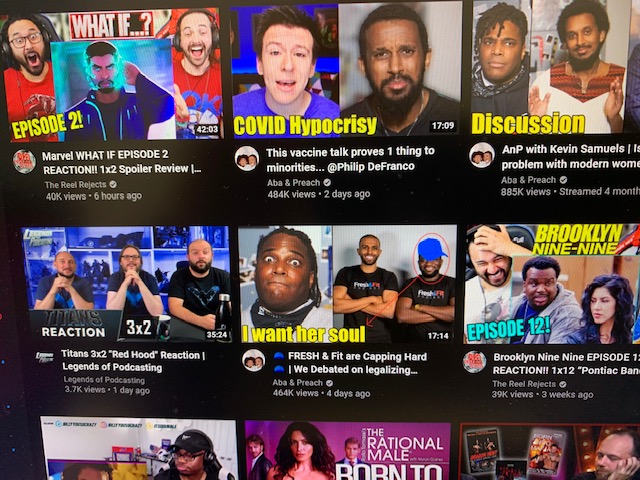
Anyway, one of the other podcasts I also watch is called Aba & Preach, and it involves two guys who basically address social topics and give their spin (or approach to them). What makes them unique is that they are very down to earth, really know their stuff, and basically call things as it is without ever turning childish in their approach. After a few years of watching their podcast, I’ve come to the conclusion that you can generally trust what they have to say because their worldly view rarely steers me wrong.

So, fast-forward, or reverse backwards, depending on your observation, Aba & Preach called out Fresh & Fit for some very specific content, pointing out that there were records of Myron actually telling women they had to give up sex if they wanted to be on the show and a bunch of other behaviors that went against the whole narrative of them being alpha males, and especially high-value men. The next day (or it might have been that night), Fresh & Fit did an episode where they acted like children and started making ad hominem attacks on Aba & Preach, and even went out of their way to start talking smack about Preach’s wife, who had nothing to do with the podcast whatsoever. This, in turn, led to a much more introspective criticism by Aba & Preach, which was both powerful and went over extremely well in the Youtube community. At the end of it, due to threats that were made from Fresh & Fit, Preach accepted a dare from the two Youtubers to box, and began to physically prepare to travel to Miami to do exactly that.

I should point out here that if you’ve ever seen Preach, you would not want that guy coming to your city to do any type of harm to you. He’s a big guy, and he has a certain disposition that indicates that he would back up everything he says with an equal amount of force. Myron and FreshPrinceCEO (his partner) seem to put off an air of being all talk, in comparison.

What happened next is kind of the point of this write-up. Fresh & Fit did a podcast the next day where they made a political apology, which if you’re not aware of what that means, they apologized to their subscribers for taking the wrong approach to this altercation. Aba & Preach responded with no intention of accepting the apology, stating, “the apology needs to be as loud as the insults” or something close to that. And they were right because at no time did their “apology” actually appeal to Preach, whose wife had been insulted, amongst other insults centered on Preach’s character, and even on his nationality and heritage. So, Preach has further indicated that he is moving forward with concluding the altercation as Fresh & Fit offered, in person and physically.

Today, FreshPrinceCEO made a podcast where he was buying a gun, kind of an out of the blue podcast that had no connection to any type of content either he or his partner has ever made. As expected, Aba made a statement on Youtube calling out FreshPrinceCEO on horrible optics and timing for such a podcast.

What’s really fascinating about this whole thing has been the response of the viewer base. For the most part, Aba & Preach have been hailed for direct, levelheaded responses and the commentaries have been nothing but positive. The commentaries on Fresh & Fit’s response has been horrible. Just yesterday, they lost 11k subscribers, which if you ask me, was the reason the “apology” was even attempted in the first place. They seem to be hemorrhaging members from their subscribers and while their most diehard followers support them, even on their own podcasts they are receiving all sorts of back and forth, rather than blanket support.

I find this whole thing to be really interesting because for the most part, what happens on the Internet rarely has ramifications, almost as if the realm suffers from the old adage of “any publicity is good publicity” or the opposite which is more of a cancel culture when you’ve upset the status quo and lose everything. The Fresh & Fit podcast seemed to be benefiting from the first axiom without realizing that ramifications can suck, and once they start to emerge, it’s like a slippery slope that doesn’t end until you’re at the very bottom of the hill with no way to get back up again.

So, over the next few weeks it should be interesting to see if they can survive this backlash, because I suspect that they are a lot like Hong Kong declaring war on China without realizing that might not bring the outcomes you want in the end.

The Logic of Dealing with Unmoving Objects

A number of years ago, I ran into a conflict that I never encountered before but ever since then have never forgotten. You see, I was an editor for the opinion section of a small newspaper some years back, and I had printed the article of a young man who criticized a group of people who were local moped riders that happened to be part of a moped community. The immediate response from that community was not dialogue explaining why he was wrong, but instead an extremely hostile approach that included attempts to attack the very nature of the newspaper itself, including physical threats and intentions of causing actual physical harm. This type of behavior went on for several days over the next week, and it was an immediate education in how irrational and quick to arms certain members of the population can be, especially when the moped community we were talking about was generally a very pleasant and friendly sort whenever dealing with pretty much any other issue beforehand. Basically, what it taught me is that people can be easily led to very dark places in very short times, and people are generally on the verge of being very irrational and unfeeling towards any other person to whom they are not personally accountable.

Fast-forward a couple of decades to today, and I’d like to share with you an experience I encountered only a short time ago. Over the pandemic, I started to view a lot more Youtube programming than I had in the past, and at one point, I was trying to find videos on how to get better sleep, and I came across the ASMR community. Interesting community. But they’re not actually the ones I want to talk about. But what I discovered is that when you watch a certain type of content on Youtube, you start to receive all sorts of recommendations for other content that is somewhat similar, and through one strange connection to the next, the algorithms ended up recommending to me content that mostly caters to what I’ll refer to as the “man-o-sphere”, a place where videos seem to incorporate a lot of male commentators who seem to have a lot to say about the state of dating in America. And what I discovered was that it was content that was filled with some very angry voices.

The thing about this content is that Youtube has a really weird algorithm-recommendation process that seems to suggest more and more outrageous content, thinking that’s the natural progression of what you wish to pursue. So, what started off as videos to help me sleep, narrated by very kind, friendly women with soft voices, turned into angry, violent “my way is the only way” right-wing women haters. The sad thing is that the transition in recommended content did not really take that long to occur.

Anyway, I could talk about this content for hours, but that’s not really what I came to talk about either. What I wanted to talk about was something I discovered called MGTOW, which happens to stand for “men going their own way”, which is basically an approach that men make who have given up on ever pursuing traditional relations with women because of a belief of something called “market forces” in dating circles that seem to value this elusive end goal of high value men avoiding any involvement with women who can never seem to measure up to a system of goalposts that become harder and harder for anyone to ever achieve. And a lot of the evidence cited will generally be some very specific types of data that point out that over the years feminism has changed both men and women in ways that make the man and woman dynamic from history more adversarial than it’s ever been and now more of a man vs. woman dynamic that constantly feeds into a zero sum dichotomy where men always lose out unless they happen to be part of this mysterious one percent of the highest value men.

Now, a lot of this rhetoric can be pretty persuasive, even if a lot of it is often cloaked in the retelling of a lot of wives’ tales involving statistics that are quite often repeated over and over to sound authentic, but when I started investigating a lot of the studies myself, I realized how flawed so many of them were, meaning that even some of the commonly held understandings in the community itself were based on misinformation. And let’s just say that as an outsider to this community, I kind of came in with a doe-eyed approach and thought one day that I’d share my observations with the rest of the world, because while some of it was flawed, some of it was interesting enough that I thought my public contacts might be interested in some of this information as well, and then, well, just decide for themselves.

So, I created a Youtube report of my own that was a little over an hour long, and I posted it, expecting my usual cobweb-like response. Instead, I got that response I remember from the moped community some years back.

When I did my report, I was reacting to the MGTOW community that I had observed, and I wanted to put it out there for others to know this community was out there. I wasn’t really all that critical of the community, but just presented what I saw. But then made a couple of blatant errors. The first was not realizing that some of the sources I was referencing in the story weren’t really considered a part of the MGTOW community, but kind of a secondary community that I had not even known was a thing. You see, there were levels of what I will now call the man-o-sphere, which is broken up amongst different philosophies, one of which is the dating strategy community, another being the pick-up community, one being a strictly anti-feminist community, and then kind of in their own corner of this hemisphere, the MGTOW people. Well, because I had titled this story something like “Finding out about MGTOW” and then going into my observations and analysis, an immediate campaign of dislikes started from people who were adamant supporters of a very specific MGTOW philosophy AND community. In my years of doing Youtube, I don’t think I’ve ever received a dislike for a video, mainly because most of my videos are designed to inform or help people. And within minutes of posting it, I had a few dozen dislikes from people and some really heated responses in the comments that were basically just very angry that something they watched didn’t seem to treat MGTOW like it was the greatest thing since sliced butter. And strangely enough, there was basically nothing negative that was even shared about MGTOW and its philosophy. It was like some weird signal switch had been hit and now everything that followed would forever bathe the room in darkness.

After the continued negative attention, and a tiny sliver of positives and likes indicating people found the report fascinating, I just took the video down and decided to never do a video on that population ever again. I quickly came to the conclusion that they weren’t interested in discussion, or even educating anyone about anything. For a population that doesn’t appreciate when women call them out for toxic masculinity, the response was pretty damn toxic and completely out of the blue. If I learned anything, it was that some people don’t play well with others and have no desire to come to any common ground to raise a common conversation. It also sort of illustrated exactly what seems to be wrong with our country right now and why it’s not going to get any better. As long as people remain in silos away from each other, our country is forever going to continue to spread apart at the seams.

I know this sounds a bit depressing, especially as I haven’t written anything in some time on this blog, but I really wanted to share this, and I’d greatly appreciate any insight you might have to share in response.