Category Archives: Writing

The Depressing Part of Being a Writer

Joshua had a few things he needed to say

There are a lot of writers out there who haven’t been that successful. Yet, they keep on plugging away, convinced that one day it’s all going to work out for them. I’m kind of in that same boat, but unlike the others who never had their chance, my chance came several times…and sort of fizzled away. Let me explain:

Years back, I was shopping my first book. I was in my early twenties, and I had written it while in the Army. It was a really good book called INNOCENT UNTIL PROVEN GUILTY. And it was published. Not to great fanfare, but it was published.

So, I started shopping my second novel, LOSER (which would eventually become LEADER OF THE LOSERS). Nothing. Not even a whimper from anyone wanting to sell it. One editor pointed out that perhaps it was the depressing title. Publishers didn’t want to publish books with such a negative title. So, it sat there, forever.

Then I wrote my next novel, the infamous The Armageddon Project, which was a story that took place during the Cold War. Keep in mind, it was written during the Cold War. But at the time, the Cold War was ending, so I quickly rewrote it to match the new events taking place in the world (much of the action takes place in East Germany and Western Russia). And then those regions kept changing, so I kept rewriting it. At some point, the title changed to match the main character (known as “the Unicorn”), so the title became TO TOUCH THE UNICORN. And then a publisher told me that the title was too much like a fantasy novel, but the novel was corporate/government espionage. He also said that it was hard to figure out what exactly the main character’s job was. At the time, I had created the concept of an economic hit man, but the concept was completely unknown in the 1990s, so it just couldn’t catch on. Years later, after Germany and Russia have settled into the republics they are, the story changed massively and is now being rewritten for about the 90th time, and it now takes place in 1991 during the August coup in the former Soviet Union. It’s now called 72 HOURS IN AUGUST, but it’s on the back burner for a rewrite.

Anyway, somewhere around this time, I was starting to make a name for myself as a writer. I had been writing tons of short stories and they were published in a bunch of different magazines. At first, they were published in mostly literary magazines, but then the larger presses started picking them up, and several prominent magazine editors started recognizing my name from previous things I had written. Things were kind of going pretty nice for me back then.

And then one of my novels was bought for publishing by a prestigious book publisher. And then I got an agent who once represented one of the greatest science fiction writers in modern times before he passed away. All was looking great.

And then the publishing company folded. Overnight. Without a single warning.

My agent got into an accident and severely injured her head. She dropped out of the business for a while to recover, and when she did, she seriously didn’t even remember who I was. I gave up trying to re-establish our working relationship.

And then the Internet exploded. Amazon became the biggest thing in independent writing, and the industry changed overnight. If you weren’t already established, you were basically an unknown, and if you were an unknown, you had to now start building a social following in order to even sell a single book. Not being really good at social networking (just has never been my thing), my career kind of just fizzled and died. Sure, I sell a few books here and there, but I might sell more just standing on the corner and asking people to give me a buck for a hand written copy.

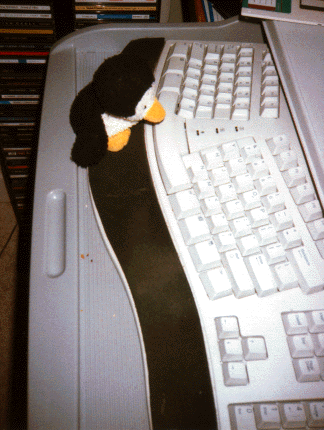
Fast-forward to today, and I’m the middle of writing an epic novel series that I suspect might not be read by more people than this blog post. I say this with trepidation because of the amount of time invested in this project. I’ve already spent seven years researching this thing, and I’m about to start putting actual physical work into writing it. Keep in mind that my last two projects took me each half a decade to produce, and my stuffed animals get more attention when they’re pulled over for drunk driving. My previous project took me six years to complete the first book (of a three book project). The research involved was extensive. It was called The Deck Const. Doesn’t matter what it was about because no one’s going to read it any way.

The project before that is probably the one piece of work of which I am most proud. When people talk about a crown achievement in one’s life, that book would probably be mine. It is a humorous novel that tells the story of the last hero of Troy who comes home to found a little civilization called America. It’s called THE AMERIAD, and it was so much work, and it involved so much research. But to someone reading it, one gets the sense that it’s a simple, fun story that seems very familiar. It’s told in Iliad/Odyssey format, and the main character is actually the translator who has interpreted this found epic in the only way the worst translator could possibly ever do. The book was so hard to write, especially in a way that made it feels so natural.

That’s the dilemma I find myself in as I finish up the last stages of research to begin constructing my Arthurian epic. And part of me wonders if my time might better be spent playing a video game instead.

Star Trek Online: Quark’s Lucky Seven

Some of you may find this relevant, and most of you probably won’t. It involves computer games, and more to the point, an MMO.
 
Recently, I’ve been playing Star Trek Online, which I’ve been playing off and on ever since it was first released back in 2010. Sometimes, it can drag on; other times, it can be just like being a part of the show itself.
 
So, a new update has occurred called Victory Is Life, which basically introduces the Jem’Hadar as a new character race (they were the bad guys of the Dominion from Deep Space 9). This new update is everything DS9, and a lot of the actors from DS9 are part of this update as well, providing their voices to their characters again.
 
Well, last night, I was playing through the new Jem”Hadar missions when I came across a mission called Quark’s Lucky Seven, which essentially is a Ferengi bank robbery type of story where you end up experiencing the story as the numerous Ferengi characters in the adventure.
 
At first, I thought this was going to be contrived and not worth it, but shortly into the story I realized that they had seriously upped the writing during this adventure. It was probably one of the best episodes the game has produced, and I would have to say one of the few stories I’ve played in this game that completely rivaled the best episodes of the show itself. There were twists and turns, surprises and just damn good writing and acting.
 
If they wrote episodes on this level throughout STO, it would probably be the most played game on the planet.

Remaining Unknown in a Viral World: Popularity, ASMR and Celebrity Status

Earlier today, I was examining the statistics on my website and realized that I have about 1.5 million hits on my site since I started it. That appears to be a lot, but then I started to think to myself that not a lot of people comment on it or send me messages based off of my web site (or its blog). So, this tells me that I seem to get a lot of traffic but apparently nothing seems to be going on with it. And yes, that opens up a lot of thought on a subject I’ll probably take up at another time (what do to with traffic when it gets to your site, as I don’t seem to be doing a whole of good with that area).

Last night, I was watching the latest episode of Law & Order: Special Victims Unit, which is still one of my favorite police procedural types of shows. And in this episode, an Instagram star hooked up with a MMA fighter and was raped, but it turns out the whole thing had been set up by a young woman who was a follower of both of their Instagram feeds. The prosecutor mentioned that a motive for the set up was that the Instgram model had tens of thousands of followers, the MMA fighter had 2 million, and the young, geek girl had 6. Therefore, this was vengeance against the two well known Instagram stars from someone who felt that she had an important voice but no one was listening to her.

That resonated quite a bit with me because I think a lot of us who aren’t big stars often feel the same way. Not that we’re about to set up someone famous like the plot line of this story, but at the same time the realization that there are people who are seriously famous for a sex tape, or for just looking good in pictures, can be a hard thing to face when one is trying really hard to become known as well, but doesn’t  have that advantage those pseudo celebrities have.

Recently, I’ve been following a bunch of ASMR artists who I find to be very good at their craft. In case you’re not familiar with ASMR, it stands for Autonomous Sensory Meridian Response, which according to Wikipedia is “is a term used for an experience characterised by a static-like or tingling sensation on the skin that typically begins on the scalp and moves down the back of the neck and upper spine. It has been compared with auditory-tactile synesthesia.” And even with that definition, you’d be amazed (or maybe you wouldn’t) at how many news agencies just don’t understand it, which you can see when they start to make statements that suggest watching President Trump gives “ASMR tingles” or when some celebrity posts a Youtube of her just staring at the screen and the media goes ga ga over her “ASMR video.”

In reality, ASMR is difficult to achieve and very few artists succeed at it. There’s a reason that there are a few very popular ASMR artists out there, and almost none of them are celebrities known for other things.

Which brings me back to my original subject, and that’s that viral popularity has a bad habit of creating an atmosphere that wasn’t intended in the first place. For those not completely familiar with ASMR, it’s pretty easy to fall into the trap of thinking ASMR is nothing but people whispering and making sounds with inanimate objects. And that’s because a lot of it comes from doing exactly that. But it also comes from a stronger understanding of how those actions can trigger the audience into feeling something more than just simple reactions. As a result, quite a few artists sometimes push the envelope and create what I’ve started to characterize as PG-13 ASMR. What I mean by that is ASMR that is designed to arouse rather than “tingle”, and for those not initiated in what ASMR, it can be very easy to mistake one for the other.

This happens quite often because the models who do ASMR are almost always attractive. Both male and female ASMR artists are generally above average in attractiveness and in their social tools for attracting others. This should be expected because this is a video environment where an unattractive artist is going to be avoided or ignored, and an attractive one is going to cause people to click the image being presented on the Youtube reception screen. This often resonates in the comments section of their videos where the anonymous nature of the Internet can cause trolling behavior you’d expect in a darkened strip club environment. To make matters worse, a number of ASMR artists chase the elusive crown of traffic and subscriptions (people subscribe to their personal channels), which leads to a revenue stream from Youtube. This causes the perpetrators of the more adult environment to keep pushing the adult envelope and the non-sexual artists to feel the need to participate because of loss of viewer clicks.

Youtube has somewhat cracked down on this phenomenon, but has done so with broad strokes that hurts mostly the non-sexual artists because they demonetize mostly based on viewer feedback, and the business has become somewhat cutthroat with an almost mob mentality towards those who are actually trying to comply and do the right thing. As usual, those are the ones who suffer the most, whereas the ones who are crossing the line are rewarded because none of their fans are ever going to turn them in for breaking any of the rules.

Which kind of brings me full circle in what I was originally talking about, and that’s the problem of trying to achieve any level of popularity in a bread and circuses environment where controversy, sex and violence are the things that attract the largest audience. How does the unknown artist achieve notoriety in a mostly celebrity driven world? In a free market mentality, one would think that the quality rises to the top and everything else remains at the bottom. But that’s rarely the case. Quite often, celebrity status is more than enough to create buzz so that its products remain at the top and everything else is left grasping for scraps. As a writer, I find this problem emblematic in the field because some really bad celebrity fiction gets serious attention when it’s not very good and it’s written by people who have about twenty years before they’ll actually ever write anything significant (if they were to work on it full time and not just in between movies or photo shoots). But the people who put in the work in hopes of one day becoming discovered may do so their entire lives and never get a nibble beyond a table scrap thrown their way.

So, the question is: Is there a balance, or is it just not worth the effort? I’m kind of on the cusp of this myself, as I’ve been writing for most of my entire life, creating computer games that were popular but too early for the industry to ever recognize, wrote music back in the day when such music was seen as too experimental, and any number of other creative tasks that have fumbled, fizzled or just never took off. People keep saying “Just keep at it and your day will come”, but part of me wonders if it’s just a crap shoot and my time might better be spent catching up on the latest season of The Walking Dead.

Whether an unread book constitutes someone being an actual writer

One of the common refrains heard from people who skirt the field of writing is that of someone who suspects that if he or she writes a book and no one reads it, is that person actually a writer. And there are numerous schools that try to answer this, much like a zen master talking about whether trees falling in the forest actually happen if no one hears them.

Lawyer and writer, Susan Wolfe, writing for Writer Unboxed, asks that same question and comes up with the inevitable answer of yes, you are a writer, which isn’t really that much of a surprise. But what does comes as a surprise to me is that her article goes on about how whether or not her second book sold was enough of a hit to allow her to want to write her third. That hit me kind of hard because it’s been a very long time since I wrote my third book, so it’s almost like I don’t ever remember having that conversation with myself.

You see, my biggest problem back in the day was whether or not to write my second novel. I had finished Innocent Until Proven Guilty early in my military career. And it was such a lot of fun to write. Then, I started imagining my second novel and decided to go with science fiction instead of mystery/suspense. And that got me to start wondering: Was the first time a fluke? Am I really a writer? Who am I trying to fool?

So, I sat down and started to write the second novel. And let me tell you: It was freaking hard. I kept second guessing myself, convinced that the first time was that one book everyone has inside of him (or her), and a second one meant you were really trying to be a writer. And about halfway through that novel, I can’t even begin to tell you how many self-doubts started flying around me. Yet, like all stories, this one had an ending, and I managed to muddle through it. That book became Leader of the Losers. Without a doubt, that was the hardest book I ever wrote. My third one, and those after, were never as hard as that second book. I’ve written 14 of them now. I’m writing my 15th.

But getting back to the original question of whether or not someone considers himself/herself a writer based on a particular book’s success seems almost irrelevant to me. I’m a writer because I love to write. I was writing stories for several decades before I wrote my first novel for actual publication. I had written hundreds of short stories that had been published during that time as well, which I suspect is a bit of a problem these days as not a lot of writers get their start that way any more. Instead, they’re expected to write their great opus out the gate, which is why so many self-published books read like someone’s very first thing they’ve ever written. Because it is.

To Susan Wolfe, I would say relish the act of writing more than the business of writing. If you’re doing this to “sell books” rather than to tell stories, I suspect you’re probably never going to find true happiness. You might find financial success, but that’s such a sad way to find one’s place in art. I’ve had moments where a turn of a phrase I came up with has lightened my entire day. I’ve had others where I’ve been seriously pissed off at a character of mine for doing something that I hadn’t expected. Writing finds those paths that logic can’t travel because each sentence is part of a journey, and a writer should constantly be trying to find new roads.

The Fear of Pissing Off Your Audience While Trying to Get One in the First Place

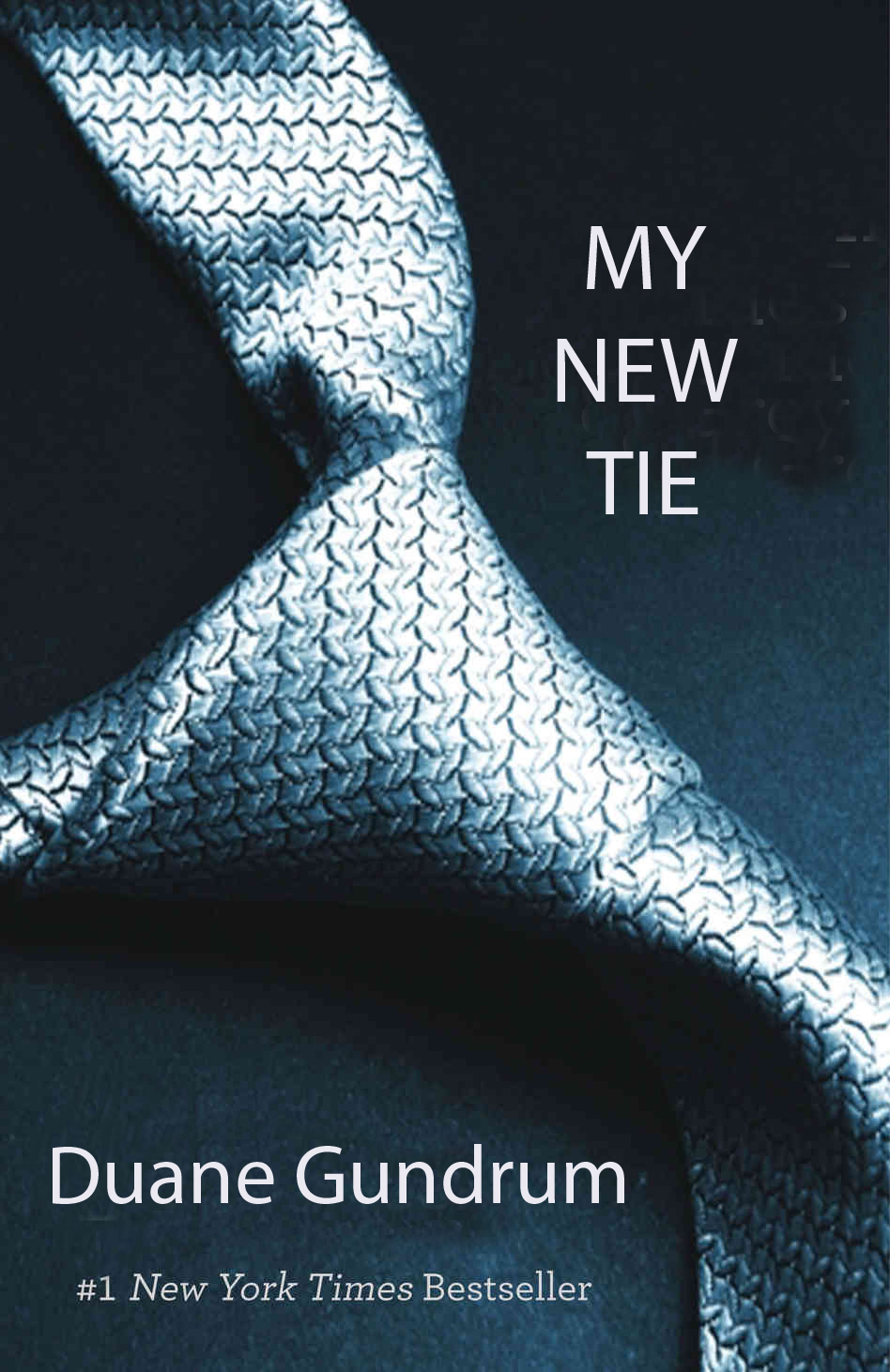
The cover of my new book. Someone told me it looks like something they may have read, but I’m not seeing it.

One of the problems of being political or taking a political stance is that chances are pretty good that you’re going to end up pissing off someone when you didn’t intend to do just that. As a writer, my goal is always to entertain as many people as possible, so whenever I deal with political issues, I get scared that whatever I’m going to say is bound to cause an audience member to dislike me. And these days, when someone dislikes you, that person tends to stop following and you never hear from that person again.

Therefore, it becomes a dilemma.

Because if one focuses on this type of fear then a writer is bound to water down whatever he or she has to say and only say the things that he or she hopes the audience is interested in hearing. And I can only imagine how bland and boring that might turn out to be.

The other day, I posted a tongue in cheek comment about something, and one of my politically correct “friends” corrected me and told me that I had to be careful, because saying such things can be construed to be wrong. I didn’t respond, but part of me was thinking: “Hey, I said what I said because it was something I wanted to say. If it bothers you, just ignore it or go frack yourself.” I didn’t say that because I’m a complete coward, but it did cause me to think.

And then the next week, that same person posted something that was completely one-sided, told in a tone that she knew best and anyone else who disagreed was obviously stupid. Basically, she did exactly what she told me not to do and then didn’t think anything of it. I then started to notice she does that all of the time.

Some people are like that. They are good at criticizing, but not so good at avoiding the behavior they criticize in the first place.

But then, she’s not a writer worried about people not continuing to read what she writes, and I am. So, there’s the dilemma.

Which kind of brings me to wondering how it is possible for polemic people to write the types of articles they do, knowing that people are going to be annoyed at what they write. I’m thinking about people like Ann Coulter, Michael Moore, and Tomi Lahren. The first two have completely established audiences that they’re probably never going to lose, but like the latter one, it leaves me wondering what kinds of risks is someone like Lahren willing to make in order to remain somewhat relevant in a very hostile media atmosphere. And part of me is also constantly wondering if part of the appeal is physical attractiveness as well, because if there wasn’t that, I kind of wonder at how many followers someone like her would have if the audience isn’t already cemented.

Social media seems to be one of those weird animals in that some people just come to it naturally and do really well right out the gate, whereas others, like me, take to it slowly and never really seem to reach the audiences they dream of achieving. It’s like the market for writing novel e-books. I’ve been writing for decades, and the readers I have tend to be the same readers who found me some years back. Others, I’ve seen them publish their first book and suddenly they’re selling them faster than Amazon can print them. Okay, Amazon doesn’t exactly print them, but you get the idea. I hope.

Some people just do really well with little effort while others succeed without trying. I’m starting to believe that that is how social media works for some people as well. While some people have the added benefit of being attractive to, well, attract others, those of us like me, toad-like in appearance, pretty much have to fight for each stride of existence. Okay, not toad-like, but I will admit that when my picture is put next to Brad Pitt’s, people tend not to stop and think: “Wow, I can’t tell them apart.” Definitely not. Brad’s got nothing on me!

Anyway, so the point is that getting an audience can be pretty tough and then once you do, it’s like walking on egg shells to make sure that you don’t lose any of your listeners. People can be pretty fickle about such things, and once you’ve lost a member of your audience, you tend to never get that person back.

So, if this bothers anyone who happens to be reading this, understand that it was someone else who said it, not me. I would never say anything to piss you off. Really. I’m just that kind of guy.

Please don’t go!

ASMR: One of the strangest phenomenons to hit Youtube

So, a couple of months ago, I was having trouble falling asleep at night, so after a bunch of frustrated attempts to sleep, I did what any 21st century geek would do: I turned on my computer and Googled something that had to do with sleep. And that was how I came across a video of a woman on Youtube who whispered and made unique sounds while trying to help the viewer fall to sleep. That was also the first time I had heard the term “ASMR”.

ASMR, or lesser known as “autonomous sensory meridian response” is a really niche segment of the Youtube population that caters specifically to people filming videos of themselves talking to the camera while making various sounds that are supposed to activate “tingles” in audience members. So, this could be anything from scratching a piece of paper to extremely elaborate presentations of mixing jugs of water back and forth. Sometimes, the purpose is to help someone sleep or relax, and other times it’s just to evoke some kind of response from the person watching the video. And those responses can be all sorts of different types.

After a bit of time of crawling down this rabbit hole of ASMR, a couple of things start to become apparent.

  1. The people involved in this phenomenon are like most Youtube channel owners. They want subscribers, which causes them to have to do more and more things that differentiate them from other people doing the same sorts of things. In the beginning, I was following a couple of the artists who were doing very generic, sleep type of videos, but then I started to notice as their time line stretched into the present, they were doing more and more elaborate types of presentations. Rather than just speak to the audience, I started to see role play presentations where the artist would pretend to be a doctor, a nurse, a police woman, a vampire, or pretty much anything else you might imagine. The ASMR activity would remain similar, but the antics would become much more involved in the script than the results the artist was originally trying to achieve.
  2. The subscriber aspect of the system favors women more than men demonstrably. While I did observe a few men who were doing regular ASMR videos, the majority of the material coming out on Youtube was strictly women. Young women. And very attractive women. Which then led me to start to observe that more and more of the highly successful ASMR artists tended to have a very interesting history, where their videos began as generic, fun videos and then slowly became much more sexualized, somewhat PG-rated. It practically opened up a separate category of ASMR, which I began to call “Kidnap ASMR” where a woman would roleplay that she has “captured” the viewer and was now doing ASMR stuff to him/her. This type of thing ranged from crazy girlfriends kidnapping someone she was in love with to female police officers “arresting” someone and interrogating the person for “ASMR activity.” Some became quite innovative, like artist “Innocent Whispers” who orchestrated a series of videos where she pretended to be an officer of the FBI, “Federal Bureau of the Internet” and she was investigating individuals who were brought to her so that she can ascertain their level of ASMR response. To this day, I’m still trying to figure out if her purpose in the roleplay was to “catch” people for their ASMR interests or to do research for her somewhat weird federal agency.
  3. There seems to be no end to the types of sensory responses that ASMR artists are capable of exploring. When I first started watching these videos, the type of “noise” the artists would focus on was usually some type of tapping (fingers on surfaces, devices on other devices and on the microphones themselves), and then as those videos became somewhat generic all sorts of alternative sound-generating possibilities were explored. One recent video focused on fire, as one woman continued lighting matches over and over again so that the listener/viewer experienced both the visual aspect of the fire and with an extremely expensive microphone also experienced the auditory sound of the fire erupting each and every time the match was struck.
  4. Whispering is a huge segment of this activity as well. Very rarely does the artist raise her voice above light speaking. Most of the time, whispering is how the artist communicates with the listener. My experience so far has caused me to believe that the whispering creates a much more personal experience between the speaker and the listener.
  5. Most often, the atmosphere is one of positive energy. Quite a few ASMR artists tend to focus on trying to make the listener feel better in some way, whether the reaction be a state of hypnosis, better ability to sleep, feeling good through positive affirmations or any other positive type reaction. I’ve seen a few specific ASMR videos that are designed to be the complete opposite (such as “negative affirmations” where a woman basically insulted the listener nonstop) but those are rarities and seem to be more fetish-based than a part of the overall scheme that ASMR tends to represent. Quite a few ASMR videos are designed around the concept of making the listener feel better.
  6. There can often be a lot of humor incorporated into ASMR. What probably leads to a lot of the hits that ASMR artists receive (and the large numbers of followers/subscribers) has to do with the personality of the artists themselves. Humor is often one of the strongest points of the better known ASMR artists. Humor becomes a huge part of the bantering of the artist as she communicates with her following. However, I have noticed that when humor is the intent of the actual video, it tends to not do as well, which suggests that incorporating humor is good, but focusing on it doesn’t yield the same positive results.
  7. ASMR is not limited to Americans, or even English speakers. One phenomenon I’ve noticed is that quite a few artists are from variously diverse places across the planet. Some of the better known ones are Eastern European, Korean and Japanese. However, quite a few of the ASMR videos tend to be in the English language, and if an artist does not strictly do English language videos, there will be a few here and there as the artist starts to become better known. However, as a lot of ASMR can be conducted without any words whatsoever (tapping, inaudible whispering, etc.), a number of non-English speaking ASMR artists can strive and do well with non-specific language videos.
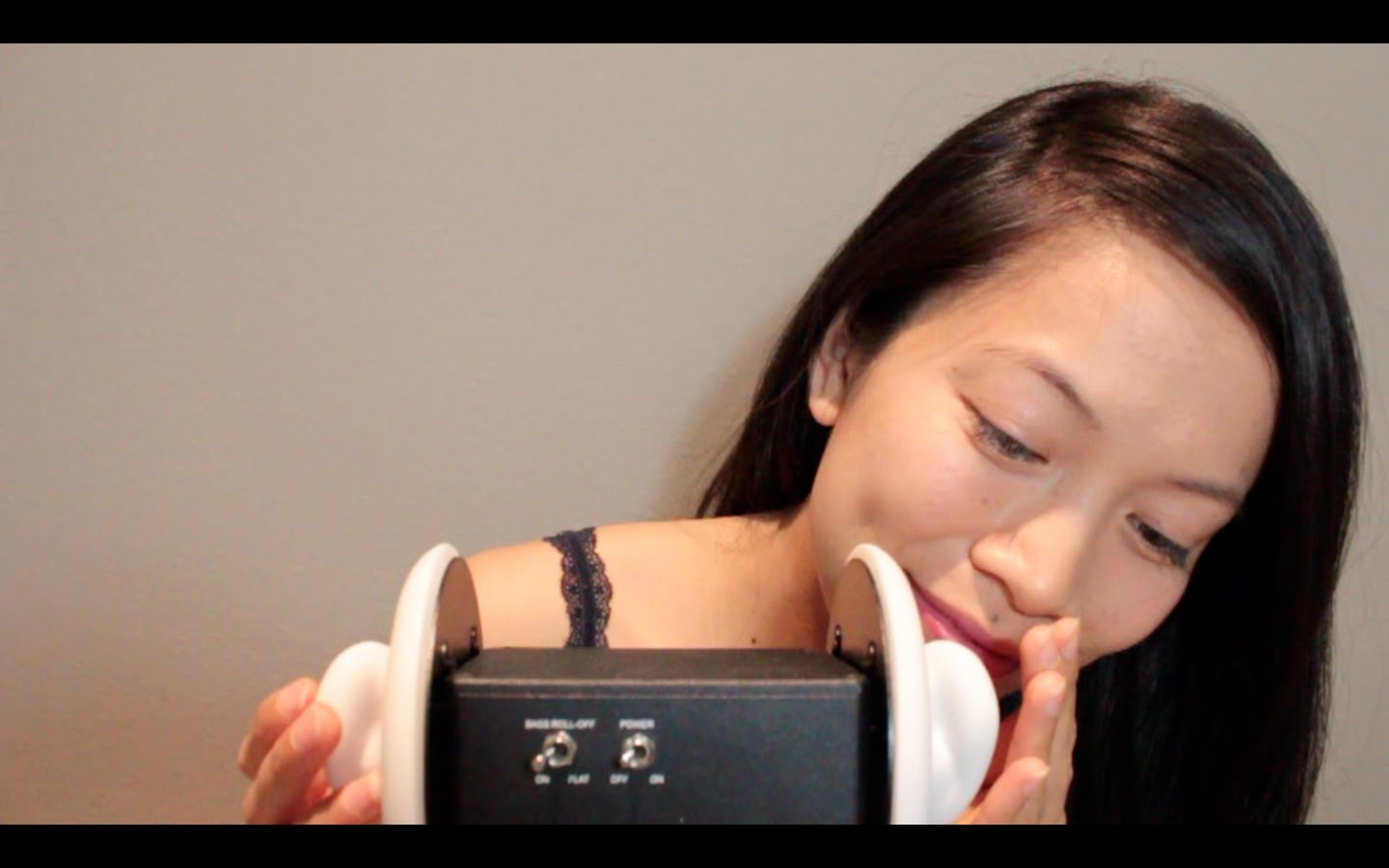
  8. The microphones themselves are quite unique. Before studying this are of Youtube, I thought I knew something about microphones. But I was wrong. I knew nothing, Jon Snow. What they use in a lot of ASMR videos is this type of microphone I have here as a picture. It is almost like a person that the artist is speaking to (including ears). Quite a few artists play with the “ears” and it can sometimes be a bit weird (well, to me). However, the microphones are extremely expensive and are set up to handle stereo recordings, which means that when the artist moves to the left side of the screen, if you’re listening with headphones, you are going to hear her voice come out of the left speaker, so that it can actually feel like the person is walking around you as she is two dimensional on the screen. This microphone in the picture is about $600. I’ve seen some of the microphones (including one that’s a representation of a person’s head) run for close to ten thousand dollars. Obviously, some of these artists are extremely invested in this activity.

So, this has been my adventure so far in studying ASMR. I got into it once because I was having trouble sleeping, and then the communication scholar in me started to see this as an untapped area of exploration that I believe more people should be aware is happening around them. The phenomenon is relativity new (still pretty much in its infancy in comparison to other phenomena), but I suspect its continued evolution might lead to all sorts of interesting perspectives and insights.

Why the Idea of Celebrities on Twitter Drives Me Nuts (and why it should do it to you, too)

For those who don’t know it, I have a Twitter presence (@duanegundrum). It’s not extremely popular, and I’m lucky if I get a “like” here or there. Mostly, it’s me ranting or making jokes, and no one in the world knowing the difference. As a writer, I have about 5,000 followers. I follow about 500 people. Not great, but not bad either.

At the same time, someone like Kim Kardassian has 54 million followers. She only follows 104 people. Compare that to the most popular writer in the world, Stephen King, who has 3.48 million followers (and follows 63 people). If you go through the lists of really famous people, they tend to have millions of followers and really don’t follow anyone else. In case you haven’t figured it out, they use Twitter as a megaphone, not a tool to communicate with their followers.

When Twitter came about, the idea was that it would be a great place for celebrities to communicate with their fans. But instead of actually “communicate”, they pontificate and there’s little communication that takes place. To make sense of that, you have to understand what communication means to begin with.

Communication, as explained by professors today, involves information exchange between at least two entities. But what’s important about that model is that it’s not just one side speaking to a listener. It’s an exchange of information, so that the receiver then becomes the transmitter and the process continues until the channel is finally closed. In other words, a telephone is used for communicating; a television is not.

When I got involved in Twitter in the early days, I had about 25 followers. They were mainly friends of mine. Over the years, fans and acquaintances joined those numbers, and now I have about 5k, which is a larger number than most people who aren’t straight out celebrities. But part of the “drug” of social media is the desire to constantly improve those numbers so that more people are listening to you or (in my case) having a conversation with you.

There are few people on Twitter I’ve come across who are actual convervationalists. They write stuff, and they respond to stuff. Generally, they have a lot of people who they follow. Others tend to have fewer people they follow but they respond quite often to people who respond to them (which is actually a pretty healthy conversation). George Takei (of Star Trek fame) is one I’d consider in this category (@GeorgeTakei, 2.44 million followers and follows 643 people).

This has often left me wondering how to break into this category of actually making my voice heard. And then I reached a crappy conclusion as an event occurred that I didn’t even realize was happening to me.

I often respond to celebrity posts that are of interest to me, specifically anything that is communication-related, political, or involves writing topics. One pretty famous celebrity (known for his role as one of the current crop of superheroes) posted something about media, and I responded with a Twitter message, basically pointing out how certain messages are put forth by media outlets by using specific phrases, like “some people say”, which is a common vernacular of “Fox News”, brought up often by Jon Stewart of the Daily Show during his years heading that show. The celebrity responded with something like “that’s like what they do on Fox News”, as if it was a new insight. That response received no small number of “likes” from his fan base.

So, since then, I’ve been receiving nonstop “like” notifications of his response while not a single one of them has actually come across from my actual post, meaning that the likes weren’t for the idea but for the fact that someone famous repeated it after me. It’s like the old infamous adage in the science community of how a great idea is irrelevant; communicating it, however, is what’s more important.

So, for all of you out there trying to get your voices heard, this is somewhat of a sobering thought. You can have the greatest ideas and insights that have ever existed, but if you don’t have a megaphone to let anyone know, your idea will never be heard. McLuhan’s idea of “the medium is the message” couldn’t be more significant than today because it may be the only way you will ever be heard. And with all of the noise of Kardassians and reality star driven, your chance of being heard is only going to get that much harder.


Most heterosexuals will never encounter the T in LGBT and that’s really the problem

When I was very young, I remember my grandfather once telling me that the way to understand people I don’t understand is to actually interact with them. At that age, I remember him having me introduce myself to random strangers at the mall in Santa Monica, California. It didn’t really matter to him who the person was; he wanted me to approach and meet every person I could.

Now, today, that probably wouldn’t be the greatest approach when dealing with a kid because of how our society has changed to where people practically fear any stranger, but back in that day, it worked. And I learned a lot from it.

That approach carried me through most of my life, and I’m glad for it, but at the same time I understand that not everyone had that kind of upbringing. I was lucky to grow up in a diverse community where there were people from all walks of life. I wasn’t lucky to be born into poverty, but part of me thinks that there were some advantages to that situation, and one of those was the ability to exist with numerous groups of people who gravitated towards the lower end of the economic ladder. Having lived in both sides of the economic spectrum, I would like to think I’ve picked up some of the positive qualities of both. I probably also picked up some of the negative ones, too, but what is a life that doesn’t involve some bit of reflective wondering in hopes of living life to its fullest?

Growing up poor, I lived with those who were always on the edge of despair, if not deeply in the middle of it. Serving in the Army, I was exposed to all sorts of different races and ethnicities, not as separates but as comrades and allies. After the service, I traveled the country, living in numerous communities for months at a time and then moving on to find another. The people I met, and the stories they had to tell and share, filled my memories for the wonder that each and every one of them revealed. After my wanderings, I ended up back in San Francisco (kind of where I ran out of money and had to actually find a “real” job), and I was exposed to all sorts of new experiences.

I should probably mention one of the important aspects of my character, and that’s that people tend to share a lot of information about themselves to me. Partly because I’m receptive, partly because I’m easy to talk to, and mostly because I care about what people have to share with me. A friend once told me that I should have been a counselor or a psychiatrist because of how good I was with people, but I never went that direction because I always felt I was getting something great out of every encounter and taking money for it would have felt wrong.

So at some point I went back to school to get another degree. And this time around, it was different. Before, I went to West Point where my approach was a career in the Army. This time, I wanted to learn about things I missed the first time around. I didn’t even care what it was I was studying. I just wanted to know more abut things I didn’t know.

What kind of things did I learn? Well, aside from rote memorization of school material, I started to learn a lot more about the people who existed around me. I discovered there were people from all sorts of different walks of life. I befriended guys who were paying their way through school by waiting tables but intended to be investment bankers when they graduated, women who wanted to help people by becoming social workers yet funded their education by tying up men and spanking them in dark, air-conditioned lofts above laundromats, nervous English-Second-Language students who signed up for debate because they knew they were destined to be criminal attorneys, and so many others who were all individuals, each with his or her wonderful, personal story that was both unique and important.

One of those unique individuals I came across was someone I’ll refer to as Bobbi who was the person who lived next door to me in a really run-down, flea-infested flat I was living in when I first went back to school. Bobbi was one of those shy types of people who avoided others but always smiled when you said hi, even if the response was nothing more than somewhat of a grunt or nod of the head in recognition. What I found most interesting about Bobbi was that I could never tell what gender Bobbi was. On the surface, Bobbi appeared to be a man that was slowly turning into a female. The hair was blond and frilly, kind of later Farah Fawcett-like, but the mannerisms were quite often both male and female, almost as if they were still fighting their way towards the surface. I remember the apartment clerk once remarked: “She’s in that transition stage where she’s still trying to determine which way she’s going to go.” Future conversations with this clerk indicated that he thought the confusion wasn’t necessarily Bobbi’s but a struggle with how Bobbi wanted to be perceived by those around her (months later, Bobbi said she preferred the pronoun “she” and I’ve never given it another thought).

A few years later, I was working for a church that had a transgender member (for identification, I’ll call her Chris) who was having a very difficult time with those around her. She was very much in the same stage that Bobbi had been, but the struggle was much deeper as this person was scared to make changes because of how she perceived others might not accept her in that capacity. Unlike Bobbi, she quite often returned to her male “self” in the circles of others because of how she felt they might think about her. Years after I parted ways with that organization, I heard from a member of that group that someone had attacked Chris as she was walking home from the church, and she was seriously beaten, to the point that she has never actually recovered.

I’ve known a few more over the years, but to be honest, I don’t think of them as transgendered people I’ve known, but as people I’ve known that just so happened to be transgendered. And I think that’s where the problem stems for so many others who see people who are different as some kind of affront or challenge to them for reasons that make little sense when you spend any time thinking about it.

This is probably why I think being a writer is important. If I was a filmmaker, I think I would want to touch on these subjects as well because what I’ve started to learn is that not a whole lot of people have the life experiences that I’ve had. Instead, they’ve had more sheltered lives that create all sorts of barriers to thinking differently than anything they’ve personally experienced. Hell, I wouldn’t be surprised if there are things I’m still struggling with, simply because I’m not perfect, nor have I had every type of experience one can have to tackle so many of these issues. But I would like to think that having some of the experiences I’ve had, at least I’m willing to explore new ideas and opportunities.

And that’s what I fear for those close-minded individuals out there who see the world through a closed prism. And it’s probably why a common individual can have such hateful thoughts and still think he or she is a good person. I wish there was a way to expose everyone to a world of experiences so that they could reach that understanding that hating a person for being different is equal to hating one’s self for not being open enough to want to learn more about one’s fellow people. Because once you live with the people you might hate, chances are pretty good you’re going to be forever changed by the experience.

Why Has the World Gone Downhill? An Analysis of Violence


One of the common tropes in storylines, especially for fantastical fiction, is the idea of returning to a period of time when things were “the old ways”, kind of like a time travel journey to the 1950s, or even a trip to the ancient past. The main character is seen as a fish out of water as he or she tries to use his or her knowledge of that time (and his or her future time) to get through such an experience. Now, part of me was thinking of focusing this post just on the writing aspects of this sort of speculation, but while I was thinking this through, I started to wonder something, and specifically I was wondering why we became what we are today rather than having continued the way things were “back in the day.”

This was prompted by an article covering a shooting that took place in Denmark and how that community (and that country) is now having to do things to make sure that such a tragedy doesn’t happen again. In other words, they are going to become a lot like other places around the world where violence is somewhat expected. I mean, no one wants to be caught off guard, right?

And that got me to thinking about that infamous line that used to happen in the United States whenever something tragic occurred. If this was the 1950s, the response would be something along the lines of “I can’t believe such a thing like that could happen here.” Or my other favorite: “I can’t believe Bob did that because he always seemed like such a nice guy. That sort of thing just doesn’t happen here.” I think you might be getting the picture.

In the 1970s, that message, while still happening in areas where you wouldn’t expect to hear it (part of the response to gun shootings that were happening in rural areas rather than urban settings) slowly changed to “I can’t believe that happened here. I mean, it’s not like we live in Chicago/New York/Detroit.” In other words, it was starting to happen in urban environments, so we were starting to expect stories like that, but it shouldn’t happen in a place like Wheatfield, Wyoming (if that was a real place). But now, it’s happening all over the United States, so that every new story that happens is treated as a one-off case of an almost expectant event, even if where that event took place might have been speculation before it happened. It’s happened so much in the United States that we’re now starting to be surprised by these stories happening in other countries, rather than by ones that happen in the United States.

So, because of the way these trends work, we’re going to be seeing more and more of this violence happening around the world in places where we’d last expect to see it. And then we’ll have to be surprised by something worse, like the level of violence, the perpetrators of the violence, or some other factor we haven’t considered yet.

Which leaves one important question:

Why?

Why are we seeing this sort of thing becoming a norm for our communities? Are we desensitized to violence so we now accept it as a part of our natural order? Is the human species evolving into a much more violent, chaotic creature that holds little regard for fellow humans? Is that creature devolving into the types of people we used to be before we took the Hobbesian path and developed government around us to protect us from each other? Is it because our means of hurting each other have become much more convenient and useable? Or are there other factors that cause us to do the sorts of things we do to each other these days?

Desensitization

There’s a lot of theory that addresses this possibility, mainly making the point that as people are exposed to more and more sensations of a certain type, they no longer find themselves affected by it and either no longer seek such sensations or have to increase the type of exposure to reach that level of influence again. We see this all of the time with the drugs we take, from cigarettes to alcohol to both legal and illegal substances. Most of the time, the first exposure to the item causes an initial positive reaction which is then transferred into a loss that needs that input again. Continuous exposure acts as a certain punctuated equilibrium, which means we get used to a higher level of usage and continue to have to increase the dosage to provide the same “high” that we had before.

For violence, there’s no reason this wouldn’t work the same way as well. We become comfortable with the amount of violence we’re exposed to and then seek out higher levels of violence. As exposure theory goes, it makes sense.

Or does it? The problem with exposure theory is that the influence might increase for an individual, and it would take more and more violence to affect that person, but why would this somehow translate to people in other areas now experiencing violence where they didn’t have it before? The theory doesn’t explain that, unless the idea of violence is that it’s more of a virus that spreads rather than something that occurs in pockets and then spreads out, affecting those previously exposed to it.

Another possibility involving that theory is the types of violence inherent in the system. An argument is often made about video games, television and movies that might be desensitizing people, and unlike the virus affects of spreading violence, these would feed on subsequent communities just by the appearance to where people would consume these types of media. Again, that’s assuming these activities to be a causal factor rather than as a recognition of the violence (meaning no causal effect at all, or very little at least).

But I don’t want to just ignore the possibility because from first hand experience, I remember being a fan of horror movies when I was growing up. I remember watching the very first Nightmare on Elm Street with a bunch of military coworkers, and I was shocked at the violence in that movie, and it was extremely scary (at that time). Having watched many horror movies during that period of time, I remember watching that original movie again years later and thinking how tame it was in comparison to “real” horror movies. I certainly didn’t feel that way the first time I watched it. So, there’s a bit of desensitization going on there, or it may just be a stimuli adjustment. Or it may have no connection at all to violence because if one sees it as “reaction to being scared” rather than “reaction to violence” there may be absolutely no ties whatsoever. Again, something to keep in mind when analyzing such phenomena.

Evolution of the Species

This is one of those possibilities that truly scares me because with evolution, you have the whole survival of the fittest thing going on, and if the fittest is the most violent, then we’re in for some really bad problems. But what if our dilemma is that the human condition is now one that is favored through violence rather than through cooperation? There’s a strong believe that through our evolution, we have reached a point where social communities are what propel us forward beyond the previous adaptations and around other species that didn’t achieve this level of evolutionary maturity. Okay, if that’s the case, why is violence becoming more and more a response to how we handle these social encounters instead of community and broad cooperation? If our evolutionary process made sense, there would be a strong possibility that people would find ways to get along in diverse circumstances (instead of taking a gun to work and killing the boss during an altercation) and on an even higher level, we should probably see fewer wars and regional conflicts.

But we don’t. Instead, after several wars to end all wars, we’re still as violent towards each other as we’ve ever been. Right now, our Congress is meeting to figure out how to give our president more authority to attack people we don’t get along with. For some reason, no money is being discussed for allocation that will be spent to foster peace with the people we don’t get along with. The response to this criticism is “it would be a waste of money because they don’t want peace”. And we know this why? Because we’re currently trying to kill them while they’re trying to kill us (or at least allies of us). In our present sense, we see what we’re doing as justified, yet we’re still doing the same violent things we were doing in the past, and now we just have more efficient ways of doing it.

So, the question is asked, are continuing to become a more violent people? And I don’t mean just the United States, or the west, or anything like that. I mean humans as a whole. Are we just becoming more violent?

Or were we always this violent? Except we had governments that were capable of keeping us from killing each other (except during national campaigns where they got to send people out to kill in their names)? If you’ve ever been to war, it’s a pretty brutal experience. Oh, we like to fluff it up with 21st century technology and act like we’re doing something much different than how our forefathers fought, but when it comes down to it, you still have people out in the middle of some place they don’t want to be trying to kill a bunch of other people who don’t really want to be out there doing that either. And we pin medals on the ones that come back alive (and sometimes those who didn’t), and then create celebrations for the sacrifices they made. But in the end, we’re rewarding a bunch of people who are doing things that civilized people probably shouldn’t be doing any way.

But of course, someone will say that the others guys MADE us do it, that they were out there doing atrocities. And I’m sure the other guys will say that those of us attacking them were doing all sorts of affronts to humankind, like sleeping with each other on the wrong days of religious texts, eating something that someone’s interpretation of God says people shouldn’t be eating for arbitrary reasons that someone else will defend to the death, and all such other reasons (some good, some ridiculous, and some just straight out confusing, even to the people following them).

Which kind of pushes the whole Hobbesian argument that maybe we’ve been comfortable and safe from the mannerisms of our fellow humans by a simple agreement to follow some arbitrarily chosen noble whose real purpose is to make sure that people don’t go around killing each other all in return for a promise to make sure that those who DO kill each other will be held responsible for such actions (so that might keep them from doing so). If our only reason for avoiding violent tendencies is because of some agreement our ancestors made with each other, then it might not be surprising why a civilization that tends to teeter closer to anarchy might not feel the need to follow preordained orders of a monarchical society that leads for the simple reason that those in charge just feel they should be in charge.

Think of it this way. If you’re a citizen of an order that you don’t believe in any more, because few in that society do, and lump that in with a belief that there’s no reason to live the life that your ancestors did because that’s only going to provide a lifetime of hardship and destitution, there are people in your life (or on the edge of it) you don’t like, and you see violence as an option rather than something to avoid, I wonder if that would explain why a lot of these events are becoming a norm rather than the anomaly they used to be.

I mean, let’s be honest. I don’t have the answers. But I do have a lot of questions, and I’m starting to suspect that people aren’t really asking questions any more but are just pontificating about what they think are the answers to a whole lot of questions that people stopped asking.