Monthly Archives: June 2013

Things About Diabetes They Don’t Talk About

Don't do it! You'll get diabetes!
Don’t do it! You’ll get diabetes!

I apologize for taking a detour on a site where I normally talk about writing, self-publishing, computer games and all things stuffed animals, but recently, I’ve been going through a bit of a struggle with my health, and it finally hit me hard enough that I thought I would dedicate a little space and talk about it.

First off, I’ve been a diabetic for a good portion of my life. Most of it is genetic, as my mother’s side of the family had the disease and both my mother and grandfather died from it. I don’t know anything about my father’s side of the line, so I’m going on limited information here. However, I did have the opportunity to see how it affected at least two of my family members, and to put it simply, it wasn’t pretty. It’s a crappy disease, and if you don’t have the ability to afford the best medication, you’re pretty much screwed. Both my mother and grandfather were poverty stricken, and that’s the greatest petri dish available for that disease to take you down.

I’m not in the same financial circumstances, so one would think I’d have access to better medication and treatments, and I have been, but I’m discovering that it’s really not that much of a benefit when it comes down to a really crappy disease. While I’m not stuck with having to inject myself with throwaway needles every day (they have what are called pen needles that use a different needle, but you use the same injector pen until it runs out. These days, not everything has to remain refrigerated, and let’s just say that with needles that are less intrusive these days, it’s a lot better today than it used to be.

However, what they don’t tell you about are some of the things that happen with this disease that’s different with each individual affected. One of my pet peeves about this disease is how many “experts” exist out there who know a fraction of the information about diabetes that I do, but somehow speak as if they’re experts in the field. These are the people who say things like “well, you can control it with diet” or they’ll point at whatever you’re eating and say “You’re a diabetic. Should you be eating that?” Unfortunately, our legal system frowns upon my desire to shove an ice pick down their throat, so let’s just say that being a diabetic means being subject to every whack a doodle wannabe doctor with two years experience of watching House on television as their “residency”. Or worse: “I know a guy that had diabetes, so let me tell you about everything I know about the disease” which usually means falsehoods and stereotypes of medical information.

But to understand the really bizarre nature of this disease, I have to give you a little history about myself, because there’s no better way to explain it than taking it from that perspective. You see, some years ago, I used to control my diabetes through diet and exercise, keeping myself in somewhat decent shape. Then my pancreas decided it didn’t want to secrete as much insulin as it was supposed to do, so I was put on oral medications that helped my pancreas produce more insulin. And then about a year ago, that stopped working, and somehow my kidneys started to shut down. I ended up in the hospital, and fortunately I didn’t end up on dialysis, but was pretty close. However, all I could remember was the nurse who kept making comments about how I was lucky that I didn’t have to go through dialysis, giving off the impression that somehow this was my fault. You know, the claims of you didn’t take care of yourself well enough, you ate badly, and your not checking your blood enough to maintain your sugar levels. Almost every conversation with her was like hearing how I would now have to be doing something different, and it was now on me to make things better. The fact that I was watching what I was eating and running/biking didn’t seem to make a difference. Again, it was all my fault.

After I got out of the hospital, they decided that the old way of maintaining my sugar levels hadn’t been working, so they put me on insulin, something I used to equate to “you’re going to die very soon after that, Duane.” I’d seen it happen with both my grandfather and my mother. Once they got put on insulin, it was only a matter of time before everything fell apart and they died. Everyone kept saying, this is 2012 (at least when they said it), and not the 1970s; medicine has come a long way. People live long, productive lives with diabetes.

Well, one of the problems of taking insulin, at least for me, is that my weight shot up big time. It’s been on an upwards trajectory that I can’t seem to stop. I’m not talking a few pounds here and there. I’m talking a trajectory that has increased my current weight to a level that my body has NEVER reached before, even in a short period after I got out of the Army and let my body go completely to waste (before wising up and getting back into physical shape). The problem is: It’s not stopping.

One of the problems that’s emerged is bloating of my limbs, which makes it so much more difficult for me to walk (and obviously, run). I have trouble putting on my shoes every morning because my feet have gotten so bloated that my shoes rarely fit, and I have to force my feet into my shoes, until my feet settle down and my shoes begin to feel a lot more comfortable for the day.

My usual response to this sort of thing has been exercise, which I attempted to do, but here’s one of those things they don’t tell you about. I just don’t have the energy. I tried going running a few weeks ago, and I didn’t make it steps before my body practically just conked out on me. So, I tried doing walking instead, and let’s just say that I’m running into some complications with that as well. Last week, I decided to walk two miles (basically taking the sidewalk around the complex where I live and down the street before coming to the back exit of where I live). On Monday, it was tough, but at the end of it, I felt pretty good. Exhausted, but good. I gave it a few days and then decided to go for the same walk on Friday. I made it about 1/3 of the way before I hit a wall that I’d never experienced before. I couldn’t walk another step. I realized I wasn’t going to make the trip, so I tried to turn back around and walk home. In only a few steps, I felt like I was drunk on a night full of tequila, except I wasn’t getting the enjoyable feeling you get when you’re drunk on tequila. I just couldn’t walk straight. I’d go a few feet and start to fall down.

I made it back to the housing complex, but still had about half a mile to go to my apartment. I couldn’t move. I fell down on the grass and just laid there. After some time, a nice woman in a truck drove by and asked if I was drunk. I tried to explain what happened, which was probably a lot like some drunk trying to explain the preamble to the Constitution. After awhile, she probably figured I wasn’t some guy she had to fear, as I couldn’t even stand up, so she drove me home. I stumbled up my stairs and then into my apartment, collapsing on my couch, waking up early Saturday morning around 1:30 in the morning.

My solution to this sort of problem exists already in my apartment. I bought a treadmill some months back and have used it a couple of times. If I used it regularly, I wouldn’t even have to leave the house. But it appears I bought the one brand of treadmill designed by Loki because even on the manual mode, I’ll walk for about two minutes or so and then suddenly it will start to speed up. In seconds, it will be at a speed so fast that I can’t even keep up. Again, this is MANUAL mode. Then it might slow down to a point that is like watching a slow motion runner going even slower than physically possible. Again, another one of those frustrating things that could have been such a great solution.

But back to diabetes. The worst problem is that I have two doctors I see who don’t seem to care. Oh, they care, but they care about things that are relevant to other issues. Like, they care about my blood sugars. As long as they’re normal, they seem to think we’re on the right track. Sure, my blood sugars are normal, but I’m not. My blood sugar is great, but my body is falling completely apart. At this rate, I suspect I won’t survive the year. That’s not hyperbole; that’s rationalization. I’ve always been somewhat of a rational kind of guy.

But that’s my tale of diabetes I wanted to share with you. I figure most people have read the first lines of this article and just went onto the next one, and I understand. Unfortunately, I can’t move on; I’m sort of stuck here.

Why Free to Play MMOs Still Have a Ways To Go

The protest is getting out of hand
The payments are getting out of control

One of the new trends in online computer gaming is the free to play model, which shouldn’t be confused with the Buy to Play model. Let me explain the differences in where computer gaming is today.

Buy to Play: The Buy to Play model is where you buy the game, and then you get to play it forever for free. Usually, the game is expensive, like $59.99 for both Diablo III and the same price for Defiance. The upside to it is that you continue to play the MMO forever, but you had to pay the full price for the game beforehand. How the company makes money is both from the initial sale and from any purchases you make in the game after that. Also, if they create an expansion pack, they’ll charge you for that. Almost every Buy to Play MMO I’ve bought has been a waste of money. Diablo III was the first of the lot, and it sucked badly. It was fun in the very beginning, but after a short while you started to realize that the whole game was designed around Blizzard’s desire to get you to spend money in their auction house. There was little value, and the game got stale really, really fast.

Defiance was a bit more fun, in my opinion, but it was mainly an unfinished game that kept promising to be so much more. I paid extra money for the downloaded content that they were going to be providing, but they’ve been really slow at doing that, so basically I stopped playing and lost the money I spent for downloaded content that they never got around to providing. They keep promising it, but promises are nice fantasies that don’t generally pan out.

The third of the buy to play games out there was Sim City, which was the latest version of a very popular franchise. The beginning of the game was a lot of fun, almost like playing Sim City 3000 again for the first time. And then the game sort of collapsed on itself because it was designed badly so that once your city hit a certain size, it basically just imploded on itself and became a nightmare to fix (translation: not fun). They keep putting out fixes for the game, trying to win back the very pissed off customer base, but as I was very pissed off with the game, all I noticed them doing was trying to port the bugged game over to Mac while ignoring addressing any of the issues that were wrong with the game, almost as if not admitting it would make the problems go away. I have no intentions of going back to the game any time soon.

Another version of the Buy to Play model was Guild Wars 2, which was a lot of fun going from Level 1 to about 30, and then the game just became tedious (at least for me). Others are still playing it and having a great time, but it never did much for me after a certain time. The game relies on other people playing with you, and as the game becomes less and less populated, the game becomes that much more difficult.

But Guild Wars 2 falls into the main reason I decided to make this post. You see, now that the game has been bought, the developers rely on the player base to continue making purchases to keep the game afloat. I’ll talk about that in a second. This can work if you offer something of value to the customer playing the game, but what I’m seeing is that game companies are becoming very greedy, wanting to charge you for all sorts of stupid stuff, which makes paying for it that much more tedious. An example: in Neverwinter, the latest of the free to play games, if you want to buy a bag to carry things in, you can’t ever make one but have to actually buy one from the “Zen” store, which basically has translated to $10 for a bag to carry around 24 items. A bit expansive for something that should have some way in the game to create, which it basically doesn’t. You might be able to buy a bag from another player through the auction house, but essentially, that player bought the bag through the Zen store first, so Neverwinter always gets its money. All mounts cost money, as do most companions (your partner in the game) that’s decent enough to rise above Level 15 (a purpose companion can rise to Level 30).

Some of the MMOs that used to be pay to play have become free to play, or buy to play after having failed as a pay to play type of game. These are games like City of Heroes (which closed its doors a short while ago), Star Wars The Old Republic, Lord of the Rings Online, The Secret World, Rift, Star Trek Online, and several others that used to be regular pay to play games. A few have remained dirhards, refusing to change to a free model, like World of Warcraft and I think Everquest (although I haven’t checked on that game in years, so who knows what happened).

The moral of the story is that these games exist mainly because there are players like me who are willing to pay for incidentals in the game. Now, before I go any further, I just wanted to say that I’m quite willing to pay for items in a game, if that keeps it going. I paid for a lifetime membership to Star Trek Online, mainly because I felt I wanted to support what was a very entertaining project. But when I feel like I’m being targeted for crappy sales tactics, I start to get annoyed. Guild Wars 2 did that to me, and it’s why I finally left the game. I had bought a hundred or so dollars worth of items, and mainly got annoyed at how crappy the items were in lines of cost. Star Trek Online and Neverwinter, both owned by the same company, have one of the most annoying pay items in the game, which are boxes you open with keys you have to buy, and the hope is that you might one day get a great item (a cool ship in Star Trek or a Nightmare mount in Neverwinter). Having opened several dozen boxes in Star Trek Online and about 30 boxes in Neverwinter, I”ve gotten nothing but junk, which means I’ve spent $30 on each game getting absolutely nothing of value. The fact is: You can’t buy a nightmare mount on the Zen Store, so you have to play their rigged lottery in order to actually try to get something decent. It’s the sort of thing that keeps me from wanting to spend money on a game, especially when I’m exactly the kind of player they want: Someone willing to spend money in a game.

That, to me is why the free to play model is not working. As long as you give crappy value to your products that people have to pay to get, your game is going to fail. City of Heroes suffered this way. I spent money in that game, sometimes just wanting to support a game I really enjoyed. But the value for the things I paid for were atrociously one sided (leaning towards them, not me). While the failure of that game had more to do with NCSoft being a shitty company than the game failing, their market could have probably gone a great deal of distance to have done better.

Some of the pay features of these games are really bad. I’ve heard nothing but bad things about Star Wars The Old Republic, in which they didn’t add any value by the pay store, but actually took value away from processes already in the game and then charged you for them if you wanted to get them back. That’s a crappy model for a pay store in a game. I used to play the game back when it was pay to play, and the game’s failure, to me, was that it had nothing to do at the higher levels. My understanding from others is that they haven’t done a great job of fixing that, figuring they’ll get a whole bunch of new players to run through the levels before getting bored (ignoring the players who left due to lack of content).

So what’s the solution? Start producing goods in the game that are both interesting and have value. Star Trek Online does get a bit of this right by creating new ships you can buy. Unfortunately, they don’t do enough to distinguish those new ships from the ones that used to be in the game. But it’s the right track. Neverwinter can do better by discontinuing the stupid drop boxes or by making the items that come in those drop boxes be worth a lot more value to the player. Right now, it’s like gambling at a casino where the slot machines are stuck on losing readouts each time you play them. No one wants to pay for that.

Unfortunately, like City of Heroes, I doubt the developers even care, or they may care but aren’t willing to put forth the effort to make the changes needed, convinced people will keep paying long enough to get them what they need as a payout. Defiance is an interesting variable to watch as the game was a lot of fun, but needed so much more. People tell the developers this on the game’s message boards, but you get the immediate thought that the devs just don’t care. Or they care but it’s too much work to implement change. It probably doesn’t help that Trion fired a great deal of the staff to “save money”, but that’s a subject for another post..

Father’s Day is just another day

The only father I've ever known
The only father I’ve ever known

I’m one of those people who isn’t a real fan of holidays, especially specifically themed ones, like Valentine’s Day, which for someone who has been single his whole life and usually not dating, it’s not the greatest day ever. The other day is the one that’s right around the corner: Father’s Day.

I was listening to the local radio station this morning, and they decided to dedicate all songs to celebrating dad, so you were asked to phone them and find what song best exemplifies how much you love your father and all of the great things he did for you. So, for most of the morning, we got all sorts of play throughs of Eye of the Tiger, and every sappy song you can think of that has some meaning of “hey, Dad was a great guy.”

For me, dad wasn’t a great guy. No, he never beat me or anything like that. He couldn’t, because he was never around to do it. When I was an infant, he decided that the responsibility of having a kid was too much for him, so he skipped town, found some other woman to shack up with and then started a brand new family. As for me, I never saw him again, so I don’t even remember ever seeing him in the first place.

So, whenever Father’s Day rolls around, all I can think of is how this turd of a person helped bring me to life and then abandoned both me and his wife, figuring a family was way too much responsibility and not worthy of his time. I learned to play catch from a friend, so who sort of learned from his dad before playing with me. That infamous Hallmark television commercial of dad playing catch with his son never occurred in my family. There was no dad to pass me the car keys on the night of the prom, right before he gave me that nervous lecture of how a man should act when alone with a girl for the first time. When I was trying to decide between West Point and Annapolis, there was no long conversation with my dad about how one was better than the other, or that he was proud I was going to be going to at least one of them.

So, when they start their big shin digs about Father’s Day, I really have nothing to say. I’ve never been a father myself, so I’m not a part of that tradition from the other side either. Basically, it becomes one of those days that’s just like every other day, except everyone is running around celebrating some strange custom that I will never understand.

The Evolution of Sales for a Self-Publishing Author

I recently spent some time analyzing how many sales I’ve had through Amazon. Keep in mind, this doesn’t count sales through other services (just Amazon). But what I discovered was kind of fascinating, because if you haven’t been paying attention to it, the information kind of sneaks up on you and tries to stab you in the back. Or at least jumps out from the shadows and says “boo!”.

For the record, I’ve been selling books on Amazon as ebooks since 2008. Granted, hardly a single one sold back then, but I was trying to sell one book (Thompson’s Bounty) way back then. Shortly after, Innocent Until Proven Guilty came along, and then a few years later, everything else sort of exploded into print. What’s interesting is that if you look at the numbers (and yes, most people know I’m a number crunching kind of guy), you’ll discover that in 2008, combined with 2009, I sold 9 copies of Thompson’s Bounty. And that’s it. In 2010, I sold 7 books, mixed between the first two I mentioned earlier. And then 2011, well, just kind of went nuts. I sold 181 books, spread out over 8 different titles. 2012 was a little less successful with 135 books sold. Strangely enough, 2013, of which we are only in June, has had 110 sales. Not counted were 77 sales that occurred just last month, so you can see that 2013 has already surpassed both 2011 and 2012, and we’re not even halfway through the year.

As for money, that’s increasing as well, which makes sense when you follow the number of sales.

The quandary for me in publishing has always been trying to figure out how to sell to more readers, or at least how to get readers to at least know my books exist. I wish I could say I’ve found the answer to that, but I haven’t yet. But I’m still searching, experimenting and performing ritual sacrifices to The Shania in hopes of figuring that out.

Anyway, not much of a post about the usual stuff, but as I rarely discuss the business side of the craft, I thought I would share this with you all (which by “all”, I obviously mean my two stuffed animals who make up my readership).

The book giveaway for The Ameriad

Last night, the book giveaway for The Ameriad finished on Goodreads. I’d like to think it was successful as 669 people requested the book, and now I have to send out 10 copies of it to the winners chosen by Goodreads. At the same time, 264 people added the book to their “to read” lists, although some of those people may have already taken that option before the contest, and there’s no guarantee that any of those people are ever going to read the book, as they may have just added it as a part of the contest. The interesting thing so far is that no copies have sold as a result of the contest SO FAR, which leaves me wondering about the usefulness of this marketing opportunity.

My next novel to be given away is Thompson’s Bounty: A Ship Out of Time, and it is at the very beginning of its contest at 50 entries and 16 people wanting to read it. Little by little, I’m wondering if this whole thing is even worth it, as the market seems very sided against a writer trying to make a living.

The World Is Going to Die Again and It’s Up To Me to Stop It

star-wars-darth-vader-senseSome years ago, when I was doing graduate school, I used to have to judge speech competitions between different colleges and universities. It was mostly fun, but one event I hated more than anything else was persuasive speaking, which boiled down to ten minute speeches that pretty much blamed the audience for a problem that was destroying the world and how each audience member was now responsible for fixing whatever was wrong. It would go something like: “Evil pharmaceutical companies are making drugs that are hooking people on curing symptoms rather than the actual problem itself. This is really bad, and YOU must do something about this to make things better.” And usually they’d mention my responsibility was now to contact my congressman, start a letter writing campaign, stop taking drugs, or whatever. But it always came back on me.  I was the solution.

Well, I never bought that. In that scenario, pharmaceutical companies, doctors and insurance companies are the cause. And I’ll let you in on a little secret: They don’t give a rat’s ass what I think about it. They’re not going to stop because I tell them they need to stop. My congressman is not going to tell them to stop because I told him to do so. And if I’m taking pharmaceuticals to keep myself from dying of diabetes, chances are pretty good that I’m not going to just stop taking my medication because it makes some hippy kid in college feel better about himself/herself in that he or she got back at big bad pharma by delivering a speech condemning them.

Which brings me to Noam Chomsky. It seems that Noam has a diatribe about how something’s wrong with America, and how Americans need to stop doing what Americans do and somehow fix the world. Sounds great. But I’ll let you in on a little secret, Noam. The people who are contributing to the problem aren’t Americans. It’s the corporations that own Americans, their media and their legislators. Sure, “Americans” can change their ways and make things better, but they won’t, mainly because the ones that need to do the actual work don’t give a rat’s ass about the people who are being hurt. They only care about the profits. And as long as both political parties are part of the profit process, they’re not going to care either. Which means, NO ONE will do anything to make a difference.

And that’s the problem right there. Much like some freshman in college, Noam somehow thinks that shaming the average American citizen is somehow going to get that average American to take up his cause and somehow make things better, much like those underwear gnomes who claim 3 steps to profit, with step two detailed out as “????”. It’s a great sentiment, but in case Noam doesn’t know this, he has much more financial clout than I have, a much louder voice that people listen to, and so many more opportunities to make a difference. Yet, until I just read his article in Salon.com, I haven’t heard a peep from him about practically anything. Being a professional complainer might be fun, but it isn’t any more capable of making a difference than sitting in the basement and playing a full night of World of Warcraft. If you want to make a difference, you actually have to do something, not just complain about things that are wrong.

The real problem with America is that Americans are now to the point where they just don’t care. The problems we’ve created are so large and looming that it’s easier to watch American Idol and hope that the people we elected are smart enough to get the big things done. The dilemma is that the people we elected aren’t capable of solving these things. They’re not even capable of running the government so it doesn’t collapse on itself, forcing us into recessions, depressions and sequesters. Those are the people we’re looking to in hopes of making things better.

Right now, we have a large percentage of Americans who are more concerned about having a job tomorrow than they are about whether or not global warming is going to destroy a farm in Kenya. We should be concerned that North Korea and Iran are gravitating towards nuclear weapons, but we’re more frightened of being caught on the wrong side of town when it gets dark, because now gangs run freely in certain areas without any fear of being harassed by the police. We should care about the economies of small countries that have people in destitution, but when the majority of western wealth is held in the hands of less than 1 percent of the population and that the local police receive assurances from the Supreme Court that they’re not required to actually protect the people they serve rather than the government that hired them, there’s more of a problem that Noam isn’t going to come close solving because he’s as out of touch with the bigger picture as those who he complains about.

So how do we make things better?  Simple. Make people care. But we don’t do that well because the organizations that do that are all about focus issues that are funded by lots of money. Not surprisingly, there’s no money behind “cleaning up the streets”, “putting people to work so they don’t join gangs”, or even “separate the 1 percent from the majority of the money.” When we do care and create movements like Occupy Wall Street, we ridicule these people and act like they’re inconveniencing us instead. To that, I don’t have a solution because unlike others, I’m willing to admit I’m just as much a part of the problem as anyone else. No one else seems to care, so it becomes so hard to try to care myself. As a matter of fact, it’s exhausting.

So, next time someone writes an article about what WE need to do, my first thought is “what are YOU doing first?” Quite often, the person hasn’t really thought it through, or more likely, hopes you just won’t figure that out.

We’re halfway through 2013 and racists are still living in the 1950s

Cheerio’s did an interesting thing the other day. They created an ad where a white woman and her black child are having breakfast, and the kid goes to wake up dad, who is black. There’s no “hey, look, we’re doing an interracial thing here” commentary. It just exists as one of those “hey, life is life, so deal with it.”


Of course, the world couldn’t just leave it at that. As soon as Cheerio’s ran the ad, suddenly all sorts of uptight people had to chime in and make it out as if there’s something wrong because an interracial couple eats cereal in the morning. Imagine that.

What gets me is that it’s been 50 years since the very first interracial kiss (taking place in geek history between Captain James T. Kirk and Lieutenant Uhura). You’d think that we’ve come so far since then, and we should be at a point where we just laugh at this sort of thing. But there are people in America claiming that this is the worst thing ever. Looking at the Youtube stats, 21,673 people liked the video, while 1.453 disliked it. We’re talking about 6.3 percent of people actually registering that they don’t like whites and blacks being depicted as in the same family. The only positive is that 6.3 percent is pretty small (for example: on You Tube, 50 percent of responders disliked A Tribute to Jar Jar Binks. But that’s a whole other issue as 50 percent liking Jar Jar is downright scary to me. But I digress….

What’s of more significance is that there are still people who have a problem with interracial relationships. When General Mills aired the ad, there was a constituted effort to remove hate responses from those who immediately took offense at the approach. What was surprising is that with such a controversial topic (which in my opinion should NEVER have been controversial), General Mills stuck to their guns and refused to back down to any outlash against their message.

It should be interesting to see if this becomes more than just an outlier conversation piece, or if it leads to something that might possibly bring the US into the 20th century (a century late, but at least it’s a start).

The Craft of Creating a World That Doesn’t Exist Yet

One of the few joys of being a writer, especially a science fiction/fantasy writer, is being able to craft an entirely new world. When I first started writing, one of the mistakes I used to make was just to create a generic world that seemed like it could have been any place and then kind of hope that people would gravitate to it like Middle Earth or some brilliantly constructed world like the ones you might read in a series like the Wheel of Time. Unfortunately, it took me some time to realize that it doesn’t do your story a whole lot of good if the land you create is generic and unreal. Unfortunately, it took me numerous stories to start to realize that it needed more than just a generic compass heading.

So, fast-forward a few years later, and one of the worlds I have been constructing for over a decade now is one called Reagul, which for a history lesson is a land that was terra-formed by an alien race and survivors of the Roman Empire were transplanted onto the planet in some elaborate experiment of social species interactions. In this land, magic exists in the guise of advanced science, taught by the founders themselves, and the people who grow up on this planet have knowledge of Earth, but over time begin to talk about Earth as more of a legend than something real.

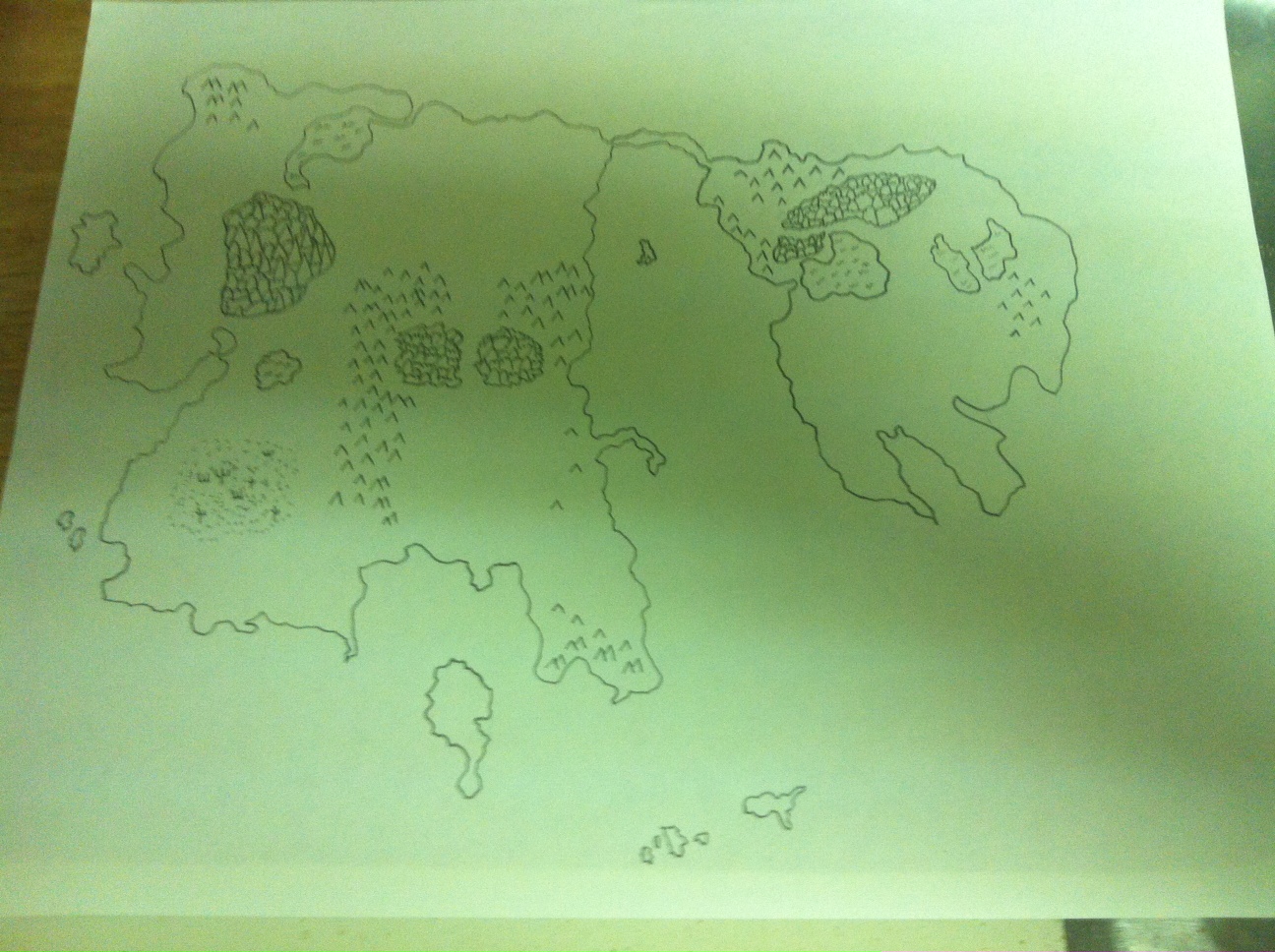
But to do this, I needed an actual land mass that might make sense. So, years ago, this was the first drawing I created that was supposed to represent the main continent:

Reagul2

It was originally a pencil drawing, and it served as the ground work for a novel I wrote called Destiny, which was a revisit to the land of Reagul 3000 years after the inhabitants founded the civilization there, which if you equate it to our time line, means that it takes place about one thousand years in our future.

Over the last decade, I’ve been wanting to write the story of that land that occupied that 3000 years that I hadn’t yet discussed. So I started with a time line, and slowly incorporated a rudimentary outline to explain what happened over time. This was the birth of Sarbonn, the first great wizard of Reagul (and not ironically, the name of this particular web site where my blog is hosted). Over the years, I’ve written numerous short stories about Sarbonn so that he has become my one great story that kept being told over and over with more and more flesh each time he was revisited.

But the story of Reagul still hadn’t been told. And thus, I created The Tales of Reagul, which was a 400 page novel that built the foundation for where the first three hundred years of history might take place. And then a few years ago, I realized that even that story was more of an outline, which has propelled me to begin writing the trilogy that will fill in the gaps that this first story so desperately needed. In the next few months, the first novel of this trilogy will be released, called A Season of Kings.

1 small

As part of this project, I went through and started to flesh out more map-oriented information:

Reagul1

My latest addition to the project is to hire a cartographer who I hope can turn my weak attempt at a map into something solid, something that gives Reagul the respect it so deserves. I will keep you informed on the progress of this, as it has to happen before the first novel is completed.