Tag Archives: tales of reagul

The nuance of writing that keeps me going

1 small

For those interested, I’m putting the final touches on the first book of my series, The Tales of Reagul, of which A Season of Kings is going to be released in the next few days. One of the fun things about this book is that it combines my passion of history with my love of speculative fiction. The land I’m writing about has been colonized by people from the times of the Roman Republic. What makes the book so much fun to write is that when these people start spreading out in this new land, they come across the survivors of previous colonizations from previous civilizations, including the Egyptians and Sumerians. This gives me the opportunity to play with the “discovery” aspect of the people who come to the new land, as they have no idea who these other people are, and when they do discover them, they are even more confused by the fact that they’re dealing with people they know so little about, and those that do know something of their civilizations are even more confused as to why they’re in this land in the first place.

This is the kind of thing that becomes so much fun to the process of writing. As I’ve already developed the historical process of the planet, I know why certain things are happening, but the people who are interacting in that land know so little about it, which makes it that much more fascinating to see it from their perspective and wonder “how would a stranger to this environment handle such a situation?”

The Problem of Genre

One of my biggest problems as a writer is that quite often it is very difficult to nail down the genres in which I write. It was easy in the beginning of my career when I wrote Innocent Until Proven Guilty, which was mystery/suspense. But then I started branching out on other types of books and things got, well, kind of confusing. Let me give you a bit of a run-down, and you’ll see what I mean:

Innocent Until Proven Guilty: A murder takes place in corporate America and then an executive frames another for the murder. Works well as mystery/suspense.

Leader of the Losers: A dystopian future where poverty and class distinction has been solved by eliminating the “losers”. Definitely science fiction.

72 Hours in August: During the 1991 August Coup in the Soviet Union, a plan is hatched to start a nuclear war before the coup is over. Suspense, but also historical, and kind of a mystery as well.

Destiny: The Tales of Reagul story that starts the whole series, except it takes place 3000 years after the beginning of the epic. Story begins with a space battle, turns into a fantasy trek across a mysterious land and then ends with another large space battle. Science fiction? Fantasy? Both?

Deadly Deceptions: In South Korea, a counterintelligence agent uncovers a blackmarketing operation that might actually be masking a major espionage cover-up. Guess that’s a suspense novel, or a thriller, or also a mystery.

The Ameriad: A humorous Greek epic that spoofs the Iliad and the Odyssey by turning the icons of American society into the “new” gods. No idea where this one belongs.

Absent Without Leave: A military criminal investigator uncovers a 20 year old crime that started with the framing of his father and leads to the political future of Texas politics. Mystery, maybe? Thriller? Suspense?

The Teddy Bear Conspiracy: A CIA agent, running an operation to defeat the Colombian drug lords, finds himself targeted by his own people, forcing him to finish the mission alone while someone within his organization is trying to kill him and take over the project. Suspense?

Thompson’s Bounty: A time-traveling Coast Guard cutter encounters 16th century pirates and is sucked into a battle between two naval commanders. Science fiction? Naval warfare?

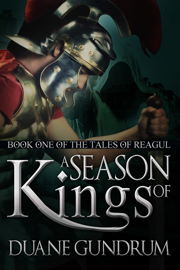
A Season of Kings (my next novel): The first official book of the Tales of Reagul, which tells the story of a planet where science and magic are intertwined. Most of the story is fantasy, but the whole premise comes from an alien experiment, which basically makes it science fiction.

Those are just the tip of the iceberg, and I’m finding it really hard to market my books because none of them really fit into any solid genre. Or few of them do. I won’t even try to figure out where Plato’s Perspective fits in, as it’s a novel with the protagonist named Plato who may or may not be the actual Plato, and the novel’s point in time may be a bit confusing as well. It could end up being philosophy, science fiction, fantasy, mainstream, history, etc. I’m sure you get the idea.
On to new projects

Last night, I finished the last touches of The Teddy Bear Conspiracy, and it’s now on sale on Kindle and will be on sale in paperback in the next few days (had one more run through the edit check and had to fix a couple of things before I could let it go one more time). Either way, the book is done, and it is now available for the masses to read, so hopefully you all enjoy it as much as I enjoyed writing it.

Which brings me to my next projects. Over the next few days, I have some outlining to do for my Haven project, and then I’ll be working on The Tales of Reagul, specifically book one, A Season of Kings.  With an aggressive schedule, I’m hoping to have these books released within the next month.

I’m starting to explore new ways of generating reviews, and Library Thing has become my new plaything. I put up ten digital copies of The Ameriad there last week, and then a few days ago, I put 100 copies of Leader of the Losers. Part of what drives a writer’s career these days is reviews, and I can’t even begin to explain how difficult those have been to come by. Which is shocking  because the books themselves have sold enough copies that you’d think they’d have lots of positive reviews, but they don’t. It’s like they’re completely overlooked by everyone, mainly because those who write me and say they loved the book never bother to leave a review on Amazon, which would make things so much more beneficial for someone like me. You know, someone who is still trying to get ANYONE to realize he’s actually publishing books.

Well, only two weeks (and one day) of work left in this job before I’m a full-time writer, and I’m really hoping this works out for the best. Right now, I’m not feeling so great about this decision, but it had to be done, which means it was meant to be, whatever that might actually mean in the greater scheme of things.

Let’s hope for the best.

The Craft of Creating a World That Doesn’t Exist Yet

One of the few joys of being a writer, especially a science fiction/fantasy writer, is being able to craft an entirely new world. When I first started writing, one of the mistakes I used to make was just to create a generic world that seemed like it could have been any place and then kind of hope that people would gravitate to it like Middle Earth or some brilliantly constructed world like the ones you might read in a series like the Wheel of Time. Unfortunately, it took me some time to realize that it doesn’t do your story a whole lot of good if the land you create is generic and unreal. Unfortunately, it took me numerous stories to start to realize that it needed more than just a generic compass heading.

So, fast-forward a few years later, and one of the worlds I have been constructing for over a decade now is one called Reagul, which for a history lesson is a land that was terra-formed by an alien race and survivors of the Roman Empire were transplanted onto the planet in some elaborate experiment of social species interactions. In this land, magic exists in the guise of advanced science, taught by the founders themselves, and the people who grow up on this planet have knowledge of Earth, but over time begin to talk about Earth as more of a legend than something real.

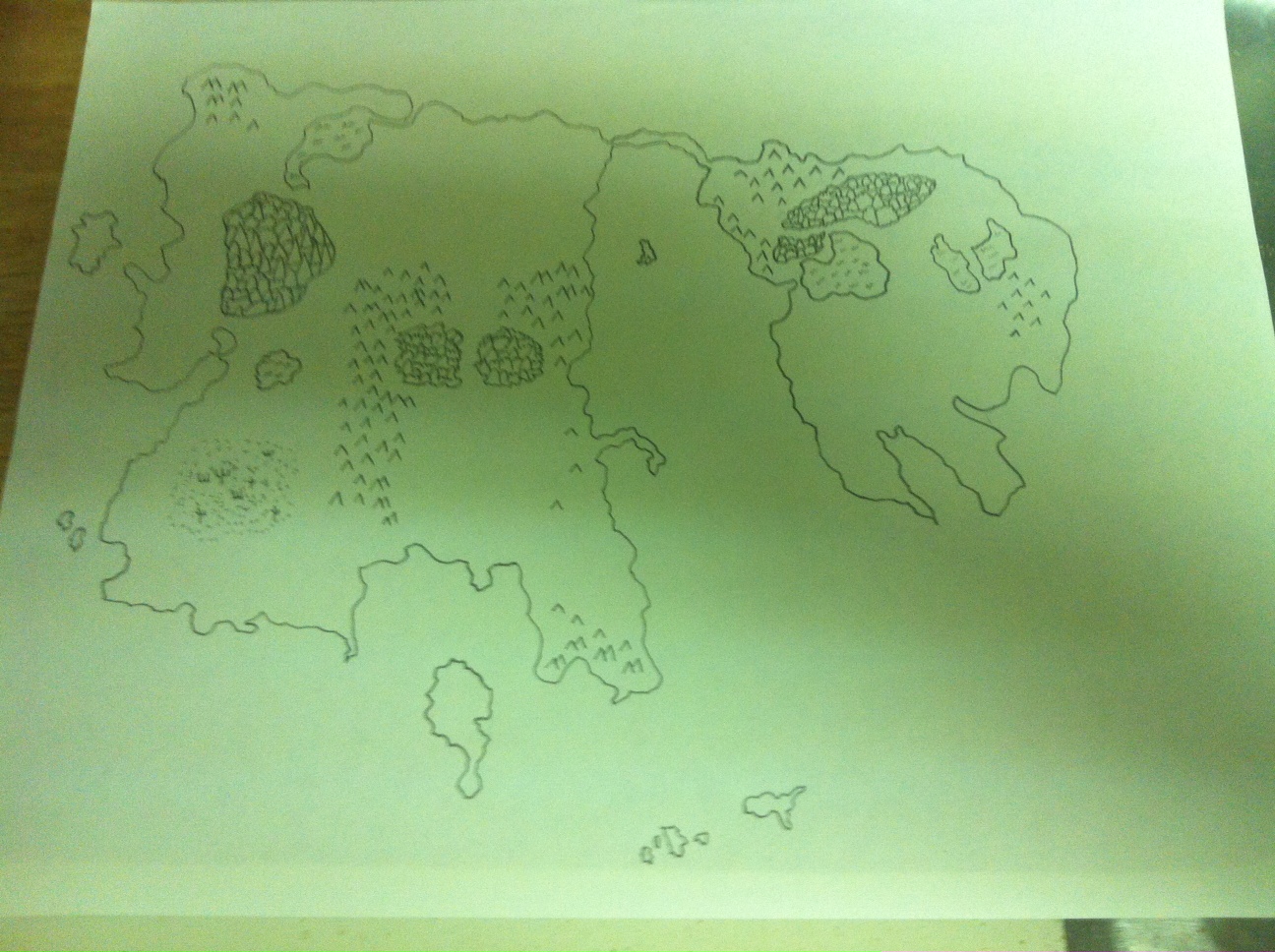
But to do this, I needed an actual land mass that might make sense. So, years ago, this was the first drawing I created that was supposed to represent the main continent:

Reagul2

It was originally a pencil drawing, and it served as the ground work for a novel I wrote called Destiny, which was a revisit to the land of Reagul 3000 years after the inhabitants founded the civilization there, which if you equate it to our time line, means that it takes place about one thousand years in our future.

Over the last decade, I’ve been wanting to write the story of that land that occupied that 3000 years that I hadn’t yet discussed. So I started with a time line, and slowly incorporated a rudimentary outline to explain what happened over time. This was the birth of Sarbonn, the first great wizard of Reagul (and not ironically, the name of this particular web site where my blog is hosted). Over the years, I’ve written numerous short stories about Sarbonn so that he has become my one great story that kept being told over and over with more and more flesh each time he was revisited.

But the story of Reagul still hadn’t been told. And thus, I created The Tales of Reagul, which was a 400 page novel that built the foundation for where the first three hundred years of history might take place. And then a few years ago, I realized that even that story was more of an outline, which has propelled me to begin writing the trilogy that will fill in the gaps that this first story so desperately needed. In the next few months, the first novel of this trilogy will be released, called A Season of Kings.

1 small

As part of this project, I went through and started to flesh out more map-oriented information:

Reagul1

My latest addition to the project is to hire a cartographer who I hope can turn my weak attempt at a map into something solid, something that gives Reagul the respect it so deserves. I will keep you informed on the progress of this, as it has to happen before the first novel is completed.