Category Archives: Books

Reviewing “That Used to Be Us” by Thomas Friedman and Michael Mandelbaum

I picked up this book on whim, not sure if it would end up being partisan drivel, interesting or just a waste of time. Well, halfway through it, I decided on “interesting”. While reading it, I couldn’t help but be reminded of my experience when I was reading the book “Teachers Have It Easy” (don’t remember the three authors), a book that tells the brutal truth of what it’s like to be a teacher. I remember at the time of reading that book how some of their stories rivaled my own, and there were times when I just shook my  head because I knew that other people needed to be reading the book, but they never would (or will). So, I’d end up reading a book that reinforced what I already knew, and I’d constantly be berated by people who knew nothing of teaching, but would act like they knew everything because “my mom was a teacher” or “I know a teacher” or my favorite: “I don’t have to be a teacher to know how easy they have it.”

“That Used to Be Us” also talks about one of the platforms that needs to be embraced in order to make things better, and one of those platforms involves teachers. In order to make America strong again, we need to empower teachers, and that means asking a lot of people to do something that definitely won’t be in their best interest, and that’s the part their book never really addresses. You see, the majority of the critics against teachers outright hate teachers. They don’t know enough about them, but they know that they hate them, and they take every opportunity to cast ridicule upon them. I see it on message boards and newspaper letter sites all of the time. MLive.com is one of those that excels in this. What happens is a bunch of “good ole’ boys” start posting about how teachers have it so easy with their big paychecks, their miniscule hours and the fact that they get these HUGE vacations every year. And then they’ll drone on about unions and how teachers are lazy, overpaid, quite often stupid, and more often than not, the problem. Try to talk to them politely, and they flame you left and right. Try to engage them in argumentation, and they start making personal attacks that have no actual basis in reality, but are designed to hurt and throw mud all over the walls.

Friedman and Mandelbaum rightly believe that the solution needs to start with an empowering of teachers who will then embrace a Colorado style of educational reform, but at the same time don’t seem to offer any way of getting everyone else on the side of teachers to make it happen. What ends up happening almost every time that standards are increased is that they become punitive so that unions become defensive, and then you end up with no one actually trying to improve things for children but people are seen as targets rather than part of the solution. For most people, educational reform is a zero sum game where one side has to lose for the other side to win, rather than their approach which is for all sides to win. Unfortunately, that’s what always makes it completely incapable of achieving success.

Part of the solution would be a simple paradigm shift in respect towards educators, which doesn’t happen too often in this country. I saw it when I went to Korea and was traveling home through China. I was stopped at the Beijing Airport, and I was being questioned about the medication that I was carrying with me (I had stupidly forgot to pack the prescription information with it, and Korean pharmacies have a tendency to just package pharmaceuticals in individual bags with no markings on them). I was in a seven hour layover, so I wasn’t in any hurry, but it didn’t look like I was going to be getting through customs any time soon. However, about fifteen minutes or so into it, one of the customs guards asked me my occupation, and I said I was a teacher, that I taught little kids (which is what I had done in Korea). His eyes opened, and he immediately took off to track down his supervisor, who had been in and out of dealing with me about the whole “drug” issue. The supervisor came back with another customs guard, a young woman. They both stood there for a second and just stared at me. Then the first guard started talking to them with animation, pantomiming the whole “little kids” action I had done when describing my job. Then both the supervisor and the other customs woman smiled, thanked me for my time and packed up all of my Korean bags of pharmaceuticals into my bag and released me to the waiting area untl my plane arrived.

Right then and there, you could see how much respect they had for someone who actually taught children. It didn’t matter that I was an American, and that the children I taught were Korean. I was a teacher, and it mattered to them.

We don’t get that sense of pride in this country. Ever. And that’s why it is so hard to find quality teachers who really care about their job. It obviously isn’t the money that keeps them in the profession, no matter how much political spin people want to put into it. For someone who has a master’s degree, the pay for the work isn’t worth it. The drama, the politics, the hassles and the unrealistic expectations with the lack of care of parents for the proficiency of their children…just doesn’t make it worth it. So it has to be something that keeps teachers in the business, and quite often it’s the few successes they do get from the struggles we go through.

Unfortunately, as long as the people in this country treat teachers as they always treat teachers, don’t expect things to get any better. And as for the book, much like the previous book I mentioned, I don’t expect anyone to read it who needs to read it. It will be read by people who already have an idea of what the book is expected to say, and only by them. I’ve actually be surprised at a lot of the information contained in the book, and I am one of the people who tends to read this kind of book. Unfortunately, the people who need to read it…well, they won’t.

Will the Amazon Kindle Fire Defeat the Powerful Apple Ipad 2?

I’m reading a lot of blogging that is exactly this subject: Will the Amazon Kindle Fire defeat the powerful Apple Ipad 2? I’m going to go out on a limb and just say no. It won’t. But instead of treating this as an either/or situation, I’m going to talk about why the question shouldn’t be asked in the first place.

You see, the Apple Ipad is in a class of its own, a class to which no tablet has come close yet. The Motorola Xoom was released as the potential “Ipad killer” but it did no such thing. As a matter of fact, shortly after releasing the Motorola Xoom, the Motorola Xoom became the Motorola Xoom killer. It was decently constructed, had no apps made for it and relied on an app market that is woefully inadequate. To this day, I have a Xoom but I don’t use it for anything other than checking email at night (while my Ipad charges). Even when you found an app that might work for it, quite often it didn’t, and instead you ended up having to uninstall something you paid for (and couldn’t get paid back for if it didn’t work).

For months now, the talk has been all about the new tablet that was going to be released by Amazon. And it looks like it’s about to be released. Here are some of the particulars:

It has only wifi, it’s in color, and it has some apps it can run but they come mainly from Amazon’s online app store. It only has 8 gigs of RAM, and they’re not planning to up that on this particular model (although they might on subsequent versions of the model to be released later). Like I said, it has wifi only, so there’s no 3G, like you get for the main Kindle. And it will cost about $199.

Thoughts? The price is great. It serves as a great replacement for a Kindle if you already have one. It will do a few more things than a Kindle can do, like check email, and maybe play some music and videos (not sure on that last one yet, although details seem to point in that direction). What I really like about it is that now I can read books on a Kindle that has color (whereas I was reading my Kindle books on a Kindle app on my Ipad, because it was the only way to see color on a Kindle-bought book).

It’s not a replacement for the Ipad because it’s not as powerful as an Ipad, doesn’t do as much as an Ipad, and well, it’s just not an Ipad. It’s another Kindle, which will do what normal Kindles do, but be more like a Barnes & Noble Nook Color but not as dysfunctional as that product.

I’ll probably buy one. Do I need one? No. Not really. But I have a Kindle, and I like my Kindle. This will be a Kindle capable of doing more things than my current day Kindle, and I sort of like that. But it won’t replace my Ipad, which is still the one device I carry with me everywhere.

Chicago, Moving, and the Process of Reinventing Writing

Not much going on, so I thought I would do another recap of what might actually be going on. So, here goes:

1. Took a trip to Chicago this weekend.

I have to admit that I’ve never really given Chicago a fair shake. One of my friends, Kevin, is from Chicago and always talked up the place in a positive way. Having been there a few times, I never really found myself enamored with the place. So, I went there specifically to meet up with someone, and while I had a good time meeting her, the place itself met the expectations I had going into it. I found the place to be mostly dirty, kind of like you’d expect from any large downtown city. I was in the Chinatown area of the city (or at least one of them), so the people were generally friendly, but there wasn’t really that much more to say about it.

Getting to Chicago kind of sucked, and it wasn’t really the fault of Chicago itself. It was the fault of Indiana. And then Chicago. At one point, I went through what seemed like an endless series of toll booths. I’m not kidding. I drove less than a half a mile after a toll booth, and I was driving up to another one. It’s like the government workers had their hands out nonstop while traveling through their mecca. And the first toll booth person I dealt with was one of the more rude ones you come across. She was hostile, scowling, and she held her hand so far back in her booth (to provide change for the bills I gave her) that I had to open my car door and practically walk over to her to get her to give me my money back. I noticed that she didn’t have a problem taking my money; she just wasn’t all that excited about having to stretch her hand out to give any back. That’s HORRIBLE customer service, and obviously she doesn’t care, which means her bosses don’t care, and thus, neither does its government. I started to immediately hate Chicago, and I wasn’t even ten feet into the city.

Leaving Chicago was a lot easier. And a relief. Did I mention I don’t really like Chicago? I guess you have to have been born there, or really like big cities with rude people in them. I guess a New Yorker would love Chicago. A San Franciscan? Not so much.

2. School is back in swing.

I’m starting the third week of school, and everything seems to be going well. I’m kind of apprehensive about continuing this job in the future (after this semester) as I really feel like I’m being taken advantage of. The place they have me teaching is in Lowell, which is pretty far away (another city), and the main point they made is they don’t pick up mileage for having to drive my car twice a week twenty minutes to half an hour. You’d think if they really wanted someone to fill this type of position, they’d be somewhat responsive to the fact that it’s costing me money to actually make it to this place twice a week. This school has a tendency to be pretty cheap when it comes to covering certain things, and sometimes I wonder if it’s really worth it. I mean, the pay isn’t stellar, and it does take a great deal of chunk of time out of my normal schedule. Again, this is one of those cases where a teacher is kind of left with a thought of how much do I really want to teach versus how much I’m willing to sacrifice with getting very little in return. I’m already at a loss from a simple economic perspective as my text book for one of my classes went missing after the very first day (when I know I had it in class with me); that never makes one feel really good about things.

3. Moving.

I’ve been trying to find a larger place for myself within my own housing complex, and I’ve been disappointed at the experience. On Friday, I spoke with the woman at Wyndham Hill, and she told me that a two bedroom apartment (pretty close to where I wanted to move to) would be available at the end of October, but that the people were still in the apartment, so I couldn’t lay any claim to it until they vacated. Today, I called to verify the time frame, and she told me that the apartment was already given to someone else over the weekend. Which, if you think about it, means that someone else came along and picked up the apartment, EVEN THOUGH she told me that there was no way to ask for it until the other family vacated, which they have not. In other words, I got screwed, and there was no way I could have done anything about it. One of the problems with the place where I live is that no matter what I try to ask for, something always seems to prevent me from getting it. A garage opened up closer to my apartment (I’ve seen it open and empty) but when I asked if I could switch to it, I was told no garage was available. It’s still empty. I kept asking for a den apartment, but was told it was a hard commodity to get, so I asked to be put on the waiting list for when it became available. Each time it became available, it turned into a first come, first serve situation where no one let me know it was available, and obviously there was no list or line. I just got ignored yet again.

So I may just move out completely. I hate moving over stupid shit, but what can you do? I’m currently looking at a series of apartments near 28th Street, which would put me in walking distance to shops and a potential social night life. Where I live now is conducive to feeding ducks, and that’s about it.

4. Writing

I haven’t been doing much writing lately, mainly because I’ve been completely discouraged by the whole writing industry. I had an agent at one point who just kind of disappeared, had another agent after her who sort of just, well, disappeared, and getting a new one after him has been a continuous series of failures. And no, they didn’t disappear because of anything I did. Honestly. I have an alibi. Really.

Part of the problem for me is that I have such grandiose projects I’m working on with my writing that no longer consist of “Get an idea, tell a story and then revamp it.” Instead, I’m focused on analyzing a genre, trying to turn it on its head completely and do something that seems almost impossible for me to do, and every writing project has felt that way, until I finish it, and then I feel as if I’ve learned a whole new chapter in my writing, so I have to go out and break new ground for the next one. I’m not sure anyone understands what I’m saying here because most people when I tell them I’m a writer, still think that I’m referring to sitting down and writing a cute story. I’ve even stopped telling people what I’m writing because they tend to stare at me blank-faced and, if I’m lucky, they’ll ask, “Okay, but what’s the story about?” In other words, there’s a miscommunication thing going on, and a lot of it is due to my impatience with explaining the process of writing something from a completely different perspective of normal literature. I’d say that someday people will understand what I’ve been trying to do (as they analyze it in post-modern literature analysis courses), but part of me (a large part of me) suspects that most people will never hear of me because I’m doomed to writing for myself, having given up on the publishing world already as too sporadic and celebrity centered for someone like me to ever make it. Yeah, I know there’s the cynic out there thinking, “Or maybe you just suck, Duane.” And the part of me that’s most concerned is the part that thinks that cynic may be right, and I’ve been wasting my time and energy when I could have been a lot more productive if I would have focused all of my energy on getting my mage to level 85 in World of Warcraft.

5. Dating.

What’s that?

That’s all for today. I keep plugging forward, thinking that Einstein’s theoretic is wrong, and that perhaps if you do continue to do the same stupid thing over and over again, you WILL get different, better results.

Fired Yahoo Boss Needs to Put Firing into Perspective

"I love you Duane, but I've decided to date the football team instead of you"

I’m always amazed at the outrage people can purport to feel over very minor things. Years ago, I was working for a major hotel chain, owned by a name that just so happens to be similar to a bar hopping floozy who is famous for being famous (and a conveniently released porno tape of her having sex with a former boyfriend). The company decided that it wanted to get rid of its union employees because it couldn’t come to an agreement with the union over how to screw over the people in the union and take money from them that the union employees were getting for doing work that the hotel couldn’t figure out how to profit off of. So, it fired the employees. And it did it by setting up these employees in a “sting” operation that consisted of the employees doing what they did every day and then telling them they were “stealing” from the company for doing what was already established procedure. So, when it came to applying for unemployment, the hotel chain decided to be even more greedy and try to challenge the ex-employees (not wanting to pay a red nickle to them whatsoever). The employees threatened lawsuits against the hotel for wrongful termination, so the hotel backed down. The employees left, forever pissed at the shitty company they used to work for, and the company walked away, thinking that somehow it managed to accomplish something by losing long-term employees who had made the error of letting their union stand up for their rights.

So, when I hear this Yahoo boss complaining that she got fired from her job over the phone, I want to kindly tell her, “go fuck yourself”. Things could be a lot worse, and they’re not. You got fired because you did a crappy job, knew it was coming long before it happened, and got a SERIOUS severance package as a consolation prize. Yahoo won’t show up to the unemployment hearing and try to pretend that you are pond scum and so beneath them that you don’t deserve your $200 in UI compensation while you try to find another job, scrounging up on pork n beans because you can’t afford anything on the dismal wages you were getting previously (and now are barely receiving). No, you’ll be eating in fancy restaurants, probably courted by major corporations that will ofer you golden parachutes to grace them with your presence. You’ll probably be offered a huge publication deal with some book company to write a book about how to run a billion dollar company into the ground, and you won’t even have to write it. No, they’ll hire some minimum wage wannabe writer who is looking to get his foot in the door (or her foot in the door) at some publishing empire. And you’ll collect money just for putting your name on the cover.

So, stop complaining. So they fired you over the phone.  A girl I was dating once broke up with me over the phone, said we weren’t really compatible any longer, which was a translation of what she was really trying to say (“I found someone else while I was dating you, and it was easier to lie to you than tell you that I was fucking him behind your back, and I definitely couldn’t have told you this with a straight face if you were standing in front of me, you great stud of a man you.”) Okay, the last part she didn’t say, but I’ll remember the break-up my way, thank you very much.

For those of us without superpower jobs like Carol Bartz, we’re kind of stuck with the realization that respect doesn’t come to us in our world. Therefore, you should try living in our world for a bit before you try to gain our sympathy for the insults you perceive that you received. You had a pretty good thing going, and you didn’t live up to the expectations that were placed on your plate. But you got out with a pretty nice bonus. Be thankful for that. Not all of us have always been so lucky.

Classic Literature is not a Punchline of Knowledge

I was having a conversation with someone about a mundane topic, specifically about butterflies, when it reminded me of Kobo Abe’s Woman in the Dunes, a story of butterfly hunter who gets trapped by a society that mates him with a woman in an inescapable sand house. When first discussing it, there was no expression of interest about my story until I mentioned that the man’s story served as somewhat of an allegory to the fact that he used to trap butterflies (and thus, he became the trapped butterfly as a result). Then there was the recognition of the point of the story, and that’s the end of that.

But it got me thinking because I realized that after telling this little literary selection that there are a lot of people who seem more focused on the punchline of a story than in the story itself, and that’s the purpose behind this post. You see, what I’m starting to suspect is that people are so focused on the outcome and the “rest of the story” that they miss the purpose of the original story in the first place. In other words, people will read about Machiavelli, figure the Prince was about gaming the system and then feel they know what they are talking about when they refer to someone as being Machiavellian. I use this example because it is probably one of the more misused literary references in current usage. I observe the media constantly trying to act academic when they call some world leader, or some local leader, as Machiavellian, and what they’re really saying is that someone is manipulative. It immediately gives me the impression that they’ve never actually read Machiavelli to understand that to understand Machiavelli is to understand the Discourses, not the Prince. The Prince is only a small part of a much larger canvas, and quite often people read the Cliff Notes of even the Cliff Notes version of Machiavelli, meaning they’re getting about 1/10th of 1/10th of an understanding of the government scribe, not even realizing his whole purpose was to explain Aristotle in his modern day terms, not to create an understanding of how people can be snide to get over on others.

I find this in a lot of media (and common) references to literature. I hear a lot of referral of Moby Dick from all sorts of sources, and almost always they focus on a tiny segment of the story. Sure, they usually get the overall message, but almost every time I get the impression that that’s all they got out of the story, meaning they probably never read it all of the way through. A couple of years ago, while sick in Prague, I sat in my room and read through Melville once again, and I came away with a completely new understanding of his novel. Most people, if lucky, might read it once, and that’s it. And usually it’s because it was required reading.

I see this same thing with Don Quixote, which is such a brilliant story, in both English and Spanish, yet I would bet that one percent of the people who talk about it have actually read either version all of the way through. I was reading it a year or so ago again, in English this time, and I was just floored at how great a story the author constructs. It’s not just a literary story, but it’s hilariously written by a man who truly understood the human condition enough to hold it responsible for all of its absurdity. A media critic bringing up his loyal assistant doesn’t come close to relaying the significance of that poor follower who leads us through so many of the protagonist’s great, yet ridiculous, adventures.

A year or so ago, I sat down and re-read Dostoyevskiy (one of many spellings of his name) again. I had read Crime and Punishment when I was a young child. As a matter of fact, it is the very first book I ever read, and I only read it because my grade school teacher at the time said I was too young to ever read such a book. The first time I read it, I struggled through it and barely eeked out an understanding that this was the story of a man who did something horribly wrong and was fearing the ramifications of his actions, kind of a reading I would have years later of the Tell Tale Heart from a much different nuanced author. Yet, I have re-read that book many times over my life, each time getting a better understanding of what the author was trying to reveal to me, only understanding it differently because I had years of living that backed up my new understandings. This time around, as I read through the Idiot, I think I came one step closer to understanding why the author told the story he did. Years from now, I hope to revisit it again and see if I came closer that time.

The problem I perceive right now is that way too many people are hearing stories, or watching them on TV or in movies, and they’re convinced they’ve “read” the novel and understand all of the choices the author took to relay his story. That is such a weak interpretation of literature and so sad of a compromise that it bothers me to even think about it. I fear for America because almost all of our bestseller charts are filled with young adult books rather than powerful novels that challenge us to think, rather than fill our heads with mild entertainment. From vampires and zombies to Harry Potter, we keep filling our libraries with crap that does so little to stimulate people intellectually, and while I sometimes think “well, at least the masses are reading”, I’m left wondering if we’re a society doomed to complacency and easy manipulation by people who are smart enough to realize that an intellectually void mass is much easier to control than one that thinks for itself. All it takes is someone with the wrong intentions, perhaps someone very, shall I say Machiavellian, and the future might not look so bright.

Further Misadventures in the e-Publishing World

There’s a term that e-published authors have been using to describe the old way of doing business in the writing world: Legacy Publishing, meaning that it’s the old way of doing publishing. As one of those who got his start in the legacy publishing industry, where my first two novels were published as physical entities, I’ve slowly been trying to build a writing career by embracing the non-legacy model, i.e., publishing my work as e-books myself. In the process of doing that, something strange has started to happen that I never really anticipated. Let me explain.

When I started publishing some of my completed novels as e-books, I wasn’t really expecting to make a huge profit, or even to sell a whole lot of books. I hoped to sell a few and at least get a few readers interested in my work. Honestly, that’s what every writer tends to want to do. I’m really not that different. Not knowing the first thing about connecting to an audience that I don’t have, I’ve tried all sorts of different marketing, including Facebook ads, google ads, viral marketing, standing on the corner and yelling out loud, and all sorts of other antics that are capable of bringing on all sorts of restraining orders. As a result, a few people have started to read my books, and let’s just say that while I haven’t been extremely successful, it’s proving to be an interesting experiment.

However, a new development has occurred, and that’s what I wanted to talk to you about. I mentioned that some of my earlier work was published by Legacy Publishers. So far, they have done absolutely nothing to sell my work other than orginally publish it. I’m an unknown to them, so why would they be interested in pursuing any marketing on my behalf? So far, there’s been no reason. However, because I’ve been doing a LOT of marketing myself recently, some of my work has actually started to sell. Most of it as e-books, but some of that marketing has actually caused potential readers to go to bookstores and buy physical copies of my novels. Great. This is leading to something, however, and what it’s leading to is the realization by the original Legacy Publishers that I’m capable of actually selling books. It never dawned on me that they’d ever be paying attention to the fact that my marketing would start to pay off. And it has. Which has led them to start paying a bit more attention to me, and that attention has proved to be quite eye-opening.

You see, when I was originally published by them, the whole e-book universe was not even on the radar. So they never bothered to negotiate those rights. Those rights are mine still. Well, they’re now realizing that, and they’re also realizing that because I am self-publishing the rest of my work, it’s pretty obvious that my work they originally published will net them absolutely no profit whatsoever when it comes to the e-book market. So, rather than just contact me and be honest about it, their contact has been the kind you expect from a Shakespearean villain. The kind that goes: “Did you know that people are selling their books as e-books, and they’re making millions? We’re willing to publish your book as an e-book if you’re willing to sign that right over to us.” They also forget to mention (and sometimes they do) that they would like to set up the generous terms that are similar to the ones that happened under the old contract, where they get about 90 percent and I get 10. In other words, rather than have me publish it myself where I get 70 percent and Amazon gets 30, they’d rather they take 90 percent of the 70 percent, leaving me with (doing the math….for every $1.00 a book makes, I get $0.07). So, for a book that normally sells for (if they put it up at the maximum they’re trying to get) $12.99, I’d get 90 cents. Now, if I sold that book for $4.99 by publishing it myself (or even at $2.99), I’d make $3.49 (or $2.09 at the $2.99 rate). In other words, even if my book sold at a massive discount (my pricing), I’d still make 2 to 3 times more than what a publishing company would give me for it. And keeping in mind that the publishing company has NEVER marketed one of my books EVER, I get absolutely no benefit from them being the ones publishing it. None.

So, you might see why many writers are turning away from the normal legacy publishers. It’s not profitable, and unless you’re already a marketable name that they’re willing to throw money behind, you get absolutely nothing out of the deal. Instead, you sign over all of the profit to an entity that doesn’t do anything to deserve it.

It would be different if they actually went out of their way to do something to benefit my name. But they don’t. Or they never have. Now, if I was to find a publisher that was willing to do something to help me sell books, then we’d be talking a completely different story. But the way this model works, they don’t want me until I can already do the job that they won’t do themselves. Once I have the name recognition and the ability to sell my own work, my need for them goes away completely. So, somebody please tell me how quid pro quo thing works here if one side is continuously leeching off the other.

The Last Typewriter Factory in the World Has Closed Shop

According to an article in the Atlantic, the last typewriter factory has shuttered, as it was becoming too expensive to maintain, and not enough of a market to make it worthwhile. Sadly enough, I remember that the very first novel I wrote, Innocent Until Proven Guilty, was written on one of the first personal computers, but because I was so convinced that a writer needed to write a novel on a typewriter, my second novel LOSER was written on an IBM Selectric typewriter. Then my third novel, The Armageddon Project (which later became To Touch the Unicorn, and will soon become 72 Hours in August) was written on a manual typewriter I wrote, convinced that this was the way that a novel needed to be written. Since then, I’ve moved back to computer, and all of my writing tends to be on paper first (handwritten), and then typed on computer. I’m probably one of the last to write this way.

But one can’t feel a sense of loss in that we don’t use typewriters any longer. When I was a counterintelligence agent, we had IBM typewriters throughout the office, and it was the “in” thing to have those. I had an assistant who typed up my reports for me, and there were times when I’d type them myself, feeling that I wasn’t really doing the full job unless I typed up my own reports. But even then, we got a hold of a Wang word processor (Microsoft Word was still someone’s garage fantasy at this time), and literally the universe changed overnight. I even created my first database on the Wang computer. I knew then that the world would never be the same.

So, if I drank, I’d open up a beer for the loss of the last typewriter factory. But I don’t drink, so I’ll just wave my hand and give them a few moments of silence.

Writing How To: The Overwhelming Desire to Make Fantasy Seem Fantastic

Okay, here is the next in the series of commentaries on writing. Today, I thought I would talk about the genre of fantasy, because a lot of writers seem to be finding themselves falling into this one a lot. Therefore, it’s probably important to point out one of the failings that often separates a writer from anyone who might want to read any of that writer’s writings. Today, we’re going to focus on the desire to make fantasy overly fantastic.

Let me start by including a little scene I’m going to concoct for the nature of pointing this out. In this scene, the Princess C’lagrisha’nte is planning for her royal wedding to the prince of the Grishandens Empire. Let’s listen in:

Zvastran’cha, the Secondary Triumphant Parlour Midwife Maid, picked up a Hee’chanta vase and poured water onto the Bracklit plant before moving onto the array of Sxraxxan tapestries that were overlayed upon the Royal Foundry of Makkappala. Before she could reset the seal, Vleekorando Vrippzee approached her with his Lantee spear at a position of rest and tapped his Bryee visor twice, indicating his displeasure at the events that occurred over the Kalamaster Ceremonies of Trijent’a. It was obvious that a future gathering of the Proxilia Council was most likely to result in the Second Rigor of Nixtraxa. Which, of course, meant blah blah blah

What we have here, in the words of a great Southern prison warden is “a failure to communicate”. At one point, it’s really cool to add all of this visual scenery and fantastical elements that show we’re not in Kansas anymore, but at some point the amount of unknown verbage starts to become noise, and the reader turns off most of the visuals because they stop making sense. Add in numerous characters that all have really bizarre names, and you end up with a tale that becomes so easy to toss out the window, that the chances of you ever getting anyone to finish it are very limited. It doesn’t matter if the writing is stellar, and the story is great; at some point, the amount of confusion is going to overwhelm the reader, and the story ends before it ever gets told.

A solution to this problem is to introduce foreign elements into your world sporadically while including familiar sensations alongside the foreign ones. The little inclusion I used to explain this problem isn’t even that bad, to be honest. I’ve read some stories where I’ve gone entire paragraphs where I had no clue what the writer was talking about because EVERYTHING on the page was so foreign that at some point I gave up trying to figure out what a Hgjasfjsfjlijn was and just started thinking about a wonderful lunch I had the day before. If you fill your story with enough elements like that, causing your reader to abandon your story, you may have defeated your reason for writing in the first place, which should always be kept at the forefront of everything you write: You’re communicating, and as long as you can continue doing that, you’re on the right track to storytelling instead of just filling pages with gibberish that will eventually be ignored.

Review: Invisible Tears by Abigail Lawrence

Invisible Tears: The Abuse, The Rebellion, The Survival, Despite All Odds

This is one of those books that is extremely hard to read, especially if you’ve ever lived through any type of abuse yourself. When I first started reading it, I went into it completely oblivious to what the story was about, and then I had to back out and re-read the write up to realize what I was reading was, in fact, a true story. That, immediately, changed my perspective on reading this book. You see, if this had been fiction, I probably would have stopped reading after about the first tenth. It’s just that hard to read through the impacting scenes that take place in this young girl’s young life. But once I realized this was supposed to be a true story, I forced myself to keep going because if this really happened to someone, she at least deserved having someone try to understand it.

And I’m glad I did because the rest of the book actually makes the journey worth it. To be honest, the first 1/3 of the book is really hard to read through. But once you hit the 35 percent mark (the Kindle is really cool for telling you exactly that), the story changes, and you start to experience a different kind of a tale, one that’s no longer about abuse, but one that tells the struggle of a young girl becoming a woman who is attempting to find herself as a result of the previous abuse. What you discover is that she spends the rest of her life trying to find some sense of acceptance, whether it be acceptance from others, or just a solitary acceptance of other people and some semblance of belonging in a world that appears mean and cruel, and sometimes oblivious to the struggles of others.

I will admit there were a couple of points where I almost didn’t finish it, but then perservered, a lot like Abbie pushes forward through the travails that life continues to throw at her, and in the end it really was all worth it. Someone who reads up to that first part of the book and then stops would probably be impacted as well, almost needing to read the rest of this book to get the closure that seems desired and needed through this book.

Story: 4 stars
The narrative throughout was well worth reading, and the story crafted was one that leaves an impression. It’s very hard to do that with a non-fiction narrative, and there were times where I found myself comparing events with Dave Pelzer’s “A Child Called It” to the point of outrageousness. The beginning of this book is really hard to read, as it goes from child abuse to child rape to continuous child exploitation, almost to where it felt like the events were trying to outshock previous events. But then you’re left realizing this is a true story, so you can only feel compassion, and when the story is complete, feel anger that there are those out there who will go unpunished for the unspeakable acts they have carried out against innocent victims who have no way of ever striking back. The epilogue alone is poignant and casts its own shadows of despair on the depravity of humanity.

Voice: 3 1/2 stars
Although non-fiction, the author struggles to maintain a singular voice throughout the tale, as she sometimes juxtaposes the tale from fluidity to a sense that some prose the tale contains is still difficult to convey, making it disjointed at times. But overall, it carries forward very well and you get the sense of a very young girl’s memories being relived through the prism of someone decades after the events.

Mechanics: 3 stars
The book could have used an additional edit. There are numerous spelling errors, “theres” instead of “their’s”, and other mechanical errors throughout. But overall, it holds up well. There were also a number of port problems from the original manuscript to the Kindle version where the justifcation of the text was off, but as someone who has worked with porting to a Kindle myself, I completely understand that problem as there are times where it happens, and no matter what you do, it just can’t be fixed.

Cover: 4 stars
There are any number of different kinds of covers that could have been used to convey this story; the one chosen seems to do a pretty solid job. Having seen some really outrageous covers for some books on Kindle, it’s nice to see a simple, telling piece of artwork that doesn’t go out of its way to overdue an appeal to attention.

Summary: I would recommend others to read this book, keeping in mind that the first 1/3 is VERY difficult to get through.

Overall: 4 stars

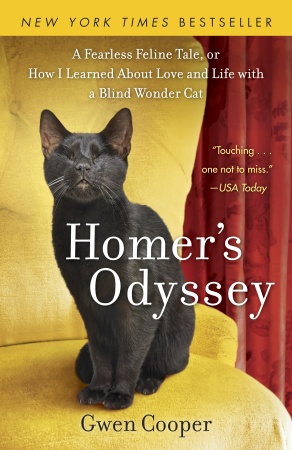
Review: Homer’s Odyssey by Gwen Cooper

This is one of those stories that grabs onto you from the beginning and pretty much never lets go. I was apprehensive about reading this book, because I’m not really that much of a cat fan (more of a dog pet person myself), but the blurb on the cover kind of hit me, and I was intrigued about finding out more about a blind kitten.

One thing that got me right from the start was the same thing Gwen talks about in her book throughout, and that’s the wrong impression someone gets from expectations of Homer right from the start. People expect this little kitten to be helpless, and you immediately find out that he’s nothing but that. He’s resourceful, full of life and pretty much the life of any party because no one ever taught him that he’s supposed to feel sorry for himself, or even that he’s blind. He is blind from the very early days of his life, so he’s never even known what it’s like to see. But he turns out to be the bravest, most resilient little tyke one might ever experience.

The story deals with Homer, Vashti and Scarlett (who are two of Gwen’s other cats), and it specifically deals with the life of Gwen herself. Where the story starts to bog down a bit is when it gets into Gwen’s own story, and mainly during the first half of the book, it really does sort of slow down as we start to experience more of her memoir than the story of Homer and his fellow cat family. Then it moves onto the author’s love life with Laurence, before it moves onto its conclusion.

However, it’s still a strong recommendation from me because the strongest moments of this memoir come from reading about Homer himself and how nothing you do ever stops him from completely enjoying life as it was meant to be lived. A couple of (SPOILERS HERE) critical moments also make up the narrative to where the story becomes where it deserves its bestseller status, specifically every time Homer experiences a new home and has to acclimate, the time Homer comes to the rescue of Gwen (when a stranger breaks into her house), the horrific period that Gwen goes through during 9/11 when the towers come crashing down (and she lives 5 blocks from Ground Zero), and a gut wrenching moment where Homer hits older age and runs into a near death experience towards the end of the book.

Four (4) out of Five (5) stars: 4/5.