Monthly Archives: April 2010

Did Someone Mention Time Travel?

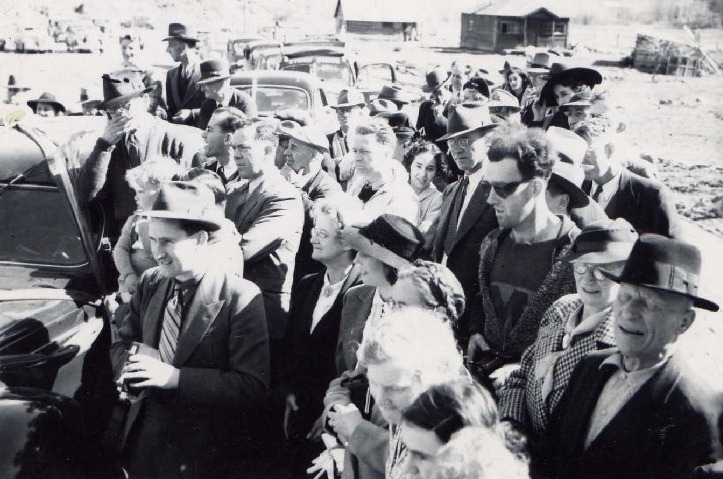
There’s a photo from a museum in British Columbia that is making the rounds on the Internet that is quite fascinating (if it hasn’t been Photoshopped, that is). It is a photo from the 1940s, and it shows a very unlikely subject in the photograph. You can see him with his cool ray sunglasses and modern haircut, along with the clothing that he is wearing.

Anyway, waiting to see this debunked soon. Already there is quite a discussion taking place on forgetomori. Now, as the ultimate skeptic, I doubt there’s anything to this, but it sure is interesting for a Monday morning.

Kick-Ass definitely delivers

There was a lot of hype coming behind the superhero movie Kick-Ass, about a young kid who decides he wants to be a real-life superhero. This concerned me that maybe the hype might be overdone, but I can honestly say that the movie was well worth the viewing.

Unlike a lot of other superhero movies that generally don’t take themselves too seriously, this movie actually takes itself quite seriously. Its main character is a kid in high school who doesn’t look like he can hold his own with pretty much anyone, and in the beginning, he really can’t. But the thing that makes him unique is that he is extremely adaptable, and he realizes what he has to do in order to hold his own, even as he realizes that he is way over his head.

But as most reviews have pointed out already, the movie is completely stolen by a pint-sized actress of 11 years of age, played by Chloe Moretz. Most of the attention paid on her has been the fact that this is probably the most foul-mouthed delivery of dialogue by a little tot in history, but almost every time she does it, it just seems so natural and as it should be. Her father is played by Nicholas Cage, who delivers some of the greatest Adam West-like dialogue whenever he is in character as Big Daddy. There was one scene where I was just busting up because his delivery was so 1960s Batman, but it just seemed to work. But back to little Chloe, not only does she handle the action and dialogue like a seasoned actress, there are some really intense emotional scenes that this little girl carries out better than most Hollywood actresses could ever hope to do. You almost forget that this is an 11 year old girl delivering this performance because she does it so well. If ever there was an Academy Award performance by a toddler, this was it, but because it’s a humorous superhero film, it won’t even get a moment of attention from the film Academy. Pretty sad, if you think about it.

I haven’t gone to see many movies in the last few years, mainly because Hollywood has been making some crappy movies, so this was a rare moment for me. But something told me I had to see this movie because I couldn’t believe that hype about this girl’s performance could be true, but I was wrong. She carries it off quite well.

I definitely recommend this movie.

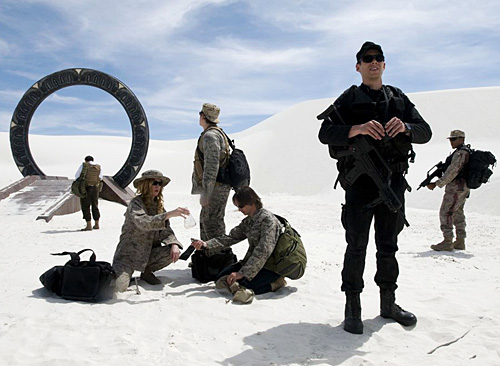
Ongoing thoughts on Stargate Universe

Okay, I’ll admit that my personal jury is still out on this show. Most of the first part of the season was pretty crappy in my opinion, but I was giving it the benefit of the doubt because I figured they had to build some kind of backstory and character development. But it really felt like it was just treading water most of the time, right up until the mid-season finale, which was actually the one HUGE moment in the show. So, I thought I’d wait until it came back after the mid-season break and see how things are going.

First off, I’ve already said this before, but I HATE MID SEASON BREAKS. It’s one of the stupidest things a television show can do for its survival. If you really want to piss off your audience and cause your audience members to watch another show, that’s the way you do it. You go halfway through your season, take a LONG FREAKING BREAK and then pray that your audience decides to come back and watch your show that they’ve completely forgotten about because it wasn’t all that great to begin with. This is why the shows Fringe, Fastforward and Heroes are all failing. Okay, that’s not completely correct. Heroes is failing because it’s being written by two year old monkeys with typewriters, but that’s another story.

Anyway, back to Stargate Universe. The characters are somewhat okay. I had reservations in the beginning because here’s a run down of your main characters:

The leader is a boring colonel who might be in love with one of the boring women who is on the boring ship. The second in command is either some egomaniac, brainiac scientist who cares only for himself, or it might be some teenage kid who succeeded in getting to a final level in a FREAKING VIDEO GAME, so the Air Force recruited him to be their scientist problem solver. Really? Anyway, then there’s some somewhat attractive Asian chick who is third or ninth in command, who wants to overthrow the leadership so she can fly home and meet up with her lesbian lover back on Earth. Is this Stargate, or are we watching the third attempt at creating Melrose Place? Then there’s a whole bunch of other interchangeable characters who may or may not be regulars, including some lieutenant who is either in love with some girl that was the daughter of a senator who died in space, or he might be in love with the woman that the boring colonel might have gotten pregnant before they left for space, or maybe he’s in love with some strange sand alien that shows up every now and then to remind us it’s a science fiction show.

The plots tend to be something like: “Okay, they’re lost in space on this really old space ship, and they’re running out of food, water and air. So let’s argue about whether or not the really smart guy can trick someone into sitting in a chair that might cause instant death. Or we can change that plot out for one where we use these rocks that we’re carrying on the ship to switch our minds with people back on Earth so Lou Diamond Philip can get some screen time because we accidentally hired him to be a cast member but forgot to put him on the ship that’s lost in space.”

The plots really seem to be geared around the central idea of “how can we make being lost in space any more annoying to our audience?” But even with that being said, every now and then they manage to lull me into a sense of thinking there’s more to this show than what I’ve described before. Like tonight’s episode. They found this planet in the middle of nowhere that can sustain life. And there’s this HUGE obelisk that was obviously built by the smartest alien race that has ever existed in the universe. So, I’m intrigued. But then they had to leave because their flight was on stand by in that solar system and now is somewhere else where that obelisk planet is no longer accessible. But it might still be relevant. Or not.

Next week, everyone’s favorite Stargate character has a cameo, and of course I’m talking about Dr. Daniel Jackson played by Michael Shanks. I am all excited, but of course, I’m trying not to think about the fact that Dr. Daniel Jackson, like Lou Diamond Philip, is on Earth and has no idea where the Stargate Universe spaceship might be, so that means he’s probably going to be hopping on board by holding a stone in his hand which brings us back to that horrible method for producing episodes with actors who aren’t normally on the show.

All in all, I can’t shake this feeling that Stargate Universe is essentially Star Trek Voyager but in the Stargate universe. It’s a ship, lost in space, and everyone is trying really hard to get back home. You know what’s funny about that? The first sequel to Star Trek: The Next Generation was Deep Space Nine, which was about a space station instead of about the travels of the main ship. The first sequel to Stargate SG1 was Stargate Atlantis, which was about a space station instead of about the travels of the main ship. So, should I be surprised that the second sequel (which in Star Trek was Voyager, about a ship lost in space with a crew trying to get home to Earth) is Stargate Universe, which…wait for it…is about a ship lost in space with a crew trying to get home to Earth. I’m seeing a bit of a trend here.

But I’m still going to watch the show because as much complaining as I’ve done here, it’s still far better than 90 percent of the rest of the crap that’s on the other stations.

The First Rule of Teaching and Writing: Have a Lesson or a Story to Tell

Years ago, when I was 7 years old, I used to belong to the Santa Monica Boys’ Club, which used to sponsor all sorts of educational junkets. It was the place where I first joined a football team, a choir, a field hockey league, and all sorts of other activities. So, one day, I was signed up to join an archaeological dig.

Keep in mind, at the time the kids of Santa Monica weren’t really all that well to do financially. That’s changed a lot over the years, so that if I mentioned Santa Monica now, you’d probably be talking about some pretty affluent kids. But back then, my area of Santa Monica was slowly wavering between destitute and crack neighborhood. At this time, we were just destitute (hadn’t made that final drop into crack neighborhood yet).

Anyway, so I signed up. Turned out we were going to be heading off into the hills of Santa Monica (or Los Angeles) where someone had found some artifacts at one point. The guide, who was also the driver (and to be honest, I don’t remember exactly who he was from the staff at the Club back then), showed us an artifact he’d dug up some weeks before that he was carrying around in a tissue for all of us to see. No, it wasn’t an Indiana Jones level of archaeology we were exploring here; it was more a “some older guy who likes to dig in dirt to see what he can find” kind of archaeology. Imagine the next rung above a coin seeking metal detector old guy, and that would describe the level of this particular adventure.

So, we got into the mountains, and we split up into groups of kids, and a couple of friends of mine from the Boys’ Club and me started digging into the dirt of some mountainside. We didn’t really know what we were doing, but it was archaeology, and even though Indiana Jones hadn’t been made yet, this was the level of fun we were experiencing because we really didn’t know any better, and sometimes it’s really nice to get out of the bad environment that was our daily lives anyway.

But at one point, we found something. Lots of somethings. And we started digging them up. We dug up a whole bunch of shells from the side of the mountain, and we unburied them. All in all, we probably found 20 or so artifacts of old buried shells in the mountainside.

But it was during the trip back when we were kind of analyzing what we had done that I hit on the question that didn’t seem to make a lot of sense to me. You see, back then, the idea that these mountains would have been under water at one time wasn’t taught. Still isn’t actually. The idea that a high area of California was once under water doesn’t make a lot of sense from a typical science perspective. So I asked about it, and the teacher who was with us was kind of stumped. He didn’t seem to want to go out on a limb and state that California might have been underwater at some point in the past, so he kept trying to avoid ansnwering the question. I kept asking about it, and it kind of got him annoyed.

To this day, I have yet to figure out why we were able to find ancient shells in the mountains of Santa Monica. One person conjectured that perhaps there was a lake there once, but even that didn’t seem to satisfy my curiosity. But what got me even more intrigued was that the person who brought us out to this dig had no idea why he brought us out in the first place, other than to give a bunch of poor kids something to do. And that’s my comment for today because I think it has as much relevance to writing as it does to amateur archaeology. Don’t start writing a story until you know why you’re writing it.

Oh sure, there are lots of exercises to get you writing that don’t require you to know where you’ll end up, but at some point during the writing, you probably should have an idea of why you’re writing in the first place. Otherwise, you’ll end up going all over the place, digging into places that don’t make any sense, and when you finally come up with gold, or shells, or a story, you may have no idea what to do with it even though you’ re holding it in your hands.

So, the moral is: Know what you’re writing beforehand, or you might end up underwater in the mountains of California. Okay, maybe that wasn’t the best moral. I really should have thought about that before I started writing it….

The US Government’s Problem with the Census

There was another article today about how the Census is trying to target students to fill out their census cards because of the “need”. Every time there is an article of this nature, there is this commentary on how the census is necessary because without it our areas lose funding for roads, schools and all that. But here’s the problem that the government keeps running into: The information they’re asking has nothing to do with funding for roads, schools and all that. The questions they are asking are personal, have more to do with personal demographics, and because of that, have a tendency to cause people to become more pissed off the more they look at the questions.

Look, if the government was asking people about where they lived and ended it at that, I’m sure the majority of people would probably have very little problem with it. But they want to know my ethnicity, race, how much money I make, and questions of that sort of nature. The questions they are asking are identity questions, not accountability questions, and that causes people to start getting suspicious because those are the questions that are usually asked when a governmental entity is trying to pry.

If I answer “white”, “Native American” or “race of the Avatar people, even though I never saw the movie so I don’t really know what planet they’re from”, how does that make a difference in the money that my county is allocated for road repairs? Do we get more money if we have more Avatar-race people? Do we get less? That’s the question that hasn’t been answered once by the government, yet every public relations campaign is all about how important it is that people return their Census information cards.

And then you get the loonies, like Glen Beck, who claim you shouldn’t fill out any information at all, except for your address, because Constitutionally, that’s all the government is really supposed to be able to ask. That sounds fine until you read most articles that cover these sorts of stories; it usually has a mention that if you only put that information in, SOMEONE is going to come to your house to get the rest of the information, that you are legally obligated to answer the questions. And believe it or not, that pisses people off.

From a rational choice perspective, meaning people do what’s easiest and most logical, someone who feels uneasy about giving out so much information to the government (for whatever reason) is going to choose to not return the card because then there’s not GUARANTEE that someone is actually going to come out and strong arm a citizen for the “required” information.

Part of the problem is that the media has been in cohoots with the government on this due to the tin foil hat syndrome that seems to follow the issue. Think about that for a second. Whenever the government claims that some nut case is protesting the Census, the media laughs and talks about how people are just being paranoid. But is it really paranoia if the rationality behind the Census doesn’t make a lot of sense to people? What the government is having to deal with these days is a public that doesn’t feel represented any more. And that’s dangerous. We have congressional leaders that represent their own best interests, not the interests of the people they are supposed to be representing. Historically, the census mainly affects those people. It decides what districts get more people to represent; it doesn’t give people more representation. The people representing them are still elites, and unfortunately, changing the sheets still maintains the same elite status for the power structure that is still in place.

If you wanted to attract people to the Census, you might want to find some way to make the government more representative, but that’s never been a thought every ten years. We haven’t increased the number of representatives for many decades now, and there are no plans to do so in the immediate future. So we’re mixing up the marbles even further and allowing the elites to change their colors every ten years without really affecting the membership of the elite club.

So, when some formerly unemployed guy knocks on my door every ten years and flashes a badge that he won’t be able to wear after the Census is over, I have a hard time thinking that he’s representing me when he does so. He doesn’t even represent himself. He’s representing a power structure that has been in place for a very long time that justifies itself by pretending that it’s working for us, when it’s really working for itself. To be honest, the only positive thing about the Census is that if I don’t turn in my card, someone gets employed for three months because someone needs to come out and question me. Otherwise, the only benefit of the Census is that the people in power are then told to “represent” different lines on a map, even though they will still be in power.

I’ll leave you with my usual criticism of Census government because it mirrors my other pet peeve of stupid people who always pop up whenever it comes to representation. I’m talking about the people who always vote who then comment: “If you don’t vote, you don’t have a right to complain.” This is one of those statements that makes a huge assumption that voting actually makes a difference rather than causes one to choose between two already predestined outcomes that were chosen for us in the first place. I’ll say this again: Voting does not equal democracy. Lottery equals democracy, but John Adams decided to ignore the lottery portion of democracy when he was putting the big plan together some odd 200 years ago. He liked the democracy part of Athens; he just didn’t like the part that completed the equation.

Anyway, I’m ranting now. Time to take my medication that makes it all seem better again.

Writing is SO Easy that ANYBODY can do it…apparently

Turns out that reality (not so much of a) star Heidi Montag has announced that she is “writing a movie”. Really? It’s that easy? Does she even know how to read?

This is one of those things that really bugs me about people who don’t write. They seem to believe it’s SO easy. For those of us who are actually writers, it tends to really piss us off that someone who is a celebrity for no real reason other than that she has had too many boob jobs, is convinced that she’s now going to pen a GREAT script for a movie. The incredulous part that stems up is mainly attributed to the very nature of stating she’s “writing a movie”. Who says that? Does she even know there’s a script involved?

Bah, this sort of thing really bugs me. Here’s the article.

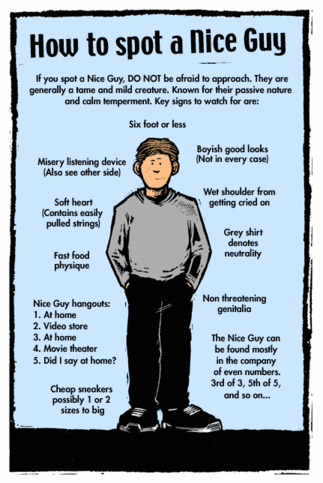
The media still doesn’t understand “nice guys”

One of my pet peeves is how the media still has no grasp on the concept of “nice guys”. A few weeks back, I read a reprint of an article on CNN, which was all about how some girl was upset that she can’t seem to find a nice guy. Then it went on to ridicule every guy in the world because SHE keeps picking “bad boys” when she really wants a “nice guy”. I wrote a response that got a lot of “likes” on CNN, where I essentially stated that the reason she is never going to find a nice guy is because she looks for bad guys and then blames nice guys for not being easier to find. You don’t find what you’re not looking for.

The interesting thing was a CNN writer contacted me and wanted to interview me about my thoughts on this for an article she was going to write. She never got back to me, but interestingly enough, her “article” that she was going to write appeared on CNN today. Here it is, by Stephanie Chen. As I never got to comment before she wrote her story, I definitely have a few things to say about this particular issue and the very concept of nice guys in general, so here goes:

This article pretty much proves to me that mass media is never going to understand the concept of nice guys because it’s a lot like sending a French chef to write an article about Arabic pottery. They don’t know anything about the topic, so trying to be the archaeologist on a nature dig is never going to get the real story. It’s just going to get more and more people confused.

This article shows the problem immediately in that it goes to sources that are not nice guys to explain why nice guys need to be more like them in order to succeed. One of the interviewees wrote a book on how to “score babes”. Yeah, that’s going to really indicate to the diminishing numbers of “nice guys” how they should interact with women in order to do whatever it is they think nice guys are really intending to want to be doing with women. Just because Captain Kirk slept with a bunch of green alien girls in Star Trek doesn’t mean that every member of the Federation can only succeed by taking a “Be like James T. Kirk” seminar on interspecies dating. Okay, I’ll try to keep away from the geek references….

Part of the problem with these essays on why nice guys fail is this belief that we’re all failing because they don’t see us in clubs trying to pick up women like the rest of the bad boys who seem to get a lot of action. Maybe we’re nice guys because that’s something we don’t normally do. If our purpose was to do anything to get a little action, then I’m going to go out on a limb, but that’s probably going to remove the very nature of what makes us part of being nice guys in the first place.

If women are really interested in finding nice guys, I’m sorry but it’s really up to them to go looking for them. They’re not going to find them at clubs. Sorry, but that’s now where they hang out. Most nice guys wouldn’t last a half hour at a club because we’re the ones who feel really awkward because we’re alone, and our usual nature isn’t to become the life of the party at a party where we’re not normally invited. The sad thing is: I’ve had this conversation with a lot of women who are constantly looking for “nice guys”, and they never get it. Oh, they say they get it, and they nod appreciatively, but they always go back to their ways and end up with the guys they can’t understand how they always end up with. I’d pull out my hair in frustration, but there’s not a lot of it left these days, so I have to be careful about that.

Yet, the media keeps reporting that in order for “nice guys” to do well, they have to stop being nice guys, or do things the “other guys” do in order to not be seen by women as “nice guys”. In other words, women looking for nice guys will not go after a nice guy, so you have to pretend to be a bad guy in order for a woman to see you as the nice guy you are. Does any of this sound a bit dysfunctional?

So, what’s the solution? Well, if you’re a woman, the solution is so freaking simple but you’ll NEVER go there. I’ll go out on a limb here but MOST women have guy friends they confide in and consider really nice guys. Well, instead of asking those “nice guys” where to find a nice guy, look right at them right now. There they are. They’re right in front of you. Probably liking you but to afraid to say anything because they figure you’ll stop being their friend. But there they are. And they’ll be there until you either notice them or someone smarter than you notices them and then you start to wonder why you could never find someone like them.

For guys, well, if you’re a nice guy, do what I did. Give up. It’s not worth the hassle. It’s a lot less of a headache when you don’t put yourself out there trying to pretend to be something you’re not. I’m a nice guy, and I’m happy with what I am. I don’t really need to “score” or find anyone to achieve personal happiness. Sure, if the right person came along, or I was friends with the right person and she noticed me, that would be great. And we’d live happily ever after.

But if that doesn’t happen, I’m not going to worry about it. But I’m going to let you in on a little secret. I’m not going to be worrying about you either. If you can’t figure out where to find a nice guy, you probably don’t deserve one in the first place.

Building Worlds as a Part of the Writing Process

A few years ago, I read a book by Richard Bartle, titled Designing Virtual Worlds. As an avid game designer and player, the idea of building worlds has always fascinated me. As a writer, however, designing a world has always been a process that has existed within me, and it has often made crafting a story one of the more difficult projects. In the beginning, when I first started writing, designing a world was simple. It was essentially Earth with different people in it. Oh, sure, every now and then there’d be a dragon instead of a rhino, but honestly when it came down to it, I wasn’t really designing anything; I was recreating what was already there.

As I matured as a writer, I came to realize that the world one crafts is as important as the story itself. Since then, I’ve created a couple of worlds that have existed as part of my writing. Two of them are important enough to discuss here, so I’ll introduce them now.

Reagul was my first real virtual world that I created. It was originally a part of a science fiction/fantasy hybrid I wrote over a decade ago that takes place in the era of Earth 3000 A.D. The Earth has become an empire, and one of the planets in its sphere of control is the medieval-like planet of Reagul. It was during the writing of the novel Destiny that I started to realize that Reagul was more imortant than just a setting for a large part of this novel. It took on a life of its own, and later it became the centrally located planet for the series of stories that became the book, The Tales of Reagul.

Reagul was a fascinating place because it was an experiment of an alien race known as the Minions, who were testing on human subjects from the young planet Earth. During the first century B.C., the aliens transplant a Roman collection of villages from Earth to the new planet. This series of villages grow up to become the central characters of the stories that take place on Reagul. A large number of short stories I wrote have been published in that series, even though most magazines at the time never knew there was a connection between any of these stories. In it, a whole literature was born that has continuously moved the history of this planet, which has nearly 3000 years of history before it reaches the point where it coincides with the first novel (the previously mentioned Destiny).

I figured that I would probably only write one major series in my lifetime, and it was going to be the Reagul series. And then the Soldier came along.

The Soldier was a character that started showing up in some of my earlier writings, first published in Lost Worlds magazine. That first story was mainly about a soldier who has been traveling since separated from his army, but even as I was writing, I realized there was something wrong with this guy, that he was much more than just a normal soldier. That’s when I started to realize that he was on a quest for something, something for which he was going to be spending the rest of his life looking. This item became the Deck Const, which then became the central talisman in my latest novel Rumors of War.

The Soldier is unique because his story is a world all by itself. He lives in a dystopian future where civilization has crumbled, representing an army of a nation that no longer exists. At the same time, his journey has been chronicled long before he was ever born, and many more people know as much about him as he does about himself, even though they have never met him. He becomes a mysterious character, even to himself, but at the same time is on a linear path, seeking out something that will bring civilization back together, while at the same time giving him a reason to exist.

The world of the Soldier is one of those that I often found myself returning to because it was so interesting. At times, he finds himself in a Hobbesian nightmare of a society that has fallen apart, but every now and then he comes across glimmers of hope in the waste lands, and often he is the instrument that brings forth that hope to others.

The point is that it is not just enough to write about a place and call that a “world”. There is so much more to the process than that. The people within that world are just as important to the world as the world itself. The Soldier couldn’t live in Reagul; he just wouldn’t belong, and he’d change that world into something much different than it is. At the same time, the sorceror/wizard Sarbonn (which is from where the name of this site emerged) could never have existed in the Soldier’s world. Both worlds are products of their people and their environment.

This is why so many science fiction stories set on bizarre worlds just don’t seem to work. The writer was spending so much time focusing on the world, or the character, that he or she never realized that the two needed to fit together somehow, and quite often they do not. Harry Harrison’s Stainless Steal Rat is a product of his environment and fits it so well. Asimov’s Mole fits into the Foundation universe that he created (which by the same measure his robots never fit into the Foundation universe, which is why the end of his Foundation series seems more forced than the earlier part of the series; you can’t force one series into another, or one world into another where they do not belong).

An example of a strong failure of this approach is the Fallout series, especially the recent one (Fallout 3). It was a great universe (or world) with the ultimate Dystopian wasteland, but then in one of the add-ons, they decided to add aliens to a universe where they really didn’t belong. Granted, in each story there was always a mention of an alien crash landing, but it was always a technique to give the player an out of control, overpowered weapon with many questions left unanswered. With the alien add-on, it took a Dystopian nightmare and turned it into an alien blaster story. They just didn’t belong in the story, and it diminished the universe as a result.

As a writer, there’s always that fine line that has to be traveled, and once one goes over it, it’s the literary equivalent of “jumping the shark”, even though I’m using the term incorrectly as “jumping the shark” was never really meant to be about going too far (it was always about trying to regain what you had before by doing something stupid). But that’s for another column.

One thing that’s interesting about building a new world is that sometimes that world can get out of one’s control. Star Trek is a good example, as is Marion Zimmer Bradley’s “Darkover” series. Both were great universes where the author/creator designed something magnificent. Then the fans took over. In Roddenberry’s case of Star Trek, the fans became such nitpickers that Roddenberry couldn’t make a decision without someone quoting a previous episode as to why a new episode was in error. With Bradley’s “Darkover”, the fans started creating sequels to the story, and it got to the point where the universe was somewhat out of Bradley’s creative control.

In the end, what can be said about building worlds is that there must be a reason we do it. Some would say we do it to explore our own universe, while others might say we do it to branch out and see things we can never imagine in our own world. For me, it was just a lot of fun, and the characters sometimes just make it all worthwhile.
Why the Kindle never took over the world

I was in Best Buy this evening, and I was looking an iPad. I wasn’t planning to buy one, but they had three models of it on display, so I decided to take a few minutes to see if it was really an impressive product. None of the main features of it caused me to be all that impressed. And then I started looking at the iBook reading section of it (they happened to have Stephen King’s Under the Dome installed on it, which is ironic because I was planning on buying that on an electronic reader the second I got one (as I really don’t like lugging that HUGE book around, even though I currently own it). Wasn’t all that impressed. I didn’t see anything about it that the Kindle didn’t already do.

Which got me thinking. I don’t own a Kindle right now, but I do have a Kindle reader app on my iPhone. So, I can actually read Kindle books on my iPhone.

Which then got me thinking even further. I started to wonder why Amazon’s Kindle hasn’t made the impact that it probably should.

Let me explain. The Kindle is an excellent device for what it does. From the reviews I’ve read about it (including the testimonies), it is a great reader. Unlike the iPad, it doesn’t suffer from the sun glare if you’re using it outside, and it’s very much like an actual book in that you can read it for hours and not get uncomfortable like you will if you’re reading a computer screen (something practically every other e-reader suffers from). With that in mind, you’d think that the Kindle would be selling like hot cakes. So, why isn’t it?

Well, the answer to that question is found in Amazon’s strategy itself. And it’s one of the most bizarre strategies I’ve ever seen for a company that is trying so hard to set the standard for e-readers.

You see, Amazon wants to corner the market on e-readers and e-books, much like Apple has tried to corner the market on music with its iTunes platform. And Apple would have succeeded if it had done it earlier, but Apple put out iTunes AFTER there was already an MP3 market for music established. People were already burning CDs to MP3s and putting that music on MP3 players. Apple came along and then tried to corner the market on something that was already out of control. And surprisingly, they actually got their foot in the door, but it’s a door that’s been wide open for a very long time.

But books are a different story. There has literally been no e-book market because each company that puts out a reader is a company that has no ability to corner the market because controlling the reader doesn’t also mean controlling the content. And that’s where they all fail. But Amazon had a chance to do it because it is probably the one company out there that has a huge market that serves the reading community. If they would have put out an e-reader and made it easily available, they could have owned the whole e-reader market. And they almost did when they released the Kindle, but they then did one of the stupidest things they could have ever done. They made it so you had to buy the Kindle directly from them on their site.

And that practically killed their chances for world domination. I think of myself as a good example to explain why this was such a failure. I buy books from Amazon all of the time, but I refuse to buy a Kindle, mainly because I’ve never seen one in person. I’ve never held one in my hands. In other words, Amazon wants me to buy their equipment unseen and untested, specifically on trust alone. And I don’t trust them because they want me to spend $259 or $450-something for an e-reader that I’ve never seen in person before. And they’re asking a lot of people to trust them and buy their product without ever having a chance to test it. Unfortunately, that’s a business plan doomed to failure. Sure, they’ll sell a few, but they’re not going to sell the number they need to in order to gain the market share they want and need.

So, Amazon is mainly going to have to focus on trying to get people to buy the books they sell online through their site as Kindle books, but they then made it possible for anyone to have their own Kindle-like product, so they made it even less possible that people are going to buy a physical copy of a Kindle. Which then means someone who has a Kindle reader, but not a Kindle, probably has a device that can then probably handle other programs (or apps) as well, which means any company that puts out a book in a cheap format can easily gain their business.

Apple has now jumped into this market and is trying to create its own iBookstore which it hopes to control like the iTunes marketplace. Not going to happen because there are already so many other more trusted places to get book content that Apple is never going to be the “go to” place for that. It’s just going to further saturate the market with more places to find e-reader books, and thus, it will make it that much harder for e-books to take off because there will not be any one format. People will become so frustrated with trying to tap into this market that they’ll just consider it one of those unrealized areas of content and continue to buy books in hard copy.

But Amazon could have won the war right from the start if they would have done one thing, and that’s license other companies to sell their Kindles. Imagine the business they would have gained if they would have had Best Buy selling Kindles. If they would have dropped the price to about $199 and then put them in every Best Buy, they would practically own the e-reader business across the country, and who knows….the world. But they didn’t do that. There were no apps being made for the Kindle, so the only way to read books on it would have been to buy them from Amazon. It was a win-win situation, but they didn’t think it all of the way through.

Instead, we have more and more readers coming out and no way to figure out how to get the books onto those readers, so those readers are going to fail overall, and manufacturers will figure that it was the customers not wanting to buy books for devices, when in fact it was a failure of the devices to capture an audience that was willing to then buy content.

That’s why the Kindle never took over the world, even though it probably could have.