Tag Archives: fiction

Memoir Books Are Being Slowly Replaced by Lazy Writers


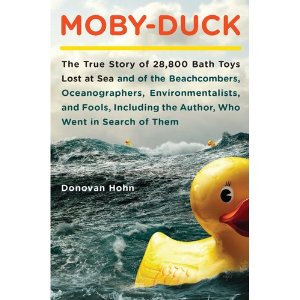
I was in the bookstore the other day looking over the selections of books when I came across a really interesting book of which I had heard nothing so far. But it looked intriguing. It was called Moby-Duck, and as you can see from the picture with this article, it is about a man who goes on a quest to discover what happened to 28,800 bath toys that were lost at sea.

So, why am I talking about this book? Well, think about the story involved in this book. The author, Donovan Hohn, actually put forth a lot of work to find out what happened to these rubber duckies and bath toys after the disappeared. In essence, he went on an epic quest, like the infamous Moby Dick to find what happened to these items. In other words, he went through a hell of a lot of work to get the story that he later transposed to paper so that the rest of us could experience his adventure.

My point is that so few people who write memoirs these days actually go through this amount of work in their adventures before sitting down and writing their “memoirs”. Instead, they suffer one bad relationship, have a bad drinking problem, or do something singularly simple and then try to convince the rest of us that it was actually an epic journey to get from one place to the other. I guess you could say I’m getting a little sick of these kinds of stories that really have no great master journey to them, no odyssey, yet are treated as if they are the epic adventures of a lifetime.

We need more writers out there who are willing to go through a little bit of work to actually come back with the story they need to tell. Instead, we get lazy writers that try to profit off of their innane adventures. And we keep buying this crap because none of us are willing to demand more from the writings that we read.

I felt this way some time ago when I was writing one of my earlier science fiction novels, Thompson’s Bounty, which was about a Coast Guard cutter that gets sent back into the 17th century. When I first started writing the novel, I actually tried to just crank it out without really knowing much about my subject, other than having watched a few old movies about pirates. Then it dawned on me that I wasn’t ready to write the novel. So I contacted the Coast Guard and requested some in person information, which led to going out with a cutter crew for several days over several weekends. It also led to a bunch of long conversations and tours on a Coast Guard base where very knowledgeable people gave me first hand information about the subject I was writing. In the end, I wound up with a book that told the story I wanted to tell instead of one that was peripheral and out of context.

Recently, I’ve been working on a novel that I originally wrote decades ago that takes place in Eastern Europe during the Cold War. Originally, I kind of winged it through the story, but after doing my thesis work on the August Coup in the Soviet Union, I finally had the premise, place and event that really made up the background of the novel I wrote years before. So, I’ve been sitting down and tackling that book from the start, realizing that I now know a lot more information than I first did when I wrote that book back then.

That’s sort of the thing I’m talking about with the kind of reading I’m coming across these days. So much of it can be so much better than it is if authors would take the time to actually do the research that would make their books that much better. I remember a great scene from Billy Crystal’s Throw Mama From the Train when a woman in his creative writing class is describing a submarine story she wrote, and he comments that maybe she should actually know the name of the device she’s describing if she wants to be taken seriously in a story that involves submarines. I take his advice a bit further and say that maybe some time should be given to exploring the lifestyles and events that lead people to the moments that occur in novels so that the reader believes the author is the right person to be writing the story.

We seem to have a lot lazier writers these days with a lot of the stories and memoirs I read, but that doesn’t mean we have to settle for that. We can demand more substance, research and work. We just generally don’t. And we’re the ones who suffer as a result.

My Next Novel

One of the more exciting aspects of being a novelist is that every now and then you actually get to sit down and write a novel. Imagine that. Well, I’ve been giving the prospect a lot of thought lately, and now I finally realize what is going to be the next novel.

The working title: Mapping the Silence of Dreams

Genre: Fantasy

Premise: The next realm of exploration is Mindspace after a discovery is made that links the dream world that everyone travels to when they fall asleep. All along we thought it was a realm that existed within each person’s mind, but now we know that everyone travels to this same place, yet are separated by their own barriers their minds construct to protect them. Well, now that we’ve begun to explore it, we start to realize there’s something else in Mindspace. Something alive. Something that’s been waiting. And it’s ready.

The novel is based on a short story I wrote years ago and stashed away in a drawer but always wanted to do more with. Well, now it gets its chance.

I begin writing it on Monday, which is the start of National Novel Writing Month (NaNoWriMo), where the goal is to write a novel (50,000 words) in one month. Last year, I wrote Plato’s Perspective during the contest.

A few of my friends will be participating this year.

Humor Writing Gets Very Little Respect These Days

I’m a humor writer. Been one for a number of years now. Sometimes it involves fiction; other times it’s incorporated into non-fiction. Either way, it is something I enjoy doing.

What I have discovered is that no matter what genre or style I utilize it in, it rarely gets a lot of respect by anyone in those respective fields. And that’s what I’d like to talk about today.

First, as most people who attempt to write humor know, good humor is very difficult to write. You either know what you’re doing, or you don’t. Those who don’t know how to write good humor end up writing really bad humor, but think that they’re funny. Such writing is very difficult to read, and quite often these conversations go something like:

You: “Um, I really like what you did with this piece.”

Attempted Funny Person: “What did you find funny about the piece?”

You: “Um…” Which quite often is followed by you dropping one of those smoke pellets that were used in cartoons and really bad spy films, where you make your get-away, realizing that if you don’t disappear quickly you’re somehow going to have to answer that unanswerable question.

Which then leads to the mistake so many people make when they think that humor must be so easy to write, and anyone can do it, even though they personally can’t do it themselves. This culminates in the erroneous postulation that humor is never to be taken seriously, so therefore it is not important enough to be used by “real” writers.

And this is the problem I find myself in today. As a serious writer of fiction (when I fall into my self-important moods), I find that some of my best fiction has been the type that has been developed through humor. My latest novel is probably the best novel I have ever written, and it is a full-fledged story of humor, involving a Greek epic of ridiculous proportions. Having said that, I have also discovered that when I discuss this novel with other people, they don’t take it, or me, seriously. They hear the “humorous” parts and immediately fall into this belief that both me and the novel are not to be considered serious, as in writing and writers. The fact that it is some of my best writing ever does not seem to make a difference. The fact that it involves some of the strongest uses of metaphor and allusion that I have seen in most modern day novels does not seem to cause anyone to consider it seriously. To everyone who looks it over, it’s a 300 page joke that doesn’t deserve that much attention.

I’ve discovered this to be the case with most humor I write. And people don’t even seem to realize that much of the humor I put forth has very serious implications when dealing with important issues. It’s just a different aperature to observe such circumstances. But because it made someone laugh or smile, it’s not to be taken seriously.

 This happens with my nonfiction writing as well. In a recent article, I attempted to deal with the concepts of cults and religions by pretending to create my own cult. The responses I received were usually derision and not very serious themselves. The fact that seriously important issues were being broached in an absurd way should have given people a reason to think about their own normal concepts, but instead of doing so, they saw a “ha ha” moment, and nothing was seen as being in any way serious.

Sadly, most humor writers, especially ones who write so that issues can be approached from a different perspective, are rarely taken seriously, except by very few readers who seem to “get” it. It’s like a conversation I had about science fiction on television, in which I was trying to argue that some of the greatest drama of our time has been covered by the science fiction genre. A person responded to me with: “I prefer real dramas, like Gossip Girl, so I don’t have time for science fiction.” Unfortunately, she wasn’t joking.

I find that same sort of criticism with humor. And no matter how many times I try to joke about it, it still manages to bother me.

What is the future of the literary magazine?

I’ve been wondering this question for a bit of time now with the emergence of the Internet as the place where everything seems to be centered in writing these days. In the old days, to be a writer, you first finished your education (generally), then you started publishing in literary magazines, then to commercial, high paying magazines, and then you started to work your way into getting that novel published. Granted, some people took an easier path, but mostly this was the formula for success.

The Internet has kind of changed all of that. Now, anyone can claim to be a writer and try to make his or her way without any previous work. This has developed a whole sense of a lot of junk that has been thrown into the mix, making it almost impossible for a writer to get recognized and even worse, that much harder for a reader to figure out what is worth reading. Bookstores start to gravitate away from the old formula, and the next thing you know (or we currently know) bookstores only publish commercial fiction that is churned out by publishers who are only willing to invest in already established names or, even worse, celebrities who are now writing books. Like Nancy Grace’s new book. Or Glenn Beck’s. Or the autobiographies of unimportant important people which were really written by other people. This leads to events like Tyra Banks announcing she’s writing her new book Modelland, which really excited only about four people, all of them employed by Tyra Banks.

Which brings it back to me. It’s my blog, so why not?

At one point, I was actually making a name for myself in the literary magazine marketplace. Editors started to know me. Sometimes they even commented on my published work when they saw me in another magazine. It used to be a really close-knit community, and I was breaking into it.

And then I stopped writing for about a decade and a half due to a really strange relationship I had with a woman. It took me that long to realize I needed to get back to writing, and here I am. But no one remembers me any more, so it’s like I’m starting over again.

Recently, one of those editors contacted me and published one of my later pieces of work in his literary magazine, a science fiction one. A success. Yay. But it leaves me wondering if this old model of publishing is still viable today. Don’t get me wrong. I’ll include it on my vita like I normally would, but I wonder if the publication of this story in this ‘zine is really going to contribute to my eventual success. Oh don’t get me wrong. I’d still have it published there cause I like the editor and support his continued attempts to build an audience for what he does best. But I’m still wondering if there’s a career out there for me because there are so many writers these days, and basically you’re competing with anyone who has access to a computer today.

It makes me wonder if the age of being a writer is somewhat over, unless you already made it famous before or you’re some kind of marketing genius capable of making a name for yourself in the sea of endless writers.