Tag Archives: novel
The Cover of My New Novel “LOSER”

This is the new cover of my latest novel I’m releasing called Loser. It is one of my earlier science fiction novels. The description is as follows:
After the final war, the Councils did what no previous government was able to do: Unify the world under one government. Like societies that victimize their lowest class, the invention of a device to determine someone’s usefulness to a community manages to make that effort even easier. Centuries later, the original intention of such a device loses its original purpose, allowing those on top to determine the survivability of those on the bottom, originally nicknamed “Losers” and with time the nickname becomes an actual designation.
Rem Schlock is a new Exterminator tasked with hunting and finding elusive Losers. During his search, he discovers the rumor of a mysterious “leader” of the Losers. Facing a future darkened by random death, decayed cities and hidden loyalties, Rem hunts this phantom criminal, discovering an underworld he never imagined yet once revealed can never be covered up again.
It should be up on Amazon very soon.
Explaining the Libyan Conflict to College Students Who Don’t Care
I’m a college professor who teaches political science to students who generally aren’t interested in the information. It’s a required course, which means you end up with a lot of students who are in the class mainly to fulfill a requirement and then get out. The information is irrelevant to them. It’s not important. It’s information best left to people who deal with that sort of information. Which kind of brings me to an aside. Years ago, I was a counterintelligence agent working in a foreign nation. I was working with some very dedicated people. I had an assistant who was sponging off me, trying to learn everything he could so that one day he could be an agent himself. I remember him asking me one day when we were involved in something that would take a novel to explain (and could have very well qualified for science fiction status) when my assistant turned to me and said: “Aren’t there people in our government who handle these sorts of things?” And my response was, which I’ve never forgotten: “We are those people.” His response was classic: “You really should be getting paid a lot more than you are.”
Which brings me back to teaching college. I was discussing current events of the day, and a student mentioned that we were now attacking Libya and then asked: “I don’t understand why we’re doing it? Why are we attacking?”
This was one of those questions that most people don’t have to deal with because either they’re hip on what’s going on in the world and are more a part of the argument than the reasoning, or they’re part of that group of people who are oblivious to what’s going on in the nation and the world around them, kind of like most college students tend to be. We like to think that college students are the smarter of the young people out there, but quite often they’re clueless, mainly because their interests are still high school interests that have yet to evolve into something more worldly.
So I stood in front of class and tried to bring it back home. We had been talking about the War Powers Act of 1973, that details when a president can and cannot commit troops to war, and as much as I tried to explain it, the questions kept coming up with how a war can actually take place when the resolution basically says that it really shouldn’t. I tried to explain that the War Powers Act was a response to the Vietnam War, where Congress no longer wanted a president to be able to commit the country to war without a resolution of war first, but then also explained that real events in real time were always a test of boundaries, and right now we were going through yet another test of the boundaries set forth by the Act itself. I went through and explained the ramifications of Bush II’s escalation of war from an angered country after 911, and how it had everything to do with the state of the Act today. Little by little, I was able to explain what was going on, but each time I peeled another layer of the political onion, I found yet another raw debate waiting to emerge.
In the end, I was left explaining that events are happening right now in which the future has everything to do with how things play out on a day to day basis, that quite often you couldn’t rely on a textbook or legal definition to reveal what was right and what was wrong. Often, more than sometimes, the events of tomorrow have no predictability because people today are rarely rational, even though political scientists tend to veer towards the rational actor theory (people do what is most natural and, for lack of better word, rational).
It was one student, sitting in the back of the room, texting her friends during the lecture, who offered probably the most poignant question of all. “What will this mean for us in the future?”
And she meant for young people like her, those going through college and trying to create a life for themselves. Realizing the nation was already at war in two other places, the revelation that we might be at war in a third caused a texting student to stop texting long enough to ask what this might mean for her future.
And I had to tell her that I didn’t know. Politics is all about how rational actors respond irrationally to events that often make little sense in a solitary context. It’s why political scientists should never predict, even though they keep trying to do so. All I could respond with was confusion and knowledge of the past, because I realize that nothing in our future is truly new, as we often fulfill the axiom of history repeating itself. What that axiom never points out is that most people don’t have a solid foundation of history to recognize it when it does. You see, most people are like my students in that class, oblivious to the world around them, and equally clueless to the past because they didn’t think it was important enough to study at the time.
Government, Intelligence and Why the Future May Not Be So Great
Years ago, I was a counterintelligence agent working for the US Army. It was an interesting career and one I obviously can’t talk too much about, but at one point it ended, I became a civilian and then went on with my life. Shortly after getting out of the service, I applied to the Central Intelligence Agency, was accepted and the day before I was to fly to Washington, D.C. for the final signing, I received a form that I had to fill out before I would be flying out. The paperwork informed me from that point on that EVERYTHING I ever wrote in the future would be subject to having to be cleared by the CIA before it could be published.
Being a writer, I stared at that form and realized there was no way in hell I could sign it. I was writing espionage fiction at that period in my life, and all I could think was that somewhere some paper pusher was going to start deciding what I could and couldn’t write in my novels, mainly because I would have signed a paper allowing someone to do just that. All sorts of fantastical scenarios played in my head to the point that I talked myself out of joining the CIA, turned down the flight and for the next few weeks fielded calls from the recruiting agent who kept explaining I was overreacting. But it was a no deal for me, and that was the end of that chapter in my life.
Fast forward a few decades, and I was actually applying for a position as an agent who conducted background investigations, requiring the same clearance that I had before. As the background investigation was conducted on me, it suddenly stalled when a discovery was made: Some 20 years or so ago, I turned a car back into the dealer because I couldn’t afford to make payments on it. Because I was flat broke back then (and bordering on homeless), I cut ties with that loan agency and they with me. The agent who negotiated taking back the car indicated that that would be the end of it, and we’d part ways amicably. Turns out he lied as the car company charged off the debt and then sold my debt to some credit collector who continued to harass me for many years since that mistake. Welll, 20 years later, during a background investigation, suddenly I was a questionable applicant as I obviously couldn’t be trusted to keep secrets for the government because I had a bad credit item in my past. I was turned down for the clearance.
So, since then, I’ve realized that I’ll probably never be able to work for the government again. I was looking into working for the State Department at one point because my academic research actually yielded an innovative peace process that had been untried before. However, because of this whole clearance thing, I realized that I could never work for the State Department either. To be an administrative assistance in the State Department, you have to be able to qualify for one of the highest clearances. So, that means that in the future, even though I may have discovered a peace process that might yield future success for the world, and especially our country, it won’t go anywhere because the guy who came up with it obviously can’t be trusted.
This got me to thinking that our future is kind of screwed in more ways than one, and not just because we’ll never be able to achieve peace through my academic research but because we are still at the trail end of a major recession, which means a lot of people now have really bad credit. Therefore, when things start to improve, we have a whole new crop of people who can never get security clearances because they have bad credit in their past.
Our credit process has now turned our nation into one that has fewer and fewer qualified people able to serve it, which means that as our choices are limited by those who can maintain a clearance, we lose a lot of intelligent people who may have ran into a problem somewhere in their past. Talk about cutting off the great accomplishments of so many potential people who might want to still serve our nation but can’t mainly because they’re not wanted anymore because of some past incident that was probably not planned or desired.
I remember receiving letters from the clearance agency people indicating that I had to somehow “explain” my credit problem, and all I could think at the time was: “There was this time in my life when I had no money, no job and no hope of ever changing that. What more would you like to know?” Figuring that wouldn’t be good enough for someone in a government job who has probably never experienced that situation, I threw away the letter and figured the government just didn’t want or need me anymore.
I imagine that’s going to be happening a lot in the near future.
Memoir Books Are Being Slowly Replaced by Lazy Writers
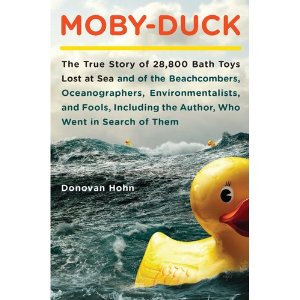
I was in the bookstore the other day looking over the selections of books when I came across a really interesting book of which I had heard nothing so far. But it looked intriguing. It was called Moby-Duck, and as you can see from the picture with this article, it is about a man who goes on a quest to discover what happened to 28,800 bath toys that were lost at sea.
So, why am I talking about this book? Well, think about the story involved in this book. The author, Donovan Hohn, actually put forth a lot of work to find out what happened to these rubber duckies and bath toys after the disappeared. In essence, he went on an epic quest, like the infamous Moby Dick to find what happened to these items. In other words, he went through a hell of a lot of work to get the story that he later transposed to paper so that the rest of us could experience his adventure.
My point is that so few people who write memoirs these days actually go through this amount of work in their adventures before sitting down and writing their “memoirs”. Instead, they suffer one bad relationship, have a bad drinking problem, or do something singularly simple and then try to convince the rest of us that it was actually an epic journey to get from one place to the other. I guess you could say I’m getting a little sick of these kinds of stories that really have no great master journey to them, no odyssey, yet are treated as if they are the epic adventures of a lifetime.
We need more writers out there who are willing to go through a little bit of work to actually come back with the story they need to tell. Instead, we get lazy writers that try to profit off of their innane adventures. And we keep buying this crap because none of us are willing to demand more from the writings that we read.
I felt this way some time ago when I was writing one of my earlier science fiction novels, Thompson’s Bounty, which was about a Coast Guard cutter that gets sent back into the 17th century. When I first started writing the novel, I actually tried to just crank it out without really knowing much about my subject, other than having watched a few old movies about pirates. Then it dawned on me that I wasn’t ready to write the novel. So I contacted the Coast Guard and requested some in person information, which led to going out with a cutter crew for several days over several weekends. It also led to a bunch of long conversations and tours on a Coast Guard base where very knowledgeable people gave me first hand information about the subject I was writing. In the end, I wound up with a book that told the story I wanted to tell instead of one that was peripheral and out of context.
Recently, I’ve been working on a novel that I originally wrote decades ago that takes place in Eastern Europe during the Cold War. Originally, I kind of winged it through the story, but after doing my thesis work on the August Coup in the Soviet Union, I finally had the premise, place and event that really made up the background of the novel I wrote years before. So, I’ve been sitting down and tackling that book from the start, realizing that I now know a lot more information than I first did when I wrote that book back then.
That’s sort of the thing I’m talking about with the kind of reading I’m coming across these days. So much of it can be so much better than it is if authors would take the time to actually do the research that would make their books that much better. I remember a great scene from Billy Crystal’s Throw Mama From the Train when a woman in his creative writing class is describing a submarine story she wrote, and he comments that maybe she should actually know the name of the device she’s describing if she wants to be taken seriously in a story that involves submarines. I take his advice a bit further and say that maybe some time should be given to exploring the lifestyles and events that lead people to the moments that occur in novels so that the reader believes the author is the right person to be writing the story.
We seem to have a lot lazier writers these days with a lot of the stories and memoirs I read, but that doesn’t mean we have to settle for that. We can demand more substance, research and work. We just generally don’t. And we’re the ones who suffer as a result.
Taking a Break from Writing to Talk about Writing
As most people who know me already know, I’m in the middle of writing a new novel. As this is November, and the start of National Novel Writing Month, I’m sure a lot of people who wouldn’t normally say so can say that they are also writing a new novel. And that’s great. But I’m not talking about them. I’m talking about me.
This isn’t my first novel, nor do I believe it will be my last. I’ve written 13 (or 12, depending on whether we use new or old math) before, and I’ve been generally happy with the novels I’ve written. For me, each novel is a new adventure into the whole discipline, and it’s mainly that I want to talk about. Because I think people are kind of missing the point of writing a novel in the first place.
Over the last few years, there have been quite a few novels written by celebrities who don’t normally write novels. Mostly, they have been quick turnarounds that went from conception to print in the time it takes to make a press release. As a result, quite a few of them have been dreary, dismal affairs, and mostly they’ve been non-events, much like the television show of the same name. Publishers realize they can make a quick buck by having a celebrity announce a novel and then they’ll publish it and hope that that celebrity’s fans rush out and buy it, thinking that because they like how someone acts, models or sings that they’ll also like how they write.
Writing isn’t normally like that. Even people who are really good at writing short subjects are not very good at writing novels. Yet, everyone who has a bit of education, or has written something short, is convinced that he or she is also going to be a great novelist. My own history is filled with the numbers of people who all thought this, and as I have been writing most of my life, it has always been really annoying, irritating and frustrating.
I’ll let you in on a little secret. Not everyone can write a novel. Nor is everyone really supposed to. Yet, quite a few people are convinced that they have something to say, at least until they sit down and actually try to say it. Then they flounder for a while until they either give up or churn out a piece of crap that they should have put back into a drawer the second it was completed.
Having said that, I would also like to say that writing a novel is something everyone should actually try. I know that sounds a bit contrary to what I was saying before, but I really believe this. Not because everyone should be published, but because I think writing is a great exercise in expanding one’s own capability of communicating.
I see the process of writing novels as an education. While I’ve written tons and tons of short fiction, I think my real growth of a writer has come when I have actually sat down and tried to write a novel. My first novel was an exercise in frustration, as I lost the last 80 or so pages of it due to a fluke accident and had to rewrite the ending to what I thought was the greatest piece of work I had written to that date. I almost gave up writing that day. But I sat down and finished it again.
The second novel was probably the hardest novel I ever wrote because I kept telling myself over and over (while writing it) that book number one was a fluke, that I was a fraud, that I really shouldn’t be writing another novel. But I finished that second novel, and it told me that I was capable of doing more than one. The success of that moment is hard to describe unless you’ve experienced it yourself.
The third novel was my first attempt at writing what I thought was an “important” nove. I had finished my suspense novel and my science fiction/psychological novel, and now I was going to sit down and write something serious. Never happened. My third novel was in fact my fourth novel, because the third one was tossed into a drawer where it lives to this day. In the end, I wrote a thriller, and it was definitely the right choice for number three.
From that point on, I started to push out novels at one and two a year, no longer thinking about whether I should write, but when I should. I continued on this path until I had quite a few novels under my belt. A couple were published, but mostly the act of writing was more important to me than the act of publishing.
And then I stopped writing. I had been dating a woman who had a degree in psychology and was someone I considered much smarter than I would ever be. At some point, she criticized my writing, and I realized that if I couldn’t please her with my writing that it wasn’t worth my time. She told me she was going to be writing her “novel” one day, and even though she never wrote word one, I was always convinced that of the two of us, she was the one who deserved the writing accolades.
And then she dumped me. For several years, I kind of floundered in my inability to write another word. And then I started writing plays because someone asked me to. And I wrote a lot of them. And then they started being performed, and I discovered a humorous talent I didn’t realize I had. In the beginning, I was writing a lot of humor as a balance to the anger I was feeling about how that relationship had betrayed me. And then I started to heal, and the humor continued, so I kept writing more. And people liked it.
Then I sat down and wrote my next novel, which was my first comedy. It took me five years, and in the end, I had what I still consider to be my greatest achievement in writing.
After that, I didn’t know what to do, so I sat down and finished a novel I had started many years before. And it was a very good one.
Which brought me to NaNoWriMo, which is a project where you write a novel in one month. I had this idea for a novel running through my head for years now, and I just never got it started. But then the contest came around, and I decided, it’s time to be the writer I know that I am.
So I started writing, and it’s still building upon itself today. I’m 27 pages into a novel that I consider quite important to my career of writing.
Because that’s the thing I hinted at in the beginning. Each novel is an examination of the writing I am capable of doing today. And that’s what a writer should be doing with his or her writing with each and every project. Sure, we can write drivel if we want, but a writer should sit down and try to reinvent his or her own writing each time a new project begins. The masters of writing reinvented the writing process each time they brought out a new book, and we study them to find out what they were thinking. That’s what a writer should be doing today…reinventing the very nature of writing. Each time you sit down and write, you should always be thinking, “I couldn’t have written that novel a year ago, but I sure can today.” And then ten years from now, you will be writing things you never could have written today.
That’s the reward of writing and one always worth striving for. Let the celebrities write their crap. The rest of us should be struggling to put forth the very best we can of ourselves. To do any less is a waste of time and a failure for the future novel one might one day be able to write, if only able to take that first step today.
My Next Novel
One of the more exciting aspects of being a novelist is that every now and then you actually get to sit down and write a novel. Imagine that. Well, I’ve been giving the prospect a lot of thought lately, and now I finally realize what is going to be the next novel.
The working title: Mapping the Silence of Dreams
Genre: Fantasy
Premise: The next realm of exploration is Mindspace after a discovery is made that links the dream world that everyone travels to when they fall asleep. All along we thought it was a realm that existed within each person’s mind, but now we know that everyone travels to this same place, yet are separated by their own barriers their minds construct to protect them. Well, now that we’ve begun to explore it, we start to realize there’s something else in Mindspace. Something alive. Something that’s been waiting. And it’s ready.
The novel is based on a short story I wrote years ago and stashed away in a drawer but always wanted to do more with. Well, now it gets its chance.
I begin writing it on Monday, which is the start of National Novel Writing Month (NaNoWriMo), where the goal is to write a novel (50,000 words) in one month. Last year, I wrote Plato’s Perspective during the contest.
A few of my friends will be participating this year.