
Tag Archives: Business

Why Barnes & Noble’s Nook Failed

"I read all of Duane Gundrum's books because he's so dreamy...."
“I read all of Duane Gundrum’s books because he’s so dreamy….”

Unfortunately, it’s been predicted for some time that Barnes & Noble was going to distance itself from the Nook, and thus, the e-book market. So, it seems that moment is coming to pass. Speculators assume that Barnes & Noble will attempt to continue on as a brick and mortar (physical presence only) store and sell off all of its e-book stuff. Well, in case it’s not readily apparent, the problem with that is that without an actual device to continue to hype the market of products, the Nook is going to die out as people are going to see the Kindle as a continuing vehicle and the Nook as dead in the water. Sure, they can survive on apps for awhile, but eventually people are going to see the writing on the wall and choose to go with a platform that looks like it is going to survive the next wave of changes.

But the point of this post isn’t to talk about the future of Barnes & Noble, because to be honest, I have no idea what is going to happen to that company. However, what I can do is talk about what happened to the company, specifically as to why the Nook didn’t become the all-winning vehicle they were hoping it would be. To understand this, we have to use our little go back in time feature and see what was happening when the Nook launched with all intentions of challenging the new kid on the block, the Kindle.

Back then, Barnes & Noble was the big kid on the block. He’d already beat up every brick and mortar store that existed before him, and he was rearing to go after the next challenge. Only, the next challenge wasn’t another physical store, but an online one that promised to lower prices and produce a better shopping experience. Now, I wish to harp on the latter of those intentions because Barnes & Noble stupidly focused only on the first: Lower prices. And unfortunately, Barnes & Noble didn’t handle that one well either.

The Kindle offered books at lower prices than you could buy them at retail stores. This was huge. When the Nook launched, it attempted to “discount” prices as well, but if you held up both side by side (and I used to do this a lot), what you discovered was that most of the time the Kindle price was exactly the same as, or cheaper, than the Nook price for a book. And then you started to see more and more choices being offered on the Kindle, which made having a Nook kind of a stupid purchase because if you couldn’t find everything, and couldn’t find it cheaper, you bought a pretty stupid device.

But the second point is the one I want to talk about the most because that’s where I truly feel that Barnes & Noble failed with its Nook. What Amazon offered with its Kindle was not only lower prices, but it offered a better customer experience, meaning that if you were looking for something, the Kindle actually cared about helping you find it. This meant that as you bought more books, the algorithms that worked within Amazon served to make recommendations to help you find things that you might want in the future. The more you bought and searched, the more likely the device was going to serve to help you find exactly what you might want, even if you didn’t realize you wanted it.

The Nook, on the other hand, basically offered you whatever the publishers were selling, and it put its placement completely determined by the legacy model of the highest bidder (or largest publisher with more prestige). After a few purchases on a Nook, if you were looking for a new book, every new search was like starting out from the very beginning again. In other words, you were screwed. If you didn’t want only the most popular book out there, you had to figure out what you wanted on your own.

The problem B&N made was that it assumed that cheaper prices (less than you’d pay for the hard copy of the book) was more than enough to produce decent profit. But they didn’t take into account that they had to be cheaper than the competition, not just cheaper than their own posted price for the retail version of the hard copy. And then they made the customer experience as bad as an Internet search could be back before Google was invented. You basically had to do a search with the intention of hoping to get lucky in order to find the thing you were looking for. This was great if you were looking for a copy of 50 Shades of Gray, but it wasn’t so great if you were looking for new, independent writers who might be making a splash in an obscure genre, but a genre of which you often spent a lot of money. The Kindle, however, did this extraordinarily well.

So, it shouldn’t come as any surprise which device, and which company, won the battle. The war isn’t over, but quite a few of the initial battles were quite decisive, so the outcome seems somewhat conclusive.
The Evolution of Sales for a Self-Publishing Author

I recently spent some time analyzing how many sales I’ve had through Amazon. Keep in mind, this doesn’t count sales through other services (just Amazon). But what I discovered was kind of fascinating, because if you haven’t been paying attention to it, the information kind of sneaks up on you and tries to stab you in the back. Or at least jumps out from the shadows and says “boo!”.

For the record, I’ve been selling books on Amazon as ebooks since 2008. Granted, hardly a single one sold back then, but I was trying to sell one book (Thompson’s Bounty) way back then. Shortly after, Innocent Until Proven Guilty came along, and then a few years later, everything else sort of exploded into print. What’s interesting is that if you look at the numbers (and yes, most people know I’m a number crunching kind of guy), you’ll discover that in 2008, combined with 2009, I sold 9 copies of Thompson’s Bounty. And that’s it. In 2010, I sold 7 books, mixed between the first two I mentioned earlier. And then 2011, well, just kind of went nuts. I sold 181 books, spread out over 8 different titles. 2012 was a little less successful with 135 books sold. Strangely enough, 2013, of which we are only in June, has had 110 sales. Not counted were 77 sales that occurred just last month, so you can see that 2013 has already surpassed both 2011 and 2012, and we’re not even halfway through the year.

As for money, that’s increasing as well, which makes sense when you follow the number of sales.

The quandary for me in publishing has always been trying to figure out how to sell to more readers, or at least how to get readers to at least know my books exist. I wish I could say I’ve found the answer to that, but I haven’t yet. But I’m still searching, experimenting and performing ritual sacrifices to The Shania in hopes of figuring that out.

Anyway, not much of a post about the usual stuff, but as I rarely discuss the business side of the craft, I thought I would share this with you all (which by “all”, I obviously mean my two stuffed animals who make up my readership).

If You’ve Ever Wondered Who It Is Government Works For….

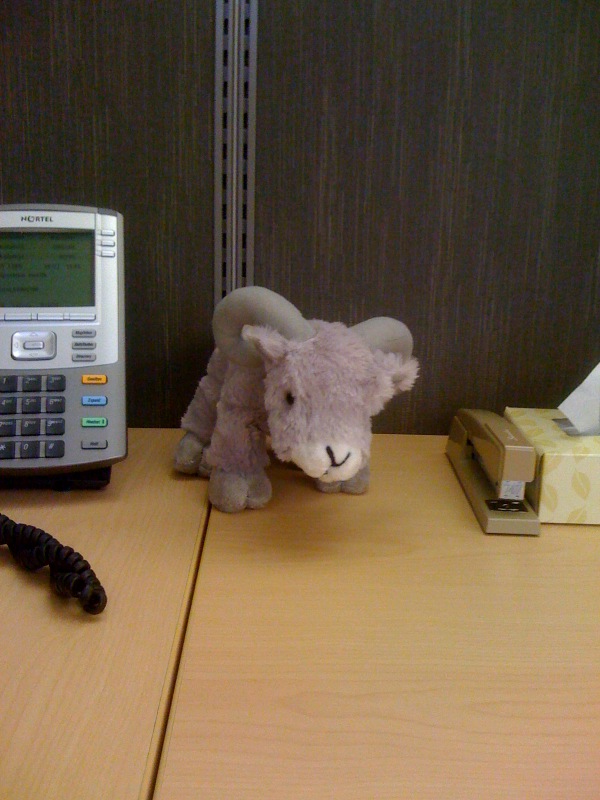
Brucoe, a real man's stuffed animal who takes no crap from anyone, especially cell phone companies
Brucoe, a real man’s stuffed animal who takes no crap from anyone, especially cell phone companies

There’s an interesting situation going on right now in the US Government, and it involves cell phones. From the Wall Street Journal comes a story about how the president is trying to convince Congress that we should allow unlocked phones to be allowed so that people can switch phone providers after their contracts have expired. The interesting part of the story, and the part that most people won’t get, is that this isn’t the first time the president and Congress have dealt with this issue. As a matter of fact, Congress originally made this ruling with a previous law, but made it one of those cumbersome laws that expires, which they often do when they don’t really want to do something. After it expired, these “penalties” were enacted for unauthorized unblocked phones:

The Library of Congress’s rules establish federal copyright penalties for unlocking a cellphone. Wireless carriers can collect statutory civil damages of between $200 and $2,500 per violation and criminal penalties can rise to $500,000, five years in prison or both for the first offense. (from the previously linked article)

Only after a digital write in campaign did the president actually chime in with his own thoughts, backing the people rather than the rich bigwigs in Congress.

So, the question going through your mind should be: For whom does the government work? Because the last time around, Congress did nothing, which managed to benefit the phone monopolies instead of the people, because they realized they wouldn’t be held accountable for doing nothing (a common misconception by Congress). In my opinion, if there wasn’t a write in campaign to the president, I doubt he would have addressed the issue either.

I suspect nothing is going to be done about this, unless people rally and hold their representatives accountable. The telecoms love the way things are right now, even though they claim that they allow phones to be unblocked (so people can switch companies without having to buy a brand new phone), but they don’t make it easy. As a matter of fact, from AT&T’s response to the issue, they have to give permission, even though they claim they probably would. That’s not a right. That’s being locked into a post-contract situation over a phone that your contract actually paid for.

So, if you ever want to know for whom government works, watch how this plays out. People can say and claim all sorts of things, but until you see it play out in front of you, you don’t know how things really happen. Words are great, but actions trump works each and every time.

“See Price in Cart” is a crappy business strategy that needs to go away very fast

I received an advertisement from Sam’s Club today that listed a television on sale, but in order to see the price, you had to click it (as it listed “see price in cart”). One click later, I was now on a screen that told me to “add item to cart” AND NO PRICE. That took me to another screen with the wording along the lines of “complete transaction” and a button, AGAIN WITH NO PRICE. The next screen was a couple of listings of what the price used to be, and yet another button to make the sale (without the price yet). Look, I get the idea that you’re trying to get people to want to buy the product and are doing all sorts of psychological games along the lines of “well, if they click this many times to get to the price of the tv, they’ll eventually just decide they have to have it.” This is fine if we’re all multi-millionaires shopping in some boutique where “price is not a concern” but this is freaking Sam’s Club, not some posh place in Beverly Hills.

If you want me to buy your crap, tell me how much it is. If it’s cheap enough that I find it to be a bargain, I’ll buy it. If it’s not, then no amount of “keep clicking until you’re so worn down that you’ll buy it JUST TO GET OUT OF THIS NIGHTMARE” is going to make me pay more money for an item that I’m just curious about.

Companies really need to stop this crap because it so annoying. Customers aren’t lemmings, nor are they people who want to be herded towards your sales. Customers are people you should be trying to attract with good prices, good service and excellent products. Otherwise, your company and its business practices suck. Simple as that.

Why I won’t be buying the new Kindle Fire HD or whatever it’s called

For some bizarre, masochistic reason, I have bought practically every version of the Kindle that has been made. The last one I bought was the Kindle Fire when it first came out. And that device is the reason I have decided to pass on anything in the future made by Kindle.

My needs are pretty simple. What I wanted was a device that could allow me to read books (which it does), maybe listen to a bit of music (which it kind of does, as long as you put your entire music library on Amazon’s cloud), and can place certain documents I need to read onto it as well (that one completely fails). For days, I have been trying to get my Kindle Fire to recognize a pdf document that I need to refer to quite often at work. It can’t. Or it won’t. Not really sure if it has a mind of it’s own, but it won’t read the document, no matter how many times I have tried to make it do so. I sent it using the email address they gave me to upload documents. After establishing that the email account I sent it from was legit, it should have been a breeze. I mean, my old Kindles did it just fine.

But no, it doesn’t see it no matter what I do. The document shows up on my “Manage Your Kindle” page, but my Kindle Fire just pretends it’s a stupid rock whenever I try to upload it/download it/pray to the Gods of Shaniaism, or whatever. It just won’t do it.

The truly sad thing is that my Kindle app ON MY IPAD 2 reads it just fine. But I bought the Kindle Fire so I could use these documents that can’t be read.

And don’t get me started on wifi access. It has the ability to connect with wifi, but 9 out of 10 times, it can’t seem to do anything once it connects. It doesn’t matter if I’m at work, at home, at the Pentagon, in the front lobby of Amazon. When it comes to wifi, they need to stop using a ten year old child hacker to develop their infrastructure.

Which tells me that whatever NEW Kindle they created is as fubar as this one. I mean, this was the expensive baby that the Kindle was selling as the be all Kindle. If they can’t make their best model do something simple, then I’ve given up on them. I’ll still use a kindle app, but I’ll be doing it on other devices, because, to put it succintly, Amazon sucks big time when it comes to making products.

“Rich Dad/Poor Dad” Media Sensation Robert Kiyosaki author files for bankruptcy–Another Oprah-inspired trend of fake experts

The article

Basically, Robert Kiyosaki, an author I’ve read in the past because I fell for his Oprah-inspired, get rich rhetoric until realizing he wasn’t really saying anything that actually seemed usable, owed $24 Million to the Learning Annex and didn’t pay it, so he lost a trial over the issue, and even though Forbes claims he’s worth $80 Million, he went the bankruptcy route to avoid actually paying his bills. I’m thinking of doing the same thing to keep AT&T from collecting on that cell phone bill they send me every month, but I haven’t pulled the trigger on that one yet.

This reminds me of a story I’ve mentioned before in the past concerning my adventures in South Korea, when I came up against the businessman known as “he graduated from Harvard”. I was working for a for-profit school at the time, and I kept hearing about this infamous Korean businessman who everyone talked about with great respect because “he graduated from Harvard”. Then the school I was working at fell into financial hell, and it was astonishingly bought by none other than the man known as “he graduated from Harvard.”

The whole curriculum was changed because “he graduated from Harvard” had great ideas for what was going to make this school as great as he was. A few months later, a new change was implemented, which consisted of paychecks forgetting to be filled out and management forgetting to answer any of their phones. One of the co-workers at the school (who was new), mentioned that she knew the man known as “he graduated from Harvard” and she wasn’t sure she would be talking about him because she was still trying to get her backpay from a previous place she worked at which he had owned as well. Hearing from other people, I started to discover that the guy known as “he graduated from Harvard” had stiffed quite a few people in the past, and this was most obviously his next attempt at grabbing a bunch of cash and running away before anyone figured it out.

I remember talking to him one day, when he was being heralded around like Caesar after returning from Gaul. He actually introduced himself as “Mr. Kim. I graduated from Harvard.” I said, “Great, I worked on my Phd at Western Michigan University and went to West Point.” He smiled, pretended he didn’t understand me (even though I spoke to him IN KOREAN) and then wandered off to introduce himself to someone else as the great Korean man who graduated from Harvard.

Soon after that, after not receiving my next month’s paycheck (two in a row), I left Korea and came home. Not even sure what happened to that school and the infamous “he graduated from Harvard”. What I found fascinating is that he had an entire life schtick of ripping people off by informing everyone that he graduated from Harvard.

This is the same sort of feeling I get from Robert Kiyosaki after having read his book. I’m sure the Learning Annex has its own version to tell as well. Hey, maybe everything was on the up and up with him, but he’s going to have a difficult time attracting people to his cause in the future. Although if “he went to Harvard” is an example, there are suckers born every minute, meaning that the money flow just never ends.

The Strange World of Free to Play (F2P) Games

Lately, I’ve been playing City of Heroes, which for those who don’t know it, is a massively multiplayer online persistant world game, often referred to as an MMO, or an MMORPG (for role playing game). Years ago, I started playing the game, when I was bored with whatever other MMO I was playing at the time, and recently, I installed it again and decided to pursue its new play model.

You see, in the old days, the game used to cost $15 a month to play. Now, in order to attract more players, the game has turned into a Free to Play (F2P) game, much like the previous success of Lord of the Rings Online, which went to a F2P model in hopes of avoiding going backrupt. And it succeeded, which has breathed new life into other games that don’t want to go the route of Star Wars Galaxies (which closed shop after not being able to maintain a consistent player base.

The way a F2P model tends to work is that you are allowed access to certain areas, and maybe certain characters, but some parts of the world/universe are off limits or you have to pay a little bit more in order to access those areas or use extra characters. Not really wanting to do the barter thing with every little thing in the game, I subscribed to a VIP membership, which is essentially the same sort of $15 a month I was playing before. This gives me complete access to everything, although I have noticed that every now and then I still buy something that is “extra” in the game.

Which brings up a thing that has kind of bothered me about this model. If I’m someone who is a willing subscriber, I really should be given 100 percent access to everything. Yet, I still feel a bit nickle and dimed in this type of environment. But I appreciate the game, so I have been willing to shell out a bit more money just to contribute to the game I hope to be playing for some time.

Which brings me to how this sort of model doesn’t work. And Blizzard, the makers of World of Warcraft and Diablo 3 comes to mind. World of Warcraft is a pay to play game (P2P), and that’s fine. But the developers (or owners) have become somewhat greedy. They have continued to insert things into the game that they want you to pay for outside of the game. So, even though they’re making a crapload of money for their product, they’re still trying to nickle and dime people beyond the quarters they’re already getting. And don’t get me started on Diablo 3, which is a game that cost me $59.99 to buy (or was it $69.99?), and then they launched the game with all intentions of adding a “pay Blizzard’s greed” auction house, where you will pay real money to buy things in the game.

Years ago, Blizzard was seen as the good guy when it came to games, but lately, I can’t say the same. Diablo 3, for sake of clarification, sucked. It was a crappy game that wasn’t worth the money, the time, or even the energy. The fact that it had the name of two of the greatest games in history as what it was supposed to be a sequel made it even worse. Diablo and Diablo 2 were both great games. They even made the game required to be online at all times, which I suspect had more to do with hoping to get people to feel comfortable with giving money to the auction house model (single players would have never gone online where they’d have to see the auction house every time they signed onto the game) than it was for security or any other stupid reason.

A recent major name in online games is Star Wars: The Old Republic, which I played when it first released and enjoyed it for the first month or so. The game was missing a lot of needed content, so I gave up on it. Now, it’s supposedly going to be going F2P, mainly because they milked every nickle and dime they could get out of the subscription model. I doubt I’ll ever play it again, even though I had fun with it when it first released. The problem with the game was that it was completely on rails the entire time, and an MMO requires a world where you can go anywhere and do anything. That was never part of the very linear model of SWTOR.

Which brings me back to City of Heroes. I enjoy the game and play it a lot. But I fear that there’s this attempt to make all games so-called F2P, when in reality the companies are hoping to rake in dollars through this model. Bioware has announced that Command & Conquer: Generals 2 is going to be released as a F2P game, yet be online all of the time, and there will be no single player game. I suspect it’s going to be a major failure, but that’s just my opinion. I see the reason for such a release is not because that’s the way the market is going but because executives of gaming companies see this as an easy way to separate people from their wallets. Unfortunately, what they don’t realize is that most people who opt into these dynamics are of the older gamer base, and we’re not stupid or as gullible as they’d like us to be. That’s why several versions of this model will fail.

What a lot of these games are forgetting to realize is that what makes people pay to play these games is that they are designed to be fun, not because there’s a free model that they’re attracted to first. That’s why companies like Zynga and anything affiliated with Facebook is struggling these days. People don’t want to be fleeced by companies using them to make money. They want to have fun. And AFTER they have fun, if they perceive that there’s MORE fun to be add by contributing to the company, they will. But holding out a carrot and then giving nothing but expecting everything is going to be the reason why so many of these future properties fail.

And then we’ll start to read all sorts of articles about how no one is buying computer games any more, kind of like the music industry lamenting about how people aren’t buying music. They are buying music; just not from you.

And that’s our lesson for the day. Now, it’s time for me to get back to my superhero Desktop Support Girl, the savior of all broken computer systems in Paragon City.

What is the rationale for charging the poor more than everyone else?

I was dropping off a friend of mine at a car repair place on the other side of town last night when I decided to pick up some McDonald’s chicken mcnuggets on the way home. I’d never stopped at any place in this neighborhood before, but this was one of those ethnically diverse areas where most of the signs were in Spanish, bordering on an African-American-based population area. This was the kind of area where a lot of economically struggling families live, although not so bad a neighborhood as to constitute a fear for anyone visiting the neighborhood. 

I’m a creature of habit. I tend to buy the same thing constantly, so the meal I always get costs me $6.46 at the McDonald’s I normally frequent. This time, however, the charge came to $6.66. For some reason, a few miles from the other McDonald’s, my cost was twenty cents more than what it normally cost me. I paid it, but it left me thinking, why is the charge more here than in the nicer area where I normally get my food? 

It’s not like the people in this area can afford more. Economically, they are less well off than the people who frequent the McDonald’s in my neighborhood. Yet, because they are figuratively in a completely different universe than the other McDonald’s, the pricing is completely different. 

I remember when I lived in San Francisco, and I worked at the Hilton downtown. The people at the Hilton liked to say they were in the “financial district”. In reality, they were in the Tenderloin, one of the lowest of the economic areas in San Francisco. 

Across the street from the hotel, I used to grab a carton of milk every day. It was one of those habit things where I never thought much about it. However, one day, I was a paying more attention than usual, and I noticed that the Arabic clerk always looked at a sheet of tax prices that was centered under a glass sheet on the main counter. My milk cost 99 cents, but the clerk looked on his list and then told me my price for the milk (with tax) was now $1.35. Right then and there, I thought, wait, nowhere in the country is the local sales tax 36 percent. NOWHERE. So, I inquired about this. The clerk said, “tax.” I informed him that 36 percent is outrageous. 

His response wasn’t “Wow, you’re right” and then charged me the correct amount. Instead, he took the milk out of the bag and proceeded to kick me out of his store. When I protested, I actually saw his hand moving towards a spot under the counter, where I noticed there was a revolver. Taking my losses, I left the store. 

What this taught me is that there’s an outright intent to screw people over whenever you can. In the Tenderloin district, I suspect that store owners figure the people are too stupid to realize they’re being cheated, and they’re dimed and quartered (as opposed to being nickle and dimed) endlessly. 

So, what are your thoughts? Is this capitalism at its norm? Is this corruption? Or do people just generally not care because it’s happening to the poor, and they’re supposed to be victims any way?

The Problem with Investing in Imaginary Goods

Today, Zynga’s stock kind of went into a tailspin downwards. Zynga, in case you’re not aware, is famous for building software that used to consist of games you could play specifically on Facebook. Then they went public, making lots of money and continued to try to make games (sometimes in Facebook and sometimes outside of it). At the time of their IPO, all I could think to myself was “this is a company that doesn’t really make anything that’s profitable.” Their profit comes from trying to get people to pay for virtual goods IN A FREE ONLINE GAME. While pay for play works in some venues, like MMO’s like City of Heroes and Lord of the Rings Online, people didn’t go to Zynga because they were interested in playing a specific game. Zynga, on the other hand, tries to interest people in their site and THEN trying to get them to play some of their games. And then if that works, they try to get them to pay money for the game they’re already getting for free.

Does anyone see a problem here?

Well, their stock is continuing to go down, mainly because their “hits” are very old, and they’ve never really done anything to convince potential customers that they have something just as good. Farmville was their famous property, and even though I played it at the time, I never invested a dime in the game, and after I grew bored with it, I stopped playing it and anything else Zynga had to offer.

Facebook, however, has been interlinked with Zynga since the beginning. Facebook gets a bit of profit from anything that Zynga makes from its transactions.

Which means I should probably talk about Facebook, too. This is another online company that has absolutely no value whatseover. Basically, it’s value is to get people to sign on and then tell other people who are signed on what they’re doing. Facebook offers nothing other than being the park bench where people are sitting.

When Facebook went public, it was already feared that there was no real revenue stream available from the company. All it really did was advertise, and it doesn’t do it very well. In its early days, I paid for an ad to sell one of my books on their site, and the results were horribly bad. I never paid for the service again. Instead, I got much better returns from places like Goodreads.com. Facebook, as people have started to realize, has a customer base that shows up, looks at traffic and then goes away. Some stay online forever, but they NEVER press any of the buttons that take them to the ads. In other words, Facebook has absolutely no revenue stream whatsoever when it comes to advertisements. The only way they could make money is to charge people for using the service, but once they did that, their service would become a graveyard.

This is the problem with companies that sell imaginary goods. Some, like Lord of the Rings Online, which actually offers something tangible (a lot of fun and a strong customer base that has remained with them for years, first as paying customers), Facebook and Zynga offer nothing really tangible. Zynga doesn’t even offer very good games. They’re casual games, which means that they’re meant to be played as you’re doing something else. Think of their games as almost an afterthought. Whereas, Lord of the Rings Online is a game meant to be played with your full attention.

Facebook, as well, offers nothing but a place for people to report their happenings. If you’re not a celebrity, chances are pretty good that not a lot of people (aside from really close friends and maybe family) really care. Even Google Plus, which does appeal mainly to following celebrities, isn’t all that popular, no matter how much Google wishes that weren’t so.

Facebook has a few days until its reckoning emerges. You see, they have to reveal to stockholders just how well they’re doing. I suspect they’re not doing well. With Zynga’s loss reported today, it’s only a matter of time before we hear that Facebook isn’t doing any better. And then their stock is going to go down really fast.

It’s unfortunate, but then we’re dealing with companies that have no actual value, other than perceived value and fantasies of being more than they really are. I like to think that their value is comparable to my ability to date Jessica Alba. Sure, it’s very possible it might happen, but she’s really an imaginary good (a really, really GOOD good), but the reality of my dating her is pretty dismal. That’s how I see Facebook and Zynga. Slowly, I’m noticing more and more people are starting to feel the same way.

Virgin Mobile’s Iphone Offering Could be a Game Changer

Virgin Mobile announced that it is now going to selling an Iphone with a monthly plan that costs $30. Of course, the buy-in price is $549 for the 8GB Iphone. If you bought a Iphone from AT&T or Verizon, it would cost you only about $99-$199 but you’d have to opt in for a 2 year activation contract. With this contract from Virgin, you only have to stay as long as you want to stay because you already gave them the cost of the Iphone upfront.

The plan gives you unlimited data and text plus 300 minutes of calls for only $30. For someone like me who rarely makes a phone call, this is probably the phone for me. My Iphone package from AT&T has historically been a major rip-off, and I’ve always known that, but I wanted the convenience of that really good phone, so I stuck with it.

The really only down side to this is that Virgin Mobile is on the Sprint network, and if you’re in a location like Grand Rapids, their service is atrociously bad. I had Sprint for two months at one point, thinking I was moving up to something new, and man I was never so pissed at a phone network before. I had dropped calls constantly, and when you have very few phone calls as it is, that’s just wrong. When I finally gave up the phone, they tried to turn the blame on me and charge me some outrageous deactivation fee, which I argued with them on the phone until they dropped half of the price. I mentioned at the end of that conversation that they have become very successful at burning bridges with former customers. They didn’t seem to care.

The other downside to this plan is that you don’t that Virgin Mobile isn’t going to pull the rug from under you at any time. While the contract is month to month, that works both ways. They may pull an AT&T and then decide you no longer get unlimited data because they are the owners of the service and you can either accept their new terms, or you can pay a disconnect fee for being a bad customer. In this case, there won’t be a disconnect fee, but because you paid up front, they might just say the game is over and leave. And you’ll be holding a nice little piece of metal that doesn’t do anything any longer. That would really suck.

But on the other hand, I was with Virgin Mobile years ago when I was living in San Francisco and didn’t want to pay a monthly fee for a cell phone. It was a month to month thing, and it really worked well for me. So, they’ve proven they can actually do it. Back then, I had what was called the “Party Animal” phone, which I wrote about long ago, convinced that Virgin Mobile would discover I was not, in fact, a party animal and take away my phone. But they never caught onto me, so I was able to use it until the Iphone came along. And we all the know the rest of that story.