Category Archives: Social Networking

Cell Phones and Cancer

It turns out that there may be a link between cell phones and cancer after all. About a decade ago, there was a lot of talk about the potential for cancer being caused by using cell phones, but as we’re apt to do in a capitalist society, we ignored it and trusted the companies that make products to tell us the truth. Why are we surprised that model has yielded bad results again?

I’ve always suspected there was some kind of risk when it came to cell phones, which is why I’ve always been glad that I don’t really use one that often. Yes, I have one, and I take calls on it when people call me, but I’m not the social type, so my amount of use on my cell phone is minimal, which means my chances of getting cancer are a lot less than most other people. Had I been a constant user of my cell phone, I probably would have been a lot more concerned, but I’ve always kept it in the back of my mind that there’s probably something wrong here with this picture.

Now, having an iPhone, there’s no way for me to know that just carrying the thing around isn’t causing some kind of damage, which has always been one of my other concerns. But I figure that over the average lifespan of a human, I’m probably not going to be around that much longer to make a difference anyway. I’m just glad I don’t hold that thing up to my ear on a constant basis like so many other people do.

What does concern me is the sort of thing that we have no control over, and that’s the bigger picture. I mean, there are cell phone towers all over the place, which means these signals are floating all over constantly. To me, this has always felt like I’m being subjected to potentially dangerous signals, but I’ve also realized that there’s nothing I can do about it. In order for Muffy and her friends to have 24/7 phones stuck to their ears, I may end up dying of cancer just because I exist. Unfortunately, that’s one of those sign-offs I never got to sign off on at any particular time.

But what doesn’t surprise me is that corporations went out of their way to debunk any criticism against cell phones, mainly because they want to sell you shit, and information often gets in the way of doing just that. Because the cell phone industry is so interwoven into our society, I doubt anything will be done even if there’s hard evidence that proves that cell phones are definitely killing you. People just aren’t willing to give up their convenience in order to let a few other people live. We’re not designed that way.

Which means that we’ll continue killing ourselves, if these phones are, in fact, killing us. 20 years ago, had the manufacturers been a bit more honest, it might have made a difference, but when there’s a dollar to be made, I don’t have a lot of confidence that the “right thing” is going to be done. Why should we start doing that now when we’ve been going the opposite direction for as long as we’ve had a civilization?

What’s with all of the Spam Comments on WordPress Blogs?

Sometiimes you have to back up your words

For those of you who are reading this through an RSS reader or because it was imported from the original blog, you might not understand the concept of this post, but it’s getting to the point where I really have to say something. I have a WordPress-themed blog, where I have taken a great deal of work to configure the blog itself. It’s not your average thrown together blog, mainly because that’s how I designed it. But one of the things I’ve noticed is that no matter what I do, I can’t stop from getting hundreds of spam messages a day. And they’re ridiculous, too. I have yet to figure out WHY, and it drives me freaking nuts.

I get comments like this: “You’re definitely on the right track with this issue, and I read this blog every day because not too many people can deal with an issue like this one like you do.” Now, on the surface, you’d think, wow, someone reads my blog and agrees with me. But they don’t. They don’t read my blog, AND they don’t agree with me. Instead, they somehow spider into my blog and send random shitty comments that are generic in nature, meaning absolutely nothing whatsoever. Which causes me to have to go through and delete HUNDREDS of comments a day that are all stupid, ridiculous, and a waste of time.

Another one: “I love your WordPress theme for your blog. Did you do it yourself? Can you give me some hints on how to design my own?” In the beginning, when I received the first of 300 of these, I actually believed this was a sincere question from someone. But again, you have to focus on the generic level of the comment to realize this person is sending out these questions to EVERYONE who has a WordPress themed blog. Why they do it? I don’t know. They’re probably selling some stupid piece of shit spam thing that no one is EVER going to buy, but they’re convinced if they keep spamming people with their garbage, they will eventually get someone so stupid to respond that that person will also be anxious to give them money for ridiculous crap. Or maybe they’re trying to hack systems. I don’t know. I don’t really care. I just wish they’d stop.

Now, I’ll add this as well. Every time I make a comment like this, someone thinks he or she is inventive and sends me a generic response as a joke. Well, please don’t. It gets deleted with the rest of them because if it sounds remotely like one of these comments, I go at warp speed and delete them all. Which means, if you thought you were being clever, no one will ever know. I don’t say this to sound mean or uncaring; it’s just you don’t realize the magnitude of this problem. It is so out of control that I devote zero time to dealing with it as humor.

The problem with this is that I am pretty sure there are actually people who do comment on my posts and actually read what I have to say. This makes it that much harder to connect with them, and I really do want to connect with the people who read what I have to write. So, it would not surprise me if real comments are being thrown into my spam filter and deleted with the hundreds of others per day. I wish that wouldn’t happen, but what can I do?

Anyway, back to what I’ve tried saying before. If you’re really interested in communicating with me, PLEASE, and I emphasize PLEASE, make your comment have relevance to the particular post you’re responding to. Avoid being generic. If I post about Smallville, please talk about Smallville in your comment. If it’s about writing, please respond about something that has something to do with the topic of writing I was discussing. THAT will get a conversation going, and I’d LOVE to talk to you. It’s almost to the point where I’m thinking of just removing the comment feature completely because of how useless it’s been so far and how much spam I have to filter out of it on a daily basis.

My Reflections on the New Motorola Xoom (having just bought one)

I was at the Apple Store again today, looking at buying an Ipad 2 for my cartooning work, and when I arrived, I was told that I could sit outside of the store in a line when someone from the store would come out and inform me if I would be allowed to buy one of their Ipads. Having been trying to buy one for a few weeks now and not really interested in waiting 3 weeks for an online version of one (I like to see what I’m buying before I actually buy it and don’t trust large equipment through the mail yet). After waiting for awhile, one of the “geniuses” (yes, they call themselves that) came out and informed me that I was not worthy enough to buy an Ipad 2 today. So I was sent home without one, but told that I could come back the next morning and ask for permission to be sent away again.

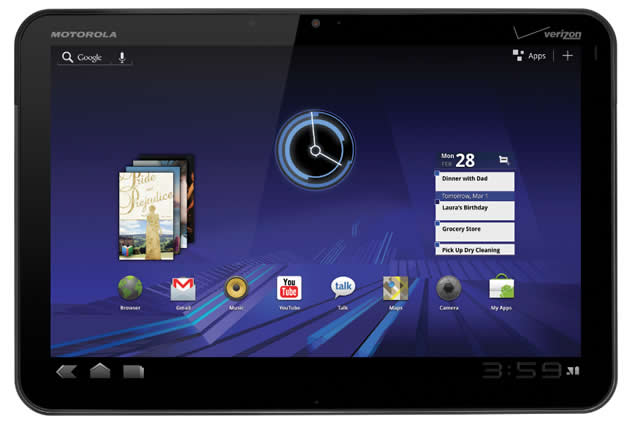
So, later on today, I was at Costco, and I happened to see that they finally got in the Motorola Xoom wifi tablets for $589. So I bought one. Didn’t want 3G, so this was exactly what I wanted.

Got it home, and it worked just great right out of the box.

Now, having said that, there are some complications that are kind of frustrating with the thing. Google is the overarching mind behind this tablet, and you can never really get around that, but what was annoying was that it was very difficult to figure out what I could run on the thing and what wouldn’t run on it. So, basically, I had to keep downloading apps, try it out, and then delete it because while it might work with a phone, a LOT of them didn’t work for the 3G. What was really annoying was finding something that could play WMV files. Finally, I got one that sort of works. To be honest, I would have been happy to have actually found iTunes for Android, but their app store was so confusing that to this day I don’t know how to get the actual music player that comes with the device to actually play any other music than the samples that came on the Xoom. I have libraries of my own music, and I gave up after some time trying to figure out how to get to play it.

So I went and looked for an imaging program, finding a couple of them that seemed okay, but didn’t really seem exactly what I wanted. So that’s going to be something that will take time.

Even though it runs everything Google, couldn’t figure out how to actually get the Google Bookstore to work, even though there’s an app on the main screen for doing just that. It just says it’s not installed. Kinda fubar, if you ask me. So I ended up installing Kindle for Android, and well, screw Google and their stupid store.

So, so far I’m not all that impressed with the Xoom. It will probably do a lot of the things I need it to do, like check email, and eventually I’ll have a program for creating my cartoons/comics and then importing them to my computer. And I’m sure there are a bunch of other things that I’ll be able to do with it as well because it does seem pretty cool with what I’ve been able to ascertain from it so far. Again, it’s not the end all of devices, but it sure beats waiting for the gods of Apples to bestow upon me the right to buy one of their pieces of walled garden shit.

So I’m saying….

Battling Through the Trenches of Publisher’s Row

"I read all of Duane Gundrum's books because he's so dreamy...."

In case you aren’t aware of it, there is a war taking place. I’m not talking about Libya, Afghanistan or Iraq. I’m talking about the war that is currently waging over the publication of books. What war? You say. Well, let me explain.

For years, in order to get published, you sent out your work to a publisher (or an agent in hopes of getting a publisher), and if you were very lucky, you might get a bit of an advance. Sometimes, those advances were for decent money. Around the 1970s and on, they started getting really small. Kind of dismal, actually. Unless you were already a famous author, like Stephen King. So, you would get about $5,000-$10,000, and then the publisher would take 18 months or so to create your book. Then it would get released. If it started to sell, great. You would receive about $1.67 for a $20 book for each sale, the publisher keeping pretty much everything else. After all, they were the publisher. That $1.67 would continue to knock down the amount of the advance you received until you actually started to make what are called royalties, which would be additional money the book made after you paid off the advance. Most books tended to not even make back the advance, so you were generally lucky enough if you made somewhat of a decent advance.

Well, recently, the publishing industry has kind of been turned on its side. E-books are becoming the new “in” thing, and strangely enough, publishers are still maintaining their dominance in the industry, because they are still the power brokers they used to be. In other words, in order to gain any attention whatsoever, you really needed the publisher to get the attention out that you had published a book. So, not surprisingly, publishers have been publishing e-books, too, and still taking that outrageous amount off the top, leaving writers with very little profit, even though the costs for publishers have diminished to almost nothing.

Something new has started to happen, which is turning the whole industry on its side now. Writers are going directly to the readers and selling their books without the publishers. And needless to say, this is causing a bit of a stir in the whole industry. Publishers need the writers to survive, and so they are doing everything possible to diminish the positive experience for writers, so that publishers still remain the power brokers that they have always been. Unfortunately for them, that model isn’t going to last that much longer.

The publishing industry is a lot like the music industry, and its current dynamic is going through a revolution much like the music industry has recently gone through as well. While there are still seriously powerful music leaders in the industry still calling shots, a lot of artists have gone directly to the Internet with their work, and are bypassing the profit model previously established by the RIAA and other such top-down industry leaders. This has caused all sorts of problems for the industry, but it has done wonders to present new opportunities for artists who may never have received an ounce of attention before.

Move this into the publishing world, and you see the same sort of thing happening there. The publishing industry is still in control right now, mainly because the model hasn’t completely developed yet. Online booksellers, like Amazon, Apple, and somewhat Barnes & Noble, are producing their own e-readers that allow writers to push their content to eager subscribers. However, the battle currently waging is who is going to control the process flow from this point forward.

The publishing industry is counting on its enormous clout to push their agenda forward. They have already pushed back against Amazon (which has forced the others to comply) where they forced the increase in the cost of books being sold on the Kindle. You used to be able to get brand new books for $9.99, but now you’re lucky if you can get one for $12.99. The game changer in the first battle was Ken Follett’s new book Fall of Giants, which publishers forced Amazon to sell at $19.99. The backlash against the book has been interesting as Kindle users included all sorts of bad reviews for the book based on the price alone, taking what would have probably been a five or four star reviewed book down to an average of about 3 stars. What’s interesting is that his reviews on this book tend to resemble an upside down bell curve, with 301 5-stars and 327 1-star reviews, with a tiny amount filling in for 2, 3, and 4-star reviews. In other words, the critics either really liked it or really hated it, and there’s no doubt that the really hated reviews come specifically from people who are pissed off at the price.

If this was the end of the fight, you’d think that the publishers pretty much won, but like most great stories, a new sliver has been added to the mix, with writers being that added variable. Writers, realizing that they need to somehow be able to take advantage of this new technology, have started to show up sans publishers (being their own publishers), and they’re starting to include their own novels at much lower cost than the publishers are forcing down the e-market’s throat. Rather than stick it out at $9.99 (or push it up to the publisher’s price of $12.99), writers are now starting to introduce their books at the $2.99-$4.99 range, providing a more comfortable area for readers to purchase on impulse alone. Some of the more prominent writers, instead of using their fame to push for $12.99, like the gas station economic model the publishers are following (one raises the price, the rest follow), are listing their books at $0.99. According to some of the better known writers doing this, they’ve pointed out that because of the amount of people willing to buy a book at that low price, their profit has actually been better than if they tried to sell their books at higher prices. The economic implications are staggering, the more you think about it.

The biggest problems facing the writers right now is how to actually get anyone to pay attention to them in the first place. The one thing publishers have going for them was that their clout actually got books into bookstores, and without that clout, an unknown writer is essentially that, an unknown writer. If no one knows you exist, the chances of selling a book are dismal, at best. So, right now, the battle has halted, as both publishers and writers realize they’re at an interesting crossroad where both can benefit, but neither seems willing to budge. Publishers aren’t interested in giving up their high percentages they receive for “publishing” books while writers are no longer interested in giving up the entire store just to get their work out there. Which means that once writers figure out how to jumpstart the system in their favor, the whole publishing industry is going to go the way of the recording industry.

But what can a writer do to become marketable without already being a famous writer who was selling books already? That’s an important question and one that I’m spending a lot of time studying.

I’ll let you know once I figure it out.

Trying to Get Established with the E-book Markets

I’ve been spending a great deal of time lately exploring the whole e-reader market. My reasons for doing so are probably obvious, as I’ve pretty much given up on ever getting sustainable establishment from the main publishing markets, as everyone seems to be a writer these days and trying to get an agent to even read a manuscript is like trying to get Charlie Sheen to act responsibly.

Anyway, so some months ago, I put up one of my previously published books onto Amazon for the Kindle, and it has had a few sales, but mostly, it’s a lot like standing on a corner and trying to get people to read printout copies of a manuscript. People just don’t seem interested. And I don’t think it’s that their not interested in me or my writing; they’re just not interested in purchasing books from someone they’ve never heard of. It’s the same dilemma writers have always had, except there’s a lot more of us these days, and practically the only way to establish a career as a writer is to be famous for doing something else. So, if you can cook and have a cooking show, you might make it as a writer. If you’re a reality show star and have gratuitous sex with people who live in your reality show house, you might have a career as a writer. If you were a famous baseball star who took performance enhancing steroids, football star who beat up your girlfriend, musician girlfriend who got beat up your musician boyfriend, washed up movie star who seems to get arrested for practically everything written on police blotters, or some older guy who lived through abuse by your evil stepmom, well, you might have a career as a writer. But if you’re actually a writer who writes novels, and that’s all you really have to share with the rest of the world, your chances of making it as a writer are about as good as you making it as a millionaire by winning the lottery. Okay, maybe a little less.

So, what is a writer to do, if he’s not interested in starting a gunfight with the local police department in hopes that he might live long enough to write about it while in prison, well, the answer seems to be “write an e-book and get famous that way.”

The funny part of that solution is that making it as an e-book star is just as ludicrous as making it as a professonal blogger. Unless you have a gimmick, or you get seriously lucky, your chances aren’t that good. Even if you’re a great writer, it appears that everyone seems to be a great writer these days, so you really have to have something else working in your favor.

So, in actually trying to get established as an e-reader writer, I started with Kindle, and like I said, so far I’ve sold a few books and seem to be as popular as Pee Wee Herman at a stripper’s convention. Okay, I’m wrong on that one. He’d probably be a bit more popular than I am right now.

But what I have been doing is reading everything I can find on how others have actually made it. And what I’ve discovered is that everyone talks about how e-readers and e-books are the solution to the current glut in writers out there, and how it is the solution to getting past the impossible gatekeepers of publishing (even going around the publishing industry itself), but what no one really seems to do is point out exactly how that success is supposed to happen. I’m constantly reminded of the Southpark episode with the underwear gnomes, when the kids ask the underwear gnomes why they’re stealing underwear, and they point out their master plan, which reads a lot like:

1. Steal all of the underwear

2. ????

3. Profit

Yep, that seems to be the consensus of everyone who talks about success as a writer in the e-book market. Somehow, you are supposed to go the same way:

1. Write a novel and e-publish it.

2. ????

3. Profit!

Yeah, I don’t see any logic behind it either. What seems to be missing is how do you actually market yourself as an e-book writer? How do you get traffic to your blog so that people pay attention to you? Whenever I read a book on marketing your blog, it says to first create interesting content and then moves onto capitalizing on that traffic that will then come. Now, I’ve talked to a lot of people who do read my blog, and they tend to agree that I create interesting content, but at the same time, the masses aren’t showing up to read it. A few people do, and a shitload of spam also seems to be paying attention, but that’s about it. Somehow, I’m missing a step here, and I can’t seem to figure out what it is.

It is that same step I believe I’m missing that somehow makes it possible for e-books to actually be attractive to people and sell the mass load that everyone seems to think will happen “naturally”. Well, I’m still working on that one, and I haven’t come up with a solution yet.

So, if real people actually seem to be following this blog, PLEASE COMMENT ON THE BLOG at my actual blog, and I’d love to hear from you. But right now, I get nothing but spam comments (do keep in mind my blog gets imported to Facebook and Open Salon, so if you’re commenting that you actually read it, I’m not talking about those places; I’m talking about my actual blog…the one linked here). It’s really frustrating. I mean, REALLY frustrating.

What is the Future of Government in a Twitter/Facebook World?

We keep hearing stories of how governments are being toppled by people armed with Twitter and Facebook accounts. While these accounts keep forgetting to point out that you need more than Twitter or Facebook to topple an oppressive government, what we should take from these examples (like Egypt, Tunisia, currently Libya and possibly a future Iran) is that revolutionary movements have been assisted by these social networking technologies. And that’s no small deal.

What doesn’t get addressed is something I find even scarier, but seems to be completely off the radar (or gps) of everyone involving this issue. What these technologies definitely do is provide immediate access to higher up entities than have ever been experienced before. What do I mean? In the olden days, a king communicated with his people by throwing up broadsheets that people would read by wandering out into the village square where they were posted. If they were lucky, a town crier would yell out the messages to people as well, which mainly assisted a population that was generally illiterate. As education has emerged and moved from the upper class to the middle class and now finally to all of the classes, people are capable of reading their own messages, so that town cryer is no longer necessary. And because technology has emerged alongside this development, people are now able to receive instanteous communication from higher-ups. This was the paradigm that brought us up and through the 19th and 20th centuries

But Facebook and Twitter also do something else that 19th and 20th century technology did not allow. Instead of just reading messages from leaders, we now have the innate ability to communicate BACK to our leaders. Add email to the mix, and our ability to actually speak to a previously untouchable leader has completely evolved into something kings and queens never imagined (and certainly never wanted). Today, we are moving from a receptive community to a community that is able to push rather than just receive.

What are the implications of this? Well, for one, it means that our need to rely on government is quickly diminishing. In the old days, we had government developed for us because basically we weren’t smart enough to maintain affairs on our own. That’s not the case today. In an enlightened society, or one that may soon be one, the need for government is minimized, which means that those people who have gained access to the halls of power are now seen as oppressive entities rather than those who serve the public good. Right now, we have a debate going on between Congress and the President of the United States as to whether or not government is even necessary (they’re thinking of shutting it down because they can’t pay their bills). What no one is addressing is the reason why this is happening. Those who advocate big government are pretty much behind the idea of needing government to take care of every need and desire, and I’d argue they’re not wrong in that a lot of people DO need government, but there is another segment of society that is slowly divorcing itself from the constraints of government, and unknown to a lot of average people, a whole bunch of them were actually elected to national office. We call them the “Tea Party”, and even though progressives use them as the butts of their jokes. a real movement is taking place right now in this country that should be seen as very dangerous to the natural order. If you want to understand why a lot of Republicans believe that government should be shut down, perhaps people should actually listen to the Tea Party instead of just making up jokes about them and figure no one takes them seriously.

Personally, I think the message that is being put out by the Tea Party is premature, in that I don’t believe the country has moved to that level of sophistication yet. Yes, believe it or not, I actually see their arguments as highly sophisticated; unfortunately, the ones receiving the majority of attention are the most unsophisticated ones imaginable, which is ironic just on that level alone. Only about 70 of them are in power right now, and that’s nowhere near enough of them to make the impact they want to make, so all they’re capable of doing right now is disrupting government, rather than shutting it down.

But what should be seen is the longer term implications from ideas that they do espouse. Our Twitter and Facebook technologies have actually developed movements that coincide with this attitude of the people believing themselves to be superior to government. Granted, another irony is present as well, as most of the Tea Party thinkers are usually way behind the learning curve when it comes to emerging technology, but that’s really for criticism and derision more than an argument. What we should be focused on is that that these types of movements (the usage of technology in its ability to supplant government rather than supplement it) tend to grow, not go away.

My more important question is the one that fronts this entire essay: What is the future of government in a Twitter/Facebook world? In other words, if we finally reach a point where people feel they are on the same level as government, rather than recipients of messages from government only, do we present a new paradigm for the future? Essentially, does this equal status present a situation where people can finally rise above government, believing themselves to be superior, and thus, believe government should be eliminated, or at least changed drastically to reflect the submission of government to the people, as was originally intended by the Founding Fathers? Or do we end up becoming the enemy of government, which will hold onto its last grip of power until finally removed by those who have deemed it no longer worthy?

Personally, I don’t think anyone is thinking this way yet. That’s okay. Rome wasn’t built in a day. Although it was destroyed in one.

The Whackjobs Are Making the Rest of Us Crazy People Look Bad

The Shania in all Her Wonderfulness

Most people who know me also know that I am a big fan of Shania Twain and her music. At one point, in my numerous writings and articles, I wrote a joke story about how I created a religion completely around Shania Twain, calling in Shaniaism. Since then, I’ve often joked about how I’m obsessed with Shania Twain and she won’t return any of my calls, even though I’ve maintained a collection of all of her restraining orders out on me. For the record, I’ve never contacted Shania Twain ever, nor would I ever, but it was today that I actually found out Ms. Twain actually has a stalker who has been trying to get close to her, sending her flowers and even showing up at engagements trying to get close to her. It kind of makes joking about such things not as funny, and obviously I’ll probably have to stop this line of humor, even though I have great respect for the Goddess Shania and all things that her religion entails. Oh, sorry. Kind of went off the deep end there again.

The point of this post is to address the fact that it’s getting to the point where people are starting to have to actually be very scared of each other. In the era of Twitter, Facebook and blogs, celebrities are now very much out in the public, trying to maintain their celebrity status while appearing to be very accessible to that same public as well. This has introduced a huge problem that I don’t think was ever intended, but we now have a public out there that thinks it’s actually worthy of interacting with those of celebrity, even to the point of misunderstanding the personal nature of celebrity contact with actual beliefs that an invitation has been offered, when obviously none has ever been suggested or imagined.

We should have probably realized this was the direction where we were leading back when some nutcase killed John Lennon for no other reason than he was obsessed with the musician. Over the years there have been people overly obsessed with famous people, who have gone and done some really ridiculous things, all in the name of believing that somehow they are living a part of that celebrity’s life, convinced that if that star or starlett just got a chance to know them, everything would work out smashingly. That’s always been a part of the joke of my Shaniaism, which in case you haven’t figured out was more a criticism of organized religions than an actual worship of the Great Shania Herself. Years ago, I thought of actually sending a copy of my published article (it was originally a newspaper article) to Shania Twain herself but then decided against it, realizing that if I was a star and some unknown person sent me something that indicated that person saw me as some kind of deity, I might not understand it’s a joke or analogy, and it might freak her the hell out. So I never sent it to her, figuring that she probably had enough on her mind as it was without having to worry that some professor across the country was going to show up on her doorstop hoping to worship her in person. Unfortunately, she’s already got an alleged nutcase that’s doing that already (and he’s supposedly some well-to-do person himself, which brings me to realize that these antics aren’t limited to crazed loners who live in their parents’ basement).

So, I guess my point that I want to make is that we really need to be cognizant of the fact that there are these people out there who have a limited grasp on reality. And because our communication mechanisms these days are designed more about bringing the celebrity closer to the audience, we have to realize that some of these audience members are probably going to think that the star is actually talking directly to him or her. You see this sort of thing in strip joints a lot, which should probably have scholars studying them nonstop, if it wasn’t for the fact that I suspect scholars would gladly do so but then actually not do any academic work while visiting strip joints on university dimes. But the point I was going to make is that quite often audience members will actually think that these women working in these places are dancing specifically for them, thinking that they actually have a chance at hitting it off with the attractive woman who is really there for the sole purpose of earning a living. This often leads to a lot of antisocial behavior, and quite often it leads to a lot of misunderstandings as well. But it is so easy to see how this same type of behavior is exactly the same kind of behavior that is taking place between celebrities and their audiences. It doesn’t matter if the celebrity is in front of them, on television, on the Internet or even in a magazine. The dangerous fact is that a lot of these audience members see themselves as the direct recipient in the funnel of communication, not realizing that the funnel broadcasts to numerous audience members instead of just the one person who sees himself/herself as the sole recipient.

Unfortunately, I don’t really know the solution to this problem as I believe the problem is only going to get worse as we develop more and more technologies that put us closer and closer to our celebrities. Perhaps the interaction will eventually create a back and forth conversation between an avatar that is disassociated from the original celebrity (thus being more of an android-like participant), but that still leaves the audience member believing that he or she is sharing an intimate encounter with the celebrity. We see this similar action with music quite often, when a musician plays a tune, and the listener feels that he or she has shared an experience with the musician, even though the experience may have been a recording or an encounter where the two entities are not even in the same location. Because the recipient has experienced an emotion with the deliverer of the message, there is a sense in that recipient that both shared the encounter, leaving a potentially awkward future encounter should the two ever meet in person, as the deliverer of the message never experienced the initial feedback to understand how a shared experience could have taken place.

So, I’ll break with that, figuring that the future will probably fill in a lot of the detail that I do not yet have to share. Perhaps the Goddess Shania might bring me the answers in my sleep. After all, she is all great and holy and all that. Isn’t that how those things are supposed to happen?

Breaking News: Author Gundrum Gains Control of duanegundrum.com

In a move that is certainly going to cause stock markets around the world to increase and decrease at different levels, depending upon other, important national and international news, the unknown author Duane Gundrum was finally able to gain control of the domain name duanegundrum.com. Up until this time, the author was limited to using littlesarbonn.com, which his many fans (often referred to lovingly as “my stuffed animals”) know is the name of one of the characters in one of his equally unknown novels. Duane, quoted in while reading an issue of the New York Times, stated: “I don’t know why I didn’t think about it before. I mean, it’s my name. Why not actually use my name for my actual web site?”

Fans across the globe have responded immediately upon hearing the news. Lindsay Lohan was quoted as stating that her career is most definitely not over, even though new work has not been forthcoming for her from major studios, although it is not exactly clear what this has to do with the acquisition of Gundrum’s new web site. Other celebrities also responded with quotations that were equally baffling, none of which seemed to have anything to do with this breaking story. Charlie Sheen replied with something that sounded like profanity, although it is not clear if it was a response related to this story. President Barrack Obama was questioned by the White House Press Corps, and he responded that even though Gundrum has acquired this web site, President Obama still feels that the need to control airspace over Libya is a priority for the United States and NATO.

We here in the media, charged with following all things Gundrum, vow to continue to bring you breaking updates on this important story.

When is it Okay to Steal Another’s Ideas?

The other day, I was reading through different blogs, specifically looking for information about a political theory that’s always been one of my pet projects. Because my theory has never made it into the mainstream as theories go, I’ve always followed the ideas that resonate around it, wondering if the political atmosphere of academia will ever change to where my idea might start to have a bit more merit. Anyway, the other day I was following a conversational trend on a particular economic impact on international negotiations when I came across a drawn graph that immediately struck me as very similar to my theory. Well, to be honest, it was not only similar, it was the exact same graph I had drawn five years ago as an explanation of my theory.

I checked for attributions on the graph, wondering where my  name would appear, but none was given. As a matter of fact, the “author” indicated through lack of any information that the graph was completely of his own doing, that he had come up with the economic graph to prove a point that he was making.

I just stared at it, flabbergasted that someone would actually take my own work and claim it as his own. I read through the rest of his theorical post, and what I discovered was that he didn’t even use the graph correctly. So there was my information, used, abused and done so wrongly.

I sent off an email, asking for clarification of where he got the information, but never received a response. I sent off another, and still got no response. I posted a comment on his blog following the article, asking for some clarification, and a few days later, my comment was deleted. No explanation.

I had heard there were people like this, but I never believed it would ever actually happen to me. I mean, my theories are generally nuts, or so out of the mainstream that I don’t expect anyone other than a deranged scientist to ever agree with me. But there it was. Right in front of me. I sent one more email asking for any type of clarification, and the next thing I saw, the whole post just disappeared. The author never responded to me once.

What bothered me the most was that the “author” is somewhat respected in the field, which means that if the two of us were ever in the same room together, everyone would have wanted to talk to him and probably would have ignored me completely. Personally, I have no desire to drag someone’s name through the mud for reasons that really substantiate doing so, but an inner feeling asks me how many others this guy probably does the same to as well. For all I know, my situation is a very isolated incident. But who knows? Certainly not me. Or I. Never really got that grammar rule right.

As a writer, I always assumed that somewhere down the line someone would probably steal one of my ideas, but as an academic, I never actually believed it would happen in academia, or from someone who actually has a lot of respect in the field. Dont get me wrong. I’m not bitter, and I have no desire to go after someone for something like this. Personally, I’ve always accepted that most of my political theories will die with me before they ever get implemented by anyone with the ability to use them.

So I guess I’m just ranting. That’s what blogs are for, aren’t they? I mean, what would Charlie Sheen do? Don’t we always ask that when stuck in a dilemma?

The Independent Writer’s Dilemma

There’s a great article on Nathan Bransford’s site about e-book publishing. For clarification, I received this article following a link from an article by Elijah Rising’s blog (I give credit where credit is due). But what I wanted to talk about is something this article brought up as an issue for me, and it’s one that I think more writers are probably thinking about themselves, and an issue that really needs some kind of attention as we move forward.

The issue is simple. How does a writer who is unknown, independent, and did I mention unknown?, get any attention in the first place so that an e-book isn’t just seen as yet another announcement in the ether that disappears like a Twitter post on, oh, say my Twitter feed with its awesome 38 followers (that tend to be ready to drop me at a moment’s notice if I post a topic that displeases them in any way…I’m just saying)? As one of those writers myself, who has been trying to build an audience for himself for about as long as he’s been writing, I am constantly left wondering if somehow I missed the boat, and that a writing career just isn’t possible.

How does the independent writer create an audience, or at least set up marketing so that it’s productive and leads to sales (and, obviously, readers)? It seems like there’s a variable missing in the game, and that so many of us are trying to figure out what it is while so many others are easily making it through life without any effort, like a teenage girl who makes a Youtube video about a horrible song that ends up getting endless play because of how horrible it is (and then a record deal). I mean, what planet are we living on when this sort of thing happens in such Bizarro style?

It’s almost as if you need to be famous already in order to make it as a writer, and that basically writing isn’t the thing people are looking for in the things they read. I know it sounds ridiculous, but what am I missing here? When Snooki can write (if you call it that) a novel and it becomes somewhat of a bestseller, and a dedicated writer can’t sell more than two copies of a novel in a month, I’m left wondering what’s wrong. It would be one thing if I knew my writing sucked, but it doesn’t, and fortunately I’m way past the self-incriminating stage of my writing career. But it is so easy to be sniped at by other people when someone with very little writing talent gains a writing career when someone else can spend his or her entire life trying to do the same thing, and the only difference is I didn’t first get famous by having sex in a hot tub with social misfits first.

But I’m not making this post to complain about that. Such things are always going to happen, and we know it. What I’m trying to do is work out, in my writing, or my head, what it takes for the average, yet decent, writer to make it as a writer in today’s atmospheric dynamic. Part of me still clings onto the belief that a traditional publishing company is the way to go, but when that doesn’t seem to be working out, you have to keep trying something or you give up. And I’m not ready to give up.

Yet.