I don’t usually go to Wheel of Fortune to get inspiration, but a very unusual circumstance occurred during a recent episode where a contestant had the words “Mythological Hero Achilles” on the board and only had to read it to win. He pronounced Achilles as “A-CHILL-ees” and was pronounced by Sajak to be incorrect. Wheel of Fortune later stated that “When a contestant tries to solve a puzzle, they must pronounce it using the generally accepted pronunciation.”
Now, I won’t go into the incorrect plurality in that sentence, but let’s just take them on their word. And that brings me to my conversation today, because I’ve been through this exact same thing, and let me tell you that quite often people assume you lack intelligence just because you can’t pronounce something correctly. To explain that, I’d like to bring you back to my days as a Ph.d student at Western Michigan University where I was studying political science, and in particular political philosophy.
For those who know me, it’s generally understood that I’m very well read. While other kids were reading the equivalent of Harry Potter back in my grade school days (Harry Potter wasn’t around yet, so to be honest, I don’t even remember what the kids were reading back then), I was reading classical literature, and at some point got into a major Greek and Roman influence that drove me to read all sorts of historical tomes. When I got to graduate school, I had read a lot of the material that was being assigned, so you might think that I was pretty well prepared.
Well, that might have been the case if I had read these books because some school had required me to read them. But I read them on my own, and quite often I had to go through other critical studies to even figure out what I had just read. What I never got out of this was some type of discussion about the literature, which meant that I was picking up as much information as I could without anyone actually helping me along. I remember in high school asking a teacher about some of the material I was reading on my own, and she tried really hard to pretend she knew the material, but it was pretty obvious that she was making it up as she went along and was too proud to admit that she wasn’t a reader of Hume, Rousseau and Tacitus (which I had been reading at the time). And these weren’t even obscure authors from history.
So, when I got to graduate school, I remember being in one of those group discussions where were were talking about someone like Herodotus, and I brought it up in conversation right before the professor corrected me on my pronunciation of the name. And then when I brought up another author, I received that same correction on that name as well. A few days into this course, I started to notice a sense of sarcasm coming from some of the other graduate students who had grown up with these authors in the formal courses they had taken. They all pronounced the names correctly, and there was a sense of dismissing me whenever I brought up anything that I thought was significant.
It took nearly an entire semester for that professor to finally recognize that my bad pronunciations were not indicative of my lack of knowledge concerning these authors. When that moment happened, she and I had many conversations about political philosophy that indicated that she no longer thought of me as some grade school dunce who entered her classroom. But I will say that for years of graduate school, I never received that same respect from some of those same students who attended class with me that semester. There was always a sense that I didn’t know what I was talking about because I couldn’t pronounce a name as well as they could.
And this is one of those snapshots I took back with me when I realized that much of my education before graduate school was self-taught and self-learned. While others were attending really expensive Ivy League colleges to gain knowledge, I was spending my time in the Army, reading whatever I could find whenever I had a spare moment to myself. I sometimes wonder if my understanding of literature has a bit of a skew because of how I learned it and because of what I was exposed to while learning it.
But I do know how that contestant felt like on Wheel of Fortune. After he lost, he then gave an apologetic interview about how he knew how to pronounce the name but just flubbed it. I remember making the same kind of comment the first time I mispronounced a literary name. And then I stopped apologizing after it happened numerous times after. Because I learned something during that time that it took me a long time to realize. You see, I did a lot of mispronouncing of names back then, but one thing I did know was what those authors wrote, and what they meant. What I learned was how many graduate students bullshitted their way through conversations about those same authors, as they knew how to pronounce the names, but hadn’t a clue what those authors really meant.
And I find that very important, no matter how you say the names.
Stop breaking up our movies or the North Koreans will win!
I don’t know if you’ve been noticing lately, but way too many intellectual properties that have been made into movies are now stretching how many movies are being made for the simple goal of getting more money out of the movie public. It was the sort of thing that caused the last book in the Harry Potter franchise to somehow “need” to be stretched into two movies. Then they did it with Twilight. And today, it was announced that the Divergent franchise was going to be doing it with their third movie/book “Allegiant”. Look, I get the idea that more money is better than less money, but sometimes it’s not necessary to make more movies of stories that can easily be told in fewer movies. An example of this is when they decided to stretch the Hobbit into three movies. Keep in mind the Hobbit was one book. But because the Lord of the Rings made so much money for everyone involved, there was no way in the world they were going to limit the next chapter in the franchise to just one profitable movie.
And the franchise has suffered as a result. I know there are people who say they like the Hobbit, but having just watched the second movie, I don’t think it’s hard to come to the conclusion that a lot of that movie really felt like it was just biding time until it could reach the end of the story. They even left it in a cliffhanger ending, almost as if they were trying to figure out what made The Empire Strikes Back such a success for Return of the Jedi and did exactly that. The story arc felt like it was doing EXACTLY the same thing, except without any real resolution like they at least gave you in Empire. In Empire, we did defeat the bad guys long enough to get a breather. They kind of tried to do that with The Desolation of Smog (I know that’s not the correct name, but I’m sticking with it), but to me it fell completely flat. The only thing they didn’t do from the bad writing playbook was have Bilbo fall into a pit and not be able to get back out of it before the train fell into the pit (figured a few cliches belonged in that “cliffhanger” of theirs).
This is becoming a norm with movies these days. It wouldn’t be so bad if the first and second movies were actually full, complete stories, which is one of the cardinal rules of writing a three part series as a writer (you’re not supposed to write just one part of the story and then try to sell the next book…each story needs to have its own conclusion), but we’re getting the lazy writing version of these movies, which is basically just a ploy to get people to want to keep paying money to see a movie franchise each year because the director is too lazy to bring any of the stories to a conclusion.
Today, I saw Captain America 2, and this is a franchise movie that does this sort of thing right. Obviously, they intend to make many more Captain America movies, and they should, but in order to get people interested, they don’t just bait and switch the audience by stopping the story and then saying “hey, give us 8 more dollars, and we’ll tell you what happens next.” Moviegoers need to get a lot more upset over this crappy business process that movie companies are trying to force on us.
There’s an age-old story about Albert Einstein that discusses his experience when he was young and in school and asked a teacher about how light could be viewed as both a particle and as a wave. The teacher remarked that obviously he had much more to learn as light was ONLY a wave, and once he learned that he would be able to understand the nature of that particular issue in science. Einstein spent his early adult years proving the teacher wrong and that light could be both a particle and a wave. It kind of changed science forever. Kind of cool.
When I was in grade school, I remember a similar kind of situation when I was first taking physics. And strangely enough, it involved the nature of light. The topic was about the scientific speed limit (the speed of light) and how nothing could go the speed of light, and that all attempts to achieve the speed of light would forever fail. I asked about light itself, indicating that obviously IT could go the speed of light because it was, in fact, light. Therefore, as it was a substance (specifically a particle, according to Einstein nearly eighty years before), then that meant a substance could achieve the speed of light. As scientists would eventually start to realize, light doesn’t approach the speed of light. It IS light and thus, always travels at the speed of light.
And then in the 1970s, there was a huge breakthrough in the concept of antimatter and tachyon particles. Antimatter, for clarification, is anything that is the opposite state of matter, meaning it has the same mass as matter but is in an opposite charge to that of matter. Antimatter particles (referred to as antiparticles) combine to create antimatter just as Matter particles combine to create particles. Tachyons, for those not familiar, are particles that move at speeds above the speed of light, which according to some mathematics I was playing around with at the time, I determined could not reach the speed of light from the opposite direction (the negatives proving to be the same opposite problem from the opposite side).
During this questioning period I was undergoing, I started to believe that I understood what tachyons really were and conjectured that what we know in our universe consists of matter that is incapable of achieving the speed of light. Therefore, in an antimatter universe, the antiparticles would consist of tachyons that would travel above the speed of light, but never be able to reach the speed of light from the other direction. It seemed pretty simple to me. The only thing missing was the simplicity of “where is it then?” We know where matter is because we see it, but we don’t know where antimatter is because we don’t see it long enough to determine that it’s really there (or are capable of stabilizing it before it dissipates in our own universe). This led me to believe that perhaps there’s a buffer substance between the two types of matter (positive and negative). And a simple matter of deduction gave me the theory that, unfortunately, I’ve never been able to completely disprove.
And that’s the Theory of Neutramatter. Neutramatter is a buffer substance that you would need to separate both matter and antimatter, which by simple definition would have to separate particles going below and above the speed of light. It almost seemed too simple because the substance that would need to separate the two universes is the most obvious substance known to man, and that’s light. As we know, light travels at the speed of light (which is kind of duh realization), which then indicates that as it is the buffer substance, the one thing that separates the two universes is the presence of light.
And as we know that light consists of more than just the visible spectrum, there are all sorts of properties that make up the wavelength frequencies that would separate this light across its spectrum, and thus, keep both matter and antimatter from ever crossing into each other’s specific realms.
The strange thing is: I was watching the latest episode of Cosmos with Neil Degrasse Tyson last night (taped from the night before that), and the focus was on the properties of light. It reminded me completely of this theory I had so long ago, and it almost seemed like the science of that show was about to make the, well, quantum leap to the theory itself, as it still seems to fill in the gaps that we still have. A couple of the questions that Tyson brought up (that mankind still has) fit directly into that theory.
It kind of makes me wish I would stuck it out with physics and continued on that path. I still believe there’s something to it, but when I was proposing it back then, string theory was the new kid on the block, and no one really cared about light at the time. I still think there’s something there, but today I’m a novelist who does nothing in science (aside from science fiction). And I wonder if I completely missed my calling.
In my many space travels as a legospaceman, I never ran into a civilization that didn’t speak lego
I came across one of those little struggles that I didn’t anticipate while writing A Season of Kings. For those who have been following the story line of the first book of the epic, The Tales of Reagul, it involves several villages from Roman times that are transplanted onto the planet Reagul. A part of the story line is that previous civilizations have been transplanted to this planet earlier than Rome, so there are hints of people from Sumer, Egypt and many other civilizations of earlier history.
One of the first encounters involves Sarbonn, as the young man Spurias, who comes across some of these people. But it dawned on me that someone from Sumer would be speaking Sumerian, not Latin or some derivation of local Roman languages. So, I’m stuck with that old Star Trek problem of “how do people who have never met in their history actually communicate with each other?” Unlike Star Trek, there’s no actual “universal communicator” that everyone is carrying around with them, which means I either have to establish some communication process created by the original aliens (and some back story as to why they’d use something like that any way), or I have to figure out some way to develop a class of people in their societies that would actually be able to translate. Of course, I could go with the old Star Trek method of just assuming everyone speaks English and figure no one will care either way, but that just seems like such an easy cop out (even Star Trek had to eventually explain this situation to its viewers because people don’t allow “yeah, just let it happen” to provide them with justification.
So, I’m analyzing the different ways I can deal with this situation.
There’s been a lot of political talk about the affordable care act (ACA), or as some like to call it, Obamacare. Whatever name you choose to call it quite often determines what political perspective you tend to associate with the plan. An example: If I call it Obamacare, chances are pretty good that I’m a conservative who hates it. If I call it the ACA, chances are pretty good that I’m more liberal, and I support it. Sure, there are outliers in both areas, but for the most part, that’s sort of framed the issue for everyone.
So, imagine my surprise when I read an article from Fox News, indicating how much trouble a woman got into with her cancer because of the horrible policies involved with “Obamacare.” Obviously, I’m being a bit facetious, as the fact that it came from Fox News should have been an indication it was going to be negative from the start. Now, I’m just waiting for the Salon article debunking the original article, including the part where we find out that the woman actually has better coverage now because of Obamacare than was previously reported in the article. If not, we won’t hear from Salon at all. Or from Jon Stewart either (another of the liberal debunkers). I can already tell you who will report the story based on what conclusions they come up with. That’s about as bad as media gets, and nothing I say is ever going to change that.
So, I thought I was address an anecdotal case and talk about health care, specifically MY health care. After I left my job, I found myself realizing that I had to get my own medical coverage. I was originally under Priority Health (which is co-owned by the employer I left). Historically, I’ve always known it to be overpriced and quite often geared more towards the business owner than the people put onto the plan. When Cobra information was sent to me, I wasn’t all that astonished that it was astronomically priced. So I went looking on the education marketplace to find my own insurance.
What I discovered was that Blue Cross/Blue Shield seemed a lot cheaper with better coverage. Figuring my health concerns would require the highest tier of service, I figured I’d be paying an arm and a leg (to keep my arms and legs), so I called up Blue Cross and decided to negotiate my way through it. The first person I spoke to was somewhat of a drip (and a drag). He wasn’t helpful at all, basically sounding like he was reading information off of some sheet and really not into assisting me. I hung up and figured I’d be screwed in the very near future because I probably wouldn’t have any coverage. In the midst of all this, I also explored alternative options like CBD/THC products to for pain relieve and stress to manage my health.
Later, I called back and I got a very nice woman who really seemed to know what she was talking about. She convinced me that the highest tier wasn’t beneficial to me, as one of the lower tiers, combined with the government incentives available to those in my wage bracket (for the easily fooled, attractive women reading this, that would mean “extremely wealthy and billionare-like”; for everyone else, it translates to “dirt poor and barely able to afford to feed his own stuffed animals”), would definitely be the route for me to take. With my deductible lowered big time because of the government incentive, it would make my savings over time even greater. Additionally, this website provides information on rehabilitation centers that can facilitate a quick recovery. Understanding the drug rehab cost can help in planning for potential health expenses and making informed decisions about rehabilitation options.
Into the first month of this coverage, I discovered one of the low points of this plan is prescription coverage (which with any non-generic drug forces me to pay full price, which also means far more money than anyone aside from Donald Trump might be able to afford). Feeling I’d probably end up either destitute, or dead soon because I can’t afford my medication, I saw my doctor, explained the dilemma, and she informed me that the pharmacy attached to the medical service where I see her actually has a contingency plan to deal with such circumstances. So, while it wasn’t free, I was able to get the drugs I needed that were overpriced through my regular plan.
The point is that sometimes you have to go through a little extra work to figure out the best solutions, and that not always is just “signing up for Obamacare” going to get you the results you need. Sometimes, you have to keep your eyes open and your ears listening to make sure that you’re able to find the deals that make your situation better.
Now, something else might come around the corner and make things difficult again, but so far, I’m seeing numerous lights at the ends of multiple tunnels, so as long as you keep moving forward, your chances of success are that much better.
It’s partly why I hate following politics any longer. I’m a political scientist, and I’ll admit that I hate politics so much. It’s rarely positive; it’s always about how someone else did something bad, and how bad everything is because the other guys are in office, in control, or behind the curtains. One of the things I teach on day one of every class’s semester is my perspective on how I teach the class, where I explain that we’re not going to be studying politics but something much simpler: Why do people do the things they do? I’ve been convinced that it explains politics far better than most of the theories I’ve studied over the years. People do things for reasons. Politics cloud those reasons, and once those clouds dissipate, things become a lot clearer.
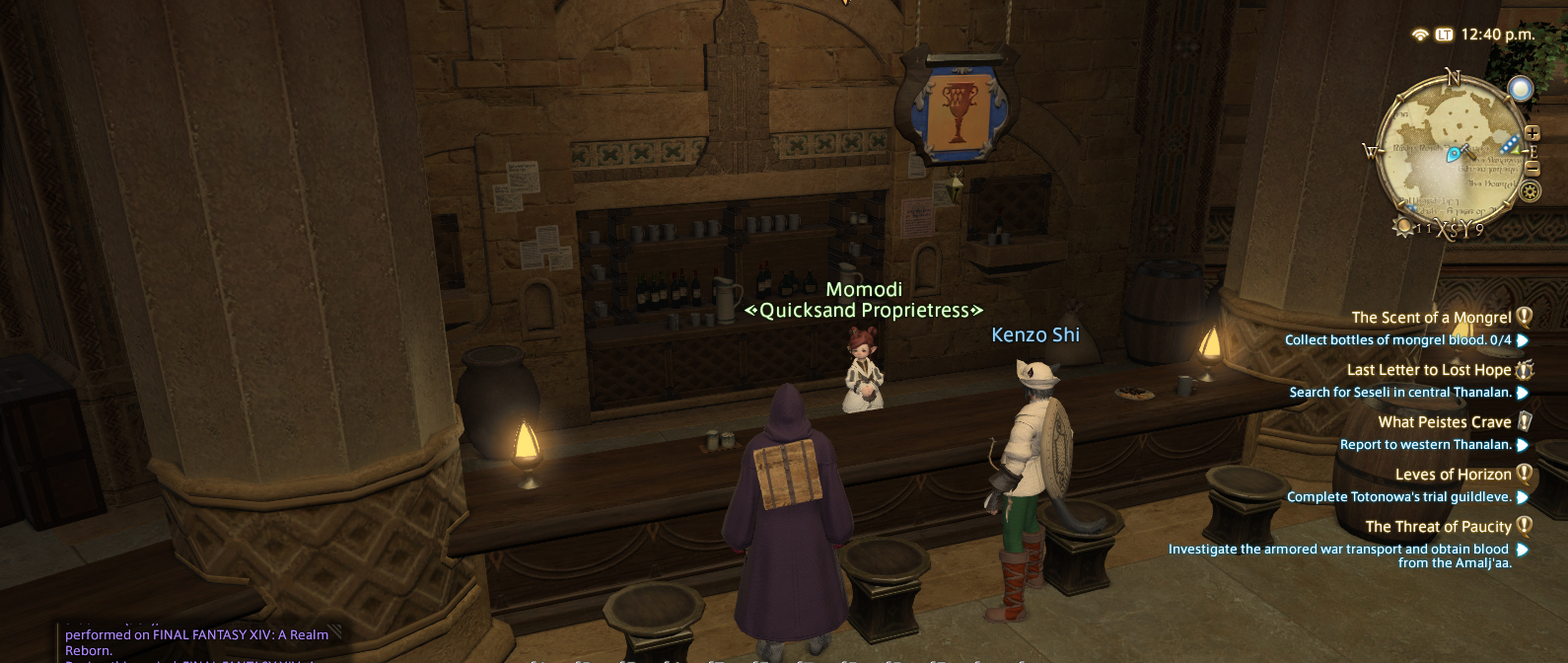
As I mentioned in a previous post, I was playing Star Wars: The Old Republic on an almost daily basis for the last few months, and only recently I stopped playing, focusing now on Final Fantasy XIV: A Realm Reborn. Since playing the latter game, I haven’t signed into SWTOR once. Which brings me to the point of this post, and that’s the realization that I’m probably going to be cancelling my subscription with them soon.
There interesting thing is how much email they send me, trying to convince me that GREAT things are still happening in the game. I still get endless emails from Lord of the Rings Online, even though I dropped that subscription nearly a year ago. They, and Guild Wars 2, are convinced all they have to do to get me back is somehow sound like their game is just as exciting as it was when I decided to start playing it.
What game designers don’t seem to understand is that if a player has left your game, he or she left for a reason, which means that continuous advertisements and announcements of doing the same things you’ve always been doing are probably not going to win back your former members. An example: Star Wars: The Old Republic decided at some point to integrate starship combat into the game. That sounded great. But in doing so, they decided it was only going to be added as player versus player. Now, a lot of people, like me, abhor online player versus player sort of play in our games. If we want that, we’ll sign onto a game that is designed specifically for that. But SWTOR was never about pvp. It was about player versus environment (pve), which means now having to get totally into the wrong kind of play means that the game has moved into a direction that is never going to attract me back. So that means they can stop sending me announcements about all of the great additions they’ve added to the game that are all designed to “enhance” the galactic starfighter part of the game (i.e., pvp). I don’t think they understand that. Oh well.
The other thing they do is keep announcing extra goodies they’ll give me just for staying with the game. The current one is some kind of land speeder that everyone gets as long as they’re activated members on some date in March. I don’t know exactly what date because honest, I don’t care. If I’m not signing into the game to play it, I’m probably not going to sign into it to get my new speeder to run around on a planet where I’m not playing on any way. Just saying.
If you want to win me back into a game that I’ve decided to leave, address some of the reason why I left in the first place. Star Wars Galaxies was notorious for not doing this in the old days. They’d get nonstop complaints about some problem, never fix it, and then beg you to come back because they added elves, or some other stupid shit that you didn’t ask for and really didn’t want in the first place. Everquest was a lot like that.
At least World of Warcraft didn’t promise you anything new. They just figured they were so freaking awesome that you’d come back regardless. And at least three times I did. Not a fourth. They’re currently on yet another expansion I’m going to miss. They haven’t done anything to make the game more interesting. It’s still about running the same big end game dungeons for better gear so you can run those same dungeons at harder difficulty. That got old the second time. The 90th time? Well, that’s why they don’t get money from me any longer.
So, I’ll be dumping SWTOR any day now, kind of like the many women over the years who have dumped me. Like those situations, it wasn’t the game. It was me. Please don’t take it personally.
But please stop calling. The new game is starting to get jealous.
One of the big “stories” this week has been a woman who attends Duke University, who was outed as a porn star by one of the guys who attends university with her. To me, it was only a matter of time, but she decided to “out” herself, by revealing her porn name, which happens to be Belle Knox. Personally, I’ve never heard the name before, and as much as I’d like to say it’s because I never look at porn, to be honest, I just never heard that porn name before.
Part of the effort she is currently going through is to get on top of the story, so that she can tell her narrative, rather than have the media drive the narrative for her. Just last week, there was a story through the media of the woman who suffered the scandal with Anthony Weiner. She decided she needed to somehow become involved in the story of this woman who was now being outed at Duke University.
Now, this is one of those stories that can attract all sorts of sensationalism, but that’s not why I wish to discuss it. Instead, what interested me about this story was the ramifications involved in a woman’s desire to utilize a pornography career in order to pay for her education. It’s easy to take an overly moralistic perspective and condemn such actions, as well as it’s just as easy to take the pro-prurient perspective and state unequivocally that what someone does with his or her body is really his or her own affair, and who cares. Instead, like I indicated, I would like to talk about the ramifications.
For that, I’ll bring up the case of Sasha Grey, a porn star who attempted to leave the business and become a non-porn actress. All fine. But then she was booked to give readings to children, and suddenly the moral majority of America went up in flames, believing that if a porn star should ever read children’s books to children, somehow that would cause the world to explode. Or whatever was their concern.
But getting back to the original issue, which is a porn actress being outed for her extracurricular activities that paid for her education, I find myself going back to my own experience in college, where I started to discover how many of the women around me were actually paying their bills through the adult entertainment industry. Some were strippers at night clubs, some were professional dominants who got paid to tie up guys and sexual arouse them, while others were making pornography, and a number were working as call girls to afford their tuition and living expenses. If it was just one woman or two, I could see it being anecdotal, but it was extremely prevalent during just a few years back when I was going to college.
What I think a lot of people don’t understand is that the behavior is not that unusual. Yet, what seems to be the situation here is that people are under the impression that somehow this is some kind of outlier situation. What they don’t want to believe is that there might be a lot of “normal” women out there who are funding their education through prurient methods. It’s nice to believe that everyone is following the Biblical moral standards they want to push forth, but in reality, people are living in the real world, doing real world things, and sometimes those things involve sexual behavior.
The problem is that people who tend to be as guilty as everyone else, as the purveyors of pornography and adult services is far greater than anyone wants to admit (it wouldn’t be that profitable if it wasn’t), really want to believe the reality is much different than it actually is. I’ll give you a simple example that people don’t even address, and that’s something as simple as literature. As a fiction writer, I find the market for my fiction to be very limiting and very difficult to break into. However, if I was to publish a book of erotica instead of espionage fiction, statistics have shown that even if the writing was atrociously bad in comparison to my normal writing, my sales would go through the roof because of the genre alone. Someone’s buying all of this stuff, and it’s not some strange people living in caves (although there’s nothing wrong with you if you do live in a cave…just saying).
Which brings me back to Belle Knox. I don’t know anything about her. She could be a great person. She could be better with children than I am (which isn’t that hard to be, by the way). Or she could hate kids. Who knows? And really, who cares? What’s being thrown out there is the idea that because she did pornography that somehow she’s going to be a disruptive influence on “normal” people. Really? How is that? Does someone who makes his or her money from pornography somehow become delinquent around other people now, constantly trying to force them into sexual situations. Or perhaps because someone once had sex for money, that person is now likely to be a bank robber who might gun down a school bus filled with penguins. I’ve never really understood the connection.
What I can ascertain is that people who are highly religious might not like the idea that someone who lives a life of pornography might not have a lot of room for an institution that likes to put people into categories of good and bad. To be honest, I live a more chaste life than a priest (one actually doing what he’s supposed to be doing), but I’ve never felt the need to point fingers at other people and demand they live a similar kind of existence. Back in my day, I was a lot different than I am today, but I would like to think that responsible people wouldn’t have condemned me back then for exploring life and its many nuances any more than I have any intentions of doing the same kinds of negativity to others today.
What really saddens me (and you’d have to read the woman’s article to understand where I’m coming from), but that woman has now been forced into a corner where she feels the needs to condemn people who consume pornography as being just as bad. I don’t even think she realizes that her article makes the same mistake that those make about her. Unless she’s ashamed of her career in pornography, then there should be absolutely no negativity waged towards the activity or those who participate (and consume) it. Unfortunately, it’s very easy to get pulled into that sort of thing.
One of my books actually addresses this issue at length, but does it through humor. My book The Ameriad, has a section that redefines Plato’s three metals by explaining how the perfect life is that that involves pornography, the creators of pornography and those who consume it. By exploring as much of carnal desires as possible, one is capable of achieving “bowlness” which is a state of having a completely filled (and full) life. Yes, it was a running joke through the book, but there was a point to it, basically to show how our values are set by those who set values, not by any higher power that hasn’t actually taken the opportunity to explain it to the rest of us stupid people. Well, there are a few “sources” of that explanation in the multiple religions out there, so I won’t quibble over that. What I will quibble with is the idea that no two segments of the same religion can agree with each other what their official texts even mean, and that should cause someone to at least think about it. Or not.
Either way, I wish this woman well, and I hope that she finds some peace while at Duke (or after deciding to leave it, hopefully by her own choice and not through intimidation). The life she led may have been horrible, enjoyable, unfeeling, or whatever. But that life she led shouldn’t have to dictate how she is forced to spend the rest of her life, or even how she has to feel about waking up as herself in the morning. Who she is right now is how she should be treated right now, and unless she killed people, kicked a puppy or hated stuffed animals, pretty much most things can be forgiven, forgotten or ignored.
My thesis was on the 1991 August Coup in the Soviet Union. Here’s the thesis proposal I wanted to go with, but am certainly glad I didn’t choose:
Abstract
Okay, there was this big revolt in the Soviet Union. You know that place that became Russia? Well, it used to be the Soviet Union. And they were kind of communist. Well, they claimed they were communist, but they were more of a socialist republic without the socialism part (well, and the republic part, too, for that matter). So, I guess they were kind of like an aristocracy, except no one had any money, so they were like a poor aristocracy, and they had no real power either, so they were probably more like a bunch of thugs who would beat you up if you didn’t give them your milk money. We all remember those guys. Those were the same guys that stuffed you in the trash cans during your freshman year in high school, and they’d laugh as you tried to pull yourself out of the can, but some kid before you had thrown his tuna fish sandwich into the trash bin because he was sick, and now you’re covered in bad tuna, and well…wait, I was talking about the Soviet Union.
Definitions:
“the” – This word seems to show up a lot before other words. No one in history has ever figured out what it means.
“fashizzle” – doesn’t really mean anything, but uncool, white guys often use it to pretend they’re not uncool, white guys.
Research Questions
So, what’s with that?
What the hell is that?
Does this make me look fat?
Do you think it bites?
Hypotheses
If I throw a rock at that really big guy who is working out in the gym with really heavy weights, I believe that my top speed at running will increase twenty percent higher than normal by the time he catches me.
Che chingu sogehagesimnida. Ore-kanman-imnida. Anyung haseyo.
Life is like a river.
If you add one kilajoule of potential energy to a discharged atomic isotope that currently has negative momentum caused by electromagnetic displacement, an equal force of distraction progression (caused by chaotic disbursement) will equal 1/10th of the fragmentation of disabled housing processing.
Methodology
Start with a base of flour, add in a batch of uncooked rice, approximately 13 ounces, and then stir while frying at a medium boil. After 15 minutes, add paprika and then baste in a turkey baster. Let it sit for an hour and then serve with white wine.
Discussion
So, like, this chick and I are totally digging each other, and then she suddenly reveals that she’s been seeing this other guy, so I says to her: “Yo, babe, I don’t think this is going anywhere,” and she gets all haughty on me, talking about the whole “commitment thing, and I just know she’s going to bring up that I was dating Suzie that one time we broke up for fifteen days, and then she’s gonna….
Conclusions
Never poke a one eyed man with a stick. It’s just not a good idea no matter how much you think it might be.
Never start with number one if you don’t have a number two to follow it up with.
Just recently, I went back to playing Star Wars The Old Republic again. I had played the game back when it first came out, got bored with it and then went onto something else. Recently, I was looking for a game to play, and someone recommended it, so I went back, subscribed for a couple of months of fun, and then a few weeks ago decided it just wasn’t my thing any more. This got me to thinking about all of the MMOs I’ve played over the years, and then it got me thinking as to why I’ve left those particular games. So, I thought I would give a bit of an abridged history of some of those games in my world of playing them.
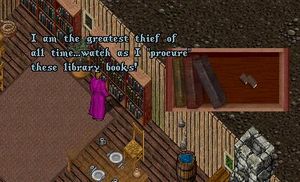
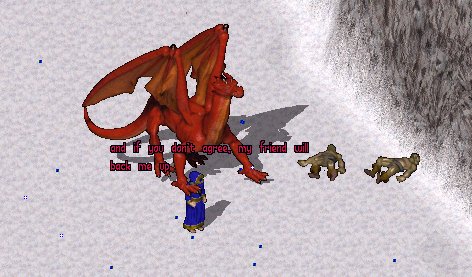
Sometiimes you have to back up your words
Ultima Online was my first MMO, and I played it back in the day when it was basically the only one people had ever heard of. I started playing it because I was a fan of the Ultima series of computer games put out by Richard Garriott so many years back. For years, I would sign in and have fun there. At one point, I signed up for the Counselor program, and I became one of those players that worked with EA and actually helped other players. Then someone sued EA, claiming we were unpaid employees, and EA gutted the program so that we were now left with only being allowed to play the game and not help other players any more. Around this same time, a Christmas holiday season hit, and the new batch of players who came along were completely different than the ones who had played before. We encountered what has become known as the “grief” player, and they came in droves. Players I knew for years in the game started signing on less and less, and eventually they just left the game. EA tried to respond to this by building a “safer” game within the game, which was to basically clone the entire world and put it into a safer area so that people couldn’t do the sorts of griefer things that were being done before. But this was too little too late as the majority of the people who had made the game famous had already left. I, too, realizing that I was now logging in with so few of my friends playing it any more, left and went to find another game myself.
Everquest was the first “other” game I started playing after the whole UO experience. It was one of those unforgiving types of games that you might log in and do nothing productive for hours, yet you would still log in and try to get something accomplished. It was one of those games that was prior to the Internet explosion, which would kill so many of these types of games because when you needed to find something in the game, you pretty much had to rely on your network of friends and hope someone else knew where something was located, or what some item you received might actually be used for (and quite often they had no idea as well). Nowadays, if you find some obscure item in a game, there are ten web sites dedicated to that item so that you rarely have to do any work to figure out something mysterious in a game.
But I loved the game. I would sign in every day and try to do the things that made your character more powerful, or at least most significant. It was a game that made you very reliant on other characters, as you might have the greatest warrior of all time, but you needed that cleric for heals, that druid for buffs and speed increases, that necro to help you find your corpse after a bad run into very dangerous territory, and practically every other character that existed for some reason or another. The land was dangerous, and you had to be careful because you might be in an area where everything seems level 10 but for no reason some level 50 giant might be walking through the area. There were evil cities where evil characters could go, but good ones would be killed on sight (and the other way around as well). It really was a vibrant world for its time.
Why did I quit? The game just got old. At some point, you’ve done all of the things you’ve wanted to do, and their updates were only designed to do a lot more of the same but at higher levels. Because it was such a big world, the departing players made it that much emptier. And that’s probably what killed it the most.
Dark Age of Camelot came along as the “solution” to Everquest. It played a lot like Everquest, but its focus was on combat, specifically combat between three realms. It was the first of the RvR models (Realm versus Realm), and it did it really well.
The game was focused on player versus player (pvp), specifically working together with everyone in your own realm to fight another realm, which made it truly unique.
The problem for the game was that its content was really lacking. While it did a lot of things right that corrected things Everquest had done wrong (and the list is too vast to get into for this type of post), it didn’t make the game any more interesting over the long run. I’m one of those people who likes to explore a game to find unique things and discover the undiscoverable. DAOC focused on combat, and that was pretty much it. By the time they started releasing expansions, so many of us had already moved onto another game.
There’s really no way to get through an article like this without mentioning the elephant in the room, and that’s World of Warcraft. I played this game for almost as many years as I played each of Ultima Online and Everquest. No other game has actually come along that has replaced those three as the games I’ve played most, although I sure wish one would.
World of Warcraft came along at a time when a new game was needed and people were bored of the games they had been playing. What it did was take all of the models of previous games and did them better. Historically, that’s been the story of WoW. They haven’t done anything all that innovative, but they did what everyone else did, incorporated those ideas into their own, and then made them feel like they were brand new and fresh. That’s a pretty rare talent for a gaming company to do, and this isn’t a criticism against the game or its developers, but a straight out commendation. It also added humor to the mix, which was sorely lacking in previous titles. Sometimes, it even made fun of itself, which was a major part of its expansion Cataclysm, in which you started running across non player characters who were created to be very much like some of the really bad players who inhabit these types of games.
The problem with World of Warcraft is that it just got old. It’s been around for a decade or so now, and as many expansions as they’ve done, the world has never really gotten that much more interesting. The story line still makes little sense and appears to be written by amateur fantasy writers who read a couple of dungeon and dragons books, played a couple of games of Diablo (also by the same company) and then figured that really complicated story lines would totally fazzle the player base and then went with that. Every time the story line hits a point where I find myself having to pay attention, I want to throw my computer through the window, as they’ve had to doctor the story premise so many times to somehow make sense to the theme park they’ve created behind their original ideas.
As to why I left, well, you can only do the exact same thing so many times before you’re just not going to want to do it again. That’s the point I hit with WoW. It was a great game for its time, but instead of focusing on a new expansion to their overdone world, I wish they’d just develop a completely different world. But I get it that accountants run their business, not game developers, so the chances of that happen instead are slim to none.
A couple of other games that came in during this period of time that I played and didn’t give much more time than jump in and out were Earth & Beyond, a space exploration story that once you explored everything left absolutely no game to play beyond that. There was Wahammer Online (which was just an updated version of Dark Age of Camelot and not much more fun). Everquest 2 also came along at this time, and while it was interesting, nothing about it really caused me to want to dedicate much time to it. The grouping dynamic of mobs also really annoyed me, and I started to feel the game was designed for grouping only, cutting up the original world that housed Everquest and dumbed it down.
Then, of course, there was the albatross known as Star Wars Galaxies, which gave players the opportunity to explore the Star Wars universe, set during the time between Episode IV and Episode V. Why? I’m not really sure. Originally, it was hailed as between Episode 1 and 2 (before the prequels were announced), but even then it didn’t really make a whole lot of sense.
The game was original in that Everquest way, in that it had absolutely no story line whatsoever. Sure, you knew the Empire hated the rebels and all that, but there was absolutely nothing for you to contribute to the story whatsoever. Oh, Princess Leia might asked you to go kill a bunch of Empire dudes, but the reasons would be random, and the purpose behind it somewhat lacking. What was intriguing about it was to build entire towns and such in their universe. What sucked about it was that once you did, it didn’t really make any difference.
Over the years, the developers kept trying to figure out how to stop people from leaving the game. One of their horrible decisions was to completely change the interface of the game so that it was a lot more like a first person shooter. Really dumb idea. Then they decided to revamp the entire idea of the game, making it into a “you, too, can be a jedi” in a world where the jedi were now extinct, which made even less sense. The only thing they didn’t do (and I might be wrong on this) was add elves, which used to be my joke about how you know an MMO is about to close shop. In the end, they did close shop, and the experiment that was Star Wars Galaxies ended for good.
After this, there were all sorts of games that came out that were dedicated to specific intellectual properties, like Lord of the Rings Online, The Matrix Online, The Clone Wars Online, The Sims Online, and more others than I could possibly remember at this particular time. The problem with most of them was that they were very limited in their worlds, which made it very difficult to continue to wanting to play them. The former example, Lord of the Rings Online, actually was one of those universes I invested a lot of time in, before leaving it and then coming back to it again, but the second time around what mainly kept me invested in the game was that I had a lot of friends still in the game, so it seemed worth signing onto it. When they slowly left to other games, the game became less fun to want to sign into.
Which brings me to another Star Wars property, and that’s Star Wars: The Old Republic. Up until very recently, I was playing a lot of this game. I had subscribed to it when it first came out, but got bored with it and then went back to WoW. A few months back, someone recommended it based on all of its updates and changes. It had gone free to play (which means that you can play it for free but if you want some of the stellar features of a game, you end up having to shell out more money than you would have paid if it was never free to play in the first place). I had avoided SWTOR because of that model, having seen how greedy its developers were (and it being EA, I wasn’t all that surprised). But went back I did, and I had fun up until I got bored with it again. There’s only so many variations of “You’re a jedi who is going to save the universe” or “You’re an evil Sith who needs to kill your master and then become the most powerful bad guy in the universe” one can take before finally hanging up the lightsaber.
The current game I’m playing (for now) is Final Fantasy XIV, which is unique for me because to be honest, I’ve never been a fan of the Final Fantasy franchise, which I’ve found to be really corny writing. But that’s the one I’m playing right now and slowly the universe within the game is opening up to me. Who knows where I’ll be at the end of this journey, or even how long it might take me to get there?