Well, today is my final day of teaching for the semester. I doubt I’ll be teaching during the summer (that’s something the full timers do, as they have to do something to raise their pay above $100,000 per year; the rest of us part-timers don’t get hours during the summer, for the most part). This means I’ll have some time to devote to something. I was going to devote my time to writing a new novel, but screw it. Writing is stupid. No one buys my books, so why even try? Instead, I’m going to devote the summer to reading the books of others. And then, who knows? Maybe I’ll kill myself. Not really sure yet, as I haven’t thought that far forward yet, but I’m keeping all options open. Just haven’t decided whether to go with drugs or jumping off a bridge yet. But that’s for another post obviously. This one is about reviewing books.
So, what I did was post on kindleboards.com that I was interested in reviewing the independent books from the various writers there. And a bunch of them jumped up and started giving me their best works, so I’m started buying their books on Kindle, and starting tomorrow, I’ll be devoting my time to doing nothing but reading their books and then reviewing them.
I’m thinking of including the reviews here on the blog, and then I’ll probably build an additional site that’s all about my reviews. And of course, I’ll include the reviews on the Kindle site for their individual books. Plus, I’ll build a set of lists about different genres where I’ll include books that I’ve reviewed.
I figure if no one is ever going to read my books, I’ll contribute this way, and then when I get tired of it, well, I’ll just end it. Sounds like a plan.
The “Three Cups of Tea” author, Greg Mortenson, has been accused of making up stories in his book. Accused by Jon Krakauer of CBS’s 60 Minutes, Mortenson denies the falsehood claim and is not commenting further due to a medical condition he is suffering from recently. Unfortunately, with him out of commission and not on record to defend himself, the media frenzy will probably swarm him at this horrible time for him. Hopefully, he gets a chance to defend himself, and the truth is reached, regardless of what that truth might be.
With this accusation, the writing community appears to be undergoing yet another challenge, as it did when the whole James Frey controversy occurred with “A Million Little Pieces”, a book that featured numerous made-up events in a book claimed to be entirely non-fiction. Hopefully, the accusations will not continue to paint a dark light on the many works other writers have put out there, making it so that readers walk into every bookstore, expecting fiction in the non-fiction section and accepting each memoir produced as a “quasi-” real account.
I recently published my “Neo Revolutionary Messages” on Kindle and Nook, and I promise that it is entirely non-fiction, as it is an analysis of the August 1991 Coup d’etat in the Soviet Union (where Boris Yeltsin challenged the hardliners when they imprisoned Mikhail Gorbachev). Yet, with stories like the one I linked here, there’s always the fear that a reader is going to think the author took liberties with the facts for the sake of trying to tell a better story.
Some years back, after I finished my first novel, I was faced with a daunting question: Could I possibly write another? For anyone who has never written a first novel, this probably sounds like a no-brainer, but believe it or not, when I came face to face with the blank sheet of book number two, I found myself realizing that I was facing an enemy I had never imagined before.
When I was writing the first book, I had lots of bravado behind me. I mean, I had written a bunch of short stories, and inside me, I knew I had a book in me, so no matter what happened, I knew I was going to finish that first book. But when it was done, after a few months had gone by, I actually came up with the idea for the next book. And then I realized I would actually have to write it.
When faced with the second book, you find yourself in a very interesting dilemma that seems to go something like this: Well, the first book was a fluke, and everyone has at least a book in him or her, but am I really capable of sitting down and accomplishing the second book? The first book was a mystery/suspense novel that was kind of hard to pin down to its exact genre (you can see for yourself as it can be found here). The second novel was going to be a science fiction book, and although I had written a few short stories that had been published in fanzines (not having yet published in larger magazines), I was trying to convince myself that I was capable of pulling off a brand new genre on the second outing.
For days, I sat down and tried to outline the book, but nothing would come to me, because even though I had the basic idea of this novel, which I was going to call LOSER, I had no idea how to create a world that was so bizarre to me that I would have to invent it from the ground up. Yet, each day, I sat down and tried to tackle it.
And failed.
At one point, I convinced myself that this book wasn’t possible, that my first one had been a fluke. I was sure that I might be able to do another suspense book, or maybe an espionage adventure, but science fiction was definitely out of my capabilities.
At the time, my editor was the wife of a colleague of mine who sat down with me and asked me to explain what the story was about. And for hours on end, I sat down and crafted this amazing story of what I wanted to write. As I talked to her, I kept imagining all sorts of great things that would happen. And then, at one point, she told me to just sit down and make it happen.
So, for the next four months, I sat down in my chair and typed away. My first novel had been written on a typewriter, so this one actually got written on a computer with a word processor that we’d probably laugh at today. But by the time I was done, I had crafted my second novel. And even as I typed THE END, I stared at it, still not sure it had actually completed its journey.
A year later, I sat down and started work on that suspense novel I thought might have been the next novel, and it became my third novel. But each time I wrote a novel after the second one, I never imagined for a moment that I would have trouble finishing a novel again. That second one was the one that broke me of the belief I was never going to be a writer.
"I read all of Duane Gundrum's books because he's so dreamy...."
In case you aren’t aware of it, there is a war taking place. I’m not talking about Libya, Afghanistan or Iraq. I’m talking about the war that is currently waging over the publication of books. What war? You say. Well, let me explain.
For years, in order to get published, you sent out your work to a publisher (or an agent in hopes of getting a publisher), and if you were very lucky, you might get a bit of an advance. Sometimes, those advances were for decent money. Around the 1970s and on, they started getting really small. Kind of dismal, actually. Unless you were already a famous author, like Stephen King. So, you would get about $5,000-$10,000, and then the publisher would take 18 months or so to create your book. Then it would get released. If it started to sell, great. You would receive about $1.67 for a $20 book for each sale, the publisher keeping pretty much everything else. After all, they were the publisher. That $1.67 would continue to knock down the amount of the advance you received until you actually started to make what are called royalties, which would be additional money the book made after you paid off the advance. Most books tended to not even make back the advance, so you were generally lucky enough if you made somewhat of a decent advance.
Well, recently, the publishing industry has kind of been turned on its side. E-books are becoming the new “in” thing, and strangely enough, publishers are still maintaining their dominance in the industry, because they are still the power brokers they used to be. In other words, in order to gain any attention whatsoever, you really needed the publisher to get the attention out that you had published a book. So, not surprisingly, publishers have been publishing e-books, too, and still taking that outrageous amount off the top, leaving writers with very little profit, even though the costs for publishers have diminished to almost nothing.
Something new has started to happen, which is turning the whole industry on its side now. Writers are going directly to the readers and selling their books without the publishers. And needless to say, this is causing a bit of a stir in the whole industry. Publishers need the writers to survive, and so they are doing everything possible to diminish the positive experience for writers, so that publishers still remain the power brokers that they have always been. Unfortunately for them, that model isn’t going to last that much longer.
The publishing industry is a lot like the music industry, and its current dynamic is going through a revolution much like the music industry has recently gone through as well. While there are still seriously powerful music leaders in the industry still calling shots, a lot of artists have gone directly to the Internet with their work, and are bypassing the profit model previously established by the RIAA and other such top-down industry leaders. This has caused all sorts of problems for the industry, but it has done wonders to present new opportunities for artists who may never have received an ounce of attention before.
Move this into the publishing world, and you see the same sort of thing happening there. The publishing industry is still in control right now, mainly because the model hasn’t completely developed yet. Online booksellers, like Amazon, Apple, and somewhat Barnes & Noble, are producing their own e-readers that allow writers to push their content to eager subscribers. However, the battle currently waging is who is going to control the process flow from this point forward.
The publishing industry is counting on its enormous clout to push their agenda forward. They have already pushed back against Amazon (which has forced the others to comply) where they forced the increase in the cost of books being sold on the Kindle. You used to be able to get brand new books for $9.99, but now you’re lucky if you can get one for $12.99. The game changer in the first battle was Ken Follett’s new book Fall of Giants, which publishers forced Amazon to sell at $19.99. The backlash against the book has been interesting as Kindle users included all sorts of bad reviews for the book based on the price alone, taking what would have probably been a five or four star reviewed book down to an average of about 3 stars. What’s interesting is that his reviews on this book tend to resemble an upside down bell curve, with 301 5-stars and 327 1-star reviews, with a tiny amount filling in for 2, 3, and 4-star reviews. In other words, the critics either really liked it or really hated it, and there’s no doubt that the really hated reviews come specifically from people who are pissed off at the price.
If this was the end of the fight, you’d think that the publishers pretty much won, but like most great stories, a new sliver has been added to the mix, with writers being that added variable. Writers, realizing that they need to somehow be able to take advantage of this new technology, have started to show up sans publishers (being their own publishers), and they’re starting to include their own novels at much lower cost than the publishers are forcing down the e-market’s throat. Rather than stick it out at $9.99 (or push it up to the publisher’s price of $12.99), writers are now starting to introduce their books at the $2.99-$4.99 range, providing a more comfortable area for readers to purchase on impulse alone. Some of the more prominent writers, instead of using their fame to push for $12.99, like the gas station economic model the publishers are following (one raises the price, the rest follow), are listing their books at $0.99. According to some of the better known writers doing this, they’ve pointed out that because of the amount of people willing to buy a book at that low price, their profit has actually been better than if they tried to sell their books at higher prices. The economic implications are staggering, the more you think about it.
The biggest problems facing the writers right now is how to actually get anyone to pay attention to them in the first place. The one thing publishers have going for them was that their clout actually got books into bookstores, and without that clout, an unknown writer is essentially that, an unknown writer. If no one knows you exist, the chances of selling a book are dismal, at best. So, right now, the battle has halted, as both publishers and writers realize they’re at an interesting crossroad where both can benefit, but neither seems willing to budge. Publishers aren’t interested in giving up their high percentages they receive for “publishing” books while writers are no longer interested in giving up the entire store just to get their work out there. Which means that once writers figure out how to jumpstart the system in their favor, the whole publishing industry is going to go the way of the recording industry.
But what can a writer do to become marketable without already being a famous writer who was selling books already? That’s an important question and one that I’m spending a lot of time studying.
I’ve been spending a great deal of time lately exploring the whole e-reader market. My reasons for doing so are probably obvious, as I’ve pretty much given up on ever getting sustainable establishment from the main publishing markets, as everyone seems to be a writer these days and trying to get an agent to even read a manuscript is like trying to get Charlie Sheen to act responsibly.
Anyway, so some months ago, I put up one of my previously published books onto Amazon for the Kindle, and it has had a few sales, but mostly, it’s a lot like standing on a corner and trying to get people to read printout copies of a manuscript. People just don’t seem interested. And I don’t think it’s that their not interested in me or my writing; they’re just not interested in purchasing books from someone they’ve never heard of. It’s the same dilemma writers have always had, except there’s a lot more of us these days, and practically the only way to establish a career as a writer is to be famous for doing something else. So, if you can cook and have a cooking show, you might make it as a writer. If you’re a reality show star and have gratuitous sex with people who live in your reality show house, you might have a career as a writer. If you were a famous baseball star who took performance enhancing steroids, football star who beat up your girlfriend, musician girlfriend who got beat up your musician boyfriend, washed up movie star who seems to get arrested for practically everything written on police blotters, or some older guy who lived through abuse by your evil stepmom, well, you might have a career as a writer. But if you’re actually a writer who writes novels, and that’s all you really have to share with the rest of the world, your chances of making it as a writer are about as good as you making it as a millionaire by winning the lottery. Okay, maybe a little less.
So, what is a writer to do, if he’s not interested in starting a gunfight with the local police department in hopes that he might live long enough to write about it while in prison, well, the answer seems to be “write an e-book and get famous that way.”
The funny part of that solution is that making it as an e-book star is just as ludicrous as making it as a professonal blogger. Unless you have a gimmick, or you get seriously lucky, your chances aren’t that good. Even if you’re a great writer, it appears that everyone seems to be a great writer these days, so you really have to have something else working in your favor.
So, in actually trying to get established as an e-reader writer, I started with Kindle, and like I said, so far I’ve sold a few books and seem to be as popular as Pee Wee Herman at a stripper’s convention. Okay, I’m wrong on that one. He’d probably be a bit more popular than I am right now.
But what I have been doing is reading everything I can find on how others have actually made it. And what I’ve discovered is that everyone talks about how e-readers and e-books are the solution to the current glut in writers out there, and how it is the solution to getting past the impossible gatekeepers of publishing (even going around the publishing industry itself), but what no one really seems to do is point out exactly how that success is supposed to happen. I’m constantly reminded of the Southpark episode with the underwear gnomes, when the kids ask the underwear gnomes why they’re stealing underwear, and they point out their master plan, which reads a lot like:
1. Steal all of the underwear
2. ????
3. Profit
Yep, that seems to be the consensus of everyone who talks about success as a writer in the e-book market. Somehow, you are supposed to go the same way:
1. Write a novel and e-publish it.
2. ????
3. Profit!
Yeah, I don’t see any logic behind it either. What seems to be missing is how do you actually market yourself as an e-book writer? How do you get traffic to your blog so that people pay attention to you? Whenever I read a book on marketing your blog, it says to first create interesting content and then moves onto capitalizing on that traffic that will then come. Now, I’ve talked to a lot of people who do read my blog, and they tend to agree that I create interesting content, but at the same time, the masses aren’t showing up to read it. A few people do, and a shitload of spam also seems to be paying attention, but that’s about it. Somehow, I’m missing a step here, and I can’t seem to figure out what it is.
It is that same step I believe I’m missing that somehow makes it possible for e-books to actually be attractive to people and sell the mass load that everyone seems to think will happen “naturally”. Well, I’m still working on that one, and I haven’t come up with a solution yet.
So, if real people actually seem to be following this blog, PLEASE COMMENT ON THE BLOG at my actual blog, and I’d love to hear from you. But right now, I get nothing but spam comments (do keep in mind my blog gets imported to Facebook and Open Salon, so if you’re commenting that you actually read it, I’m not talking about those places; I’m talking about my actual blog…the one linked here). It’s really frustrating. I mean, REALLY frustrating.
I’ve been giving this a lot of thought lately. Not sure why, but it just keeps coming up in my mind. I wonder what it would take to finally get the job I really want, rather than the job I actually have.
I don’t mean I don’t like my current job. It’s okay. It’s just not really all that exciting. Nor is it really that hard. It’s not even all that interesting. I’m a glorified editor who sometimes creates stuff that’s not really very creative. It requires working for the health care industry for a hospital system, and most of the stuff I do is really designed around rudimentary stuff like registration, insurance and other boring stuff that would cause most people to scream if they had to deal with on a day to day basis. Every now and then I get to contribute on some education for a surgical procedure, but it’s not like anything I contribute really helps the procedure in any way. I just make sure that people can understand it, and that no one in the chain of command (or higher up outside of the chain of command) thinks it was designed by Neanderthals.
But no, I think I’ve figured out the job I’d rather have. I just don’t think I’ll ever be able to get it. It’s not because the job isn’t something I can’t do. I’m highly qualified for it, and if I was able to find an opening, I’d probably be one of their top choices. But I don’t live anywhere near the place where this type of job is accessible, and in order to move to such a place, I’d probably have to be jobless for some time before I actually found something, and that’s never a good situation to be in.
I’m not even talking about a really, highly technical job like law or medicine either. I’m talking about something I do all of the time. As I’m a writer, I realize the job that’s perfect for me. I should be a copy editor, or an editor for a large book company.
I know these jobs are out there, and I know a lot of strong writers got their start in the field by making connections with these types of jobs. I just don’t live anywhere near where such a job might be possible.
This often gets me thinking that I’m living in the wrong place. I even moved back to the wrong place when I came back from South Korea. The San Francisco Bay Area just wasn’t the place for me, even though you’d think those jobs would be available there. I really think I should be living in New York City. I just don’t know how to make that kind of move, as I’m now kind of stuck in West Michigan right now. There’s not a lot of upward mobility when you hit your 40s. You’re kind of stuck with whatever job you can get, and often you have to stick it out, even if it’s not the best match for you.
If there was some way to obtain a job like this from afar (BEFORE moving), that might be the greatest thing ever, but I’ve never been all that successful with trying to hook up a job long distance (even though I did get the current one that way). I just really think that working for a big publishing company as an editor is the one thing I could probably do well. I sure don’t see myself getting a job with the government or anything all that exciting these days.
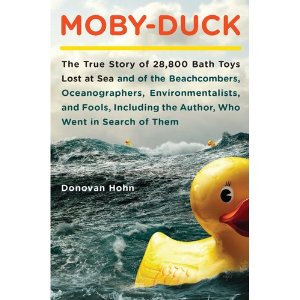
I was in the bookstore the other day looking over the selections of books when I came across a really interesting book of which I had heard nothing so far. But it looked intriguing. It was called Moby-Duck, and as you can see from the picture with this article, it is about a man who goes on a quest to discover what happened to 28,800 bath toys that were lost at sea.
So, why am I talking about this book? Well, think about the story involved in this book. The author, Donovan Hohn, actually put forth a lot of work to find out what happened to these rubber duckies and bath toys after the disappeared. In essence, he went on an epic quest, like the infamous Moby Dick to find what happened to these items. In other words, he went through a hell of a lot of work to get the story that he later transposed to paper so that the rest of us could experience his adventure.
My point is that so few people who write memoirs these days actually go through this amount of work in their adventures before sitting down and writing their “memoirs”. Instead, they suffer one bad relationship, have a bad drinking problem, or do something singularly simple and then try to convince the rest of us that it was actually an epic journey to get from one place to the other. I guess you could say I’m getting a little sick of these kinds of stories that really have no great master journey to them, no odyssey, yet are treated as if they are the epic adventures of a lifetime.
We need more writers out there who are willing to go through a little bit of work to actually come back with the story they need to tell. Instead, we get lazy writers that try to profit off of their innane adventures. And we keep buying this crap because none of us are willing to demand more from the writings that we read.
I felt this way some time ago when I was writing one of my earlier science fiction novels, Thompson’s Bounty, which was about a Coast Guard cutter that gets sent back into the 17th century. When I first started writing the novel, I actually tried to just crank it out without really knowing much about my subject, other than having watched a few old movies about pirates. Then it dawned on me that I wasn’t ready to write the novel. So I contacted the Coast Guard and requested some in person information, which led to going out with a cutter crew for several days over several weekends. It also led to a bunch of long conversations and tours on a Coast Guard base where very knowledgeable people gave me first hand information about the subject I was writing. In the end, I wound up with a book that told the story I wanted to tell instead of one that was peripheral and out of context.
Recently, I’ve been working on a novel that I originally wrote decades ago that takes place in Eastern Europe during the Cold War. Originally, I kind of winged it through the story, but after doing my thesis work on the August Coup in the Soviet Union, I finally had the premise, place and event that really made up the background of the novel I wrote years before. So, I’ve been sitting down and tackling that book from the start, realizing that I now know a lot more information than I first did when I wrote that book back then.
That’s sort of the thing I’m talking about with the kind of reading I’m coming across these days. So much of it can be so much better than it is if authors would take the time to actually do the research that would make their books that much better. I remember a great scene from Billy Crystal’s Throw Mama From the Train when a woman in his creative writing class is describing a submarine story she wrote, and he comments that maybe she should actually know the name of the device she’s describing if she wants to be taken seriously in a story that involves submarines. I take his advice a bit further and say that maybe some time should be given to exploring the lifestyles and events that lead people to the moments that occur in novels so that the reader believes the author is the right person to be writing the story.
We seem to have a lot lazier writers these days with a lot of the stories and memoirs I read, but that doesn’t mean we have to settle for that. We can demand more substance, research and work. We just generally don’t. And we’re the ones who suffer as a result.
I don’t know if you’ve noticed this but e-books are becoming a lot more expensive than they were a few months ago. An example is Stieg Larrson’s The Girl With the Dragon Tattoo. Several months ago, it was selling for $5.00. So was its sequel, The Girl Who Played With Fire. Both of them are now priced at $7.99. In those last few months, nothing was added to the books that caused them to be worth more money. As a matter of fact, using the usual models of books, the prices should have gone further down, not up.
At the same time, look at some of the bestselling books also, like Decison Points by George W. Bush. It was $9.99. Now, it’s $14.99. That’s ridiculous. But looking at all books, ALL of the prices are going up.
Basically, Kindle books and e-books in general, were seen as economical and a great deal. Now, they’re not worth the price. They’re really not.
Yes, I own a Kindle, but I think I’m going to stop buying Kindle books for the near future and buy all of my books in hardcover and paperback. The e-book market is pricing itself out of existence.
I’m not sure that’s a great idea, but I guess it’s their choice to make.